
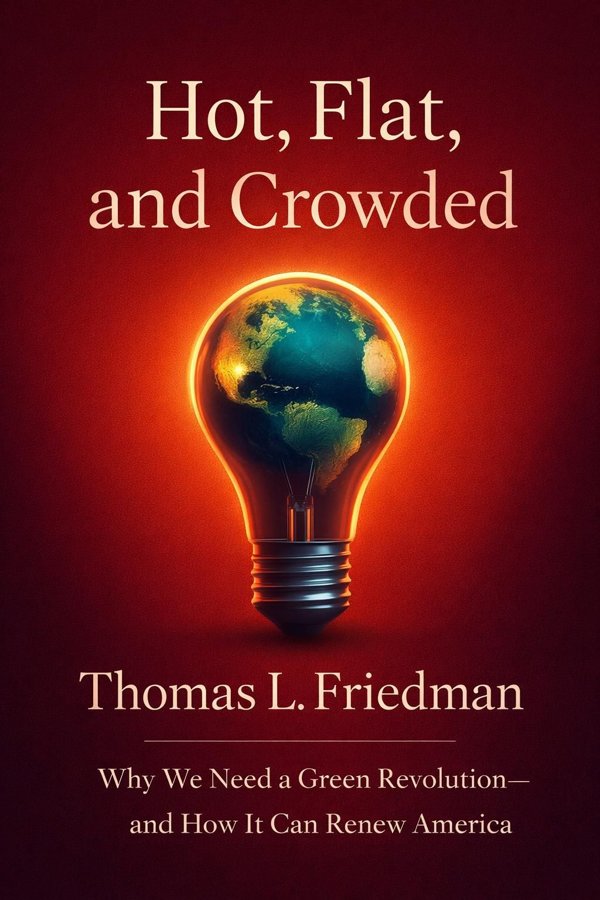
Hot, Flat, and Crowded: Why We Need a Green Revolution—and How It Can Renew America: Summary & Key Insights
 10 min9 chaptersAudio available
Key Takeaways from Hot, Flat, and Crowded: Why We Need a Green Revolution—and How It Can Renew America
The most dangerous thing about climate change is not that it is distant, but that it is already woven into the systems that sustain modern life.
Globalization does not only spread opportunity; it also spreads pressure.
Population growth matters not simply because there are more people, but because more people are living modern, energy-intensive lives.
Nations decline less from lack of resources than from lack of direction.
Environmental reform gains power when it is understood not as restraint alone but as reinvention.
What Is Hot, Flat, and Crowded: Why We Need a Green Revolution—and How It Can Renew America About?
Hot, Flat, and Crowded: Why We Need a Green Revolution—and How It Can Renew America by Thomas L. Friedman is a environment book spanning 9 pages. Thomas L. Friedman’s Hot, Flat, and Crowded is a sweeping argument that the defining challenge of our era is not one crisis but the collision of three: climate change, globalization, and population growth. A hotter planet, a flatter world economy, and a more crowded Earth are combining to strain energy systems, ecosystems, politics, and everyday life. Friedman contends that these forces are not temporary disruptions; they are the new reality, and they demand a new kind of response. What makes the book powerful is its refusal to treat environmentalism as a niche concern. Friedman frames clean energy, efficiency, and sustainability as matters of national renewal, economic competitiveness, public health, and geopolitical stability. For him, a green revolution is not simply about saving polar bears or reducing emissions. It is about restoring American dynamism by building the industries, technologies, and civic purpose required for the twenty-first century. As a Pulitzer Prize-winning journalist and longtime New York Times columnist, Friedman brings a global perspective shaped by reporting across politics, economics, and foreign affairs. The result is an accessible, urgent, and ambitious book that connects environmental warning with strategic opportunity.
This FizzRead summary covers all 9 key chapters of Hot, Flat, and Crowded: Why We Need a Green Revolution—and How It Can Renew America in approximately 10 minutes, distilling the most important ideas, arguments, and takeaways from Thomas L. Friedman's work. Also available as an audio summary and Key Quotes Podcast.
Hot, Flat, and Crowded: Why We Need a Green Revolution—and How It Can Renew America
Thomas L. Friedman’s Hot, Flat, and Crowded is a sweeping argument that the defining challenge of our era is not one crisis but the collision of three: climate change, globalization, and population growth. A hotter planet, a flatter world economy, and a more crowded Earth are combining to strain energy systems, ecosystems, politics, and everyday life. Friedman contends that these forces are not temporary disruptions; they are the new reality, and they demand a new kind of response.
What makes the book powerful is its refusal to treat environmentalism as a niche concern. Friedman frames clean energy, efficiency, and sustainability as matters of national renewal, economic competitiveness, public health, and geopolitical stability. For him, a green revolution is not simply about saving polar bears or reducing emissions. It is about restoring American dynamism by building the industries, technologies, and civic purpose required for the twenty-first century.
As a Pulitzer Prize-winning journalist and longtime New York Times columnist, Friedman brings a global perspective shaped by reporting across politics, economics, and foreign affairs. The result is an accessible, urgent, and ambitious book that connects environmental warning with strategic opportunity.
Who Should Read Hot, Flat, and Crowded: Why We Need a Green Revolution—and How It Can Renew America?
This book is perfect for anyone interested in environment and looking to gain actionable insights in a short read. Whether you're a student, professional, or lifelong learner, the key ideas from Hot, Flat, and Crowded: Why We Need a Green Revolution—and How It Can Renew America by Thomas L. Friedman will help you think differently.
- ✓Readers who enjoy environment and want practical takeaways
- ✓Professionals looking to apply new ideas to their work and life
- ✓Anyone who wants the core insights of Hot, Flat, and Crowded: Why We Need a Green Revolution—and How It Can Renew America in just 10 minutes
Want the full summary?
Get instant access to this book summary and 100K+ more with Fizz Moment.
Get Free SummaryAvailable on App Store • Free to download
Key Chapters
The most dangerous thing about climate change is not that it is distant, but that it is already woven into the systems that sustain modern life. Friedman uses the word “hot” to describe a planet whose atmosphere is being destabilized by human activity, especially the burning of fossil fuels. Rising temperatures are not just a scientific statistic. They show up as more intense storms, droughts, floods, heat waves, crop stress, species loss, and growing uncertainty for cities, businesses, and governments.
Friedman’s key point is that climate change is not an isolated environmental issue. It amplifies nearly every other vulnerability in society. A hotter world puts pressure on water supplies, agricultural output, migration patterns, disease spread, insurance markets, and national security. This is why slow, symbolic responses are inadequate. If the climate is becoming more volatile while energy demand keeps rising, then the costs of delay multiply over time.
He also challenges the psychology of inaction. Because climate change often unfolds gradually, people tend to discount it until crises become undeniable. Yet by then, adaptation is more expensive and prevention is harder. Practical examples include coastal communities investing in resilient infrastructure, companies redesigning supply chains to account for climate risk, and households reducing energy use through insulation, efficient appliances, and cleaner transportation.
Friedman argues that the climate alarm has already sounded. The question is whether societies will treat it as background noise or as a call to redesign how they live and grow. Actionable takeaway: treat climate change as a practical systems problem, and start where you have influence by cutting energy waste, supporting resilient infrastructure, and backing policies that speed the transition to low-carbon power.
Globalization does not only spread opportunity; it also spreads pressure. In Friedman’s framework, the world is “flat” because technology, trade, finance, and communication have lowered barriers and connected billions of people to the same markets and aspirations. More countries and communities can now participate in global growth. That is a remarkable achievement, but it also means resource consumption, energy demand, and ecological strain rise much faster than in earlier eras.
Friedman is careful not to portray globalization as the villain. The problem is that humanity globalized commerce far faster than it globalized environmental responsibility. As developing nations industrialize and expand their middle classes, they understandably want homes, cars, electricity, air conditioning, meat, electronics, and mobility. But if everyone climbs the old fossil-fuel ladder, the environmental cost becomes unsustainable.
This creates a double-edged reality. The same global integration that drives pollution can also speed solutions. Ideas, clean technologies, and best practices can travel rapidly across borders. A city can adopt building standards pioneered elsewhere. A company can redesign products to use fewer materials across international supply chains. A government can leapfrog dirty infrastructure by investing directly in renewables, smart grids, or mass transit.
The “flat” world therefore intensifies competition between old and new energy models. Countries that master clean technology will gain economic and strategic advantages, while those tied to outdated systems will face higher costs and greater instability. Actionable takeaway: see globalization as a force to shape, not resist—support products, companies, and policies that scale cleaner solutions internationally rather than locking in dirtier forms of growth.
Population growth matters not simply because there are more people, but because more people are living modern, energy-intensive lives. Friedman’s “crowded” world is one where rising population combines with urbanization and higher consumption to put unprecedented stress on land, water, food systems, energy networks, and social institutions. The challenge is not humanity itself; it is the mismatch between expanding demand and outdated ways of meeting it.
A crowded planet turns local problems into global ones. Water scarcity in one region can raise food prices elsewhere. Congested cities become breeding grounds for pollution and poor health if infrastructure lags. Weak states become more fragile when population pressure collides with unemployment, environmental degradation, and energy insecurity. Friedman connects these trends to broader instability, arguing that crowding is not just a demographic issue but a political and economic one.
At the same time, he does not frame population growth in fatalistic terms. Dense cities can become engines of efficiency if they are well designed. Public transit, compact development, green buildings, better waste systems, and smarter water use can allow more people to live at higher standards with lower environmental impact. Likewise, education, women’s empowerment, and public health often lead to more stable population trends while improving quality of life.
The core insight is that scale changes everything. Systems that once seemed adequate break down when billions more people seek prosperity. The real question is whether societies redesign those systems in time. Actionable takeaway: support policies and local initiatives that make growth smarter—especially investments in efficient cities, water conservation, transit, public health, and education.
Nations decline less from lack of resources than from lack of direction. One of Friedman’s boldest claims is that America’s environmental challenge is inseparable from its civic and strategic challenge. He argues that the United States lost momentum by settling for cheap energy, short-term politics, and complacent consumption instead of pursuing the next great national project. A green revolution, in his view, could become a unifying mission that restores American innovation, discipline, and global credibility.
This is not nostalgia for old industrial dominance. Friedman sees renewal in building the systems of the future: clean power, efficient transport, advanced manufacturing, smarter buildings, battery technology, and modernized grids. If the United States leads in these areas, it does more than cut emissions. It creates jobs, reduces dependence on unstable petro-states, improves public health, and demonstrates a model other nations can follow.
He contrasts this with a country that drifts, trapped in ideological fights while competitors invest in the next generation of energy infrastructure. America’s role matters because it remains a major consumer, emitter, investor, and cultural influence. If it treats clean energy as sacrifice, others may hesitate. If it treats it as strategy and opportunity, others may accelerate.
For individuals, this idea applies beyond national politics. Renewal begins when institutions set ambitious goals and align incentives around them. Schools can teach energy literacy, cities can retrofit buildings, and businesses can treat efficiency as innovation rather than compliance. Actionable takeaway: frame sustainability as a mission of renewal—back leaders, organizations, and community projects that connect environmental action with economic strength and civic purpose.
Environmental reform gains power when it is understood not as restraint alone but as reinvention. Friedman argues that a true green revolution must be broader than recycling programs or isolated conservation efforts. It requires a transformation in how societies produce energy, design products, build cities, move people, and measure prosperity. In that sense, green is not a niche preference. It is the operating system for a durable economy.
Friedman’s case rests on a simple observation: every major era of economic leadership has been built on mastering foundational technologies. In the twentieth century, those included oil, automobiles, highways, electrification, aviation, and mass production. In the twenty-first century, the next platform is likely to include renewables, energy storage, efficient buildings, advanced materials, electrified transport, and digital energy management. Countries that invest early can build industries, export expertise, and shape standards.
He also emphasizes that green transformation creates compounding gains. Energy efficiency lowers costs for households and companies. Cleaner air reduces medical burdens. Domestic energy innovation strengthens national security by reducing vulnerability to oil shocks and geopolitical blackmail. Better design often means less waste, lower input costs, and higher resilience.
In practical terms, the green revolution includes retrofitting buildings, incentivizing clean R&D, modernizing grids, expanding public transit, and designing markets that reward low-carbon innovation. The larger message is that sustainability should be treated as a source of competitiveness. Actionable takeaway: whenever you evaluate a policy, business idea, or investment, ask not only whether it is greener, but whether it helps build the next generation of economic advantage.
Markets are powerful, but they do not automatically price the future. Friedman rejects the false choice between free enterprise and public policy. His view is that markets drive innovation best when governments create clear rules, long-term signals, and fair incentives. Climate change and energy dependence persist partly because the market price of fossil fuels often ignores hidden costs such as pollution, military protection of supply routes, health impacts, and environmental damage.
This is why Friedman supports policy frameworks that make clean choices economically rational. If businesses know carbon will carry a cost, they are more likely to invest in efficiency, renewable energy, and lower-emission technologies. If utilities are rewarded for conserving power rather than merely selling more of it, they will innovate differently. If building codes require higher performance, architects and developers will adapt and improve.
He does not advocate bureaucratic micromanagement. Instead, he favors strategic government: set standards, fund basic research, modernize infrastructure, and let competition solve problems within those boundaries. Historical examples support this model. Governments helped launch the Internet, aerospace, and many energy technologies by funding research and creating stable demand conditions before private markets fully scaled them.
For citizens, this idea is crucial because personal virtue alone cannot overcome system-wide incentives. You can buy efficient light bulbs, but if the grid remains outdated or dirty, progress is limited. Structural change matters. Actionable takeaway: support policies that align profit with sustainability—carbon pricing, clean energy standards, efficiency codes, and public R&D—because durable change happens when the rules reward better behavior at scale.
The green transition will not be won by governments alone; it also depends on companies reimagining what success looks like. Friedman highlights the role of business not only as a polluter to regulate but as a problem-solver capable of rapid invention, scaling, and execution. When firms treat energy use, waste, and environmental impact as strategic issues, they often uncover new efficiencies, products, and markets.
Corporate responsibility in Friedman’s argument goes beyond philanthropy or branding. It means integrating sustainability into design, operations, logistics, procurement, and long-term planning. A manufacturer that reduces material waste lowers costs. A retailer that improves its supply chain cuts emissions and gains resilience. A tech company that designs lower-power devices serves both customers and the planet. The point is not moral perfection but competitive adaptation.
Friedman also sees business leadership as culturally influential. Companies shape what consumers expect and what industries normalize. When major firms adopt renewable procurement, circular design, transparency standards, or energy-saving innovation, they push entire ecosystems forward. Investors increasingly reinforce this dynamic by rewarding firms that manage climate risk and regulatory exposure intelligently.
Still, Friedman warns against shallow “greenwashing.” Real leadership requires measurable outcomes, not slogans. Businesses must ask hard questions about where energy comes from, how products are made, what happens after use, and how vulnerabilities in climate and resource systems affect profitability.
This lesson applies to organizations of any size. Even small firms can audit energy use, reduce packaging, improve procurement, and redesign processes. Actionable takeaway: treat sustainability as a core innovation challenge—measure resource use, set concrete targets, and look for green improvements that strengthen both resilience and competitiveness.
Big energy transitions are ultimately social transitions. Friedman argues that no policy agenda can succeed if people continue to equate prosperity with waste, convenience with excess, and freedom with unlimited consumption. A green revolution requires a cultural shift in how individuals, families, and communities understand responsibility, status, and quality of life.
This is not a call for joyless austerity. Friedman’s deeper point is that smart living can be richer, healthier, and more secure than wasteful living. Homes that use less energy are often more comfortable. Walkable neighborhoods can improve health and social connection. Public transit and efficient vehicles can reduce congestion and costs. Choosing durable products over disposable ones can save money while reducing waste. When enough people adopt these norms, markets and politics start to change too.
He also emphasizes the social dimension of transformation. Habits spread through imitation, expectations, and institutions. Schools that teach environmental literacy create future citizens who think in systems. Communities that celebrate energy-saving retrofits, local food systems, or shared mobility make sustainable choices more visible and normal. Religious groups, universities, employers, and neighborhood associations can all help translate abstract concerns into daily practice.
The key is to move from passive awareness to active citizenship. Concern about climate or energy means little unless it influences purchasing, voting, organizing, and conversations. Cultural momentum grows when people see that their choices belong to a larger movement rather than isolated sacrifice. Actionable takeaway: pick three daily behaviors—such as reducing home energy use, rethinking transport, and buying more durable goods—and pair them with one civic action, like supporting local sustainability initiatives or voting for long-term energy reform.
All Chapters in Hot, Flat, and Crowded: Why We Need a Green Revolution—and How It Can Renew America
About the Author
Thomas L. Friedman is an American journalist, author, and public commentator known for explaining how global economic, political, and technological forces shape everyday life. A longtime columnist for The New York Times, he has reported extensively on foreign affairs, the Middle East, globalization, and international trade. Friedman is a three-time Pulitzer Prize winner and the author of several bestselling books, including From Beirut to Jerusalem, The Lexus and the Olive Tree, and The World Is Flat. His work is known for combining on-the-ground reporting with large-scale arguments about global systems and historical change. In Hot, Flat, and Crowded, he brings that signature style to climate change and energy, arguing that environmental transformation is not only necessary for the planet but also essential for economic renewal and national leadership.
Get This Summary in Your Preferred Format
Read or listen to the Hot, Flat, and Crowded: Why We Need a Green Revolution—and How It Can Renew America summary by Thomas L. Friedman anytime, anywhere. FizzRead offers multiple formats so you can learn on your terms — all free.
Available formats: App · Audio · PDF · EPUB — All included free with FizzRead
Download Hot, Flat, and Crowded: Why We Need a Green Revolution—and How It Can Renew America PDF and EPUB Summary
Key Quotes from Hot, Flat, and Crowded: Why We Need a Green Revolution—and How It Can Renew America
“The most dangerous thing about climate change is not that it is distant, but that it is already woven into the systems that sustain modern life.”
“Globalization does not only spread opportunity; it also spreads pressure.”
“Population growth matters not simply because there are more people, but because more people are living modern, energy-intensive lives.”
“Nations decline less from lack of resources than from lack of direction.”
“Environmental reform gains power when it is understood not as restraint alone but as reinvention.”
Frequently Asked Questions about Hot, Flat, and Crowded: Why We Need a Green Revolution—and How It Can Renew America
Hot, Flat, and Crowded: Why We Need a Green Revolution—and How It Can Renew America by Thomas L. Friedman is a environment book that explores key ideas across 9 chapters. Thomas L. Friedman’s Hot, Flat, and Crowded is a sweeping argument that the defining challenge of our era is not one crisis but the collision of three: climate change, globalization, and population growth. A hotter planet, a flatter world economy, and a more crowded Earth are combining to strain energy systems, ecosystems, politics, and everyday life. Friedman contends that these forces are not temporary disruptions; they are the new reality, and they demand a new kind of response. What makes the book powerful is its refusal to treat environmentalism as a niche concern. Friedman frames clean energy, efficiency, and sustainability as matters of national renewal, economic competitiveness, public health, and geopolitical stability. For him, a green revolution is not simply about saving polar bears or reducing emissions. It is about restoring American dynamism by building the industries, technologies, and civic purpose required for the twenty-first century. As a Pulitzer Prize-winning journalist and longtime New York Times columnist, Friedman brings a global perspective shaped by reporting across politics, economics, and foreign affairs. The result is an accessible, urgent, and ambitious book that connects environmental warning with strategic opportunity.
More by Thomas L. Friedman
Thank You for Being Late: An Optimist’s Guide to Thriving in the Age of Accelerations
Thomas L. Friedman
10 min
The Lexus And The Olive Tree: Understanding Globalization
Thomas L. Friedman
10 min
The World Is Flat: A Brief History of the Twenty-First Century
Thomas L. Friedman
10 min
That Used to Be Us: How America Fell Behind in the World It Invented and How We Can Come Back
Thomas L. Friedman, Michael Mandelbaum
10 minYou Might Also Like

A Life on Our Planet: My Witness Statement and a Vision for the Future
David Attenborough
10 min
A Sky Full Of Birds
Matt Merritt
10 min
Carbon Zero: Imagining Cities That Can Save the Planet
Alex Steffen
10 min
Eaarth: Making a Life on a Tough New Planet
Bill McKibben
10 min
The Social Contract and Environmental Governance
Various Editors
10 min
The Wild Places
Robert Macfarlane
10 minBrowse by Category
Ready to read Hot, Flat, and Crowded: Why We Need a Green Revolution—and How It Can Renew America?
Get the full summary and 100K+ more books with Fizz Moment.