
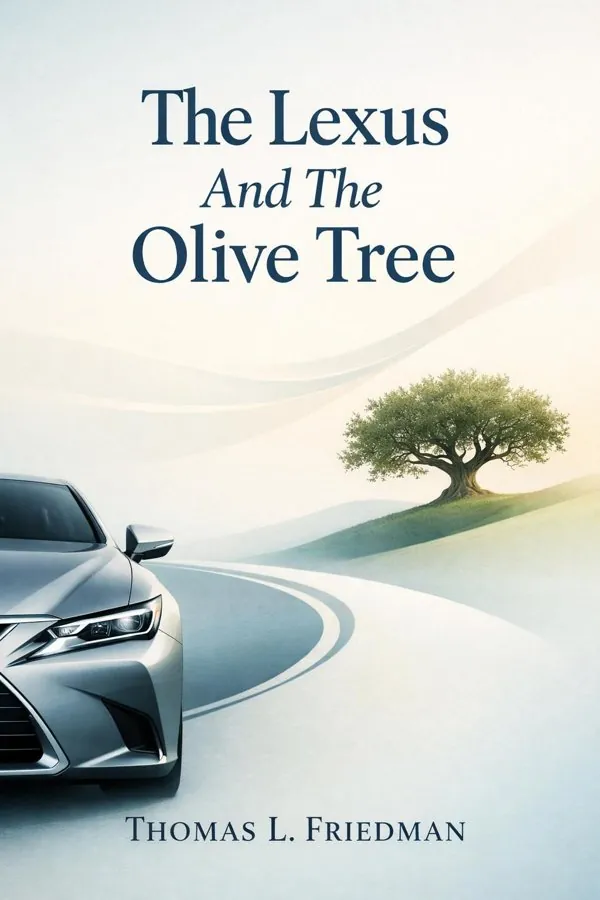
The Lexus And The Olive Tree: Understanding Globalization: Summary & Key Insights
 10 min5 chaptersAudio available
What Is The Lexus And The Olive Tree: Understanding Globalization About?
The Lexus And The Olive Tree: Understanding Globalization by Thomas L. Friedman is a economics book spanning 5 pages. This book explores the forces of globalization that have reshaped the world since the end of the Cold War. Friedman uses the metaphor of the Lexus, representing modernity and technological progress, and the olive tree, symbolizing tradition and identity, to explain the tension between global integration and local preservation. Through vivid reporting and analysis, he examines how nations, corporations, and individuals adapt to the interconnected global economy.
This FizzRead summary covers all 5 key chapters of The Lexus And The Olive Tree: Understanding Globalization in approximately 10 minutes, distilling the most important ideas, arguments, and takeaways from Thomas L. Friedman's work. Also available as an audio summary and Key Quotes Podcast.
The Lexus And The Olive Tree: Understanding Globalization
This book explores the forces of globalization that have reshaped the world since the end of the Cold War. Friedman uses the metaphor of the Lexus, representing modernity and technological progress, and the olive tree, symbolizing tradition and identity, to explain the tension between global integration and local preservation. Through vivid reporting and analysis, he examines how nations, corporations, and individuals adapt to the interconnected global economy.
Who Should Read The Lexus And The Olive Tree: Understanding Globalization?
This book is perfect for anyone interested in economics and looking to gain actionable insights in a short read. Whether you're a student, professional, or lifelong learner, the key ideas from The Lexus And The Olive Tree: Understanding Globalization by Thomas L. Friedman will help you think differently.
- ✓Readers who enjoy economics and want practical takeaways
- ✓Professionals looking to apply new ideas to their work and life
- ✓Anyone who wants the core insights of The Lexus And The Olive Tree: Understanding Globalization in just 10 minutes
Want the full summary?
Get instant access to this book summary and 100K+ more with Fizz Moment.
Get Free SummaryAvailable on App Store • Free to download
Key Chapters
When I first visited Toyota’s Lexus factory in Japan, I was struck by a paradox. Here were men and women in spotless uniforms, coordinating with robots to produce one of the most advanced cars on Earth. Outside, across the globe, conflicts were erupting over land, faith, race, and tribe. It occurred to me that the world was being pulled simultaneously in two directions: toward prosperity through technology, and toward identity through tradition.
That duality defines our world today. The Lexus embodies modernization—the drive to build, innovate, and compete in a global marketplace. It’s the product of a system that rewards efficiency, openness, and integration. The olive tree, by contrast, represents everything that roots us—a sense of family, history, religion, and homeland. Both are vital, but when one dominates, the other suffers. A society obsessed with the Lexus risks losing meaning; a society obsessed with the olive tree may descend into isolation and conflict.
You can see this tension everywhere. The young entrepreneur in Bangalore who dreams of Silicon Valley success also struggles to uphold the traditions of his community. The small-town American watching foreign goods flood his market wonders what’s left of local craftsmanship. Globalization doesn’t erase identity—it challenges it to evolve. And that evolutionary struggle defines the human condition in the age of the internet.
I believe that to thrive, both individuals and nations must find harmony between modernization and preservation. The Lexus should serve the olive tree—progress should enhance our capacity for dignity, belonging, and purpose. That balance, though fragile, is what makes globalization not just an economic process but a civilizational story.
The Cold War world was stable, if rigid. Two superpowers defined the limits of behavior; every alliance, revolution, and diplomacy was viewed through the lens of East versus West. When the Berlin Wall fell, that bipolar structure collapsed. What replaced it was not chaos but a new organizing principle—globalization.
Globalization operates on a different set of rules. Power is no longer concentrated in nuclear arsenals or ideological blocs, but in technology, information, and markets that connect countries and people across borders. Instead of superpower confrontation, we have global integration; instead of the Iron Curtain, we have the web and the fiber-optic cable.
In this new world, the key question is not 'Which side are you on?' but 'Are you plugged in or not?' Nations are judged by their ability to attract investment, educate their workforce, and adapt quickly to global standards. Capital now flows to places where innovation thrives, transparency improves, and governments play by market rules. Those who resist integration often pay with stagnation.
But globalization isn’t just about economics—it’s a system of interconnections shaping politics, culture, and security. Local events—a currency crisis in Thailand, a terrorist attack in Nairobi, a stock fluctuation on Wall Street—now ripple instantly worldwide. This creates both opportunity and vulnerability, forcing leaders to govern in real-time response to global forces they can neither control nor ignore.
Understanding this shift is crucial, because our institutions, laws, and mindsets are still catching up. The Cold War logic cannot explain a world where financial traders in London influence farmers in Kenya, or where a human rights campaign on social media alters the policies of a distant regime. The globalization system demands flexibility, openness, and imagination—qualities that will define the leaders and citizens of the twenty-first century.
+ 3 more chapters — available in the FizzRead app
All Chapters in The Lexus And The Olive Tree: Understanding Globalization
About the Author
Thomas L. Friedman is an American journalist, author, and columnist for The New York Times. He is known for his writings on foreign affairs, globalization, and environmental issues. Friedman has won multiple Pulitzer Prizes for his work and is recognized as one of the leading commentators on international relations and global economics.
Get This Summary in Your Preferred Format
Read or listen to the The Lexus And The Olive Tree: Understanding Globalization summary by Thomas L. Friedman anytime, anywhere. FizzRead offers multiple formats so you can learn on your terms — all free.
Available formats: App · Audio · PDF · EPUB — All included free with FizzRead
Download The Lexus And The Olive Tree: Understanding Globalization PDF and EPUB Summary
Key Quotes from The Lexus And The Olive Tree: Understanding Globalization
“When I first visited Toyota’s Lexus factory in Japan, I was struck by a paradox.”
“The Cold War world was stable, if rigid.”
Frequently Asked Questions about The Lexus And The Olive Tree: Understanding Globalization
The Lexus And The Olive Tree: Understanding Globalization by Thomas L. Friedman is a economics book that explores key ideas across 5 chapters. This book explores the forces of globalization that have reshaped the world since the end of the Cold War. Friedman uses the metaphor of the Lexus, representing modernity and technological progress, and the olive tree, symbolizing tradition and identity, to explain the tension between global integration and local preservation. Through vivid reporting and analysis, he examines how nations, corporations, and individuals adapt to the interconnected global economy.
More by Thomas L. Friedman

Thank You for Being Late: An Optimist’s Guide to Thriving in the Age of Accelerations
Thomas L. Friedman
10 min
The World Is Flat: A Brief History of the Twenty-First Century
Thomas L. Friedman
10 min
Hot, Flat, and Crowded: Why We Need a Green Revolution—and How It Can Renew America
Thomas L. Friedman
10 min
That Used to Be Us: How America Fell Behind in the World It Invented and How We Can Come Back
Thomas L. Friedman, Michael Mandelbaum
10 minYou Might Also Like
Business Adventures
John Brooks
10 min
Nudge
Richard H. Thaler, Cass R. Sunstein
10 min
The Hitchhiker"s Guide to the Galaxy
Douglas Adams
10 minThe Muqaddimah
Ibn Khaldun
10 minThe Outsiders
William N. Thorndike
10 min
A Little History of Economics
Niall Kishtainy
10 minBrowse by Category
Ready to read The Lexus And The Olive Tree: Understanding Globalization?
Get the full summary and 100K+ more books with Fizz Moment.