
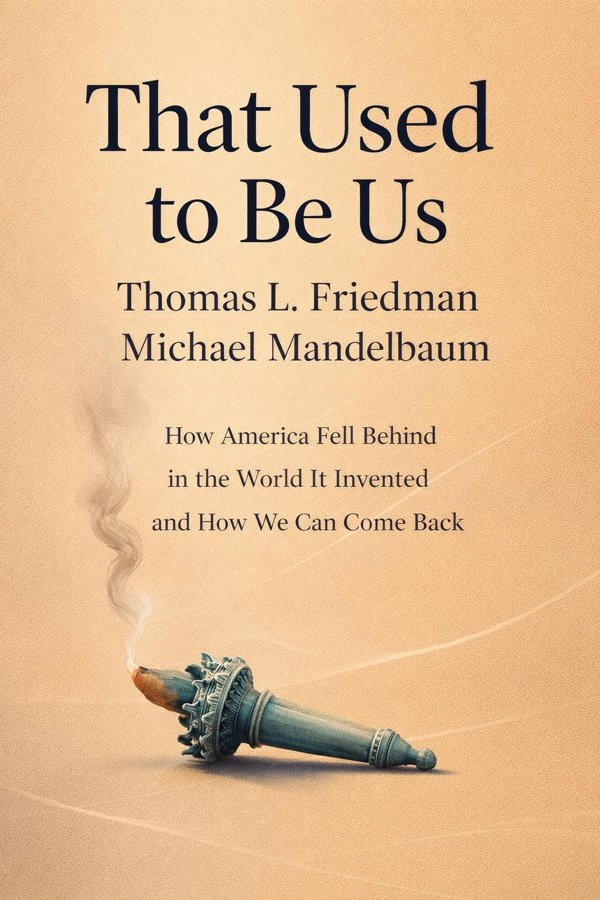
That Used to Be Us: How America Fell Behind in the World It Invented and How We Can Come Back: Summary & Key Insights
by Thomas L. Friedman, Michael Mandelbaum
 10 min9 chaptersAudio available
Key Takeaways from That Used to Be Us: How America Fell Behind in the World It Invented and How We Can Come Back
Nations rarely fail because one crisis hits them; they fall behind when they mistake a new era for a temporary disturbance.
Financial crashes are often described as accidents, but this book treats the 2008 recession as a message.
Strong nations do not thrive on slogans; they thrive on systems.
A national dream survives only if people believe effort still leads somewhere.
In the modern economy, being good is no longer enough; countries must be faster, smarter, and more adaptive than they were before.
What Is That Used to Be Us: How America Fell Behind in the World It Invented and How We Can Come Back About?
That Used to Be Us: How America Fell Behind in the World It Invented and How We Can Come Back by Thomas L. Friedman, Michael Mandelbaum is a politics book spanning 11 pages. That Used to Be Us is a forceful diagnosis of America’s slipping position in a world it once shaped more confidently than any other nation. Thomas L. Friedman and Michael Mandelbaum argue that the United States is not declining because history suddenly turned against it, but because it failed to adapt to a new era defined by globalization, digital technology, and environmental strain. The book asks a blunt question: how did the country that pioneered so much of the modern economy become so politically paralyzed and strategically unfocused? Its answer is equally direct: America’s greatest threat is not external competition alone, but internal complacency. What makes the book matter is its blend of urgency and practicality. Rather than offering nostalgia, the authors outline what national renewal would actually require: better education, stronger infrastructure, more responsible public finances, a serious energy strategy, and political reform. Friedman brings the global perspective of a Pulitzer Prize-winning columnist, while Mandelbaum contributes the historical and policy depth of a leading foreign affairs scholar. Together, they offer not just a critique of American drift, but a roadmap for rebuilding competence, confidence, and long-term national strength.
This FizzRead summary covers all 9 key chapters of That Used to Be Us: How America Fell Behind in the World It Invented and How We Can Come Back in approximately 10 minutes, distilling the most important ideas, arguments, and takeaways from Thomas L. Friedman, Michael Mandelbaum's work. Also available as an audio summary and Key Quotes Podcast.
That Used to Be Us: How America Fell Behind in the World It Invented and How We Can Come Back
That Used to Be Us is a forceful diagnosis of America’s slipping position in a world it once shaped more confidently than any other nation. Thomas L. Friedman and Michael Mandelbaum argue that the United States is not declining because history suddenly turned against it, but because it failed to adapt to a new era defined by globalization, digital technology, and environmental strain. The book asks a blunt question: how did the country that pioneered so much of the modern economy become so politically paralyzed and strategically unfocused? Its answer is equally direct: America’s greatest threat is not external competition alone, but internal complacency.
What makes the book matter is its blend of urgency and practicality. Rather than offering nostalgia, the authors outline what national renewal would actually require: better education, stronger infrastructure, more responsible public finances, a serious energy strategy, and political reform. Friedman brings the global perspective of a Pulitzer Prize-winning columnist, while Mandelbaum contributes the historical and policy depth of a leading foreign affairs scholar. Together, they offer not just a critique of American drift, but a roadmap for rebuilding competence, confidence, and long-term national strength.
Who Should Read That Used to Be Us: How America Fell Behind in the World It Invented and How We Can Come Back?
This book is perfect for anyone interested in politics and looking to gain actionable insights in a short read. Whether you're a student, professional, or lifelong learner, the key ideas from That Used to Be Us: How America Fell Behind in the World It Invented and How We Can Come Back by Thomas L. Friedman, Michael Mandelbaum will help you think differently.
- ✓Readers who enjoy politics and want practical takeaways
- ✓Professionals looking to apply new ideas to their work and life
- ✓Anyone who wants the core insights of That Used to Be Us: How America Fell Behind in the World It Invented and How We Can Come Back in just 10 minutes
Want the full summary?
Get instant access to this book summary and 100K+ more with Fizz Moment.
Get Free SummaryAvailable on App Store • Free to download
Key Chapters
Nations rarely fail because one crisis hits them; they fall behind when they mistake a new era for a temporary disturbance. Friedman and Mandelbaum argue that the early twenty-first century brought exactly such a turning point. Three forces converged at once: globalization, the information-technology revolution, and climate change. Together, they created what the authors call the Great Disruption, a period in which old assumptions about work, competition, security, and national prosperity no longer held.
Globalization meant American workers and firms were no longer competing mainly with their neighbors or domestic rivals, but with talent and production networks across the planet. The IT revolution accelerated this shift by making knowledge, communication, and innovation move faster and more cheaply than ever before. Climate change added a third layer of pressure, forcing societies to rethink energy use, environmental sustainability, and long-term resilience. These were not isolated trends. They reinforced one another, intensifying competition while raising the costs of political delay.
The authors’ central point is that America responded too slowly. Instead of upgrading institutions for a more demanding age, the country often acted as if past advantages would continue automatically. Schools, infrastructure, fiscal habits, and political structures were left lagging while the world sped up. A useful way to apply this idea today is to look at any institution and ask whether it was built for the conditions of the twentieth century or the realities of the twenty-first. A local school system, a business model, or even a career path may all require this kind of reassessment.
Actionable takeaway: stop treating rapid global change as background noise. Identify one area of your work, organization, or community that still operates by outdated assumptions, and begin redesigning it for a more connected, technology-driven, and sustainability-conscious world.
Financial crashes are often described as accidents, but this book treats the 2008 recession as a message. Friedman and Mandelbaum argue that the Great Recession did not simply reveal problems in banking; it exposed a broader national habit of denial. For years, the United States had postponed difficult choices by borrowing money, tolerating weak regulation, and assuming future growth would cover present irresponsibility. The crisis shattered that illusion.
The authors contend that America had been consuming more than it produced and promising more than it could responsibly finance. Cheap credit helped hide stagnant wages, weak savings, and structural inefficiencies. At the political level, both parties often found it easier to avoid hard reforms than to prepare the country for deeper global competition. The recession therefore became more than an economic downturn. It was a mirror reflecting overconfidence, short-termism, and institutional fragility.
This matters because the book rejects the comforting idea that recovery alone solves the underlying issue. An economy can rebound while the same habits remain intact. Families know this instinctively: getting out of one financial emergency means little if spending patterns never change. The same is true for nations. A responsible response requires rebuilding competitiveness, not merely restoring consumption. That means investing in productive assets such as education, research, and infrastructure while confronting debt honestly.
Readers can apply this principle on a smaller scale by distinguishing between relief and repair. Emergency action may be necessary, but lasting stability comes from addressing root causes. Whether in personal finance, public policy, or business strategy, resilience depends on confronting structural weakness before the next shock arrives.
Actionable takeaway: when facing a setback, ask not only how to recover quickly, but what behaviors or systems made the crisis possible in the first place.
Strong nations do not thrive on slogans; they thrive on systems. One of the book’s most important contributions is its argument that America’s long-term success has historically depended on five foundational pillars: education, infrastructure, immigration, government-funded research, and rulemaking. These are not glamorous topics, but the authors insist they are the practical architecture of national prosperity.
Education develops human capital, allowing citizens to adapt, innovate, and compete. Infrastructure, from roads and airports to broadband and power grids, lowers the friction of economic life. Immigration brings talent, energy, and entrepreneurial ambition, especially when a country remains attractive to skilled newcomers. Government-funded research often seeds breakthroughs that private firms later commercialize, as seen in technologies connected to the internet, medicine, and defense. Rulemaking, both domestic and international, allows markets to function with trust, predictability, and fairness.
Friedman and Mandelbaum argue that America once excelled at all five, but allowed each to weaken. Schools became uneven, infrastructure aged, immigration policy turned dysfunctional, research support became politically vulnerable, and governing rules were increasingly shaped by gridlock or special interests. The result was not immediate collapse but gradual erosion. A nation can coast for a while on earlier investments, but eventually deferred maintenance catches up.
This framework is useful because it shifts debate away from abstract patriotism and toward concrete state capacity. If leaders want growth, the question is not whether they love the country enough, but whether they are strengthening these enabling systems. The same logic applies to institutions of any size: healthy organizations also depend on talent development, reliable platforms, openness to new people, investment in experimentation, and clear rules.
Actionable takeaway: evaluate any proposed reform by asking whether it strengthens or weakens one of the five pillars that make long-term prosperity possible.
A national dream survives only if people believe effort still leads somewhere. The authors argue that one of America’s deepest problems is not just slower growth, but the erosion of confidence that the system remains fair, open, and upwardly mobile. For generations, the American Dream promised that talent, discipline, and hard work could improve a person’s life. That belief gave the country energy and legitimacy. When it weakens, social frustration rises and politics becomes more brittle.
Friedman and Mandelbaum do not claim that inequality alone defines the crisis, but they do stress that broad opportunity matters more than comforting national myths. If education quality depends too heavily on zip code, if middle-class wages stagnate while costs climb, and if public institutions no longer equip people for a changing economy, then mobility declines. In that environment, citizens become more likely to blame one another or cling to nostalgia rather than adapt.
The book’s response is not to romanticize a lost past. Instead, it calls for renewing the conditions that once made mobility plausible: strong schools, affordable pathways to skills, investment in innovation, and a culture that rewards contribution rather than rent-seeking. A practical example is workforce retraining. In an economy transformed by automation and global competition, a person may need multiple careers over a lifetime. Systems built for one educational sprint at age eighteen are no longer enough.
This idea also matters at the level of community. Towns, employers, and universities can either widen access to opportunity or concentrate advantage further. Restoring belief in mobility requires visible ladders, not just rhetoric about merit.
Actionable takeaway: support policies and institutions that expand real pathways into stable work, skill development, and entrepreneurship, especially for people starting without elite advantages.
In the modern economy, being good is no longer enough; countries must be faster, smarter, and more adaptive than they were before. The authors emphasize that globalization has transformed competition from a mostly national contest into a global one. American workers now compete with engineers in India, manufacturers in China, designers in Europe, and startups everywhere. Capital, ideas, and production can move quickly, and that mobility punishes complacency.
The book does not portray global competition as purely a threat. It can lower prices, expand markets, and spur innovation. But its benefits are uneven, and nations that fail to prepare their citizens for this environment suffer more than those that do. America’s problem, according to Friedman and Mandelbaum, was not that competition appeared unexpectedly; it was that the country underinvested in the skills, systems, and discipline needed to excel within it.
A practical example is advanced manufacturing. Success no longer depends only on low wages. It requires precision engineering, digital integration, logistics, supply-chain resilience, and a technically trained workforce. Countries that align education, industry, and infrastructure gain an edge. Those that rely on old assumptions about natural dominance lose ground.
The authors therefore urge readers to think in terms of national competitiveness without falling into crude economic nationalism. The goal is not isolation, but preparedness. At the personal level, this means building transferable skills, technological fluency, and a habit of continuous learning. At the policy level, it means making a country a better place to invent, build, and scale new ideas.
Actionable takeaway: assume competition is global by default. Invest in skills, technologies, and partnerships that make you harder to replace in an interconnected economy.
People often talk about innovation as if it were a mysterious spark, but the book argues that sustained innovation is usually the product of ecosystems. America has long excelled in invention, entrepreneurship, and higher education, yet Friedman and Mandelbaum warn that these strengths are not self-renewing. The information-technology revolution created immense opportunities, but turning them into broad prosperity requires institutions that can spread and support innovation across society.
The authors distinguish between having brilliant companies and having a national system capable of producing talent, funding research, protecting intellectual exchange, and translating ideas into jobs and industries. Silicon Valley is not just a collection of genius founders. It depends on universities, risk capital, legal frameworks, research networks, openness to immigrants, and infrastructure that supports experimentation. Innovation, in other words, is social as well as technical.
This matters because many political debates focus on preserving existing jobs rather than equipping people for emerging sectors. The authors do not dismiss the pain of disruption, but they argue that resisting technological change is usually a losing strategy. A better response is to help workers and regions move up the value chain. For example, digital tools can improve manufacturing, healthcare, education, and logistics, but only if institutions train people to use them effectively.
An important practical lesson here is that innovation policy should not be limited to celebrating startups. It also includes strengthening community colleges, STEM education, university research, modern regulation, and broadband access. Individuals can apply the same logic by treating learning as an ongoing process rather than a one-time credential.
Actionable takeaway: do not ask only how to protect yourself from technological change; ask how to position yourself, your organization, or your community to benefit from it.
Energy policy is often framed as an environmental debate, but this book treats it as a test of national seriousness. Friedman and Mandelbaum argue that America’s dependence on outdated energy habits undermines economic efficiency, geopolitical flexibility, and environmental stability all at once. Climate change is not just a scientific issue in their account; it is a strategic challenge that rewards countries willing to innovate and plan ahead.
The authors criticize the false choice between growth and sustainability. In their view, energy efficiency, clean technology, and a smarter environmental strategy can strengthen competitiveness rather than weaken it. Countries that lead in clean-energy innovation may create new industries, reduce vulnerability to oil shocks, and improve public health. Those that delay may end up buying the future from others.
The broader point is that external costs eventually become internal burdens. Pollution, climate instability, and inefficient energy systems may be ignored politically for years, but they still produce damage through extreme weather, healthcare expenses, infrastructure stress, and strategic dependence on unstable suppliers. A business analogy helps: dumping maintenance costs into the future may flatter short-term earnings, but it leaves the organization exposed.
Practical applications include investing in resilient infrastructure, modernizing grids, promoting research in cleaner fuels and storage, and pricing incentives so that markets reward efficiency rather than waste. On an individual level, energy choices in housing, transportation, and consumption often align long-term savings with environmental responsibility.
Actionable takeaway: treat energy and climate decisions as investments in security and competitiveness, not as separate moral gestures. Support policies and choices that reduce waste, improve resilience, and encourage innovation.
A country can survive many external pressures, but it struggles when its political system can no longer solve problems. For Friedman and Mandelbaum, America’s deepest crisis is not simply economic or geopolitical. It is the erosion of effective governance. At the very moment when globalization, technology, and environmental challenges demanded disciplined national action, politics became more polarized, theatrical, and captive to short-term incentives.
The authors argue that the United States still possesses immense strengths, including top universities, entrepreneurial culture, military power, and deep capital markets. What prevents these assets from translating into coherent renewal is political paralysis. Electoral incentives reward ideological purity over compromise. Interest groups defend narrow benefits. Media dynamics amplify outrage. Leaders often spend more time positioning for the next campaign than building durable policy consensus.
This dysfunction matters because many of the required reforms are not conceptually mysterious. Better schools, upgraded infrastructure, smarter immigration rules, fiscal discipline, and energy innovation are all achievable in principle. What is missing is the willingness to prioritize national capacity over partisan point-scoring. The authors therefore present dysfunction not as a side problem but as the bottleneck through which every other issue must pass.
Readers can apply this insight by becoming more attentive to the quality of governance, not just the emotional satisfaction of political identity. In organizations as in nations, cultures that punish compromise often drift into decline. Good systems need argument, but they also need mechanisms for decision and adaptation.
Actionable takeaway: judge leaders less by rhetorical combat and more by whether they can build coalitions, make trade-offs, and deliver long-term results on difficult structural problems.
Policy matters, but the authors insist that national recovery is also moral and cultural. A society cannot borrow endlessly, avoid sacrifice, celebrate easy answers, and still expect durable greatness. One of the book’s most memorable themes is that America needs not just better programs but a return to seriousness: honesty about limits, willingness to compete, respect for competence, and a shared sense of responsibility.
Friedman and Mandelbaum connect this cultural argument to what they call leadership and citizenship. Leaders must level with the public rather than flatter it with unrealistic promises. Citizens, meanwhile, must accept that democratic self-government requires attention, patience, and trade-offs. A healthy republic depends on more than rights; it depends on habits such as delayed gratification, public-mindedness, and respect for evidence.
The book’s title reflects this concern. “That used to be us” is not only an expression of nostalgia but also a reminder of standards the country once took more seriously. The authors do not claim America was ever perfect. Rather, they argue that earlier generations often displayed greater readiness to invest in the future through infrastructure, scientific ambition, and institutional reform. Reclaiming that spirit means recovering a bias toward building rather than blaming.
A practical application is to think about citizenship in everyday settings: school boards, local elections, neighborhood problem-solving, and public conversation. Renewal is not created solely in Washington. It also grows when communities reward competence and long-term stewardship instead of performative outrage.
Actionable takeaway: practice a more demanding form of citizenship by supporting leaders who tell hard truths, valuing evidence over tribal comfort, and contributing to institutions that strengthen the common good.
All Chapters in That Used to Be Us: How America Fell Behind in the World It Invented and How We Can Come Back
About the Authors
Thomas L. Friedman is a Pulitzer Prize-winning journalist, columnist for The New York Times, and bestselling author known for his influential writing on globalization, technology, the Middle East, and foreign policy. His work often translates complex international trends into clear, vivid arguments for general readers. Michael Mandelbaum is a leading scholar of American foreign policy and international relations, long associated with Johns Hopkins University, where he has taught and written extensively on strategy, diplomacy, and global affairs. Mandelbaum is known for combining historical perspective with practical policy analysis. Together, Friedman and Mandelbaum bring complementary strengths to That Used to Be Us: one offers journalistic immediacy and global observation, while the other contributes academic rigor and strategic depth.
Get This Summary in Your Preferred Format
Read or listen to the That Used to Be Us: How America Fell Behind in the World It Invented and How We Can Come Back summary by Thomas L. Friedman, Michael Mandelbaum anytime, anywhere. FizzRead offers multiple formats so you can learn on your terms — all free.
Available formats: App · Audio · PDF · EPUB — All included free with FizzRead
Download That Used to Be Us: How America Fell Behind in the World It Invented and How We Can Come Back PDF and EPUB Summary
Key Quotes from That Used to Be Us: How America Fell Behind in the World It Invented and How We Can Come Back
“Nations rarely fail because one crisis hits them; they fall behind when they mistake a new era for a temporary disturbance.”
“Financial crashes are often described as accidents, but this book treats the 2008 recession as a message.”
“Strong nations do not thrive on slogans; they thrive on systems.”
“A national dream survives only if people believe effort still leads somewhere.”
“In the modern economy, being good is no longer enough; countries must be faster, smarter, and more adaptive than they were before.”
Frequently Asked Questions about That Used to Be Us: How America Fell Behind in the World It Invented and How We Can Come Back
That Used to Be Us: How America Fell Behind in the World It Invented and How We Can Come Back by Thomas L. Friedman, Michael Mandelbaum is a politics book that explores key ideas across 9 chapters. That Used to Be Us is a forceful diagnosis of America’s slipping position in a world it once shaped more confidently than any other nation. Thomas L. Friedman and Michael Mandelbaum argue that the United States is not declining because history suddenly turned against it, but because it failed to adapt to a new era defined by globalization, digital technology, and environmental strain. The book asks a blunt question: how did the country that pioneered so much of the modern economy become so politically paralyzed and strategically unfocused? Its answer is equally direct: America’s greatest threat is not external competition alone, but internal complacency. What makes the book matter is its blend of urgency and practicality. Rather than offering nostalgia, the authors outline what national renewal would actually require: better education, stronger infrastructure, more responsible public finances, a serious energy strategy, and political reform. Friedman brings the global perspective of a Pulitzer Prize-winning columnist, while Mandelbaum contributes the historical and policy depth of a leading foreign affairs scholar. Together, they offer not just a critique of American drift, but a roadmap for rebuilding competence, confidence, and long-term national strength.
You Might Also Like
Antifa: The Anti-Fascist Handbook
Mark Bray
10 min
Attack from Within: How Disinformation Is Sabotaging America
Barbara McQuade
10 min
Coercion, Capital, and European States, AD 990–1992
Charles Tilly
10 min
Digital Democracy: Concepts, Methodologies, Tools, and Applications
Various Authors
10 min
Fascism
Stanley G. Payne
10 min
Fire And Fury: Inside The Trump White House
Michael Wolff
10 minBrowse by Category
Ready to read That Used to Be Us: How America Fell Behind in the World It Invented and How We Can Come Back?
Get the full summary and 100K+ more books with Fizz Moment.