
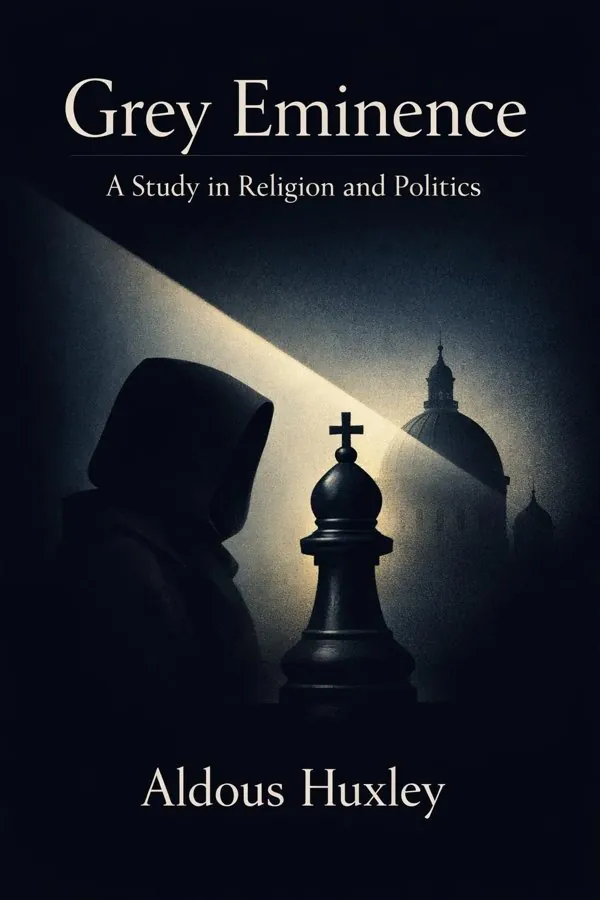
Grey Eminence: A Study in Religion and Politics: Summary & Key Insights
 10 min10 chaptersAudio available
Key Takeaways from Grey Eminence: A Study in Religion and Politics
A life that later appears paradoxical often begins with patterns established very early.
The desire to surrender the self can become either a path to wisdom or a cover for dangerous certainty.
Some transitions happen so gradually that they feel like faithfulness rather than change.
Power often seeks moral legitimacy, and moral seriousness often seeks effective power.
The most consequential person in a room is not always the one seated at the center.
What Is Grey Eminence: A Study in Religion and Politics About?
Grey Eminence: A Study in Religion and Politics by Aldous Huxley is a biographies book spanning 10 pages. Grey Eminence: A Study in Religion and Politics is Aldous Huxley’s penetrating portrait of François Leclerc du Tremblay, better known as Father Joseph, the Capuchin friar who became the indispensable behind-the-scenes adviser to Cardinal Richelieu. At first glance, Father Joseph appears to embody a contradiction: a mystic dedicated to humility, prayer, and self-denial who nevertheless helped shape state policy, diplomacy, and war in seventeenth-century Europe. Huxley turns that contradiction into the heart of the book. Rather than offering a simple biography, he investigates how spiritual idealism can become entangled with ambition, violence, and the machinery of power. The result is not only a study of one remarkable life, but also a timeless inquiry into the dangers of confusing religious purpose with political necessity. Huxley writes with unusual authority because he combines historical research, psychological insight, moral seriousness, and philosophical range. His portrait of Father Joseph speaks far beyond its period, raising urgent questions about leaders, institutions, and the stories we tell ourselves when noble intentions produce destructive outcomes.
This FizzRead summary covers all 10 key chapters of Grey Eminence: A Study in Religion and Politics in approximately 10 minutes, distilling the most important ideas, arguments, and takeaways from Aldous Huxley's work. Also available as an audio summary and Key Quotes Podcast.
Grey Eminence: A Study in Religion and Politics
Grey Eminence: A Study in Religion and Politics is Aldous Huxley’s penetrating portrait of François Leclerc du Tremblay, better known as Father Joseph, the Capuchin friar who became the indispensable behind-the-scenes adviser to Cardinal Richelieu. At first glance, Father Joseph appears to embody a contradiction: a mystic dedicated to humility, prayer, and self-denial who nevertheless helped shape state policy, diplomacy, and war in seventeenth-century Europe. Huxley turns that contradiction into the heart of the book. Rather than offering a simple biography, he investigates how spiritual idealism can become entangled with ambition, violence, and the machinery of power. The result is not only a study of one remarkable life, but also a timeless inquiry into the dangers of confusing religious purpose with political necessity. Huxley writes with unusual authority because he combines historical research, psychological insight, moral seriousness, and philosophical range. His portrait of Father Joseph speaks far beyond its period, raising urgent questions about leaders, institutions, and the stories we tell ourselves when noble intentions produce destructive outcomes.
Who Should Read Grey Eminence: A Study in Religion and Politics?
This book is perfect for anyone interested in biographies and looking to gain actionable insights in a short read. Whether you're a student, professional, or lifelong learner, the key ideas from Grey Eminence: A Study in Religion and Politics by Aldous Huxley will help you think differently.
- ✓Readers who enjoy biographies and want practical takeaways
- ✓Professionals looking to apply new ideas to their work and life
- ✓Anyone who wants the core insights of Grey Eminence: A Study in Religion and Politics in just 10 minutes
Want the full summary?
Get instant access to this book summary and 100K+ more with Fizz Moment.
Get Free SummaryAvailable on App Store • Free to download
Key Chapters
A life that later appears paradoxical often begins with patterns established very early. Huxley shows that François Leclerc du Tremblay’s childhood and youth already contained the ingredients of the man Father Joseph would become: aristocratic discipline, religious seriousness, intellectual ambition, and a sensitivity to the upheavals of his age. Born in 1577 into the lesser French nobility, he grew up in a society marked by the aftershocks of the Wars of Religion, where questions of faith and statecraft were never cleanly separated. In such an environment, piety and public duty could seem not opposed but naturally intertwined.
As a young man, François was drawn both to heroic action and spiritual intensity. He had the education, family connections, and temperament to pursue influence, yet he also felt a genuine attraction to renunciation. His eventual decision to become a Capuchin friar did not erase the worldly capacities formed in him; it redirected them. That is one of Huxley’s central points: entering religious life does not automatically dissolve ambition, intelligence, or the desire to act upon history. It may even clothe those impulses in more powerful moral language.
This insight remains highly practical. Many people imagine that changing institutions, careers, or titles means they have changed themselves. But inner habits often survive external transformation. A business executive who joins a nonprofit may still seek control. A public servant may still crave admiration while speaking of sacrifice. Father Joseph’s life warns us that vocation can refine character, but it can also provide a more respectable stage for old drives.
Actionable takeaway: when evaluating your motives in any mission-driven role, examine what traits you carried into it. Ask not only what you now serve, but what in you still seeks power, recognition, or influence.
The desire to surrender the self can become either a path to wisdom or a cover for dangerous certainty. Huxley takes Father Joseph’s mystical writings seriously, showing that he was no mere political opportunist wearing a monk’s robe. He genuinely believed in the spiritual annihilation of self-will and in becoming an instrument of divine action. In theory, this ideal is one of humility: the individual ego must disappear so that God’s will may work unimpeded.
Yet Huxley also sees the peril hidden inside this aspiration. If a person convinces himself that his preferences are not personal desires but manifestations of a higher will, self-criticism becomes difficult. Ordinary moral hesitations can be dismissed as weakness. The more spiritual the language, the less visible the ego may become to itself. Father Joseph’s devotion was real, but it may also have made him more vulnerable to identifying divine purpose with his own strategic judgments.
This is a strikingly modern problem. Leaders in religion, politics, activism, and even business often describe themselves as servants of a cause larger than themselves. That can inspire courage and sacrifice. But it can also produce absolutism. Once someone believes he is merely an instrument, he may stop asking whether the instrument is causing harm. Huxley’s analysis reminds readers that authentic spirituality should deepen conscience, not suspend it.
In practical terms, any mission-driven person needs structures of correction. A teacher devoted to students, a founder devoted to impact, or a minister devoted to faith still needs trusted critics who can question methods as well as intentions. Father Joseph’s life suggests that sincerity is not a sufficient safeguard.
Actionable takeaway: whenever you feel most certain that you are acting for a higher purpose, deliberately invite moral scrutiny. Ask someone independent to challenge both your reasoning and your methods.
Some transitions happen so gradually that they feel like faithfulness rather than change. Huxley traces how Father Joseph moved from the inward disciplines of the Capuchin order into increasingly active involvement in public affairs. He did not begin by seeking to become a power broker. Instead, diplomatic errands, reforming projects, religious initiatives, and proximity to influential figures drew him step by step into a wider sphere. In a world where religious conflict, dynastic rivalry, and state interests overlapped, a spiritually serious and highly capable monk could easily be seen as uniquely suited for mediation.
What makes this transition important is that Father Joseph likely understood it as service, not compromise. He may have believed that entering political life was necessary to secure religious peace, strengthen Catholic interests, and reduce disorder. Huxley does not deny the plausibility of such motives. His concern is that practical engagement can slowly reshape the moral imagination. The urgent task of managing crises begins to displace the contemplative perspective that once judged all worldly action in the light of eternity.
This dynamic appears in many careers. A doctor enters administration to improve hospitals. A scholar takes policy work to influence education. A religious leader joins public campaigns to protect moral values. Over time, procedural demands, alliances, and strategic calculations may become normal, while the original inward standard grows faint. The drift is rarely dramatic; that is precisely why it is dangerous.
Huxley’s portrait encourages readers to notice how noble participation in systems can become habituation to their logic. What begins as reluctant engagement may end as identity.
Actionable takeaway: if your role is pulling you from principle into constant expediency, schedule regular moments of withdrawal and reflection. Revisit the values that justified your entry before the system defines your purpose for you.
Power often seeks moral legitimacy, and moral seriousness often seeks effective power. Huxley presents the partnership between Cardinal Richelieu and Father Joseph as one of the decisive alliances of seventeenth-century France. Richelieu was the architect of centralized royal authority and a relentless practitioner of raison d’état, the doctrine that state necessity can override ordinary scruples. Father Joseph became his close confidant, envoy, and adviser, helping translate grand aims into practical operations.
Their relationship matters because it reveals how different forms of authority reinforce each other. Richelieu had office, resources, and strategic vision. Father Joseph contributed discretion, ideological commitment, diplomatic skill, and the aura of spiritual integrity. The monk in the background gave depth and legitimacy to political action, while the statesman gave worldly force to the monk’s aspirations. This is the essence of the “grey eminence”: a figure without the highest formal title who nonetheless shapes outcomes from behind the scenes.
Huxley does not portray Father Joseph as a puppet. He was influential precisely because he was intelligent, disciplined, and trusted. But that trust had a cost. By serving Richelieu so closely, he became implicated in policies that stretched and sometimes violated the moral principles associated with his vocation. The bond illustrates how proximity to power can transform counsel into complicity.
This pattern remains recognizable today. Advisers, chiefs of staff, strategists, speechwriters, policy experts, and spiritual counselors may not be publicly visible, yet they often enable decisions that affect millions. Their lack of formal prominence can make self-examination less urgent, not more.
Actionable takeaway: if you operate behind the scenes, do not hide from responsibility by pointing to someone else’s title. Influence without accountability is still moral agency, and you must judge the consequences of what you help make possible.
The most consequential person in a room is not always the one seated at the center. Huxley uses Father Joseph to illuminate the enduring type later described by the phrase “grey eminence”: the hidden adviser whose authority derives from access, trust, and subtle influence rather than formal office. Unlike the “red eminence” of Richelieu’s cardinalate, Father Joseph wore the humble grey habit of the Capuchins, yet his counsel could affect treaties, alliances, and military strategy.
This concept is larger than one biography. Huxley is interested in a political archetype: the person who operates in the half-light between spirituality and administration, public principle and private maneuver. Such figures are hard to judge because they can appear self-effacing while exercising enormous power. Their invisibility may even seem virtuous. They are not grandstanding politicians but servants, assistants, or men of conscience. Yet the concealment of their role can make it harder for institutions to confront the real sources of decisions.
Modern organizations are full of grey eminences. In governments, they may be senior advisers. In companies, they may be founders’ confidants or unelected power centers. In nonprofits and religious bodies, they may be gatekeepers who frame problems, shape appointments, and define acceptable strategy. Because they often act through persuasion rather than command, they can tell themselves they merely advise. Huxley shows why that is too easy.
A healthy institution requires clarity about who is influencing what and by what standards. Hidden authority tends to weaken accountability and moral visibility. Father Joseph’s story demonstrates that an apparently secondary role can carry primary ethical significance.
Actionable takeaway: identify the grey eminences in your own organization, including yourself if necessary. Ask whether their influence is transparent, accountable, and aligned with the values the institution publicly claims to serve.
Good intentions become dangerous when they authorize methods that would otherwise seem intolerable. Huxley’s most disturbing insight is that Father Joseph did not descend into politics by abandoning religion; he entered politics carrying religion with him. He appears to have believed that strengthening France, defeating rivals, and advancing Catholic interests were compatible with divine purpose. The problem was not simple hypocrisy. It was the fusion of sacred aspiration with coercive statecraft.
Once this fusion occurs, political calculation acquires a moral glow. Compromise becomes prudence, deception becomes necessity, and violence becomes tragic duty in the service of a higher end. Huxley is not naïve about history; he knows states cannot be run as monasteries. But he insists that religious language can become especially potent when attached to reasons of state, because it sanctifies what should remain morally troubling. Father Joseph’s case shows how a man of prayer can assist systems of force without fully acknowledging what is being surrendered.
This lesson applies far beyond religion. Any elevated cause can play the same role: national security, social justice, institutional survival, shareholder value, public health, or cultural preservation. The nobler the cause sounds, the easier it is to excuse questionable tactics. Individuals and organizations then focus on outcomes while numbing themselves to the character they are becoming.
A practical way to resist this drift is to separate ends from justifications. It is not enough to ask whether your goal is admirable. You must also ask what habits, structures, and harms your methods normalize. Father Joseph’s tragedy lies partly in the possibility that he remained spiritually earnest while politically compromised.
Actionable takeaway: whenever a cause you cherish seems to justify secrecy, manipulation, or cruelty, pause and test the means independently of the end. If the method deforms conscience, the mission is already in danger.
Ideas become most frightening when they can move armies. Huxley places Father Joseph within the vast catastrophe of the Thirty Years’ War, where confessional rivalry, dynastic ambition, and balance-of-power politics devastated Europe. Father Joseph’s diplomatic and strategic work cannot be separated from this larger arena. Even when framed as national necessity or religious defense, policy choices contributed to prolonged conflict, suffering, and destruction on a continental scale.
Huxley’s emphasis is not merely historical. He wants readers to see how distance from consequences encourages moral abstraction. Advisers and statesmen operate with maps, dispatches, negotiations, and doctrines. These tools are necessary, but they also make suffering statistical. Villages burned, populations displaced, and soldiers killed can disappear into phrases such as “strategic pressure” or “favorable terms.” Father Joseph’s life dramatizes the danger of a contemplative mind becoming comfortable with remote, system-level decisions whose human cost remains mostly unseen.
This insight is relevant in modern settings where decision-makers are insulated from outcomes: executives restructuring workforces, technologists deploying powerful systems, officials designing sanctions, or institutions making cuts from central offices. The more abstract the language, the easier it becomes to mistake efficiency for wisdom. Huxley presses the reader to restore moral imagination to large-scale action.
A practical safeguard is deliberate contact with reality. Leaders who only see reports tend to think in categories. Leaders who encounter those affected retain some resistance to abstraction. Father Joseph’s era shows what can happen when strategic brilliance outruns humane attention.
Actionable takeaway: if your decisions affect people at scale, build habits that reconnect policy to lived consequences. Seek firsthand testimony, concrete cases, and human stories before approving actions justified only in broad strategic terms.
Some tensions are productive; others become destructive when denied. Huxley argues that the deepest conflict in Father Joseph’s life was not between private belief and public duty in any superficial sense, but between two fundamentally different orientations to reality. Mysticism seeks self-transcendence, humility, truthfulness, and union with what is ultimate. Realpolitik deals in interest, leverage, timing, secrecy, and force. Each has its own language, habits, and standards of success.
Father Joseph tried to inhabit both worlds at once. He appears to have hoped that spiritual purity could animate political action without being corrupted by it. Huxley doubts that such a synthesis can be sustained. The disciplines required by power gradually reshape the soul. Strategic thinking teaches one to manipulate appearances, rank priorities, and accept collateral damage. Mystical awareness, by contrast, depends on the stripping away of illusion and on a radical seriousness about means as well as ends. To blend them without residue is nearly impossible.
This is not an argument for withdrawal from all public life. Huxley is subtler than that. Rather, he warns that anyone who enters systems of power must recognize the cost of doing so. Ethical language cannot erase structural realities. A compassionate politician, principled executive, or spiritually serious activist may accomplish genuine good, but none should imagine that the logic of power leaves the inner life untouched.
The practical application is disciplined realism. Do not claim perfect harmony where there is enduring tension. Better to admit conflict honestly than to conceal it beneath noble rhetoric. Father Joseph becomes tragic partly because his life suggests how hard it is to preserve contemplative integrity within coercive systems.
Actionable takeaway: name the moral tensions in your work explicitly. If your role requires compromise, secrecy, or coercion, do not baptize those realities with idealistic language. Honest tension is safer than false moral unity.
People rarely become dangerous by deciding to be evil; they become dangerous by misreading themselves. Huxley’s psychological analysis of Father Joseph is one of the book’s lasting strengths. He treats his subject neither as villain nor saint, but as a human being capable of sincerity, blindness, discipline, ambition, devotion, and rationalization all at once. This complexity is crucial, because the moral failures that matter most in history often arise from divided motives rather than outright cynicism.
Father Joseph’s spirituality may have intensified, rather than canceled, his tendency toward self-deception. If one sees oneself as chosen, sacrificed, or purified, ordinary ego needs can hide behind exalted self-images. Ambition can masquerade as duty. Emotional gratification can present itself as obedience. Strategic mastery can feel like holy labor. Huxley suggests that the inner life is not transparent to itself; therefore, ethical confidence should always be tempered by suspicion of one’s own narrative.
This is deeply practical. In everyday professional life, people often explain questionable choices using flattering stories: “I had to be tough,” “I’m protecting the mission,” “Only I can handle this,” or “The situation is too complex for outsiders to understand.” These may contain truth, but they can also conceal pride, fear, resentment, or attachment to control. Psychological self-knowledge is therefore an ethical necessity, not a luxury.
Useful practices include journaling about motives, reviewing past decisions after emotions cool, and asking trusted peers not just whether you were effective but whether you were honest with yourself. Father Joseph’s life invites readers to treat introspection as a moral discipline.
Actionable takeaway: after any major decision, write down both your official reason and the less flattering motives that might also be present. The habit of naming mixed motives is one of the best defenses against principled self-deception.
The end of a life often exposes what its busy middle managed to conceal. In Huxley’s account, Father Joseph’s final years and death in 1638 carry a somber significance. By then he had spent decades in intense religious effort and exhausting political labor, helping Richelieu pursue aims that altered Europe but at immense human cost. His death came before some of the full consequences of these policies were complete, yet Huxley invites readers to view his exhaustion and decline as more than biographical detail. They symbolize the depletion produced by a life divided between holiness and power.
Huxley does not reduce Father Joseph to a moral lesson with a neat verdict. There is tragedy precisely because the man remained, in many respects, earnest and formidable. But his end forces the central question: what did all this service finally amount to? If the contemplative soul becomes consumed by the apparatus it hoped to guide, the loss is not only personal. It is civilizational. Societies need people who can remind power of its limits. When such people are absorbed into power’s operations, everyone is poorer.
For modern readers, the lesson concerns burnout, moral injury, and the hidden cost of over-identification with one’s role. Many high-capacity people spend years serving institutions they believe need them, only to discover that constant strategic engagement has hollowed out reflection, relationships, and conscience. Achievement then arrives with inner diminishment.
Actionable takeaway: regularly ask what your work is costing your inner life. If service leaves you less truthful, less compassionate, or less capable of silence, do not call that sacrifice alone. It may be a warning that your vocation is being consumed by the system you serve.
All Chapters in Grey Eminence: A Study in Religion and Politics
About the Author
Aldous Huxley (1894–1963) was an English novelist, essayist, and cultural critic whose work ranged across literature, history, religion, science, and philosophy. Born into a distinguished intellectual family, he became one of the twentieth century’s most versatile writers. He is best known for Brave New World, his influential dystopian novel, but his nonfiction is equally notable for its breadth and seriousness. Huxley was deeply interested in the relationship between inner life and social order, often examining how modern institutions, ideologies, and technologies shape human values. His books include essays on politics, education, mysticism, and consciousness, as well as later works such as The Doors of Perception. In Grey Eminence, he brings his characteristic blend of historical scholarship, moral inquiry, and psychological insight to the life of Father Joseph.
Get This Summary in Your Preferred Format
Read or listen to the Grey Eminence: A Study in Religion and Politics summary by Aldous Huxley anytime, anywhere. FizzRead offers multiple formats so you can learn on your terms — all free.
Available formats: App · Audio · PDF · EPUB — All included free with FizzRead
Download Grey Eminence: A Study in Religion and Politics PDF and EPUB Summary
Key Quotes from Grey Eminence: A Study in Religion and Politics
“A life that later appears paradoxical often begins with patterns established very early.”
“The desire to surrender the self can become either a path to wisdom or a cover for dangerous certainty.”
“Some transitions happen so gradually that they feel like faithfulness rather than change.”
“Power often seeks moral legitimacy, and moral seriousness often seeks effective power.”
“The most consequential person in a room is not always the one seated at the center.”
Frequently Asked Questions about Grey Eminence: A Study in Religion and Politics
Grey Eminence: A Study in Religion and Politics by Aldous Huxley is a biographies book that explores key ideas across 10 chapters. Grey Eminence: A Study in Religion and Politics is Aldous Huxley’s penetrating portrait of François Leclerc du Tremblay, better known as Father Joseph, the Capuchin friar who became the indispensable behind-the-scenes adviser to Cardinal Richelieu. At first glance, Father Joseph appears to embody a contradiction: a mystic dedicated to humility, prayer, and self-denial who nevertheless helped shape state policy, diplomacy, and war in seventeenth-century Europe. Huxley turns that contradiction into the heart of the book. Rather than offering a simple biography, he investigates how spiritual idealism can become entangled with ambition, violence, and the machinery of power. The result is not only a study of one remarkable life, but also a timeless inquiry into the dangers of confusing religious purpose with political necessity. Huxley writes with unusual authority because he combines historical research, psychological insight, moral seriousness, and philosophical range. His portrait of Father Joseph speaks far beyond its period, raising urgent questions about leaders, institutions, and the stories we tell ourselves when noble intentions produce destructive outcomes.
More by Aldous Huxley
You Might Also Like

An American Marriage
Tayari Jones
10 min
Benjamin Franklin: An American Life
Walter Isaacson
10 min
I Know Why The Caged Bird Sings
Maya Angelou
10 min
Long Walk to Freedom
Nelson Mandela
10 min
Persepolis
Marjane Satrapi
10 min
Surely You're Joking, Mr. Feynman!
Richard P. Feynman
10 minBrowse by Category
Ready to read Grey Eminence: A Study in Religion and Politics?
Get the full summary and 100K+ more books with Fizz Moment.