
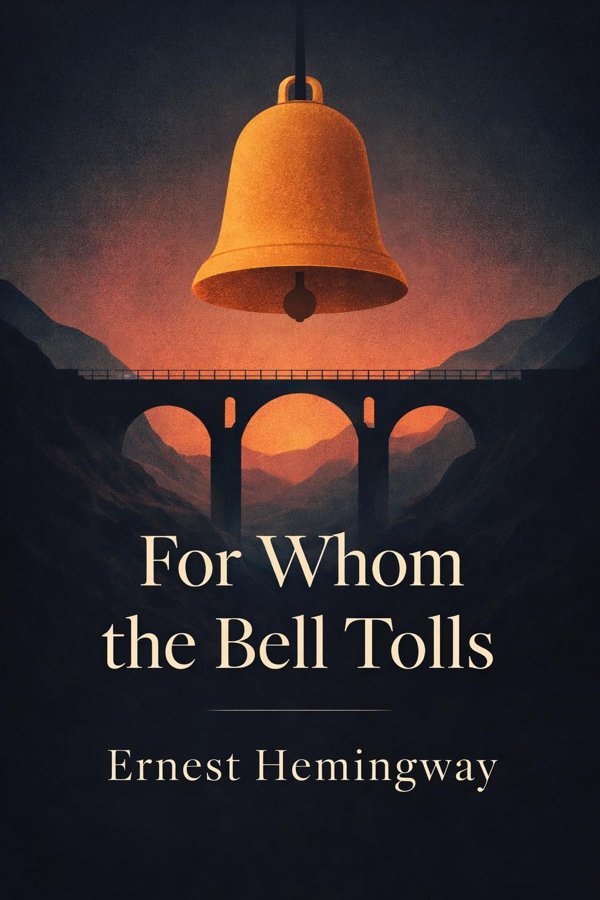
For Whom the Bell Tolls: Summary & Key Insights
 10 min8 chaptersAudio available
Key Takeaways from For Whom the Bell Tolls
A single assignment can reveal an entire human character.
In times of crisis, character often appears as conflict within a single community.
Love in wartime is never merely romantic; it becomes an argument for why life still matters.
War turns abstract ideals into personal costs.
The truest test of courage may come when victory is no longer possible.
What Is For Whom the Bell Tolls About?
For Whom the Bell Tolls by Ernest Hemingway is a war_military book spanning 5 pages. Set over just a few days during the Spanish Civil War, For Whom the Bell Tolls turns a military assignment into a profound meditation on loyalty, courage, love, and mortality. The novel follows Robert Jordan, an American volunteer fighting for the Republican cause, as he travels into the mountains to work with a guerrilla band and blow up a bridge at a decisive moment in an upcoming offensive. What begins as a tactical mission quickly becomes a moral and emotional trial. Jordan must navigate fear, distrust, political brutality, and the fragile bonds that form under extreme pressure. What makes the book endure is not only its vivid wartime setting, but its insistence that history is lived through intimate human choices. Hemingway shows how ideology, violence, tenderness, and sacrifice collide in ordinary people forced into extraordinary circumstances. Few writers were better equipped to tell such a story: Hemingway reported on wars, wrote with unmatched economy and force, and understood how men and women speak, suffer, and endure under fire. The result is a novel that feels immediate, unsentimental, and deeply humane.
This FizzRead summary covers all 8 key chapters of For Whom the Bell Tolls in approximately 10 minutes, distilling the most important ideas, arguments, and takeaways from Ernest Hemingway's work. Also available as an audio summary and Key Quotes Podcast.
For Whom the Bell Tolls
Set over just a few days during the Spanish Civil War, For Whom the Bell Tolls turns a military assignment into a profound meditation on loyalty, courage, love, and mortality. The novel follows Robert Jordan, an American volunteer fighting for the Republican cause, as he travels into the mountains to work with a guerrilla band and blow up a bridge at a decisive moment in an upcoming offensive. What begins as a tactical mission quickly becomes a moral and emotional trial. Jordan must navigate fear, distrust, political brutality, and the fragile bonds that form under extreme pressure.
What makes the book endure is not only its vivid wartime setting, but its insistence that history is lived through intimate human choices. Hemingway shows how ideology, violence, tenderness, and sacrifice collide in ordinary people forced into extraordinary circumstances. Few writers were better equipped to tell such a story: Hemingway reported on wars, wrote with unmatched economy and force, and understood how men and women speak, suffer, and endure under fire. The result is a novel that feels immediate, unsentimental, and deeply humane.
Who Should Read For Whom the Bell Tolls?
This book is perfect for anyone interested in war_military and looking to gain actionable insights in a short read. Whether you're a student, professional, or lifelong learner, the key ideas from For Whom the Bell Tolls by Ernest Hemingway will help you think differently.
- ✓Readers who enjoy war_military and want practical takeaways
- ✓Professionals looking to apply new ideas to their work and life
- ✓Anyone who wants the core insights of For Whom the Bell Tolls in just 10 minutes
Want the full summary?
Get instant access to this book summary and 100K+ more with Fizz Moment.
Get Free SummaryAvailable on App Store • Free to download
Key Chapters
A single assignment can reveal an entire human character. Robert Jordan enters the novel as a disciplined American dynamiter attached to the Republican side, sent behind enemy lines to destroy a strategically important bridge. On paper, the mission sounds clear: coordinate with guerrillas, wait for the proper signal, and execute the demolition at the exact moment it will support a larger offensive. In practice, the task is full of uncertainty. Jordan must rely on people he has never met, work in dangerous terrain, and trust that distant commanders understand the true cost of their orders.
This mission matters because it frames one of the novel’s central tensions: the gap between military plans and lived reality. Jordan is not simply an action hero carrying explosives. He is a thinking soldier who weighs consequences. He understands that success may require the deaths of people he has come to know, and that even a perfectly completed mission may not alter the larger tragedy of war. Hemingway uses Jordan’s professionalism to explore what duty looks like when certainty is impossible.
In modern life, many responsibilities feel similar, if less dramatic. Leaders are asked to carry out decisions made by institutions, often with incomplete information and real human consequences. Jordan’s example suggests that competence matters, but conscience matters too. He prepares carefully, observes details, asks hard questions, and never treats risk casually.
Actionable takeaway: when facing a difficult responsibility, define the mission clearly, assess the human cost honestly, and act with both skill and moral awareness.
In times of crisis, character often appears as conflict within a single community. Among the guerrillas, Pablo and Pilar stand as opposing forces shaped by the same war. Pablo was once a bold and effective leader, feared by enemies and respected by his own people. But experience has changed him. He has seen too much blood, too much randomness, and too much loss. What remains is caution sliding into cowardice, and self-preservation posing as wisdom. He resists Jordan’s mission because he believes it will destroy them all.
Pilar, by contrast, embodies endurance, practical authority, and emotional clarity. She is earthy, unsentimental, and spiritually commanding. Where Pablo shrinks from danger, Pilar absorbs it and keeps moving. Yet Hemingway does not reduce either figure to a simple symbol. Pablo’s fear is not entirely irrational; he understands the cost of action better than those still intoxicated by ideals. Pilar’s strength is not abstract heroism; it is grounded in memory, suffering, and responsibility for others.
Together, they dramatize a hard truth: courage is rarely the absence of fear, and fear is not always foolish. In organizations, families, and political movements, people often split into these roles. One voice urges action for a higher cause; another warns of damage, retaliation, or collapse. Both voices must be heard, though not equally obeyed.
Hemingway suggests that communities survive when they can distinguish prudent caution from demoralizing paralysis. Pilar sees that action is still necessary, even if the odds are grim.
Actionable takeaway: in moments of group uncertainty, listen seriously to fear, but let the most responsible and steady voice guide the final decision.
Love in wartime is never merely romantic; it becomes an argument for why life still matters. Maria enters the novel as a young woman marked by political violence and personal trauma. Her past includes humiliation, bereavement, and the brutal stripping away of safety. When she meets Robert Jordan, their bond forms quickly, but Hemingway treats it as more than sudden attraction. Their relationship becomes a fragile act of restoration, a way for both characters to reclaim some human future in the midst of destruction.
Maria represents the possibility that tenderness can survive after violation. Jordan, who has learned to live through discipline and mission, discovers in her a reason to imagine life beyond immediate duty. Their conversations, fantasies, and small moments together do not deny the war; they push back against its attempt to define everything. Hemingway’s achievement lies in making this love feel urgent without making it sentimental. The relationship is compressed by time, intensified by danger, and shadowed constantly by likely death.
This matters beyond the novel because crisis often narrows people into roles: worker, fighter, survivor, caretaker. Love resists that reduction. It reminds people that they are more than functions inside a system of pressure. Even brief experiences of care, trust, and emotional presence can restore meaning when circumstances feel dehumanizing.
The practical lesson is not that romance solves suffering, but that connection helps people endure what would otherwise crush them. In hard seasons, closeness may look like listening well, speaking gently, or allowing yourself to hope despite uncertainty.
Actionable takeaway: protect spaces for genuine human connection, especially when pressure tempts you to become emotionally numb.
War turns abstract ideals into personal costs. One of Hemingway’s deepest concerns in For Whom the Bell Tolls is the burden of duty when every choice seems compromised. Jordan believes in the Republican cause and accepts the necessity of his mission, yet he never pretends that duty is clean. To blow up the bridge means exposing the guerrillas to likely death. To refuse the mission would be to abandon comrades elsewhere and fail a larger strategic need. The novel refuses the comfort of a painless moral answer.
This is what gives the book much of its ethical power. Sacrifice is not glorified as easy nobility. Instead, Hemingway shows how sacrifice wounds those who choose it and those who witness it. Characters must decide not between good and evil, but between competing responsibilities: loyalty to individuals, loyalty to political ideals, loyalty to military necessity, and loyalty to one’s own conscience. Jordan’s seriousness comes from understanding that true duty includes accepting grief, doubt, and irreversibility.
Modern readers may recognize similar tensions in less extreme forms. A manager may choose layoffs to keep a company alive. A doctor may recommend painful treatment with uncertain outcomes. A parent may make a decision one child resents for the sake of the whole family. In such cases, maturity means acknowledging that some right actions still hurt.
Hemingway also implies that sacrifice gains dignity when chosen lucidly rather than theatrically. Jordan plans, reflects, and accepts consequences without self-dramatization.
Actionable takeaway: when facing a painful decision, do not ask only what is easiest or most admirable; ask what responsibility demands, then bear the cost honestly.
The truest test of courage may come when victory is no longer possible. Near the end of the novel, Robert Jordan confronts the reality that he cannot escape with the others. Injured and left behind, he prepares to delay the enemy so his companions can get away. This final vigil distills the themes that have been building throughout the story: mortality, responsibility, composure, and the refusal to surrender one’s inner freedom even when the body is broken.
What makes the scene powerful is its lack of melodrama. Jordan does not transform into a mythic martyr. He remains what he has always been: a man thinking clearly under pressure, aware of pain, regret, and unfinished desire. He remembers Maria. He considers the mission. He recognizes the limits of what one person can control. Yet he still chooses action. Hemingway presents death not as a romantic climax but as the final context in which character is revealed.
This is one reason the novel continues to resonate. Most people will never face death in combat, but everyone eventually confronts endings they cannot reverse: illness, the collapse of plans, the loss of strength, the closing of a chapter. Jordan’s example suggests that dignity lies less in dominating fate than in meeting it with steadiness.
The practical value of this idea is subtle but real. When circumstances cannot be fixed, people still retain agency in attitude, preparation, and care for others. Courage can mean making one last useful choice instead of surrendering to panic or self-pity.
Actionable takeaway: when you cannot control the outcome, focus on the next meaningful act you can still perform with clarity and grace.
The most honest war stories do not divide the world neatly into heroes and villains. Although For Whom the Bell Tolls is committed to the Republican side, Hemingway refuses simple propaganda. He acknowledges the attraction of anti-fascist commitment, but he also shows cruelty, vengeance, incompetence, and moral corrosion among those fighting for supposedly just ends. One of the novel’s most disturbing elements is its portrayal of political violence carried out by ordinary people swept into collective fury. These scenes force readers to see how quickly righteousness can become brutality.
This moral ambiguity is central to the novel’s seriousness. Hemingway does not argue that all causes are identical or that political differences do not matter. Instead, he shows that war deforms everyone it touches. Even necessary resistance can contain ugliness. Even noble goals can be pursued by damaged, frightened, or vindictive people. This keeps the novel from becoming simplistic and helps explain why it remains relevant in any era of polarization.
In contemporary terms, the lesson extends beyond war. Movements, institutions, and communities often justify harsh behavior by appealing to a larger good. People excuse cruelty if they believe they are on the right side. Hemingway warns that conviction without self-scrutiny can become dangerous.
A practical application is to examine not only what cause you support, but how you support it. Are you becoming contemptuous? Are you excusing dehumanization because your opponents seem worse? The novel insists that means matter as much as ends.
Actionable takeaway: hold fast to your principles, but never let allegiance to a cause exempt you from moral self-examination.
When time is short, life can feel both sharper and more fragile. One remarkable feature of For Whom the Bell Tolls is its compressed time frame. The main action unfolds over roughly three days, yet within that span Hemingway creates a world dense with memory, desire, political conflict, strategy, and spiritual reflection. This compression intensifies everything. Conversations carry the weight of final confessions. Small gestures become precious. Love advances rapidly not because the novel is careless, but because war eliminates the luxury of delay.
Hemingway uses this structure to suggest that people do not need long periods to encounter life’s essentials. Under pressure, they reveal themselves quickly. Jordan learns whom he can trust, what he values most, and what he is willing to die for. The guerrilla band, too, becomes a miniature society where fear, loyalty, authority, weakness, and tenderness all emerge with unusual clarity.
This has practical relevance for modern readers because crises often compress time in similar ways. A medical emergency, a job deadline, a family rupture, or a period of political upheaval can force choices and insights that ordinary routines postpone. Such periods are painful, but they can also strip away illusion. You see what matters because there is no room left for distraction.
The novel invites readers to consider whether they must wait for catastrophe to live attentively. If mortality and uncertainty are always present, then urgency is not only a wartime condition; it is a human one.
Actionable takeaway: act sooner on what truly matters—speak love, make decisions, and live deliberately before circumstances force clarity upon you.
All Chapters in For Whom the Bell Tolls
About the Author
Ernest Hemingway was born in 1899 in Oak Park, Illinois, and became one of the defining writers of the 20th century. He began his career in journalism, a background that shaped the clarity and compression of his prose. Hemingway served as an ambulance driver in World War I and later worked as a foreign correspondent, experiences that deeply influenced his fiction. His major works include The Sun Also Rises, A Farewell to Arms, For Whom the Bell Tolls, and The Old Man and the Sea. Known for writing about courage, loss, endurance, and violence, he developed a style that was both economical and emotionally powerful. Hemingway received the Nobel Prize in Literature in 1954. Despite personal struggles in later life, his influence on modern fiction remains immense.
Get This Summary in Your Preferred Format
Read or listen to the For Whom the Bell Tolls summary by Ernest Hemingway anytime, anywhere. FizzRead offers multiple formats so you can learn on your terms — all free.
Available formats: App · Audio · PDF · EPUB — All included free with FizzRead
Download For Whom the Bell Tolls PDF and EPUB Summary
Key Quotes from For Whom the Bell Tolls
“A single assignment can reveal an entire human character.”
“In times of crisis, character often appears as conflict within a single community.”
“Love in wartime is never merely romantic; it becomes an argument for why life still matters.”
“War turns abstract ideals into personal costs.”
“The truest test of courage may come when victory is no longer possible.”
Frequently Asked Questions about For Whom the Bell Tolls
For Whom the Bell Tolls by Ernest Hemingway is a war_military book that explores key ideas across 8 chapters. Set over just a few days during the Spanish Civil War, For Whom the Bell Tolls turns a military assignment into a profound meditation on loyalty, courage, love, and mortality. The novel follows Robert Jordan, an American volunteer fighting for the Republican cause, as he travels into the mountains to work with a guerrilla band and blow up a bridge at a decisive moment in an upcoming offensive. What begins as a tactical mission quickly becomes a moral and emotional trial. Jordan must navigate fear, distrust, political brutality, and the fragile bonds that form under extreme pressure. What makes the book endure is not only its vivid wartime setting, but its insistence that history is lived through intimate human choices. Hemingway shows how ideology, violence, tenderness, and sacrifice collide in ordinary people forced into extraordinary circumstances. Few writers were better equipped to tell such a story: Hemingway reported on wars, wrote with unmatched economy and force, and understood how men and women speak, suffer, and endure under fire. The result is a novel that feels immediate, unsentimental, and deeply humane.
More by Ernest Hemingway

You Might Also Like
Patriot
Andrew Britton
10 min
War
John Hersey
10 min
An Army at Dawn: The War in North Africa, 1942–1943
Rick Atkinson
10 min
Brave New War: The Next Stage of Terrorism and the End of Globalization
John Robb
10 min
Catch-22
Joseph Heller
10 min
Command and Control: Nuclear Weapons, the Damascus Accident, and the Illusion of Safety
Eric Schlosser
10 minBrowse by Category
Ready to read For Whom the Bell Tolls?
Get the full summary and 100K+ more books with Fizz Moment.