
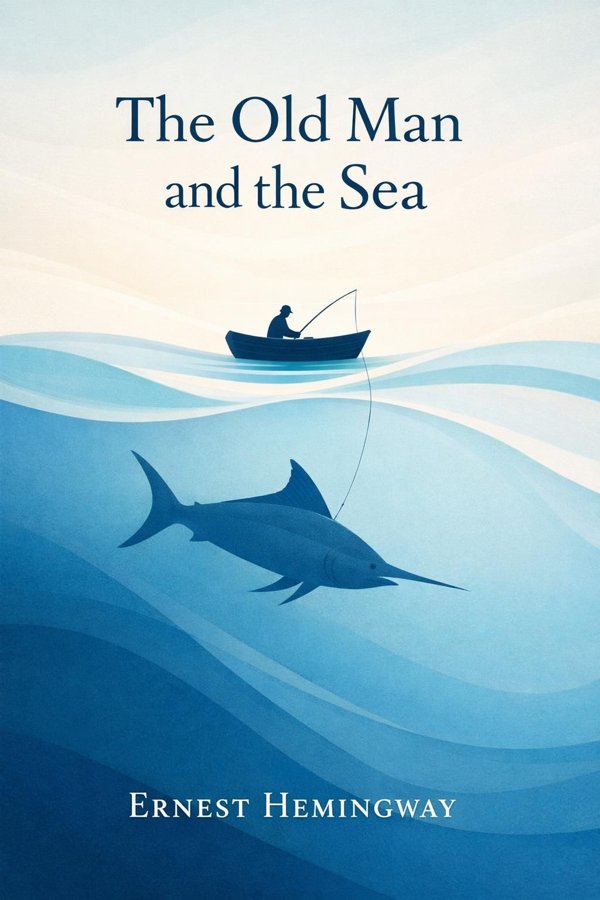
The Old Man and the Sea: Summary & Key Insights
 10 min8 chapters
Key Takeaways from The Old Man and the Sea
One of the novel’s deepest insights is that losing outwardly does not mean losing inwardly.
A meaningful life is not one without struggle, but one in which struggle is borne with purpose.
Hemingway presents Santiago not as a conqueror of nature, but as someone deeply bound to it.
Solitude is often feared because it strips away distraction, but Hemingway shows that it can also reveal a person’s truest resources.
In The Old Man and the Sea, pride is a complicated force that helps Santiago endure but also pushes him toward greater risk.
What Is The Old Man and the Sea About?
The Old Man and the Sea by Ernest Hemingway is a general book. Ernest Hemingway’s The Old Man and the Sea is a brief novel with the force of a myth. Set in a small Cuban fishing village, it follows Santiago, an old fisherman enduring a long run of bad luck, who sails far into the Gulf Stream in search of a catch that might restore both his livelihood and his pride. What unfolds is not merely an adventure at sea, but a concentrated meditation on endurance, dignity, loneliness, discipline, and the stubborn human need to keep going when the world offers no guarantees. Hemingway transforms a simple struggle between a man and a marlin into a profound reflection on what it means to face suffering without surrendering self-respect. The novel matters because it speaks to anyone who has worked hard, lost much, and still chosen to try again. Hemingway, one of the most influential writers of the twentieth century and winner of the Nobel Prize in Literature, writes with remarkable restraint, proving that emotional depth can emerge from clarity and simplicity. This is a small book that carries enormous emotional and philosophical weight.
This FizzRead summary covers all 8 key chapters of The Old Man and the Sea in approximately 10 minutes, distilling the most important ideas, arguments, and takeaways from Ernest Hemingway's work.
The Old Man and the Sea
Ernest Hemingway’s The Old Man and the Sea is a brief novel with the force of a myth. Set in a small Cuban fishing village, it follows Santiago, an old fisherman enduring a long run of bad luck, who sails far into the Gulf Stream in search of a catch that might restore both his livelihood and his pride. What unfolds is not merely an adventure at sea, but a concentrated meditation on endurance, dignity, loneliness, discipline, and the stubborn human need to keep going when the world offers no guarantees. Hemingway transforms a simple struggle between a man and a marlin into a profound reflection on what it means to face suffering without surrendering self-respect. The novel matters because it speaks to anyone who has worked hard, lost much, and still chosen to try again. Hemingway, one of the most influential writers of the twentieth century and winner of the Nobel Prize in Literature, writes with remarkable restraint, proving that emotional depth can emerge from clarity and simplicity. This is a small book that carries enormous emotional and philosophical weight.
Who Should Read The Old Man and the Sea?
This book is perfect for anyone interested in general and looking to gain actionable insights in a short read. Whether you're a student, professional, or lifelong learner, the key ideas from The Old Man and the Sea by Ernest Hemingway will help you think differently.
- ✓Readers who enjoy general and want practical takeaways
- ✓Professionals looking to apply new ideas to their work and life
- ✓Anyone who wants the core insights of The Old Man and the Sea in just 10 minutes
Want the full summary?
Get instant access to this book summary and 100K+ more with Fizz Moment.
Get Free SummaryAvailable on App Store • Free to download
Key Chapters
One of the novel’s deepest insights is that losing outwardly does not mean losing inwardly. Santiago hooks a magnificent marlin after months of failure and wages an exhausting battle to bring it in. Yet by the time he returns to shore, sharks have stripped the fish to a skeleton. On the surface, his triumph has been ruined. But Hemingway asks a harder and more important question: what if dignity depends less on outcomes than on how a person meets struggle?
Santiago refuses self-pity. He feels pain, fatigue, hunger, and disappointment, but he does not let those experiences define him as broken. His worth comes from his conduct: patience, endurance, skill, humility before nature, and refusal to quit. This makes the novel powerful for anyone whose efforts have been undermined by bad timing, competition, illness, or forces beyond their control. A business can fail after years of smart work. An athlete can train perfectly and still lose. A caregiver can do everything right and still face heartbreak. In all these cases, character is tested not by easy victories but by difficult losses.
Hemingway does not romanticize suffering. Santiago hurts, and the destruction of the marlin matters. Still, the old man proves that honor can remain intact even when results fall apart. That is why the ending feels tragic and uplifting at once: he returns with little to show materially, yet spiritually he has demonstrated greatness.
Practical application matters here. When evaluating your own efforts, do not judge yourself only by visible reward. Ask instead: Did I act with discipline? Did I stay true to my craft? Did I meet hardship with courage rather than bitterness?
Actionable takeaway: Define success by the quality of your effort and integrity, not only by the final score.
A meaningful life is not one without struggle, but one in which struggle is borne with purpose. Santiago has gone eighty-four days without catching a fish, and many around him see him as unlucky, even finished. Yet he goes back out. That repeated return is the heart of the novel. Persistence is not portrayed as blind optimism or simple stubbornness; it is a decision to continue honoring one’s calling despite repeated disappointment.
This idea resonates far beyond fishing. Writers face rejection, entrepreneurs face failed launches, students face discouraging grades, and parents face daily efforts that seem invisible. The challenge is not just enduring pain once, but continuing after discouragement has become routine. Santiago shows how persistence becomes a form of identity. He fishes because that is who he is. His commitment gives shape to his suffering and keeps despair from becoming his master.
Importantly, Hemingway distinguishes persistence from fantasy. Santiago is experienced, observant, and practical. He reads currents, watches birds, manages his lines, and relies on discipline rather than wishful thinking. Persistence is strongest when joined to preparation. Merely repeating effort without learning is wasteful; returning with skill and seriousness is transformative.
The old man’s voyage suggests that hardship often reveals hidden reserves of strength. He discovers what he can still do because he chooses not to stop. Many people underestimate themselves because they retreat too early. They never stay with the challenge long enough to discover endurance, creativity, or courage.
Actionable takeaway: When setbacks accumulate, commit to one more disciplined attempt, pairing perseverance with improved skill rather than passive hope.
Hemingway presents Santiago not as a conqueror of nature, but as someone deeply bound to it. He studies the sea, the fish, the birds, the currents, and the weather with reverence. He speaks of the marlin with admiration and even affection. This relationship is essential to understanding the book: true mastery does not come from domination alone, but from respectful attention.
Santiago’s expertise is built through observation. He knows how fish move, how lines should be set, and how subtle signs reveal hidden life below the surface. His success is not an accident; it is the fruit of long intimacy with his environment. In modern life, this idea applies to any serious craft. A chef must understand ingredients, not merely recipes. A teacher must learn students, not just lesson plans. A manager must read people and systems, not only spreadsheets. Mastery grows when we stop trying to impose ourselves blindly and begin learning the patterns of what we work with.
At the same time, the novel reminds us that respect does not remove conflict. Santiago loves the marlin, but he must kill it. Nature inspires awe, but it also demands sacrifice, skill, and acceptance of harsh realities. This tension mirrors real life: meaningful work often requires difficult choices. Respecting reality does not mean avoiding struggle; it means entering struggle without arrogance.
There is also a useful corrective here for a culture that values speed over depth. Santiago succeeds because he pays attention. He is patient enough to notice what others miss. Many failures come not from lack of talent but from careless engagement with the world.
Actionable takeaway: Build excellence by studying your field closely, respecting its realities, and replacing forceful shortcuts with patient observation.
Solitude is often feared because it strips away distraction, but Hemingway shows that it can also reveal a person’s truest resources. Once Santiago is far out at sea, he is alone with pain, memory, instinct, and will. He talks to himself, remembers the boy Manolin, thinks about baseball and Joe DiMaggio, and measures himself against the demands of the moment. In that isolation, his inner life becomes visible.
The novel does not pretend loneliness is easy. Santiago longs for companionship and repeatedly wishes the boy were with him. Human connection matters, and the tenderness between Santiago and Manolin gives the story much of its emotional warmth. Yet the old man must face the decisive struggle alone. This reflects a universal truth: however much support we receive, some battles remain deeply personal. No one else can endure our exact pain, make our hardest decisions, or summon our courage for us.
In practical terms, this idea applies to periods of illness, grief, professional uncertainty, or creative work. During such times, advice and encouragement help, but eventually a person must develop the capacity to stay present with difficulty. Solitude can sharpen self-knowledge. It exposes our habits of thinking, our fears, and our reserves of faith. It can also reveal what sustains us: memory, love, ritual, belief, and pride in one’s craft.
Santiago’s example suggests that inner dialogue matters. He does not allow silence to become emptiness; he fills it with purpose, observation, and self-command. Instead of collapsing under aloneness, he turns it into concentration.
Actionable takeaway: Use solitary moments to strengthen self-trust—replace aimless rumination with focused reflection, encouraging self-talk, and renewed commitment to your values.
Not all pride is vanity. In The Old Man and the Sea, pride is a complicated force that helps Santiago endure but also pushes him toward greater risk. He wants to prove he is still capable, still worthy, still a fisherman of rare skill. That desire gives him strength when his hands cramp and his body aches. Yet it also drives him far out to sea, beyond ordinary safety, into an ordeal that becomes nearly unbearable.
This ambiguity makes the novel psychologically rich. Pride can preserve self-respect during humiliation. Without some sense of personal worth, people give up too easily. Santiago’s pride keeps him from accepting defeat as his identity. He will not let a streak of bad luck define his whole life. In careers, relationships, and personal recovery, that kind of pride is healthy. It says: I am not done yet.
But pride also needs limits. When it becomes entangled with proving oneself at any cost, it can invite unnecessary suffering. Professionals may overwork to defend an image of competence. Leaders may refuse help to avoid seeming weak. Competitors may pursue goals so aggressively that they damage what they hoped to protect. Santiago’s journey carries a warning: strength can become self-endangerment when pride is not balanced by wisdom.
Hemingway never reduces Santiago to a simple lesson. His pride is noble, human, and costly all at once. That complexity is what makes the character believable. Most meaningful ambition contains the same tension. We need enough pride to persist, but enough humility to recognize limits.
Actionable takeaway: Let pride fuel resilience and high standards, but regularly ask whether your goals still serve your well-being rather than your ego.
Hemingway suggests that work can be more than survival; it can be a way of expressing identity, discipline, and love. Santiago is a fisherman not just economically but spiritually. He knows his trade intimately, respects its traditions, and performs it with seriousness even when no one is watching. His devotion to fishing gives his life form and meaning, especially in old age when social status and physical power may be fading.
This matters because many people reduce work to results alone: money earned, titles won, recognition received. The novel proposes a richer view. A craft shapes character through repetition, care, and standards. Santiago prepares his lines carefully, reads the sea attentively, and handles adversity with a professional’s mindset. He does not become honorable because he succeeds; he succeeds in a deeper sense because he has become honorable through practice.
In ordinary life, craft can mean writing clearly, parenting attentively, fixing machines well, cooking thoughtfully, or serving customers honestly. The external importance of the task matters less than the internal seriousness with which it is done. Devotion to craft creates self-respect because it links daily action to values. It also provides stability during uncertainty. When rewards fluctuate, the commitment to doing the work well remains.
The novel is especially resonant for people in later stages of life. Santiago may be physically diminished, but his accumulated knowledge gives him depth. Hemingway honors experience, reminding readers that mastery often ripens with age even as strength declines.
Actionable takeaway: Choose one area of your life and treat it as a craft—practice deliberately, set standards, and let consistent care become a source of meaning.
For all its emphasis on endurance, The Old Man and the Sea is not a cold novel. Its emotional center is the relationship between Santiago and the boy, Manolin. The boy admires the old man, worries about him, brings him food, helps with equipment, and remains loyal even after others view Santiago as unlucky. Their bond shows that while heroic struggle may be solitary in execution, it is sustained by love.
This tenderness broadens the novel’s message. Strength is not only the ability to bear pain; it is also the ability to care and be cared for. Santiago’s thoughts often return to the boy, and those thoughts humanize him. He is not merely a symbol of endurance but a person embedded in affection, memory, and community. The boy, in turn, learns from Santiago not through lectures but through example: devotion to work, courage under pressure, and grace amid hardship.
In practical terms, this idea matters in every demanding field. Mentors shape resilience in younger people by offering belief before success arrives. Families and friends often provide the emotional infrastructure that makes perseverance possible. During difficult seasons, simple acts—checking in, sharing a meal, carrying equipment, expressing confidence—can preserve someone’s hope.
The novel also suggests that compassion helps redeem suffering. Santiago’s struggle would feel purely bleak without the boy’s loyalty. Instead, it becomes part of an intergenerational story about respect, learning, and continuity. Human beings endure better when they know they matter to someone.
Actionable takeaway: Do not face struggle only as an individual challenge—strengthen resilience by giving and receiving practical care, encouragement, and mentorship.
Perhaps the most mature insight in the novel is that greatness does not consist of total control. Santiago is exceptionally skilled and brave, yet he cannot command the sea, prevent the sharks, or fully preserve what he has won. Hemingway’s world is one in which effort matters immensely, but outcomes remain vulnerable to fate, nature, and time. Accepting that truth is not weakness; it is wisdom.
Modern culture often encourages the illusion that with enough planning, optimization, and confidence, every goal can be secured. The Old Man and the Sea pushes back against this fantasy. Santiago does nearly everything right, and still he suffers irreversible loss. The lesson is not that effort is meaningless, but that reality is larger than individual will. Maturity lies in acting wholeheartedly while remaining humble before forces we cannot master.
This perspective can be liberating. Many people carry unnecessary shame because they treat every setback as a personal failure. The novel invites a different view: some losses occur even when courage and competence are present. The right response is not self-contempt but sober acceptance combined with continued commitment.
Accepting limits also deepens gratitude. Santiago’s reverence for the marlin and the sea comes partly from knowing they are not his to control. What is uncontrollable can still be honored. That mindset improves leadership, relationships, and personal ambition. We become steadier when we distinguish between what we can influence and what we must endure.
Actionable takeaway: Give your full effort to what is within your control, and meet what lies beyond it with humility instead of resentment.
All Chapters in The Old Man and the Sea
About the Author
Ernest Hemingway was an American writer and journalist born in 1899 who became one of the most influential literary voices of the twentieth century. Known for his spare, disciplined prose and emotionally charged understatement, he helped define modern fiction. His experiences as a war correspondent, traveler, hunter, and fisherman shaped much of his work, giving it a distinctive blend of realism, toughness, and vulnerability. Among his most famous books are The Sun Also Rises, A Farewell to Arms, For Whom the Bell Tolls, and The Old Man and the Sea. The latter earned him the Pulitzer Prize in 1953, and he received the Nobel Prize in Literature in 1954. Hemingway’s writing continues to be admired for its clarity, psychological depth, and enduring exploration of courage, loss, and human endurance.
Get This Summary in Your Preferred Format
Read or listen to the The Old Man and the Sea summary by Ernest Hemingway anytime, anywhere. FizzRead offers multiple formats so you can learn on your terms — all free.
Available formats: App · Audio · PDF · EPUB — All included free with FizzRead
Download The Old Man and the Sea PDF and EPUB Summary
Key Quotes from The Old Man and the Sea
“One of the novel’s deepest insights is that losing outwardly does not mean losing inwardly.”
“A meaningful life is not one without struggle, but one in which struggle is borne with purpose.”
“Hemingway presents Santiago not as a conqueror of nature, but as someone deeply bound to it.”
“Solitude is often feared because it strips away distraction, but Hemingway shows that it can also reveal a person’s truest resources.”
“In The Old Man and the Sea, pride is a complicated force that helps Santiago endure but also pushes him toward greater risk.”
Frequently Asked Questions about The Old Man and the Sea
The Old Man and the Sea by Ernest Hemingway is a general book that explores key ideas across 8 chapters. Ernest Hemingway’s The Old Man and the Sea is a brief novel with the force of a myth. Set in a small Cuban fishing village, it follows Santiago, an old fisherman enduring a long run of bad luck, who sails far into the Gulf Stream in search of a catch that might restore both his livelihood and his pride. What unfolds is not merely an adventure at sea, but a concentrated meditation on endurance, dignity, loneliness, discipline, and the stubborn human need to keep going when the world offers no guarantees. Hemingway transforms a simple struggle between a man and a marlin into a profound reflection on what it means to face suffering without surrendering self-respect. The novel matters because it speaks to anyone who has worked hard, lost much, and still chosen to try again. Hemingway, one of the most influential writers of the twentieth century and winner of the Nobel Prize in Literature, writes with remarkable restraint, proving that emotional depth can emerge from clarity and simplicity. This is a small book that carries enormous emotional and philosophical weight.
More by Ernest Hemingway



You Might Also Like
Duct Tape Marketing: The World's Most Practical Small Business Marketing Guide
John Jantsch
10 minDusk, Night, Dawn: On Revival and Courage
Anne Lamott
10 minFinish Big: How Great Entrepreneurs Exit Their Companies on Top
Bo Burlingham
10 minFirst As Tragedy, Then As Farce
Slavoj Zizek
10 minFirst Principles: What America's Founders Learned from the Greeks and Romans and How That Shaped Our Country
Thomas E. Ricks
10 minGood Habits, Bad Habits: The Science of Making Positive Changes That Stick
Wendy Wood
10 minBrowse by Category
Ready to read The Old Man and the Sea?
Get the full summary and 100K+ more books with Fizz Moment.