
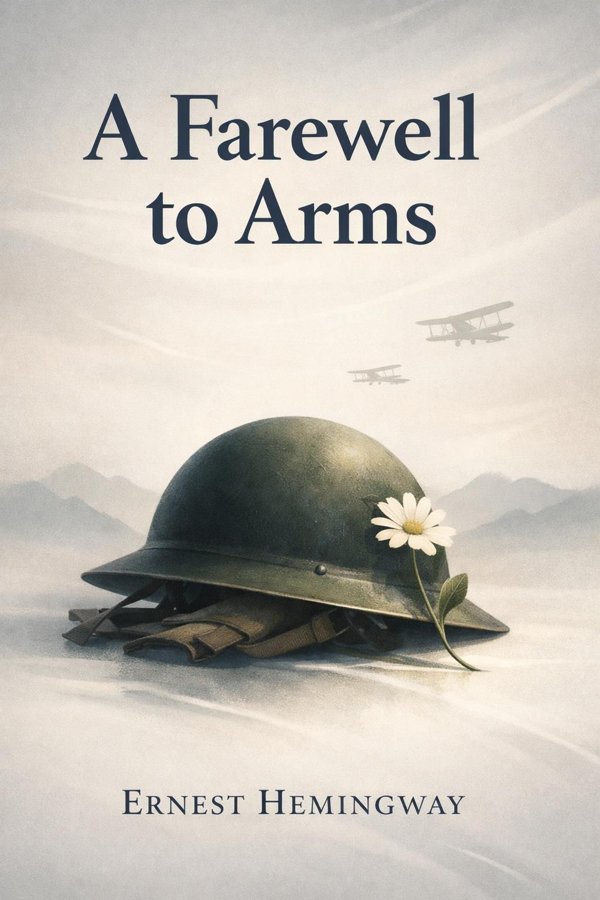
A Farewell to Arms: Summary & Key Insights
 10 min4 chaptersAudio available
What Is A Farewell to Arms About?
A Farewell to Arms by Ernest Hemingway is a classics book spanning 4 pages. A Farewell to Arms is a novel set during World War I, telling the story of an American ambulance driver in the Italian army and his love affair with a British nurse. The book explores themes of love, war, loss, and the search for meaning amid chaos.
This FizzRead summary covers all 4 key chapters of A Farewell to Arms in approximately 10 minutes, distilling the most important ideas, arguments, and takeaways from Ernest Hemingway's work. Also available as an audio summary and Key Quotes Podcast.
A Farewell to Arms
A Farewell to Arms is a novel set during World War I, telling the story of an American ambulance driver in the Italian army and his love affair with a British nurse. The book explores themes of love, war, loss, and the search for meaning amid chaos.
Who Should Read A Farewell to Arms?
This book is perfect for anyone interested in classics and looking to gain actionable insights in a short read. Whether you're a student, professional, or lifelong learner, the key ideas from A Farewell to Arms by Ernest Hemingway will help you think differently.
- ✓Readers who enjoy classics and want practical takeaways
- ✓Professionals looking to apply new ideas to their work and life
- ✓Anyone who wants the core insights of A Farewell to Arms in just 10 minutes
Want the full summary?
Get instant access to this book summary and 100K+ more with Fizz Moment.
Get Free SummaryAvailable on App Store • Free to download
Key Chapters
I placed Lieutenant Frederic Henry in the trenches of the Italian front because that was where life and meaning were most at odds. He is an American serving as an ambulance driver in a foreign army, a man who has volunteered but holds no illusions about patriotism. He moves through a world of mud, fatigue, and arbitrary destruction. Through his eyes, you can see what I saw then: the machinery of war grinding men into silence.
Frederic’s interactions with his fellow soldiers — the cynical drivers, the weary officers, the priest whose faith seems a quiet defiance — define the tone of the story’s opening. There is drinking, talk of girls, and the constant waiting for bombardment, but underneath is the numbness that comes when men have seen too much. I use short exchanges to show how communication itself breaks down under sustained fear. War is not dramatic here; it’s monotonous, mechanically cruel.
Even in these early pages, Frederic is observing, detached. He does what is required, arranging vehicles, tending to the wounded, but without conviction. This is my way of showing what modern war did to identity — how duty becomes habit, and habit replaces belief. The landscape mirrors this emptiness: rain falling endlessly, towns collapsing in shellfire, villages emptied overnight. In that rain, Frederic stands as a figure whose soul is slowly eroded.
His conversations with the priest reveal the first hints of his inner conflict. The priest speaks of love and faith, of the peace found in the countryside, while Frederic listens but cannot respond with more than polite indifference. He is too far from faith, too far from stillness. He will later turn to love as a substitute for belief, but at this stage, both seem out of reach.
The front itself becomes a metaphor — a line that divides not only armies but ways of feeling. There is a thin barrier between the living and the dead, between those in uniform and those who have ceased to exist. Frederic, like many of us who saw the war firsthand, is drifting along that line, unsure on which side he truly belongs.
When Frederic meets Catherine Barkley, I wanted the reader to feel the collision of two wounded souls. Catherine is a British nurse who has lost her fiancé in battle, and her grief has stripped her of the soothing illusions of romance. Frederic, seeing her for the first time, approaches love almost as another campaign — flirtation as shelter, affection as distraction. Their first meetings are tense, full of play that borders on pain. There’s tenderness in Catherine’s insistence on honesty and irony in Frederic’s attempt to charm her when both know they are trying to escape something larger than themselves.
Catherine’s story is one of courage disguised as fragility. She appears docile, gentle, yet each word she speaks pulses with control. She tells Frederic she is afraid, but what she really means is that she has understood the futility of fear. In the trenches of emotion, she fights by surrendering: she gives herself to love entirely because everything else has already been taken from her.
Their first true connection comes when Frederic is wounded. The mortar explosion that sends him to the hospital in Milan is both an injury and a transformation. Removed from the front, stripped of his uniformed role, Frederic begins to see beyond the mechanical motions of the military. In the hospital, Catherine’s care becomes the only world he knows. What begins as flirtation becomes intimacy, and intimacy becomes an escape from everything outside the hospital walls.
Those Milan days are where love, for both of them, turns into its own exile. I wrote their scenes with restraint — small gestures, everyday words, the quiet rhythm of two people discovering tenderness in the midst of devastation. They talk of ordinary things, make jokes, share nights that feel short-lived but infinite. In a war-torn world, they create a temporary peace. Yet the shadow of impermanence is always there; even tenderness cannot outlast history.
Frederic’s love for Catherine reveals his first act of rebellion against the war: he prioritizes a human connection over the system of orders. For Catherine, this is not rebellion but truth. She tells him that their love is all she believes in now. It’s here that I wanted to show the human capacity to rebuild meaning through affection — not as consolation, but as resistance.
+ 2 more chapters — available in the FizzRead app
All Chapters in A Farewell to Arms
About the Author
Ernest Hemingway (1899–1961) was an American novelist, short-story writer, and journalist. Known for his economical and understated style, he was one of the most influential writers of the 20th century and won the Nobel Prize in Literature in 1954.
Get This Summary in Your Preferred Format
Read or listen to the A Farewell to Arms summary by Ernest Hemingway anytime, anywhere. FizzRead offers multiple formats so you can learn on your terms — all free.
Available formats: App · Audio · PDF · EPUB — All included free with FizzRead
Download A Farewell to Arms PDF and EPUB Summary
Key Quotes from A Farewell to Arms
“I placed Lieutenant Frederic Henry in the trenches of the Italian front because that was where life and meaning were most at odds.”
“When Frederic meets Catherine Barkley, I wanted the reader to feel the collision of two wounded souls.”
Frequently Asked Questions about A Farewell to Arms
A Farewell to Arms by Ernest Hemingway is a classics book that explores key ideas across 4 chapters. A Farewell to Arms is a novel set during World War I, telling the story of an American ambulance driver in the Italian army and his love affair with a British nurse. The book explores themes of love, war, loss, and the search for meaning amid chaos.
More by Ernest Hemingway

You Might Also Like





Featured In
Browse by Category
Ready to read A Farewell to Arms?
Get the full summary and 100K+ more books with Fizz Moment.