
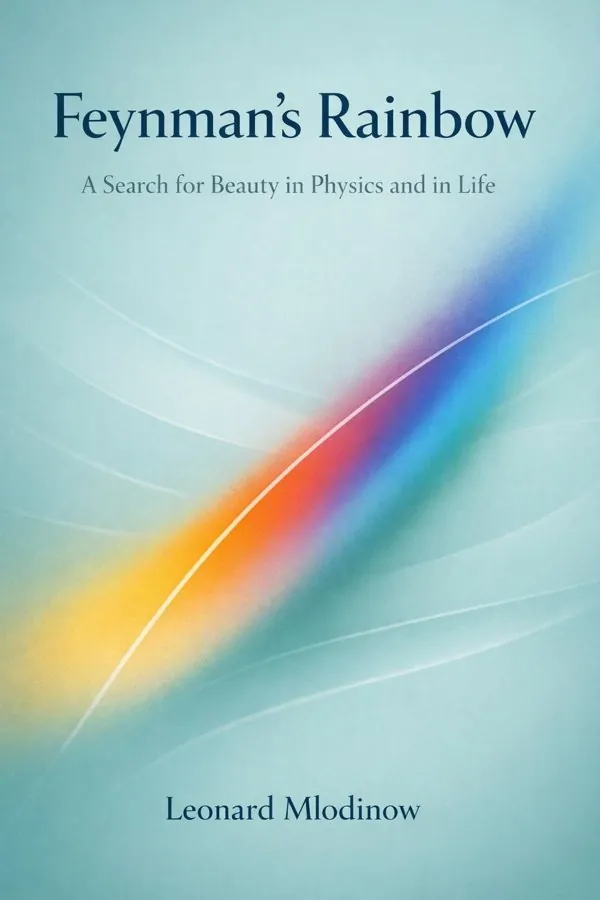
Feynman's Rainbow: A Search for Beauty in Physics and in Life: Summary & Key Insights
 10 min4 chaptersAudio available
What Is Feynman's Rainbow: A Search for Beauty in Physics and in Life About?
Feynman's Rainbow: A Search for Beauty in Physics and in Life by Leonard Mlodinow is a biographies book spanning 4 pages. In this memoir, physicist Leonard Mlodinow recounts his time at Caltech in the early 1980s, when he was mentored by the legendary Richard Feynman. Through their conversations, Mlodinow explores the nature of creativity, scientific discovery, and the search for meaning in both physics and life. The book blends personal reflection with insights into Feynman’s unique approach to science and living.
This FizzRead summary covers all 4 key chapters of Feynman's Rainbow: A Search for Beauty in Physics and in Life in approximately 10 minutes, distilling the most important ideas, arguments, and takeaways from Leonard Mlodinow's work. Also available as an audio summary and Key Quotes Podcast.
Feynman's Rainbow: A Search for Beauty in Physics and in Life
In this memoir, physicist Leonard Mlodinow recounts his time at Caltech in the early 1980s, when he was mentored by the legendary Richard Feynman. Through their conversations, Mlodinow explores the nature of creativity, scientific discovery, and the search for meaning in both physics and life. The book blends personal reflection with insights into Feynman’s unique approach to science and living.
Who Should Read Feynman's Rainbow: A Search for Beauty in Physics and in Life?
This book is perfect for anyone interested in biographies and looking to gain actionable insights in a short read. Whether you're a student, professional, or lifelong learner, the key ideas from Feynman's Rainbow: A Search for Beauty in Physics and in Life by Leonard Mlodinow will help you think differently.
- ✓Readers who enjoy biographies and want practical takeaways
- ✓Professionals looking to apply new ideas to their work and life
- ✓Anyone who wants the core insights of Feynman's Rainbow: A Search for Beauty in Physics and in Life in just 10 minutes
Want the full summary?
Get instant access to this book summary and 100K+ more with Fizz Moment.
Get Free SummaryAvailable on App Store • Free to download
Key Chapters
When I first joined Caltech as a postdoctoral physicist, I entered a world that thrummed with a rare kind of intensity. It wasn’t only the brilliance of the professors or the complexity of the theories—it was the culture of relentless questioning. Ideas were not protected here; they were thrown into the open, tested, and often dismantled. Yet amidst this intellectual firestorm, I felt small. My colleagues seemed effortlessly confident, their minds attuned to the mysteries of quantum mechanics as if it were their native language. I wondered whether I had what it took.
Then came Feynman. Everyone at Caltech revered him, but meeting him was unlike meeting any other scientist. He was direct, playful, unguarded. When I nervously introduced myself, he deflected the formality with a grin. He wanted to know what I was thinking about, not what I had accomplished. The first thing Feynman taught me was that curiosity mattered more than status. To him, physics wasn’t a competition—it was an adventure.
Working in the same department allowed me to observe his interactions closely. Feynman didn’t simply lecture; he performed, and in doing so, reminded us that the beauty of physics lay not in the symbols, but in the questions behind them. He would strip a concept to its core, then rebuild it with a clarity that made you feel the universe had just revealed something personal. I began to see that his genius rested not only on intellect, but on attitude—his refusal to be intimidated by mystery.
In those early weeks, Caltech felt like both a crucible and a home. I was surrounded by people probing the fundamental nature of space-time. Yet Feynman showed me that science, like life, is not a quest for certainty. It’s the art of embracing uncertainty without fear. His example began to soften my self-doubt. Slowly, I started to trust that confusion was not failure—it was the beginning of discovery.
The more I spoke with Feynman, the more I realized how differently he approached creativity. To him, solving a problem was never just about logic. It was about seeing the world fresh, as if no one had ever described it before. He told me once that every problem worth solving starts with curiosity, not ambition. That struck me deeply. As a young scientist, I had been measuring my success by results—papers, citations, recognition. Feynman measured by wonder.
One afternoon, as we sat outside under the California sun, he explained how the best physics often comes from play. He compared it to a child turning over rocks just to see what’s underneath. That metaphor encapsulated his view of life itself. You don’t chase discoveries; you stumble upon them when you’re open. This insight transformed how I approached my own research. I stopped seeking validation and started seeking clarity. Discoveries came not when I forced them, but when I allowed myself to explore freely.
Feynman encouraged me to ignore the noise of academia—the obsession with prestige—and instead follow what truly fascinated me. He told stories of his own early days, tales of tinkering and mischief, of staying up late to figure out how ants found their way home. To him, science was not a career but a calling. And he urged me, gently but persistently, to rediscover why I had once loved it.
Through our conversations, I learned that creativity in physics comes from accepting that the universe doesn’t owe us answers in a neat form. It reveals itself through patterns and play, through failed experiments and flashes of intuition. Feynman’s joy in revelation, no matter how small, reminded me that the act of discovery itself is its own reward. That lesson extended beyond the lab. I began to live with more spontaneity—to let myself wonder, to risk being wrong. In doing so, I felt more alive than I ever had before.
+ 2 more chapters — available in the FizzRead app
All Chapters in Feynman's Rainbow: A Search for Beauty in Physics and in Life
About the Author
Leonard Mlodinow is an American physicist and author known for his popular science books that make complex scientific ideas accessible to general readers. He has taught at Caltech and written several bestsellers, including 'The Drunkard’s Walk' and 'Subliminal'.
Get This Summary in Your Preferred Format
Read or listen to the Feynman's Rainbow: A Search for Beauty in Physics and in Life summary by Leonard Mlodinow anytime, anywhere. FizzRead offers multiple formats so you can learn on your terms — all free.
Available formats: App · Audio · PDF · EPUB — All included free with FizzRead
Download Feynman's Rainbow: A Search for Beauty in Physics and in Life PDF and EPUB Summary
Key Quotes from Feynman's Rainbow: A Search for Beauty in Physics and in Life
“When I first joined Caltech as a postdoctoral physicist, I entered a world that thrummed with a rare kind of intensity.”
“The more I spoke with Feynman, the more I realized how differently he approached creativity.”
Frequently Asked Questions about Feynman's Rainbow: A Search for Beauty in Physics and in Life
Feynman's Rainbow: A Search for Beauty in Physics and in Life by Leonard Mlodinow is a biographies book that explores key ideas across 4 chapters. In this memoir, physicist Leonard Mlodinow recounts his time at Caltech in the early 1980s, when he was mentored by the legendary Richard Feynman. Through their conversations, Mlodinow explores the nature of creativity, scientific discovery, and the search for meaning in both physics and life. The book blends personal reflection with insights into Feynman’s unique approach to science and living.
More by Leonard Mlodinow

The Drunkard’s Walk: How Randomness Rules Our Lives
Leonard Mlodinow
10 min
The Grand Design
Stephen Hawking, Leonard Mlodinow
10 min
Emotional: The New Thinking About Feelings
Leonard Mlodinow
10 min
The Upright Thinkers: The Human Journey from Living in Trees to Understanding the Cosmos
Leonard Mlodinow
10 minYou Might Also Like

An American Marriage
Tayari Jones
10 min
Benjamin Franklin: An American Life
Walter Isaacson
10 min
I Know Why The Caged Bird Sings
Maya Angelou
10 min
Long Walk to Freedom
Nelson Mandela
10 min
Persepolis
Marjane Satrapi
10 min
Surely You're Joking, Mr. Feynman!
Richard P. Feynman
10 minBrowse by Category
Ready to read Feynman's Rainbow: A Search for Beauty in Physics and in Life?
Get the full summary and 100K+ more books with Fizz Moment.