
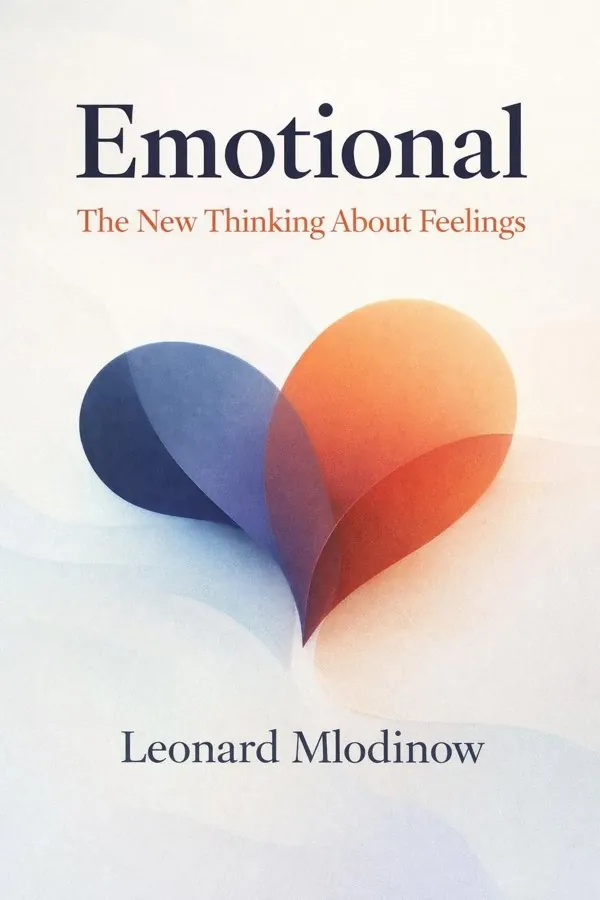
Emotional: The New Thinking About Feelings: Summary & Key Insights
 10 min11 chaptersAudio available
What Is Emotional: The New Thinking About Feelings About?
Emotional: The New Thinking About Feelings by Leonard Mlodinow is a popular_sci book spanning 11 pages. In 'Emotional: The New Thinking About Feelings', Leonard Mlodinow explores the science of emotion and its essential role in human thought, decision-making, and creativity. Drawing on neuroscience and psychology, he argues that emotions are not obstacles to rationality but vital components of intelligence and human connection.
This FizzRead summary covers all 11 key chapters of Emotional: The New Thinking About Feelings in approximately 10 minutes, distilling the most important ideas, arguments, and takeaways from Leonard Mlodinow's work. Also available as an audio summary and Key Quotes Podcast.
Emotional: The New Thinking About Feelings
In 'Emotional: The New Thinking About Feelings', Leonard Mlodinow explores the science of emotion and its essential role in human thought, decision-making, and creativity. Drawing on neuroscience and psychology, he argues that emotions are not obstacles to rationality but vital components of intelligence and human connection.
Who Should Read Emotional: The New Thinking About Feelings?
This book is perfect for anyone interested in popular_sci and looking to gain actionable insights in a short read. Whether you're a student, professional, or lifelong learner, the key ideas from Emotional: The New Thinking About Feelings by Leonard Mlodinow will help you think differently.
- ✓Readers who enjoy popular_sci and want practical takeaways
- ✓Professionals looking to apply new ideas to their work and life
- ✓Anyone who wants the core insights of Emotional: The New Thinking About Feelings in just 10 minutes
Want the full summary?
Get instant access to this book summary and 100K+ more with Fizz Moment.
Get Free SummaryAvailable on App Store • Free to download
Key Chapters
To grasp how revolutionary our modern understanding of emotion truly is, we must look back to where it all began. For much of history, emotion was seen through a lens of suspicion. Plato warned of passions that distort reason, his allegory likening the mind to a charioteer struggling to reign in unruly horses. Later, Descartes divided thought into pure intellect and mechanical appetites, further deepening the dualism. Emotion was portrayed as bodily and irrational, intellect as immaterial and pure. This moral framing lingered in Enlightenment philosophy, shaping our cultural ideal of the 'rational man.'
But over centuries, cracks began to form in that rigid hierarchy. Darwin, in his 19th-century work on the expression of emotions, proposed that feelings were not imperfections but evolved adaptations—signals embedded in our species’ survival mechanisms. Freud, though controversial, added a dimension of unconscious complexity, showing that emotional drives often shape thought beneath the surface. The rise of psychology and neuroscience in the 20th century finally began to map what these philosophers only intuited: emotions and cognition emerge from integrated brain systems, inseparable and mutually dependent.
As I explored these threads, one realization kept recurring. The historical split between emotion and reason was less about science than about cultural discomfort. Rationality was associated with control, emotion with vulnerability. To admit the value of emotion seemed to concede weakness. But as neuroscience matured, we could finally measure what earlier thinkers could only imagine. Today, we understand that emotions help us attend selectively to the world, prioritize information, and act. They are not interruptions—they are guides.
Emotions begin deep in the brain, in regions we share with other animals. The limbic system—home to structures such as the amygdala, hypothalamus, and hippocampus—plays a central role. When stimuli enter our minds, these circuits assess their significance long before conscious thought arises. The amygdala, for instance, can trigger fear responses even before we recognize danger consciously. Yet the story doesn’t stop there. The prefrontal cortex, a more recently evolved structure, interacts dynamically with the limbic system to modulate emotion—interpreting, reframing, and integrating feelings into reason.
What’s fascinating is that this interplay operates continuously. Emotion feeds cognition, and cognition refines emotion. Brain imaging shows that during decision-making, emotional centers light up even when subjects believe they are 'thinking logically.' Feelings inject value into information—they tell the brain what matters. Without them, reasoning loses its compass.
I was struck by experiments with individuals who suffered damage to the prefrontal cortex, such as Antonio Damasio’s famous patient 'Elliot.' He could reason abstractly but was paralyzed in making choices; devoid of emotional input, he could not weigh significance. His story epitomizes the central thesis of this book: emotion is not the opposite of reason, it is a form of reason encoded in chemistry.
Through these findings, neuroscience teaches us that consciousness itself depends on emotion’s architecture. The limbic system sets the tone that gives experience its texture, shaping the color of our world. When we grasp that truth, we begin to see emotion and intelligence as two faces of the same mind.
+ 9 more chapters — available in the FizzRead app
All Chapters in Emotional: The New Thinking About Feelings
About the Author
Leonard Mlodinow is an American physicist and author known for his works on popular science and mathematics. He has co-authored books with Stephen Hawking and written several bestsellers that make complex scientific ideas accessible to general readers.
Get This Summary in Your Preferred Format
Read or listen to the Emotional: The New Thinking About Feelings summary by Leonard Mlodinow anytime, anywhere. FizzRead offers multiple formats so you can learn on your terms — all free.
Available formats: App · Audio · PDF · EPUB — All included free with FizzRead
Download Emotional: The New Thinking About Feelings PDF and EPUB Summary
Key Quotes from Emotional: The New Thinking About Feelings
“To grasp how revolutionary our modern understanding of emotion truly is, we must look back to where it all began.”
“Emotions begin deep in the brain, in regions we share with other animals.”
Frequently Asked Questions about Emotional: The New Thinking About Feelings
Emotional: The New Thinking About Feelings by Leonard Mlodinow is a popular_sci book that explores key ideas across 11 chapters. In 'Emotional: The New Thinking About Feelings', Leonard Mlodinow explores the science of emotion and its essential role in human thought, decision-making, and creativity. Drawing on neuroscience and psychology, he argues that emotions are not obstacles to rationality but vital components of intelligence and human connection.
More by Leonard Mlodinow

The Drunkard’s Walk: How Randomness Rules Our Lives
Leonard Mlodinow
10 min
The Grand Design
Stephen Hawking, Leonard Mlodinow
10 min
The Upright Thinkers: The Human Journey from Living in Trees to Understanding the Cosmos
Leonard Mlodinow
10 min
Feynman's Rainbow: A Search for Beauty in Physics and in Life
Leonard Mlodinow
10 minYou Might Also Like
Structures: Or Why Things Don"t Fall Down
J.E. Gordon
10 min
The Road to Wigan Pier
George Orwell
10 min
Bonk: The Curious Coupling of Science and Sex
Mary Roach
10 min
First Bite: How We Learn to Eat
Bee Wilson
10 min
In Pursuit Of The Unknown: 17 Equations That Changed The World
Ian Stewart
10 min
Napoleon's Buttons: 17 Molecules That Changed History
Penny Le Couteur and Jay Burreson
10 minBrowse by Category
Ready to read Emotional: The New Thinking About Feelings?
Get the full summary and 100K+ more books with Fizz Moment.