
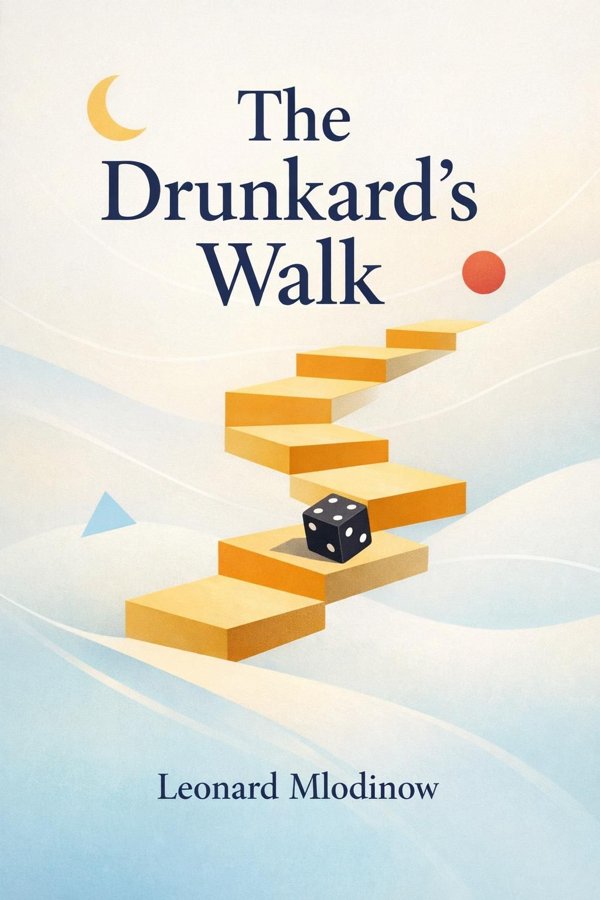
The Drunkard’s Walk: How Randomness Rules Our Lives: Summary & Key Insights
 10 min7 chaptersAudio available
What Is The Drunkard’s Walk: How Randomness Rules Our Lives About?
The Drunkard’s Walk: How Randomness Rules Our Lives by Leonard Mlodinow is a popular_sci book spanning 7 pages. In this engaging exploration of chance and probability, Leonard Mlodinow reveals how randomness influences our daily lives, decisions, and perceptions of success. Drawing from mathematics, psychology, and history, he demonstrates how humans often misinterpret random events, leading to flawed judgments about luck, skill, and causality. The book encourages readers to embrace uncertainty and understand the hidden role of chance in shaping outcomes.
This FizzRead summary covers all 7 key chapters of The Drunkard’s Walk: How Randomness Rules Our Lives in approximately 10 minutes, distilling the most important ideas, arguments, and takeaways from Leonard Mlodinow's work. Also available as an audio summary and Key Quotes Podcast.
The Drunkard’s Walk: How Randomness Rules Our Lives
In this engaging exploration of chance and probability, Leonard Mlodinow reveals how randomness influences our daily lives, decisions, and perceptions of success. Drawing from mathematics, psychology, and history, he demonstrates how humans often misinterpret random events, leading to flawed judgments about luck, skill, and causality. The book encourages readers to embrace uncertainty and understand the hidden role of chance in shaping outcomes.
Who Should Read The Drunkard’s Walk: How Randomness Rules Our Lives?
This book is perfect for anyone interested in popular_sci and looking to gain actionable insights in a short read. Whether you're a student, professional, or lifelong learner, the key ideas from The Drunkard’s Walk: How Randomness Rules Our Lives by Leonard Mlodinow will help you think differently.
- ✓Readers who enjoy popular_sci and want practical takeaways
- ✓Professionals looking to apply new ideas to their work and life
- ✓Anyone who wants the core insights of The Drunkard’s Walk: How Randomness Rules Our Lives in just 10 minutes
Want the full summary?
Get instant access to this book summary and 100K+ more with Fizz Moment.
Get Free SummaryAvailable on App Store • Free to download
Key Chapters
To understand how randomness fits into the structure of our lives, we first have to step back into history—to a time before probability had words. In ancient societies, fate was the domain of gods, divination, and rituals. Gamblers might roll dice or bones, but few saw these as tools of calculation. It wasn’t until the Renaissance, with thinkers like Gerolamo Cardano, that chance began to be treated as a subject for human understanding. Cardano, a physician and gambler, sought to uncover the hidden order in games of dice, laying the intellectual groundwork for the mathematics of probability. His reflections revealed a radical idea: uncertainty could be measured and expressed in numbers. A century later, Blaise Pascal and Pierre de Fermat carried Cardano’s ideas further through an exchange of letters about gambling problems. From those conversations emerged the foundations of modern probability theory—a language that let people quantify uncertainty and predict outcomes over large numbers of trials. This shift was revolutionary. It did more than change mathematics; it reshaped how we think about fairness, risk, and justice. No longer was randomness a force beyond comprehension—it became a phenomenon that, while still unpredictable in the short term, showed order in the long run. This realization would ripple outward, from insurance and finance to science and public policy. Yet as powerful as probability theory became, it did not align easily with how the human mind perceives chance. We are pattern-seeking creatures, equipped by evolution to find meaning in noise, and that instinct—useful in the wild—misleads us in a world governed by probability.
One of the most profound discoveries in the history of probability is the law of large numbers. It tells us that while single events may be unpredictable, the average outcomes across many events follow stable, predictable patterns. Toss a coin once, and anything can happen. Toss it a thousand times, and the results will hover very near fifty-fifty. This principle explains why casinos turn consistent profits despite the random roll of dice, and why insurance companies can price policies accurately despite ignorance of any one person’s fate. Yet this same law helps us confront a humbling truth: what seems meaningful in small samples often isn’t. We are quick to assign significance to streaks—to the manager who wins three championships or the stock that doubles in a month—but over time, much of this apparent pattern dissolves. The law of large numbers restores perspective, showing us that luck and skill can only be disentangled statistically, not anecdotally. In life, as in physics, the universe has noise built into it. Understanding this law allows us to make wiser judgments and to temper the emotional swings that come with randomness. When I apply it to human experiences—career success, economic cycles, even personal relationships—I see how many of our triumphs and failures could have turned out differently by chance alone.
+ 5 more chapters — available in the FizzRead app
All Chapters in The Drunkard’s Walk: How Randomness Rules Our Lives
About the Author
Leonard Mlodinow is an American physicist, mathematician, and author known for his works on popular science and the philosophy of randomness. He has taught at Caltech and collaborated with Stephen Hawking on several books. Mlodinow’s writing bridges complex scientific ideas and everyday experience, making abstract concepts accessible to general readers.
Get This Summary in Your Preferred Format
Read or listen to the The Drunkard’s Walk: How Randomness Rules Our Lives summary by Leonard Mlodinow anytime, anywhere. FizzRead offers multiple formats so you can learn on your terms — all free.
Available formats: App · Audio · PDF · EPUB — All included free with FizzRead
Download The Drunkard’s Walk: How Randomness Rules Our Lives PDF and EPUB Summary
Key Quotes from The Drunkard’s Walk: How Randomness Rules Our Lives
“To understand how randomness fits into the structure of our lives, we first have to step back into history—to a time before probability had words.”
“One of the most profound discoveries in the history of probability is the law of large numbers.”
Frequently Asked Questions about The Drunkard’s Walk: How Randomness Rules Our Lives
The Drunkard’s Walk: How Randomness Rules Our Lives by Leonard Mlodinow is a popular_sci book that explores key ideas across 7 chapters. In this engaging exploration of chance and probability, Leonard Mlodinow reveals how randomness influences our daily lives, decisions, and perceptions of success. Drawing from mathematics, psychology, and history, he demonstrates how humans often misinterpret random events, leading to flawed judgments about luck, skill, and causality. The book encourages readers to embrace uncertainty and understand the hidden role of chance in shaping outcomes.
More by Leonard Mlodinow
The Grand Design
Stephen Hawking, Leonard Mlodinow
10 min
Emotional: The New Thinking About Feelings
Leonard Mlodinow
10 min
The Upright Thinkers: The Human Journey from Living in Trees to Understanding the Cosmos
Leonard Mlodinow
10 min
Feynman's Rainbow: A Search for Beauty in Physics and in Life
Leonard Mlodinow
10 minYou Might Also Like

Structures: Or Why Things Don"t Fall Down
J.E. Gordon
10 min
The Road to Wigan Pier
George Orwell
10 min
Bonk: The Curious Coupling of Science and Sex
Mary Roach
10 min
First Bite: How We Learn to Eat
Bee Wilson
10 min
In Pursuit Of The Unknown: 17 Equations That Changed The World
Ian Stewart
10 min
Napoleon's Buttons: 17 Molecules That Changed History
Penny Le Couteur and Jay Burreson
10 minBrowse by Category
Ready to read The Drunkard’s Walk: How Randomness Rules Our Lives?
Get the full summary and 100K+ more books with Fizz Moment.