
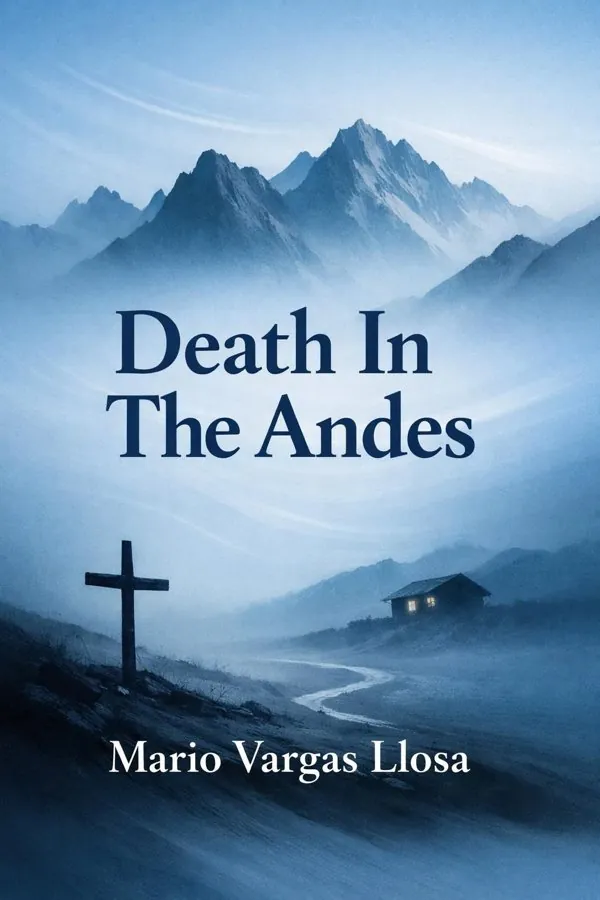
Death In The Andes: A Novel: Summary & Key Insights
 10 min9 chaptersAudio available
Key Takeaways from Death In The Andes: A Novel
A mystery becomes more unsettling when the place itself resists explanation.
People rarely choose between rationality and superstition in calm conditions; they reach for whatever helps them survive.
In a novel crowded with disappearances and dread, the love story between Tomás and Mercedes offers an unexpected counterweight: tenderness as a form of resistance.
The most frightening mysteries are those that cannot be cleanly resolved.
Some crimes do not end when the investigation stops; they continue inside those who survive them.
What Is Death In The Andes: A Novel About?
Death In The Andes: A Novel by Mario Vargas Llosa is a bestsellers book spanning 5 pages. In Mario Vargas Llosa’s Death In The Andes, a simple investigation opens into a profound portrait of fear, violence, and cultural fracture. The novel begins with the disappearance of three men in Naccos, a bleak settlement high in the Peruvian Andes, where Corporal Lituma and his deputy Tomás are tasked with uncovering the truth. But this is no ordinary mystery. As Lituma questions laborers, peasants, and drifters, he encounters a world shaped as much by myth and ritual as by guerrilla terror and state neglect. What looks like a detective story gradually becomes a meditation on how societies unravel when institutions collapse and ancient fears return. The novel matters because it captures Peru at a moment of deep crisis while also asking universal questions: What happens when reason loses its authority? How do communities survive under constant threat? And why does violence so often revive old beliefs instead of destroying them? Vargas Llosa, one of Latin America’s most celebrated novelists and the 2010 Nobel Prize winner in Literature, brings unmatched political insight, narrative power, and psychological depth to this haunting exploration of the Andes and the human condition.
This FizzRead summary covers all 9 key chapters of Death In The Andes: A Novel in approximately 10 minutes, distilling the most important ideas, arguments, and takeaways from Mario Vargas Llosa's work. Also available as an audio summary and Key Quotes Podcast.
Death In The Andes: A Novel
In Mario Vargas Llosa’s Death In The Andes, a simple investigation opens into a profound portrait of fear, violence, and cultural fracture. The novel begins with the disappearance of three men in Naccos, a bleak settlement high in the Peruvian Andes, where Corporal Lituma and his deputy Tomás are tasked with uncovering the truth. But this is no ordinary mystery. As Lituma questions laborers, peasants, and drifters, he encounters a world shaped as much by myth and ritual as by guerrilla terror and state neglect. What looks like a detective story gradually becomes a meditation on how societies unravel when institutions collapse and ancient fears return. The novel matters because it captures Peru at a moment of deep crisis while also asking universal questions: What happens when reason loses its authority? How do communities survive under constant threat? And why does violence so often revive old beliefs instead of destroying them? Vargas Llosa, one of Latin America’s most celebrated novelists and the 2010 Nobel Prize winner in Literature, brings unmatched political insight, narrative power, and psychological depth to this haunting exploration of the Andes and the human condition.
Who Should Read Death In The Andes: A Novel?
This book is perfect for anyone interested in bestsellers and looking to gain actionable insights in a short read. Whether you're a student, professional, or lifelong learner, the key ideas from Death In The Andes: A Novel by Mario Vargas Llosa will help you think differently.
- ✓Readers who enjoy bestsellers and want practical takeaways
- ✓Professionals looking to apply new ideas to their work and life
- ✓Anyone who wants the core insights of Death In The Andes: A Novel in just 10 minutes
Want the full summary?
Get instant access to this book summary and 100K+ more with Fizz Moment.
Get Free SummaryAvailable on App Store • Free to download
Key Chapters
A mystery becomes more unsettling when the place itself resists explanation. That is the force of Lituma’s arrival in Naccos, where the disappearance of three men is not treated as an urgent crime but as one more disturbance in a landscape already saturated with dread. Lituma, a coastal policeman who has appeared in several Vargas Llosa works, enters the Andes as both investigator and outsider. He carries the habits of official reason: ask questions, gather testimony, reconstruct events. Yet from the beginning, the environment undermines that logic. The roads are precarious, communication is weak, people speak evasively, and fear has become a reflex.
The setting matters as much as the plot. Naccos is not merely remote; it is socially abandoned. Workers build roads that symbolize national progress, but the state’s presence is fragile and inconsistent. This gap between modernization and neglect creates the vacuum in which rumor, terror, and silence flourish. Lituma’s task is therefore larger than solving a disappearance. He must navigate a society where people no longer trust that truth will protect them.
In practical terms, the novel shows how any investigator, leader, or citizen faces limits when entering an unfamiliar culture with ready-made assumptions. In workplaces, communities, or political life, problems often seem irrational only because outsiders fail to see the hidden rules that govern local behavior. Lituma’s frustration mirrors what happens when formal systems confront lived realities they do not understand.
Actionable takeaway: When trying to solve a difficult problem, begin by studying the environment that produced it. Facts matter, but context often explains why facts remain buried.
People rarely choose between rationality and superstition in calm conditions; they reach for whatever helps them survive. In Naccos, the villagers and laborers live under two overlapping forms of terror. One is modern and political: the Shining Path insurgency, whose massacres, threats, and ideological fanaticism have taught people that any gesture can be fatal. The other is older and more intimate: belief in mountain spirits, omens, curses, and ancient forces that seem to govern the harsh highland world.
Vargas Llosa refuses to treat these beliefs as quaint folklore. Instead, he shows how fear revives them. When institutions fail, people search for explanations that restore meaning, even if that meaning is terrifying. The community’s silence about the missing men is not simply ignorance. It reflects a worldview in which the invisible may be more dangerous than the visible, and where speaking openly can offend both human killers and supernatural powers.
This tension has broad relevance. In times of crisis, modern societies also generate conspiracies, magical thinking, and symbolic narratives. When people feel unprotected, they often prefer stories that make chaos feel patterned. The novel helps readers see that irrational beliefs are not always signs of backwardness; they may be adaptive responses to insecurity, humiliation, and powerlessness.
Lituma’s struggle, then, is not just with crime but with competing systems of truth. He wants evidence. The people around him live by signs, inherited dread, and the practical wisdom of silence.
Actionable takeaway: When confronting fear-driven behavior in others, do not dismiss it too quickly. Ask what insecurity, trauma, or institutional failure might be making that behavior seem necessary.
In a novel crowded with disappearances and dread, the love story between Tomás and Mercedes offers an unexpected counterweight: tenderness as a form of resistance. Tomás, Lituma’s younger deputy, fills the long nights in Naccos by telling the story of how he met Mercedes, pursued her, and tried to build a life with her despite social obstacles, danger, and his own impulsive nature. These recollections are not decorative side plots. They reveal how desire, memory, and devotion can preserve human warmth in a world threatened by barbarity.
Tomás’s storytelling also shapes the novel’s structure. While Lituma investigates external mystery, Tomás narrates an inner drama of longing and attachment. His account gives the reader emotional continuity in a setting otherwise dominated by suspicion. It suggests that people do not survive terror through ideology alone. They survive through private commitments: a lover, a promise, a shared future, a reason to keep going.
Practically speaking, this idea applies far beyond fiction. During periods of instability, whether political upheaval, illness, or personal hardship, human beings often endure because of small, intimate loyalties rather than abstract ideals. A relationship can become a psychological anchor, helping people preserve identity and hope when the larger social world feels chaotic.
At the same time, Vargas Llosa does not romanticize love as a cure. Tomás remains vulnerable, flawed, and entangled in violence. But his devotion to Mercedes proves that even damaged environments cannot fully extinguish the longing for connection.
Actionable takeaway: In difficult periods, protect the relationships that remind you who you are. Emotional bonds are not distractions from survival; they are often what make survival meaningful.
The most frightening mysteries are those that cannot be cleanly resolved. As Lituma gathers fragments about the missing men, the novel steadily erodes the reader’s confidence that a fully rational explanation will prevail. Testimonies hint at drunkenness, revenge, insurgent brutality, and ritual sacrifice. The boundaries between criminal act, communal complicity, and mythic interpretation become dangerously porous. Vargas Llosa builds suspense not by withholding information alone but by making every explanation incomplete.
This ambiguity is central to the novel’s power. The Andes emerge as a place where ritual and reason are not separate domains but overlapping ways of making sense of suffering. Lituma wants causal clarity: who took the men, when, and why? Yet the people around him understand events through symbolic logic shaped by mountain gods, sacrificial traditions, and collective fear. The result is not simply a conflict between modernity and tradition. It is the dissolution of certainty itself.
In real life, difficult situations often resemble this structure. Organizations, families, and societies rarely fail for one reason. A crisis may involve material causes, emotional undercurrents, hidden loyalties, and narratives people cannot easily admit. If we insist on a single, neat explanation, we miss the complexity that produced the outcome.
Vargas Llosa’s achievement lies in making uncertainty feel morally consequential. Lituma’s inability to know everything is not a technical inconvenience; it exposes the fragility of justice in places where truth is distributed unevenly and fear governs memory.
Actionable takeaway: Resist the urge to force complex events into a single explanation. Better decisions come from holding multiple possibilities in view until the deeper pattern becomes visible.
Some crimes do not end when the investigation stops; they continue inside those who survive them. The aftermath of the Naccos case is defined less by legal closure than by residue: unease, moral exhaustion, and the sense that something essential has been lost. Lituma may leave the mountains, but he does not leave with the reassuring certainty that justice was served. The novel closes on the recognition that violence in Peru has damaged not only bodies and institutions but also the very conditions required for truth.
This is one of Vargas Llosa’s most unsettling insights. In societies marked by repeated brutality, unanswered crimes become normal. People adapt by lowering expectations, avoiding questions, and learning to live beside horror. That adaptation may preserve daily life, but it also corrodes civic trust. If disappearances can be absorbed into routine, then collective moral boundaries have already shifted.
The idea has modern relevance wherever communities face chronic violence, corruption, or impunity. When people no longer believe that wrongdoing will be investigated honestly, they start to organize their lives around caution rather than citizenship. Silence becomes prudent. Cynicism becomes realism. The cost is not only political but psychological.
Lituma’s departure dramatizes this cost. He has seen enough to know that official inquiry can identify symptoms without curing the disease. The deeper wound lies in a culture of fear so entrenched that truth itself becomes risky.
Actionable takeaway: Do not measure justice only by whether a case closes. Ask whether the conditions that produced the harm have changed, and whether people now feel safer telling the truth.
Terror is most effective when it no longer feels exceptional. One of the novel’s major achievements is its portrayal of how the Shining Path insurgency seeps into daily existence. The guerrillas are not constantly onstage, yet their presence is everywhere: in half-finished roads, abandoned villages, nervous conversations, and the careful calculation behind every decision. Violence does not merely interrupt ordinary life; it reorganizes it.
Vargas Llosa shows that ideological extremism often operates by shrinking the horizon of the possible. Under persistent threat, people stop thinking in terms of justice, freedom, or improvement and begin thinking only in terms of immediate survival. Who can be trusted? What can be said aloud? Which route is safe? This narrowing of life is one of terror’s deepest victories. It weakens public solidarity and makes collective resistance harder.
The novel is especially sharp in showing how remote populations bear the brunt of national conflict while remaining politically invisible. The laborers in Naccos are not grand historical actors. They are ordinary people trapped between insurgents, a weak state, and environmental hardship. Their vulnerability reminds readers that political violence is not an abstraction; it is lived through hunger, fear, exhaustion, and uncertainty.
This insight applies widely. In any environment shaped by intimidation, whether political, corporate, or domestic, the damage appears in small behavioral changes: self-censorship, hypervigilance, avoidance, and moral compromise. These are warning signs that a culture has been bent by fear.
Actionable takeaway: Pay attention to how fear changes everyday habits. Small adaptations to intimidation can reveal a much larger system of coercion at work.
Place in this novel is not background; it is an active force. The Andes are rendered as majestic, punishing, and psychologically destabilizing. High altitude, isolation, cold, landslides, and immense silence shape how characters think and feel. Naccos exists at the edge of endurance, where the body is strained and the mind becomes more susceptible to obsession, dread, and altered perception. The geography intensifies every emotion and turns the investigation into a confrontation with the land itself.
Vargas Llosa uses this setting to challenge urban assumptions about national identity. Coastal Peru and Andean Peru are linked politically, but they are experienced as profoundly different realities. Lituma’s discomfort reflects a broader divide between official narratives of nationhood and the neglected interior where those narratives break down. The mountains expose how fragile centralized authority becomes when it reaches places it barely understands.
There is also a symbolic dimension. The Andes hold memory. They contain buried histories of conquest, exclusion, sacrifice, and survival. As Lituma probes the present, he senses older layers pressing through it. The terrain seems to preserve ancient patterns even as modern violence rewrites them.
Readers can apply this lesson by recognizing how environments influence judgment. Stressful settings, institutional cultures, or social ecosystems are never neutral containers. They shape what seems believable, urgent, and possible. Good analysis requires reading the landscape as carefully as the people within it.
Actionable takeaway: When evaluating human behavior, factor in the setting. Harsh environments often amplify fear, distort communication, and make extreme actions seem more plausible.
One of the novel’s darkest suggestions is that civilization is more fragile than we like to believe. Under pressure from war, deprivation, and isolation, moral norms can erode quickly, and communities may return to patterns of cruelty they thought history had left behind. Vargas Llosa does not claim that the Andes are uniquely barbaric. Rather, he shows that when institutions fail and fear becomes endemic, human beings can normalize acts they would once have considered unthinkable.
This idea is explored through the possibility of sacrificial violence and collective complicity. The horror lies not only in what may have happened but in the community’s ability to absorb it. Everyday routines continue. Work resumes. Conversation shifts. The extraordinary is folded back into the ordinary. This normalization is the mechanism by which societies live with atrocity.
The lesson extends beyond the political context of Peru. Any society can drift toward dehumanization when people are taught that some lives matter less, that emergencies justify everything, or that silence is safer than conscience. The novel warns against the comforting belief that modernity automatically secures moral progress. Roads, uniforms, and official titles do not guarantee humanity.
Yet the book is not pure despair. By exposing how easily norms collapse, it also implies the importance of maintaining them deliberately through memory, accountability, and empathy. Moral order survives only when people actively defend it.
Actionable takeaway: Do not assume decency sustains itself. In times of fear, consciously practice moral clarity, speak against dehumanization, and protect the norms that keep violence from becoming ordinary.
All Chapters in Death In The Andes: A Novel
About the Author
Mario Vargas Llosa is a Peruvian novelist, essayist, journalist, and public intellectual whose work has shaped modern world literature. Born in Arequipa, Peru, in 1936, he became one of the leading figures of the Latin American literary boom alongside writers such as Gabriel García Márquez and Julio Cortázar. His fiction often explores political power, authoritarianism, violence, freedom, and the tension between private desire and public history. Among his best-known books are The Time of the Hero, Conversation in the Cathedral, The War of the End of the World, and Aunt Julia and the Scriptwriter. In 2010, he was awarded the Nobel Prize in Literature for his incisive portrayal of structures of power and of individual resistance, revolt, and defeat. His work remains celebrated for its intellectual range, narrative sophistication, and moral urgency.
Get This Summary in Your Preferred Format
Read or listen to the Death In The Andes: A Novel summary by Mario Vargas Llosa anytime, anywhere. FizzRead offers multiple formats so you can learn on your terms — all free.
Available formats: App · Audio · PDF · EPUB — All included free with FizzRead
Download Death In The Andes: A Novel PDF and EPUB Summary
Key Quotes from Death In The Andes: A Novel
“A mystery becomes more unsettling when the place itself resists explanation.”
“People rarely choose between rationality and superstition in calm conditions; they reach for whatever helps them survive.”
“In a novel crowded with disappearances and dread, the love story between Tomás and Mercedes offers an unexpected counterweight: tenderness as a form of resistance.”
“The most frightening mysteries are those that cannot be cleanly resolved.”
“Some crimes do not end when the investigation stops; they continue inside those who survive them.”
Frequently Asked Questions about Death In The Andes: A Novel
Death In The Andes: A Novel by Mario Vargas Llosa is a bestsellers book that explores key ideas across 9 chapters. In Mario Vargas Llosa’s Death In The Andes, a simple investigation opens into a profound portrait of fear, violence, and cultural fracture. The novel begins with the disappearance of three men in Naccos, a bleak settlement high in the Peruvian Andes, where Corporal Lituma and his deputy Tomás are tasked with uncovering the truth. But this is no ordinary mystery. As Lituma questions laborers, peasants, and drifters, he encounters a world shaped as much by myth and ritual as by guerrilla terror and state neglect. What looks like a detective story gradually becomes a meditation on how societies unravel when institutions collapse and ancient fears return. The novel matters because it captures Peru at a moment of deep crisis while also asking universal questions: What happens when reason loses its authority? How do communities survive under constant threat? And why does violence so often revive old beliefs instead of destroying them? Vargas Llosa, one of Latin America’s most celebrated novelists and the 2010 Nobel Prize winner in Literature, brings unmatched political insight, narrative power, and psychological depth to this haunting exploration of the Andes and the human condition.
More by Mario Vargas Llosa


You Might Also Like

The Godfather
Mario Puzo
10 min
The Handmaid's Tale
Margaret Atwood
10 min
The Hunger Games
Suzanne Collins
10 min
The Nightingale
Kristin Hannah
10 min
The Seven Husbands of Evelyn Hugo
Taylor Jenkins Reid
10 min
Backwater Justice
Fern Michaels
10 minBrowse by Category
Ready to read Death In The Andes: A Novel?
Get the full summary and 100K+ more books with Fizz Moment.