
David and Goliath: Underdogs, Misfits, and the Art of Battling Giants: Summary & Key Insights
 10 min3 chaptersAudio available
What Is David and Goliath: Underdogs, Misfits, and the Art of Battling Giants About?
David and Goliath: Underdogs, Misfits, and the Art of Battling Giants by Malcolm Gladwell is a psychology book spanning 3 pages. David and Goliath explores how disadvantages can become advantages and how perceived weaknesses can lead to unexpected success. Malcolm Gladwell examines historical and contemporary examples of underdogs who overcame great odds, challenging conventional ideas about power, success, and resilience.
This FizzRead summary covers all 3 key chapters of David and Goliath: Underdogs, Misfits, and the Art of Battling Giants in approximately 10 minutes, distilling the most important ideas, arguments, and takeaways from Malcolm Gladwell's work. Also available as an audio summary and Key Quotes Podcast.
David and Goliath: Underdogs, Misfits, and the Art of Battling Giants
David and Goliath explores how disadvantages can become advantages and how perceived weaknesses can lead to unexpected success. Malcolm Gladwell examines historical and contemporary examples of underdogs who overcame great odds, challenging conventional ideas about power, success, and resilience.
Who Should Read David and Goliath: Underdogs, Misfits, and the Art of Battling Giants?
This book is perfect for anyone interested in psychology and looking to gain actionable insights in a short read. Whether you're a student, professional, or lifelong learner, the key ideas from David and Goliath: Underdogs, Misfits, and the Art of Battling Giants by Malcolm Gladwell will help you think differently.
- ✓Readers who enjoy psychology and want practical takeaways
- ✓Professionals looking to apply new ideas to their work and life
- ✓Anyone who wants the core insights of David and Goliath: Underdogs, Misfits, and the Art of Battling Giants in just 10 minutes
Want the full summary?
Get instant access to this book summary and 100K+ more with Fizz Moment.
Get Free SummaryAvailable on App Store • Free to download
Key Chapters
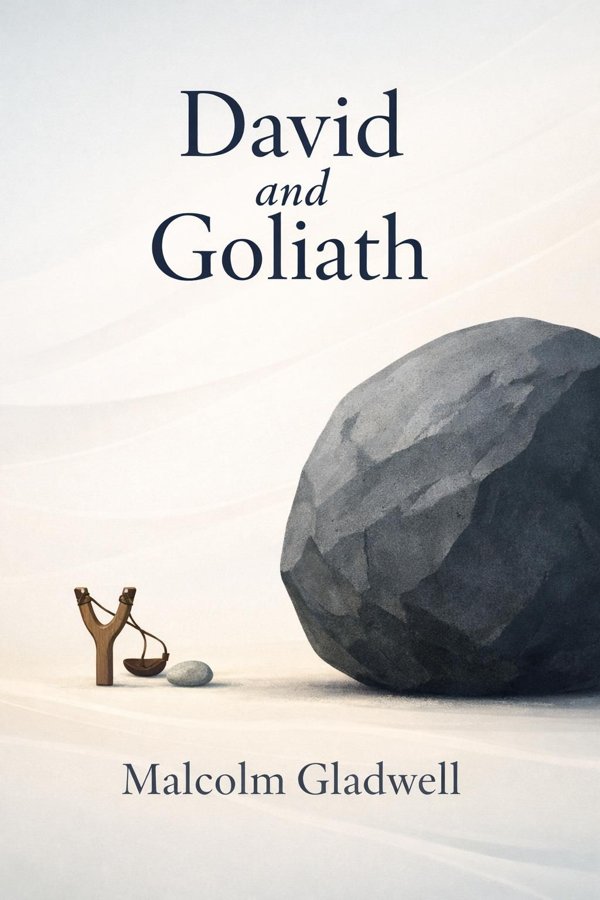
The first part of my exploration begins with a reimagining of the classic duel between David and Goliath. For centuries we have miscast it as a miracle of chance—the shepherd who defied logic. Look deeper, and a different truth emerges. Goliath was a giant, yes, but he was also slow, perhaps limited by his own gigantism. David refused the sword and armor because he was not fighting Goliath’s kind of battle. His sling, in practiced hands, was a weapon of immense precision—its velocity akin to a modern handgun. In that moment, what seemed like vulnerability became strategic brilliance. The very qualities that disqualified David from fighting conventionally were what enabled him to succeed unconventionally.
That theme reverberates through the stories of others I explore in this section. Consider the phenomenon of the inverted U-curve—a pattern showing that advantages often diminish and even reverse when pushed too far. Wealth, for instance, helps parents provide stability, opportunity, and education—but beyond a certain threshold, it corrodes motivation, entitlement replaces gratitude, and children grow disconnected from the very drive that built their family’s fortune. Similarly, small class sizes in schools seem ideal, until they become so small that discussion dies and diversity of thought wanes. In both education and economics, more is not always better.
Then there is the principle of relative deprivation—how our perception of our own talent is warped by the company we keep. I recount the story of a brilliant student who enters an elite Ivy League university only to feel diminished among other prodigies. The result is self-doubt, not because her ability changed, but because the yardstick did. Meanwhile, had she studied in a less prestigious environment, she might have flourished as a star, brimming with confidence. The moral is subtle but powerful: success and failure are relational states. Where we stand depends as much on our surroundings as on our abilities. What appears to be an advantage—elite status, wealth, prestige—can quietly erode the very qualities that nurture greatness.
In the second section, I delve into what psychologists call ‘desirable difficulties’: the idea that certain hardships force us to adapt in ways that create extraordinary strengths. It’s counterintuitive, even unsettling. We are taught to avoid pain, to minimize risk, to smooth the path ahead. Yet history tells a different story—that many who’ve achieved greatness did so not in spite of difficulty but because of it.
Take dyslexia, for example. At first glance, it looks like a cruel disadvantage: a neurological challenge that makes reading arduous. But look at the backgrounds of many successful entrepreneurs, trial lawyers, and innovators, and you begin to notice an unusual pattern. People like Richard Branson and Gary Cohn didn’t succeed by escaping their disability—they succeeded because it forced them to develop compensatory talents like empathy, memory, persuasion, and strategic risk-taking. A mind that cannot rely on easy reading learns to rely on intuition and relationships instead. What seems broken becomes a training ground for resilience.
Then I tell the story of a man who endured one of the most devastating experiences imaginable: losing both parents at a young age. Statistically, such trauma can cripple a child’s development. But in rare cases, it forges leaders who learn self-reliance early, who grow accustomed to uncertainty and risk. The pain never disappears, but it bequeaths an inner toughness, a refusal to surrender. I found in these stories a paradox that defines much of human experience—the wounds we wish away are often the crucibles of our character.
Desirable difficulties are not a call to romanticize suffering; they are a reminder that challenge and growth are intertwined. The lives of the dyslexic entrepreneur or the orphaned statesman illustrate how adversity can activate dormant capacities. They teach us that comfort breeds compliance, while friction breeds innovation. Our struggles, when faced with creativity and courage, can become our most profound teachers.
+ 1 more chapters — available in the FizzRead app
All Chapters in David and Goliath: Underdogs, Misfits, and the Art of Battling Giants
About the Author
Malcolm Gladwell is a Canadian journalist, author, and public speaker known for his works on social science and human behavior, including The Tipping Point, Blink, and Outliers. He has been a staff writer for The New Yorker since 1996.
Get This Summary in Your Preferred Format
Read or listen to the David and Goliath: Underdogs, Misfits, and the Art of Battling Giants summary by Malcolm Gladwell anytime, anywhere. FizzRead offers multiple formats so you can learn on your terms — all free.
Available formats: App · Audio · PDF · EPUB — All included free with FizzRead
Download David and Goliath: Underdogs, Misfits, and the Art of Battling Giants PDF and EPUB Summary
Key Quotes from David and Goliath: Underdogs, Misfits, and the Art of Battling Giants
“The first part of my exploration begins with a reimagining of the classic duel between David and Goliath.”
“In the second section, I delve into what psychologists call ‘desirable difficulties’: the idea that certain hardships force us to adapt in ways that create extraordinary strengths.”
Frequently Asked Questions about David and Goliath: Underdogs, Misfits, and the Art of Battling Giants
David and Goliath: Underdogs, Misfits, and the Art of Battling Giants by Malcolm Gladwell is a psychology book that explores key ideas across 3 chapters. David and Goliath explores how disadvantages can become advantages and how perceived weaknesses can lead to unexpected success. Malcolm Gladwell examines historical and contemporary examples of underdogs who overcame great odds, challenging conventional ideas about power, success, and resilience.
More by Malcolm Gladwell
You Might Also Like
The Body Keeps the Score
Bessel van der Kolk
10 min
Surrounded by Idiots
Thomas Erikson
10 min
Emotional Intelligence
Daniel Goleman
10 min
Attached
Amir Levine
10 min
Why Does He Do That
Lundy Bancroft
10 min
Women Who Run with the Wolves
Clarissa Pinkola Estés
10 minBrowse by Category
Ready to read David and Goliath: Underdogs, Misfits, and the Art of Battling Giants?
Get the full summary and 100K+ more books with Fizz Moment.