
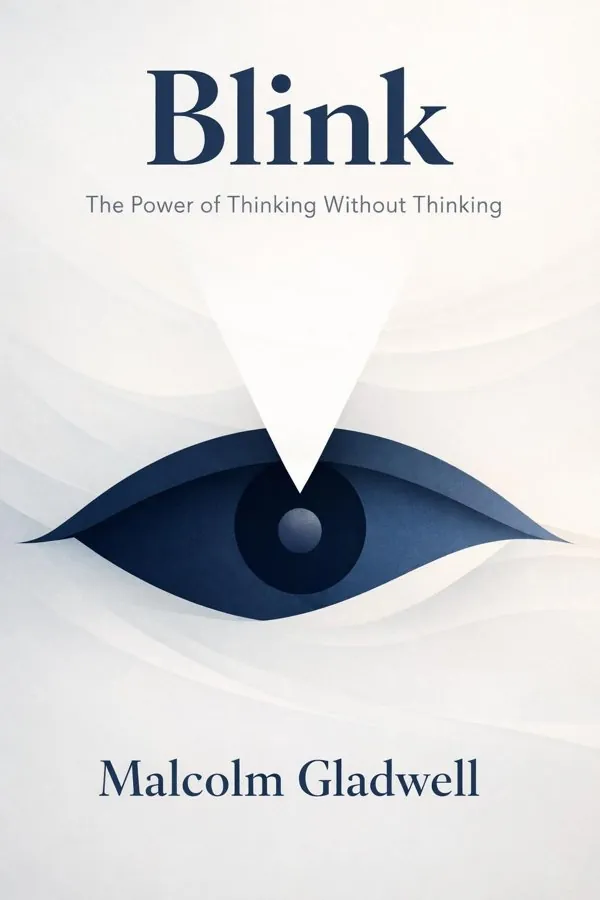
Blink: The Power of Thinking Without Thinking: Summary & Key Insights
 10 min5 chaptersAudio available
What Is Blink: The Power of Thinking Without Thinking About?
Blink: The Power of Thinking Without Thinking by Malcolm Gladwell is a psychology book spanning 5 pages. Blink explores the power of rapid cognition—our ability to make quick judgments and decisions in the blink of an eye. Malcolm Gladwell examines how snap decisions can be both remarkably accurate and dangerously flawed, drawing on psychology, neuroscience, and real-world examples to reveal when we should trust our instincts and when we should be wary of them.
This FizzRead summary covers all 5 key chapters of Blink: The Power of Thinking Without Thinking in approximately 10 minutes, distilling the most important ideas, arguments, and takeaways from Malcolm Gladwell's work. Also available as an audio summary and Key Quotes Podcast.
Blink: The Power of Thinking Without Thinking
Blink explores the power of rapid cognition—our ability to make quick judgments and decisions in the blink of an eye. Malcolm Gladwell examines how snap decisions can be both remarkably accurate and dangerously flawed, drawing on psychology, neuroscience, and real-world examples to reveal when we should trust our instincts and when we should be wary of them.
Who Should Read Blink: The Power of Thinking Without Thinking?
This book is perfect for anyone interested in psychology and looking to gain actionable insights in a short read. Whether you're a student, professional, or lifelong learner, the key ideas from Blink: The Power of Thinking Without Thinking by Malcolm Gladwell will help you think differently.
- ✓Readers who enjoy psychology and want practical takeaways
- ✓Professionals looking to apply new ideas to their work and life
- ✓Anyone who wants the core insights of Blink: The Power of Thinking Without Thinking in just 10 minutes
Want the full summary?
Get instant access to this book summary and 100K+ more with Fizz Moment.
Get Free SummaryAvailable on App Store • Free to download
Key Chapters
I began my exploration of rapid cognition with a story that illustrates its most extraordinary expression: an ancient Greek statue known as a kouros. When a museum considered buying it, months of scientific testing suggested it was authentic. Yet, in a single glance, several art experts felt uneasy. They couldn’t articulate why—it just didn’t look right. Their instincts, grounded in years of experience, were warning them of something beyond conscious description. In the end, their intuition proved correct. The statue was a fake. That story captures the essence of thin-slicing—the ability of our unconscious mind to extract meaning from a few fragments of information.
We tend to assume that good decisions emerge from careful, rational thought. But much of our best understanding actually happens automatically. Consider the psychologist John Gottman, who can predict whether a couple will divorce after observing just a few minutes of conversation. What seems miraculous is simply decades of pattern recognition distilled into seconds. This process relies on what I call the adaptive unconscious—a part of our mind that’s constantly processing data, filtering signals, and drawing conclusions before our conscious mind even wakes up.
Thin-slicing is not wild guessing; it’s deeply informed quick judgment. The key is calibration: experience, feedback, and context refine our ability to accurately interpret these brief slices of information. Yet we must respect its boundaries. Rapid cognition is powerful precisely because it’s selective—it focuses on the most relevant data, not every detail. Overloading ourselves with information often degrades performance, not enhances it. Sometimes, less truly is more.
As I delved deeper into this phenomenon, I realized that understanding when and how to thin-slice well could transform everything from art appreciation to love, leadership, and life itself. The unconscious isn’t our enemy; it’s a partner whose potential emerges when we learn to listen to its quiet, instantaneous wisdom.
Rapid cognition draws on our brain’s extraordinary ability to identify patterns beneath awareness. This capacity underlies seemingly miraculous feats—like experienced firefighters who sense when a burning building is about to collapse or physicians who diagnose an illness simply by looking at a patient. But these judgments stem not from guesswork, but from finely honed templates built over countless experiences. What takes conscious thought years to learn, the unconscious applies in a flash.
The psychologist Gary Klein studied how experts make life-and-death choices without consciously weighing options. In one striking example, a seasoned fire lieutenant abruptly ordered his men out of a burning building. Moments later, the floor collapsed. He couldn’t explain his decision—only later did he realize the sound of the fire was wrong. His unconscious registered the anomaly instantly. That’s the adaptive unconscious in action: an internal radar synthesizing signals we cannot name.
However, this mental machinery can deceive us if miscalibrated. We are all susceptible to the Warren Harding error—the tendency to mistake superficial attributes, such as appearance or charisma, for competence or worth. Harding looked presidential, so voters invested him with qualities he did not possess. Thin-slicing, when based on the wrong cues, seduces us with false certainty. The danger is that fast thinking feels true, whether or not it is.
The psychology behind snap judgments underscores that unconscious processing is neither good nor bad—it’s neutral power. Like any tool, its value depends on training, feedback, and awareness. Expertise refines the filters; prejudice and fear distort them. To harness intuition responsibly, we must cultivate environments that allow rapid cognition to be informed rather than impulsive. Experience alone is not enough; what makes thin-slicing reliable is reflection and learning after each decision. The unconscious listens—to experience, to pattern, to repetition. The more honest the feedback, the sharper the instinct.
+ 3 more chapters — available in the FizzRead app
All Chapters in Blink: The Power of Thinking Without Thinking
About the Author
Malcolm Gladwell is a Canadian journalist, author, and speaker known for his books on social science and human behavior, including The Tipping Point, Outliers, and David and Goliath. His work often explores the unexpected factors that shape success, decision-making, and perception.
Get This Summary in Your Preferred Format
Read or listen to the Blink: The Power of Thinking Without Thinking summary by Malcolm Gladwell anytime, anywhere. FizzRead offers multiple formats so you can learn on your terms — all free.
Available formats: App · Audio · PDF · EPUB — All included free with FizzRead
Download Blink: The Power of Thinking Without Thinking PDF and EPUB Summary
Key Quotes from Blink: The Power of Thinking Without Thinking
“I began my exploration of rapid cognition with a story that illustrates its most extraordinary expression: an ancient Greek statue known as a kouros.”
“Rapid cognition draws on our brain’s extraordinary ability to identify patterns beneath awareness.”
Frequently Asked Questions about Blink: The Power of Thinking Without Thinking
Blink: The Power of Thinking Without Thinking by Malcolm Gladwell is a psychology book that explores key ideas across 5 chapters. Blink explores the power of rapid cognition—our ability to make quick judgments and decisions in the blink of an eye. Malcolm Gladwell examines how snap decisions can be both remarkably accurate and dangerously flawed, drawing on psychology, neuroscience, and real-world examples to reveal when we should trust our instincts and when we should be wary of them.
More by Malcolm Gladwell
You Might Also Like

The Body Keeps the Score
Bessel van der Kolk
10 min
Surrounded by Idiots
Thomas Erikson
10 min
Emotional Intelligence
Daniel Goleman
10 min
Attached
Amir Levine
10 min
Why Does He Do That
Lundy Bancroft
10 min
Women Who Run with the Wolves
Clarissa Pinkola Estés
10 minBrowse by Category
Ready to read Blink: The Power of Thinking Without Thinking?
Get the full summary and 100K+ more books with Fizz Moment.