
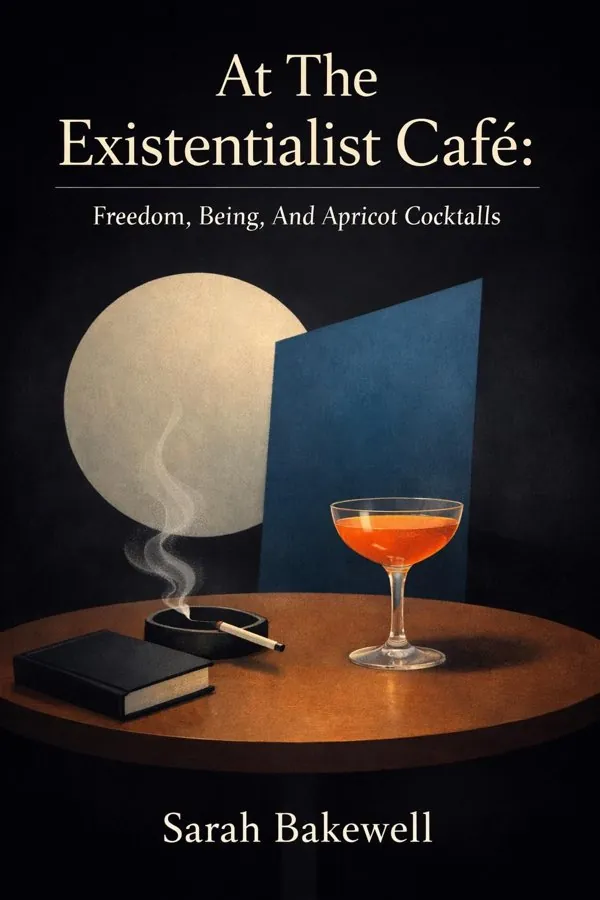
At The Existentialist Café: Freedom, Being, And Apricot Cocktails: Summary & Key Insights
 10 min9 chaptersAudio available
Key Takeaways from At The Existentialist Café: Freedom, Being, And Apricot Cocktails
A revolution in philosophy began with a simple question: what if we started not with abstract theories, but with how the world actually appears to us?
Human life becomes more urgent when we realize it is finite.
Big ideas often begin not in solitude, but in charged encounters between people.
The unsettling heart of existentialism is this: you are freer than you want to admit.
Ideas about freedom become sharper when freedom is threatened.
What Is At The Existentialist Café: Freedom, Being, And Apricot Cocktails About?
At The Existentialist Café: Freedom, Being, And Apricot Cocktails by Sarah Bakewell is a civilization book spanning 11 pages. At The Existentialist Café is a lively intellectual history of existentialism told through the lives, friendships, rivalries, and political entanglements of the thinkers who shaped it. Sarah Bakewell begins with a famous Paris café moment—Jean-Paul Sartre realizing that philosophy could start from an apricot cocktail and the experience of perceiving it—and expands outward into a rich story involving Edmund Husserl, Martin Heidegger, Simone de Beauvoir, Maurice Merleau-Ponty, Albert Camus, and others. The book is about freedom, responsibility, authenticity, embodiment, anxiety, and what it means to live as a human being in a fractured modern world. What makes it matter is that Bakewell shows existentialism not as abstract theory, but as a practical response to war, oppression, love, political compromise, and moral choice. She makes difficult ideas readable without flattening them, connecting twentieth-century philosophy to everyday questions people still face now. Bakewell is especially qualified for this task because she is an acclaimed biographer and popular intellectual historian with a gift for turning dense philosophical traditions into vivid, human stories.
This FizzRead summary covers all 9 key chapters of At The Existentialist Café: Freedom, Being, And Apricot Cocktails in approximately 10 minutes, distilling the most important ideas, arguments, and takeaways from Sarah Bakewell's work. Also available as an audio summary and Key Quotes Podcast.
At The Existentialist Café: Freedom, Being, And Apricot Cocktails
At The Existentialist Café is a lively intellectual history of existentialism told through the lives, friendships, rivalries, and political entanglements of the thinkers who shaped it. Sarah Bakewell begins with a famous Paris café moment—Jean-Paul Sartre realizing that philosophy could start from an apricot cocktail and the experience of perceiving it—and expands outward into a rich story involving Edmund Husserl, Martin Heidegger, Simone de Beauvoir, Maurice Merleau-Ponty, Albert Camus, and others. The book is about freedom, responsibility, authenticity, embodiment, anxiety, and what it means to live as a human being in a fractured modern world. What makes it matter is that Bakewell shows existentialism not as abstract theory, but as a practical response to war, oppression, love, political compromise, and moral choice. She makes difficult ideas readable without flattening them, connecting twentieth-century philosophy to everyday questions people still face now. Bakewell is especially qualified for this task because she is an acclaimed biographer and popular intellectual historian with a gift for turning dense philosophical traditions into vivid, human stories.
Who Should Read At The Existentialist Café: Freedom, Being, And Apricot Cocktails?
This book is perfect for anyone interested in civilization and looking to gain actionable insights in a short read. Whether you're a student, professional, or lifelong learner, the key ideas from At The Existentialist Café: Freedom, Being, And Apricot Cocktails by Sarah Bakewell will help you think differently.
- ✓Readers who enjoy civilization and want practical takeaways
- ✓Professionals looking to apply new ideas to their work and life
- ✓Anyone who wants the core insights of At The Existentialist Café: Freedom, Being, And Apricot Cocktails in just 10 minutes
Want the full summary?
Get instant access to this book summary and 100K+ more with Fizz Moment.
Get Free SummaryAvailable on App Store • Free to download
Key Chapters
A revolution in philosophy began with a simple question: what if we started not with abstract theories, but with how the world actually appears to us? Sarah Bakewell shows that the roots of existentialism lie in Edmund Husserl’s phenomenology, a method that tried to describe experience before it was buried under assumptions, systems, and jargon. Husserl believed philosophy had become detached from life. Instead of arguing endlessly about whether knowledge was possible, he wanted thinkers to return “to the things themselves”: to consciousness, perception, memory, emotion, and the structure of experience.
This shift mattered because it changed the task of philosophy. Rather than constructing grand metaphysical systems from above, phenomenology asked us to pay close attention to what it feels like to be a human subject in a world of objects, others, meanings, and time. Husserl’s method influenced many later thinkers, even when they disagreed with him. Existentialism inherited from him the conviction that philosophy must begin from life as it is lived.
In practical terms, phenomenology can sharpen how we observe ourselves and others. When you feel anxious before an interview, for example, phenomenology asks: how does that anxiety shape time, your body, and the room around you? The experience itself becomes philosophically meaningful. This can also improve listening, empathy, and self-awareness, because it trains you to notice before you judge.
Actionable takeaway: the next time you have a strong emotion or face a difficult decision, pause and describe the experience as precisely as possible before explaining it away. Start with what is actually present in your awareness.
Human life becomes more urgent when we realize it is finite. Bakewell presents Martin Heidegger as the thinker who transformed Husserl’s phenomenology into a more radical inquiry: not just how things appear, but what it means to be. In Being and Time, Heidegger argued that philosophers had forgotten the most basic question of all—the question of Being itself. He shifted attention from detached consciousness to Dasein, the human being understood as always already involved in a world of tasks, relationships, language, habit, and mortality.
For Heidegger, we do not first exist as isolated minds looking out at reality. We are thrown into a world we did not choose, shaped by history, culture, and circumstance. Yet within this thrownness we still interpret, project, and choose. Everyday life tends to pull us into conformity, distraction, and what he called “the they,” the anonymous pressure of social norms. Authenticity becomes possible when we confront our own mortality and stop outsourcing our life to convention.
Bakewell also does not separate Heidegger’s philosophical brilliance from his moral failures, especially his involvement with Nazism. This tension is central to the book: profound philosophy does not guarantee ethical clarity. Readers are pushed to ask whether ideas about authenticity can coexist with political blindness or complicity.
Applied to ordinary life, Heidegger’s thought asks whether your routines are genuinely yours. Are you working, consuming, and speaking in ways you have chosen, or merely imitating what “people like us” do? Mortality, in this framework, is not morbid; it is clarifying.
Actionable takeaway: identify one area of life where habit or social pressure is making decisions for you, and make one deliberate choice that reflects your own priorities instead.
Big ideas often begin not in solitude, but in charged encounters between people. One of Bakewell’s most memorable contributions is showing that existentialism emerged through friendships, seductions, arguments, and shared experiments in living. The famous café scene with Sartre, Simone de Beauvoir, and Raymond Aron dramatizes a core insight: anything in experience, even an apricot cocktail, can become a subject for philosophy if one attends to how it is lived. This moment helped Sartre understand phenomenology as a method that could bridge thought and life.
Sartre and de Beauvoir did not just develop theories; they crafted lives that tested their ideas. Their partnership challenged social expectations around marriage, fidelity, work, and intellectual equality. They treated existence as something to be made rather than inherited. Bakewell captures the excitement of this generation, especially in interwar Paris, where philosophy was becoming public, stylish, literary, and politically charged.
This matters because it reframes philosophy as collaborative and embodied. Ideas do not float free of personality or circumstance. They emerge from conversations, emotional commitments, and historical pressure. In modern terms, this reminds us that our thinking is shaped by who we speak with, what communities we inhabit, and what risks we are willing to take.
Practically, this can change how you approach learning. Instead of treating wisdom as private consumption, you can develop it through discussion groups, honest friendships, and disagreement. Many of our deepest convictions only become visible when another person challenges them.
Actionable takeaway: choose one important question about work, love, identity, or meaning, and discuss it with someone thoughtful rather than trying to solve it alone. Let philosophy become a lived conversation.
The unsettling heart of existentialism is this: you are freer than you want to admit. Bakewell shows how Jean-Paul Sartre turned this insight into one of the most provocative philosophies of the twentieth century. For Sartre, human beings are not fixed by essence, destiny, or role. We first exist, and then define ourselves through action. That sounds liberating, but Sartre insisted it is also terrifying, because it means we are responsible for what we make of our lives.
This is why existentialism is so often linked to anguish. We want excuses—our upbringing, our job title, our social script, our personality type. Sartre argued that while circumstances are real, we often hide behind them in what he called bad faith: the denial of our freedom by pretending we are mere objects with preset functions. A waiter who treats himself as only a waiter, or a person who claims “that’s just who I am,” may be avoiding the fluid, open nature of human existence.
Bakewell makes clear that Sartre did not mean freedom is unlimited. We are constrained by facts: history, class, body, war, institutions. But within those constraints, we still interpret and choose. This view can be bracing in daily life. It means you may not control your situation, but you do shape your stance, your next move, and the meaning of your choices.
In practice, Sartre’s idea can help with career dissatisfaction, relationship patterns, or moral drift. Instead of waiting to “find yourself,” you can ask what repeated actions are currently creating you.
Actionable takeaway: replace one sentence of self-excuse this week—such as “I can’t help it” or “I’m just like this”—with a more honest one: “I have been choosing this, and I can begin choosing differently.”
Ideas about freedom become sharper when freedom is threatened. Bakewell traces how war, occupation, exile, and totalitarianism forced existentialist thinkers to test their philosophies in real conditions of danger. The Second World War was not background scenery for existentialism; it was a crucible. Sartre experienced captivity as a prisoner of war. Beauvoir, Camus, Merleau-Ponty, and others faced the moral compromises and ambiguities of occupied France. Questions that might have seemed abstract—What do I owe others? What is resistance? Can violence be justified?—became immediate.
Existentialism gained power in this period because it addressed life under pressure. It emphasized choice without naivety, responsibility without certainty, and action without guarantees of purity. The war also revealed one of the movement’s enduring tensions: the desire to insist on freedom even in oppressive conditions, without ignoring the crushing force of circumstance. This balance remains relevant in any era shaped by political fear, social pressure, or institutional injustice.
Bakewell also highlights that not all philosophers responded honorably. Heidegger’s Nazi involvement stands in stark contrast to the resistance efforts of others. The book refuses hero worship. It asks us to judge ideas not only by their elegance, but by how people lived when stakes were high.
For modern readers, this chapter of the story speaks to workplaces, societies, and systems where ethical compromise is normalized. You may not face occupation, but you likely face smaller moments of silence, conformity, or cowardice. Existentialism asks what freedom requires there.
Actionable takeaway: identify one situation where you have been passive in the face of something you believe is wrong, and decide on one concrete act—however modest—that aligns your behavior with your convictions.
We do not merely have bodies; we live through them. One of Bakewell’s great strengths is showing that existentialism did not remain confined to abstract freedom or solitary anxiety. Through Maurice Merleau-Ponty, it became a philosophy of embodiment and perception. Merleau-Ponty argued that the body is not a machine carrying the mind around, but the very means by which we inhabit the world. We perceive, move, gesture, and understand through bodily engagement before we ever analyze anything intellectually.
This perspective corrects overly cerebral pictures of the self. Many modern habits—from endless screen time to productivity culture—encourage us to treat ourselves as minds managing bodies like inconvenient tools. Merleau-Ponty suggests the opposite: our posture, habits, physical vulnerability, and sensory world are central to meaning. Even our relationships are bodily; we read emotion in faces, experience trust through presence, and encounter space through movement.
Bakewell uses this to expand existentialism beyond lone individuals making dramatic choices. Existence is also textured, perceptual, social, and situated. This matters for everything from psychology to disability studies to art. It also resonates with ordinary life. Stress can feel like narrowed breathing and contracted muscles before it becomes a thought. Joy can arrive as energy, rhythm, and openness. Understanding this helps people make wiser choices about work, rest, and attention.
Practically, an embodied view of selfhood can improve decision-making. Sometimes clarity comes not from more thinking, but from walking, resting, changing environments, or noticing physical signals.
Actionable takeaway: when facing confusion or overwhelm, stop trying to solve it only in your head. Spend ten minutes noticing your bodily state—breath, tension, fatigue, movement—and let that information guide your next choice.
Freedom is incomplete if it belongs only to the abstract individual. Simone de Beauvoir emerges in Bakewell’s account not as Sartre’s supporting figure, but as a major philosopher in her own right who deepened existentialism ethically, politically, and socially. In works such as The Ethics of Ambiguity and The Second Sex, Beauvoir argued that human life is defined by ambiguity: we are both subjects and objects, free and constrained, self-making yet shaped by others. Ethics begins when we recognize this complexity rather than deny it.
Her crucial contribution was to show that freedom is relational. It is not enough to proclaim oneself free while benefiting from structures that deny freedom to others. Oppression turns people into objects, reducing their possibilities. This is why Beauvoir’s existentialism became foundational for feminist thought. In The Second Sex, she analyzed how women had historically been cast as “the Other,” denied full subjecthood and encouraged to live according to roles imposed from outside.
Bakewell presents Beauvoir as both philosopher and witness to lived inequality. Her work continues to matter because it connects personal identity with social structure. Many contemporary debates about gender, labor, care, and autonomy still turn on Beauvoir’s insight that one is not simply born into meaning; one is shaped, limited, and also capable of resistance.
This has practical implications for how we think about family expectations, workplace norms, and internalized roles. It asks us not only, “What do I want?” but also, “What conditions make wanting and choosing possible for me and for others?”
Actionable takeaway: examine one role you occupy—employee, parent, partner, daughter, son, student—and ask which parts express your freedom and which parts reflect expectations you have uncritically absorbed.
A philosophy can lose clarity precisely when it becomes fashionable. Bakewell follows existentialism from its explosive postwar popularity into its internal disputes, political contradictions, and eventual decline as a dominant movement. Sartre and Beauvoir became public intellectual celebrities. Their ideas spread through novels, plays, journalism, cafés, universities, and political activism. Existentialism became associated with black turtlenecks, smoky rooms, jazz, rebellion, and seriousness about freedom.
Yet success complicated everything. Sartre’s later politics, especially his entanglements with communism and revolutionary movements, raised hard questions about whether existential freedom could survive ideological commitments. His break with Camus over violence and historical necessity exposed a deep divide: should one justify present cruelty in the name of future justice? Merleau-Ponty also drifted away from Sartre, disagreeing over politics and philosophy. The movement that once prized individual lucidity became fractured by competing interpretations of responsibility and history.
Bakewell treats this decline not as simple failure, but as part of existentialism’s realism. A philosophy centered on human freedom must also face human inconsistency, vanity, tribalism, and error. This makes the story more useful, not less. It warns readers against turning any worldview into a badge of identity immune from self-criticism.
In modern life, this lesson applies to political tribes, self-help movements, and professional ideologies. The moment a living idea becomes a style or dogma, it risks losing contact with experience. Existentialism remains strongest when it stays self-questioning.
Actionable takeaway: take one belief system you identify with strongly—political, professional, moral, or spiritual—and ask what evidence or experience would force you to revise it. Build self-criticism into conviction.
The reason existentialism survives is simple: it names problems that never went away. Bakewell’s closing emphasis is that these thinkers remain relevant not because they offer a complete doctrine, but because they confront enduring features of human life—freedom, anxiety, embodiment, death, social pressure, moral compromise, and the search for authenticity. The twentieth century gave these questions dramatic form through war and ideological extremism, but the twenty-first encounters them through burnout, consumerism, digital identity, loneliness, and political polarization.
Existentialism helps because it refuses comforting illusions. It does not promise a fixed essence, a guaranteed purpose, or a final system that removes ambiguity. Instead, it asks people to face the instability of life without surrendering agency. That can be especially useful in a culture obsessed with optimization and image management. Existentialism reminds us that a human life is not a brand, and authenticity is not performance.
The book’s ongoing value also lies in its method. Bakewell models an intellectually generous way of reading difficult thinkers: critically, historically, and humanly. She neither idolizes nor dismisses them. That stance is itself existential in spirit, because it treats ideas as tools for living rather than relics or slogans.
In everyday practice, existentialism can deepen choices about career, attention, relationships, and civic responsibility. It encourages honest self-authorship while insisting that our freedom is bound up with the freedom of others.
Actionable takeaway: choose one recurring modern pressure—social media comparison, career anxiety, fear of missing out, passive conformity—and ask the existentialist question beneath it: “Am I living by choice here, or by drift?” Then make one concrete correction.
All Chapters in At The Existentialist Café: Freedom, Being, And Apricot Cocktails
About the Author
Sarah Bakewell is a British author and biographer celebrated for making philosophy and intellectual history vivid for general readers. She studied philosophy and worked for years as a curator before turning to writing, a background that helped shape her talent for presenting complex ideas with clarity and narrative flair. Bakewell earned wide acclaim for How to Live: A Life of Montaigne, an inventive biographical study that won major literary prizes and introduced many readers to philosophical biography as a genre. Her work often focuses on the meeting point between ideas and lived experience, showing how thinkers respond to the pressures of their times. In At The Existentialist Café, she brings that gift to existentialism, combining scholarship, wit, and humane insight to illuminate one of modern philosophy’s most influential movements.
Get This Summary in Your Preferred Format
Read or listen to the At The Existentialist Café: Freedom, Being, And Apricot Cocktails summary by Sarah Bakewell anytime, anywhere. FizzRead offers multiple formats so you can learn on your terms — all free.
Available formats: App · Audio · PDF · EPUB — All included free with FizzRead
Download At The Existentialist Café: Freedom, Being, And Apricot Cocktails PDF and EPUB Summary
Key Quotes from At The Existentialist Café: Freedom, Being, And Apricot Cocktails
“A revolution in philosophy began with a simple question: what if we started not with abstract theories, but with how the world actually appears to us?”
“Human life becomes more urgent when we realize it is finite.”
“Big ideas often begin not in solitude, but in charged encounters between people.”
“The unsettling heart of existentialism is this: you are freer than you want to admit.”
“Ideas about freedom become sharper when freedom is threatened.”
Frequently Asked Questions about At The Existentialist Café: Freedom, Being, And Apricot Cocktails
At The Existentialist Café: Freedom, Being, And Apricot Cocktails by Sarah Bakewell is a civilization book that explores key ideas across 9 chapters. At The Existentialist Café is a lively intellectual history of existentialism told through the lives, friendships, rivalries, and political entanglements of the thinkers who shaped it. Sarah Bakewell begins with a famous Paris café moment—Jean-Paul Sartre realizing that philosophy could start from an apricot cocktail and the experience of perceiving it—and expands outward into a rich story involving Edmund Husserl, Martin Heidegger, Simone de Beauvoir, Maurice Merleau-Ponty, Albert Camus, and others. The book is about freedom, responsibility, authenticity, embodiment, anxiety, and what it means to live as a human being in a fractured modern world. What makes it matter is that Bakewell shows existentialism not as abstract theory, but as a practical response to war, oppression, love, political compromise, and moral choice. She makes difficult ideas readable without flattening them, connecting twentieth-century philosophy to everyday questions people still face now. Bakewell is especially qualified for this task because she is an acclaimed biographer and popular intellectual historian with a gift for turning dense philosophical traditions into vivid, human stories.
More by Sarah Bakewell


You Might Also Like
The Structure of Scientific Revolutions
Thomas S. Kuhn
10 min
Genius
Harold Bloom
10 min
A Cultural History of the Medieval Age
Various Editors
10 min
A History of God: The 4,000-Year Quest of Judaism, Christianity and Islam
Karen Armstrong
10 min
A History of the World in 10½ Chapters
Julian Barnes
10 min
A Short History of Progress
Ronald Wright
10 minBrowse by Category
Ready to read At The Existentialist Café: Freedom, Being, And Apricot Cocktails?
Get the full summary and 100K+ more books with Fizz Moment.