
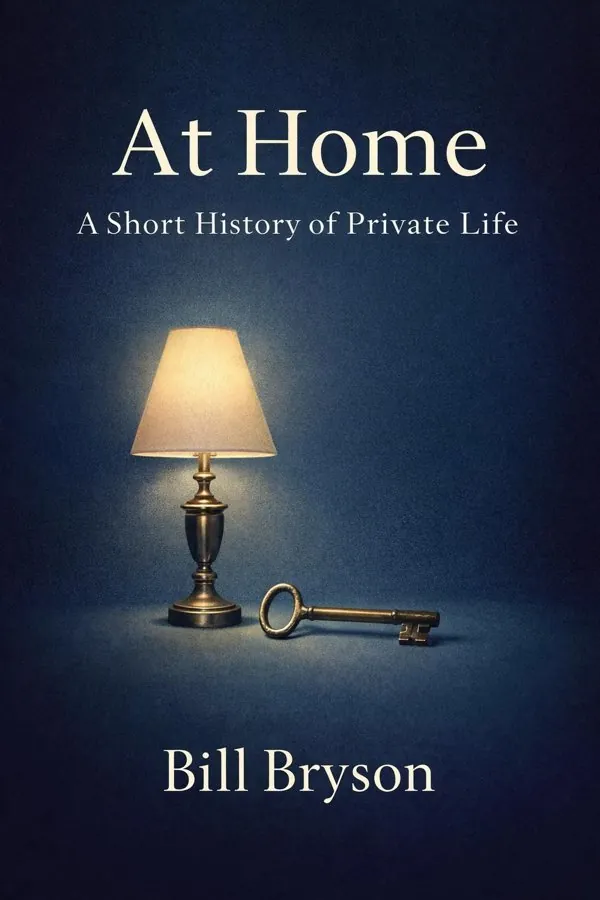
At Home: A Short History of Private Life: Summary & Key Insights
by Bill Bryson
 10 min11 chaptersAudio available
What Is At Home: A Short History of Private Life About?
At Home: A Short History of Private Life by Bill Bryson is a civilization book spanning 11 pages. In this engaging and witty exploration, Bill Bryson takes readers on a room-by-room tour of his Victorian parsonage in England, using each space as a springboard to explore the fascinating history of domestic life. From the evolution of plumbing and lighting to the origins of everyday objects, Bryson reveals how the comforts of home reflect centuries of social, scientific, and cultural change.
This FizzRead summary covers all 11 key chapters of At Home: A Short History of Private Life in approximately 10 minutes, distilling the most important ideas, arguments, and takeaways from Bill Bryson's work. Also available as an audio summary and Key Quotes Podcast.
At Home: A Short History of Private Life
In this engaging and witty exploration, Bill Bryson takes readers on a room-by-room tour of his Victorian parsonage in England, using each space as a springboard to explore the fascinating history of domestic life. From the evolution of plumbing and lighting to the origins of everyday objects, Bryson reveals how the comforts of home reflect centuries of social, scientific, and cultural change.
Who Should Read At Home: A Short History of Private Life?
This book is perfect for anyone interested in civilization and looking to gain actionable insights in a short read. Whether you're a student, professional, or lifelong learner, the key ideas from At Home: A Short History of Private Life by Bill Bryson will help you think differently.
- ✓Readers who enjoy civilization and want practical takeaways
- ✓Professionals looking to apply new ideas to their work and life
- ✓Anyone who wants the core insights of At Home: A Short History of Private Life in just 10 minutes
Want the full summary?
Get instant access to this book summary and 100K+ more with Fizz Moment.
Get Free SummaryAvailable on App Store • Free to download
Key Chapters
When you first enter a house, the hall greets you—a space that, in most centuries, revealed far more about its occupants than any portrait could. My own hall, once austere and echoing, made me wonder when this transitional space became so unassuming. For most of history, the hall was the principal room of the house. Medieval homes were essentially large communal chambers where people ate, worked, and slept together. It was noisy, smoky, and alive with activity—a symbol not of privacy but of hierarchy.
Over time, architecture mirrored social transformation. As wealth and specialized labor spread, rooms proliferated. The master of the house retreated into private chambers, servants into their cramped quarters, and the hall evolved from a place of living to a place of passage—a corridor of transition. Comfort, once a rare privilege, became a goal of the middle class. The very idea of comfort required smaller, warmer, individualized spaces, and with them, new ideas of morality and respectability.
Standing in my hall, I can trace this evolution from feudal openness to Victorian propriety. The disappearance of communal living marked an inward turn of civilization, where walls did not just divide rooms, but also defined new boundaries between the public and the personal. Our architecture, in essence, encoded our attitudes toward status, family, and self.
The kitchen, once relegated to the smoky hinterlands of the house, is today its beating heart. Yet this transformation is astonishingly recent. In early homes, cooking was both dangerous and dirty. Fireplaces dominated the architecture, smoke choked the air, and sanitation was unthinkable. My exploration of the history of cooking begins with the humble act of boiling water. To do so once required not only labor but also mastery of materials—firewood, pots, means of ventilation—that determined one’s safety and comfort.
The story of the kitchen is the story of technological optimism. The introduction of the chimney enabled better heat control; later, the cast‑iron stove and gas range revolutionized cooking by making it efficient and predictable. Domestic science in the nineteenth century, spurred by figures like Catherine Beecher, transformed the kitchen into a domain of rational order. Yet, behind these innovations lay the invisible lives of servants—most often women—whose labor powered the domestic machine. The shift from servant labor to self‑service marked a silent democratic revolution inside the home.
Food itself mirrored broader global transformations. Spices, sugar, and tea tell the story of colonization and trade. A simple loaf of bread connects us to industrial milling and agricultural science. Even hygiene—washing hands, refrigerating milk—arose from painful episodes of disease and reform. Standing by my own stove, I sense how each spoonful of comfort rests on centuries of trial, invention, and social change.
+ 9 more chapters — available in the FizzRead app
All Chapters in At Home: A Short History of Private Life
About the Author
Bill Bryson is an American-British author known for his humorous books on travel, science, and language. His works, including 'A Short History of Nearly Everything' and 'Notes from a Small Island', have earned him international acclaim for making complex subjects accessible and entertaining.
Get This Summary in Your Preferred Format
Read or listen to the At Home: A Short History of Private Life summary by Bill Bryson anytime, anywhere. FizzRead offers multiple formats so you can learn on your terms — all free.
Available formats: App · Audio · PDF · EPUB — All included free with FizzRead
Download At Home: A Short History of Private Life PDF and EPUB Summary
Key Quotes from At Home: A Short History of Private Life
“When you first enter a house, the hall greets you—a space that, in most centuries, revealed far more about its occupants than any portrait could.”
“The kitchen, once relegated to the smoky hinterlands of the house, is today its beating heart.”
Frequently Asked Questions about At Home: A Short History of Private Life
At Home: A Short History of Private Life by Bill Bryson is a civilization book that explores key ideas across 11 chapters. In this engaging and witty exploration, Bill Bryson takes readers on a room-by-room tour of his Victorian parsonage in England, using each space as a springboard to explore the fascinating history of domestic life. From the evolution of plumbing and lighting to the origins of everyday objects, Bryson reveals how the comforts of home reflect centuries of social, scientific, and cultural change.
More by Bill Bryson



You Might Also Like

The Structure of Scientific Revolutions
Thomas S. Kuhn
10 min
Genius
Harold Bloom
10 min
A Cultural History of the Medieval Age
Various Editors
10 min
A History of God: The 4,000-Year Quest of Judaism, Christianity and Islam
Karen Armstrong
10 min
A History of the World in 10½ Chapters
Julian Barnes
10 min
A Short History of Progress
Ronald Wright
10 minBrowse by Category
Ready to read At Home: A Short History of Private Life?
Get the full summary and 100K+ more books with Fizz Moment.