
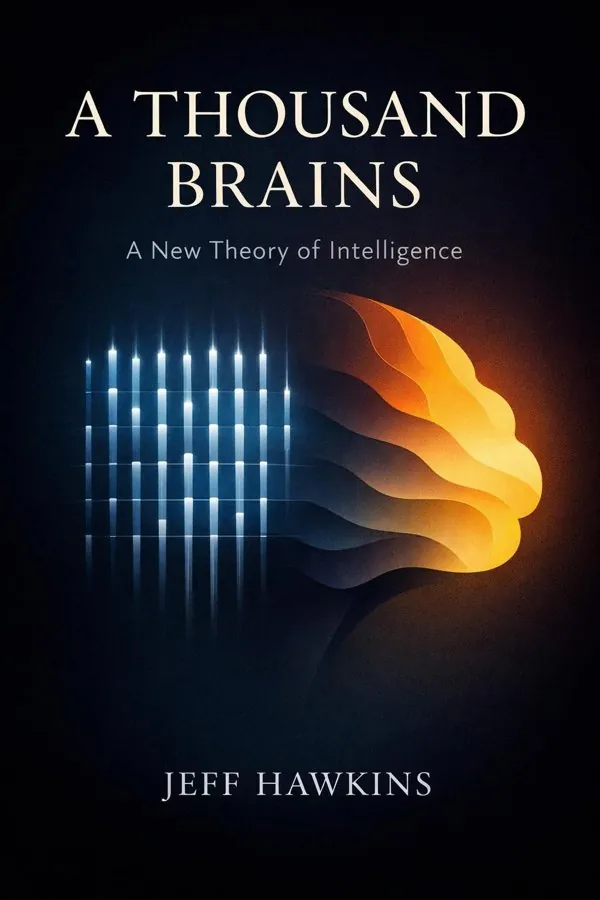
A Thousand Brains: A New Theory of Intelligence: Summary & Key Insights
by Jeff Hawkins
 10 min12 chaptersAudio available
What Is A Thousand Brains: A New Theory of Intelligence About?
A Thousand Brains: A New Theory of Intelligence by Jeff Hawkins is a neuroscience book spanning 12 pages. In this groundbreaking work, Jeff Hawkins, co-founder of Numenta and inventor of the PalmPilot, presents a new theory of intelligence based on the structure and function of the neocortex. He argues that understanding how the brain builds models of the world can revolutionize artificial intelligence and deepen our understanding of human cognition. The book explores how thousands of cortical columns work together to create perception, thought, and behavior, offering a unifying framework for both neuroscience and AI.
This FizzRead summary covers all 12 key chapters of A Thousand Brains: A New Theory of Intelligence in approximately 10 minutes, distilling the most important ideas, arguments, and takeaways from Jeff Hawkins's work. Also available as an audio summary and Key Quotes Podcast.
A Thousand Brains: A New Theory of Intelligence
In this groundbreaking work, Jeff Hawkins, co-founder of Numenta and inventor of the PalmPilot, presents a new theory of intelligence based on the structure and function of the neocortex. He argues that understanding how the brain builds models of the world can revolutionize artificial intelligence and deepen our understanding of human cognition. The book explores how thousands of cortical columns work together to create perception, thought, and behavior, offering a unifying framework for both neuroscience and AI.
Who Should Read A Thousand Brains: A New Theory of Intelligence?
This book is perfect for anyone interested in neuroscience and looking to gain actionable insights in a short read. Whether you're a student, professional, or lifelong learner, the key ideas from A Thousand Brains: A New Theory of Intelligence by Jeff Hawkins will help you think differently.
- ✓Readers who enjoy neuroscience and want practical takeaways
- ✓Professionals looking to apply new ideas to their work and life
- ✓Anyone who wants the core insights of A Thousand Brains: A New Theory of Intelligence in just 10 minutes
Want the full summary?
Get instant access to this book summary and 100K+ more with Fizz Moment.
Get Free SummaryAvailable on App Store • Free to download
Key Chapters
Imagine closing your eyes and reaching for your coffee mug. You know where it is, how it feels, even what temperature to expect. That knowing is not stored as a static image but as a dynamic, predictive model of reality—an internal representation built from experience. In the cortex, perception is not passive. Every sensory input is interpreted through a model the brain has already built. Seeing, hearing, and touching all are acts of prediction.
I explain that the neocortex constructs models layer by layer, using sensory data and movement to refine understanding. This modeling is how we make sense of a complex world. When light hits your eyes or sound reaches your ears, your brain does not just record those signals—it integrates them into a spatial and temporal understanding of the world around you. The world you perceive is, in essence, your brain’s best guess at reality, continuously updated.
This process is essential for survival. You don’t experience the world as raw data; you experience meaning, and meaning is the result of internal models. These models aren’t static—they are constantly evolving as your sensory experiences change. The brain’s job is to minimize uncertainty by predicting accurately. Every time a prediction fails, the model adapts. Through this process, your brain becomes a master at understanding the environment—not by memorizing, but by modeling.
In neuroscience we know the cortex is organized into repeating structures called columns. What I discovered is that each of these columns learns complete models of objects independently. This means that your brain doesn’t have one unified model stored in a single place; instead, thousands of columns each hold their own version of understanding.
When you touch a coffee mug with your fingers, each fingertip activates different columns that learn the shape, texture, and spatial layout of the mug. Over time, these columns combine their local models into a coherent whole. This is revolutionary because it suggests that intelligence is distributed. Every column is a little scientist, observing, learning, and hypothesizing about what it is sensing.
In this framework, intelligence is not the property of a specific part of the brain—it emerges from the collaboration of these countless small learning units. The Thousand Brains Theory flips the traditional view: instead of a hierarchical top-down structure, the cortex is a democratic system of many local experts voting on reality.
+ 10 more chapters — available in the FizzRead app
All Chapters in A Thousand Brains: A New Theory of Intelligence
About the Author
Jeff Hawkins is an American neuroscientist, inventor, and entrepreneur known for his pioneering work in mobile computing and theoretical neuroscience. He founded Palm Computing and Handspring, and later established Numenta to research machine intelligence based on brain theory. His work focuses on understanding the neocortex and applying those insights to artificial intelligence.
Get This Summary in Your Preferred Format
Read or listen to the A Thousand Brains: A New Theory of Intelligence summary by Jeff Hawkins anytime, anywhere. FizzRead offers multiple formats so you can learn on your terms — all free.
Available formats: App · Audio · PDF · EPUB — All included free with FizzRead
Download A Thousand Brains: A New Theory of Intelligence PDF and EPUB Summary
Key Quotes from A Thousand Brains: A New Theory of Intelligence
“Imagine closing your eyes and reaching for your coffee mug.”
“In neuroscience we know the cortex is organized into repeating structures called columns.”
Frequently Asked Questions about A Thousand Brains: A New Theory of Intelligence
A Thousand Brains: A New Theory of Intelligence by Jeff Hawkins is a neuroscience book that explores key ideas across 12 chapters. In this groundbreaking work, Jeff Hawkins, co-founder of Numenta and inventor of the PalmPilot, presents a new theory of intelligence based on the structure and function of the neocortex. He argues that understanding how the brain builds models of the world can revolutionize artificial intelligence and deepen our understanding of human cognition. The book explores how thousands of cortical columns work together to create perception, thought, and behavior, offering a unifying framework for both neuroscience and AI.
More by Jeff Hawkins

You Might Also Like
Anxious
Joseph LeDoux
10 min
Hallucinations
Oliver Sacks
10 min
The Biological Mind: How Brain, Body, and Environment Collaborate to Make Us Who We Are
Alan Jasanoff
10 min
The Feeling of Life Itself: Why Consciousness Is Widespread but Can't Be Computed
Christof Koch
10 min
The No-Nonsense Meditation Book
Steven Laureys
10 min
A General Theory of Love
Thomas Lewis, Fari Amini, Richard Lannon
10 minBrowse by Category
Ready to read A Thousand Brains: A New Theory of Intelligence?
Get the full summary and 100K+ more books with Fizz Moment.