
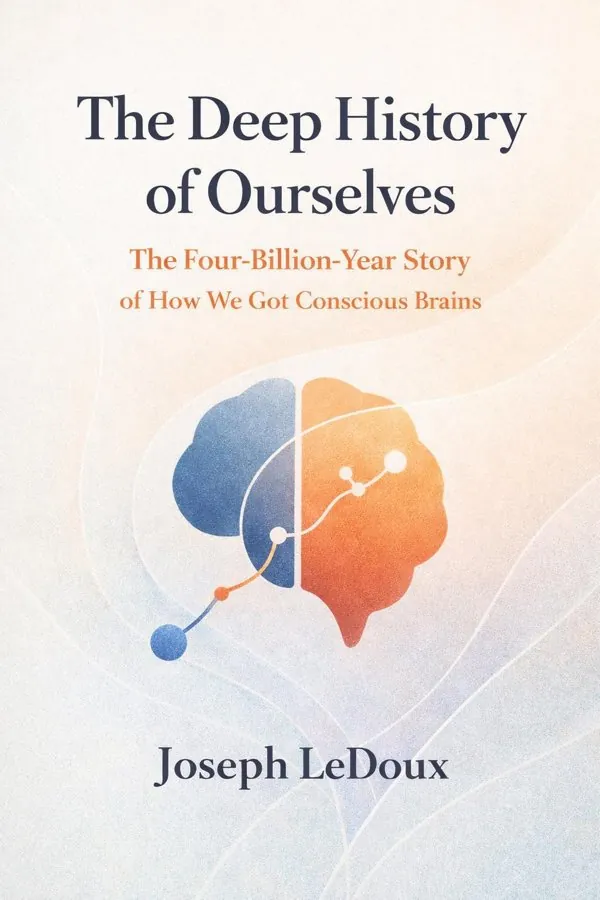
The Deep History of Ourselves: The Four-Billion-Year Story of How We Got Conscious Brains: Summary & Key Insights
 10 min9 chaptersAudio available
Key Takeaways from The Deep History of Ourselves: The Four-Billion-Year Story of How We Got Conscious Brains
The roots of mind may be far older and simpler than we usually imagine.
Complexity creates a new kind of challenge: once life became multicellular, survival required coordination across many specialized parts.
A creature that can only react is trapped by the present moment.
The brain is not a single invention but a layered accumulation of solutions to survival problems.
Emotions feel intimate and personal, but LeDoux argues that their roots lie in ancient survival functions.
What Is The Deep History of Ourselves: The Four-Billion-Year Story of How We Got Conscious Brains About?
The Deep History of Ourselves: The Four-Billion-Year Story of How We Got Conscious Brains by Joseph LeDoux is a neuroscience book spanning 11 pages. How did a planet once populated only by simple cells eventually produce creatures capable of fear, memory, language, self-reflection, and consciousness? In The Deep History of Ourselves, neuroscientist Joseph LeDoux tackles that immense question by tracing the biological and evolutionary story that led from primitive life to the human mind. Rather than treating consciousness as a mysterious gift that suddenly appeared, LeDoux shows how it emerged gradually from ancient mechanisms for sensing, surviving, learning, and coordinating behavior. This book matters because it connects some of the biggest questions in neuroscience, psychology, and evolution: What is a mind? Where do emotions come from? How did brains become capable of awareness? LeDoux guides readers across billions of years, explaining how cells created boundaries, nervous systems enabled coordination, vertebrate brains expanded behavioral flexibility, and human cognition built on much older survival systems. His central contribution is to place consciousness within deep evolutionary history rather than outside nature. LeDoux is uniquely qualified to tell this story. A leading neuroscientist known for his work on emotion, memory, fear, and anxiety, he combines scientific rigor with philosophical curiosity, making this a rich and intellectually ambitious account of how we became thinking, feeling beings.
This FizzRead summary covers all 9 key chapters of The Deep History of Ourselves: The Four-Billion-Year Story of How We Got Conscious Brains in approximately 10 minutes, distilling the most important ideas, arguments, and takeaways from Joseph LeDoux's work. Also available as an audio summary and Key Quotes Podcast.
The Deep History of Ourselves: The Four-Billion-Year Story of How We Got Conscious Brains
How did a planet once populated only by simple cells eventually produce creatures capable of fear, memory, language, self-reflection, and consciousness? In The Deep History of Ourselves, neuroscientist Joseph LeDoux tackles that immense question by tracing the biological and evolutionary story that led from primitive life to the human mind. Rather than treating consciousness as a mysterious gift that suddenly appeared, LeDoux shows how it emerged gradually from ancient mechanisms for sensing, surviving, learning, and coordinating behavior.
This book matters because it connects some of the biggest questions in neuroscience, psychology, and evolution: What is a mind? Where do emotions come from? How did brains become capable of awareness? LeDoux guides readers across billions of years, explaining how cells created boundaries, nervous systems enabled coordination, vertebrate brains expanded behavioral flexibility, and human cognition built on much older survival systems. His central contribution is to place consciousness within deep evolutionary history rather than outside nature.
LeDoux is uniquely qualified to tell this story. A leading neuroscientist known for his work on emotion, memory, fear, and anxiety, he combines scientific rigor with philosophical curiosity, making this a rich and intellectually ambitious account of how we became thinking, feeling beings.
Who Should Read The Deep History of Ourselves: The Four-Billion-Year Story of How We Got Conscious Brains?
This book is perfect for anyone interested in neuroscience and looking to gain actionable insights in a short read. Whether you're a student, professional, or lifelong learner, the key ideas from The Deep History of Ourselves: The Four-Billion-Year Story of How We Got Conscious Brains by Joseph LeDoux will help you think differently.
- ✓Readers who enjoy neuroscience and want practical takeaways
- ✓Professionals looking to apply new ideas to their work and life
- ✓Anyone who wants the core insights of The Deep History of Ourselves: The Four-Billion-Year Story of How We Got Conscious Brains in just 10 minutes
Want the full summary?
Get instant access to this book summary and 100K+ more with Fizz Moment.
Get Free SummaryAvailable on App Store • Free to download
Key Chapters
The roots of mind may be far older and simpler than we usually imagine. LeDoux begins with the earliest forms of life, emphasizing that even single-celled organisms had to solve basic problems that remain central to all living beings: how to distinguish self from world, how to detect danger or opportunity, and how to act in ways that preserve existence. A membrane created an inside and an outside, and that simple boundary was revolutionary. It allowed life to maintain internal stability while monitoring the surrounding environment.
This does not mean single cells were conscious in the human sense. Rather, it means that the most basic ingredients of mental life began with biological self-maintenance. Cells sensed chemical gradients, moved toward nutrients, avoided threats, and regulated internal conditions. In LeDoux’s account, these capacities form the deep prehistory of later nervous systems and brains. The story of consciousness starts not with thoughts, language, or introspection, but with the ancient biological need to survive.
A practical way to understand this is to notice how much of human life still depends on these foundational processes. Hunger, pain, stress, and bodily regulation are not separate from the mind; they are part of the long continuity from cellular life to complex consciousness. Even modern decisions are constrained by ancient imperatives to maintain balance and avoid harm.
Actionable takeaway: When thinking about your mind, start with the body. Pay attention to sleep, stress, hunger, and physical regulation, because higher thought rests on older biological systems that still shape your behavior every day.
Complexity creates a new kind of challenge: once life became multicellular, survival required coordination across many specialized parts. LeDoux shows that the evolution of nervous systems was not a luxury but a necessity. A body made of many cells needs ways to communicate quickly, integrate information, and generate unified action. Nervous systems emerged as solutions to this coordination problem.
In simple organisms, responses to the environment could remain local and limited. But as bodies grew larger and behaviors more varied, organisms needed rapid signaling to organize movement, feeding, defense, and internal regulation. Neural communication allowed information from one part of the body to influence another almost instantly. This made more adaptive behavior possible: approach food, withdraw from danger, orient toward signals, and maintain internal order while interacting with a changing environment.
This helps explain why brains are not isolated thinking machines. They are command-and-integration systems built on a long history of managing action. The earliest function of nervous systems was not abstract reasoning; it was coordinated survival. Even today, many neural processes work below conscious awareness, constantly integrating sensory data and preparing responses before we notice anything at all.
A practical example appears in everyday reflex-like behaviors. You pull your hand from a hot surface before fully thinking about it. You orient toward a sudden sound automatically. These responses reflect ancient neural priorities: speed, protection, and action.
Actionable takeaway: Recognize that much of your behavior is organized by fast, nonconscious brain systems. If you want to change habits or reactions, work with repetition, cues, and environmental design rather than relying on willpower alone.
A creature that can only react is trapped by the present moment. One of LeDoux’s key insights is that evolution gradually moved organisms from fixed reflexes toward more flexible forms of behavior. Reflexes are efficient and often lifesaving, but they are limited. More advanced nervous systems allowed animals to select among possible actions, adapt to context, and learn from consequences.
This transition matters because it marks a major step toward what we eventually call mind. As behavioral repertoires expanded, organisms could no longer rely solely on hardwired responses. They needed systems that integrated multiple signals, weighed competing demands, and produced coordinated patterns of action. This made behavior less mechanical and more adaptive. Instead of responding the same way every time, animals could modify their actions depending on circumstances.
LeDoux uses this evolutionary shift to show that the foundations of cognition are practical. The brain became more complex because flexible behavior improved survival. Planning, selection, inhibition, and environmental sensitivity all grew out of that need. In this sense, intelligence is not separate from action but deeply tied to it.
You can see this in daily life whenever you interrupt an impulse. For example, feeling angry does not force you to shout. Hearing your phone buzz does not require you to check it immediately. Between stimulus and action, the brain can create options. That capacity did not appear overnight; it was built through long evolutionary pressures favoring behavioral flexibility.
Actionable takeaway: Train flexibility deliberately. In moments of stress or temptation, pause and name at least two alternative responses. That small practice strengthens the very capacity that more complex brains evolved to provide.
The brain is not a single invention but a layered accumulation of solutions to survival problems. LeDoux explains that vertebrate evolution introduced increasingly sophisticated brain architectures that supported richer perception, better action control, and more elaborate learning. Rather than replacing older systems, newer structures were added on top of and alongside ancient ones.
This layered view is crucial because it counters simplistic ideas that the “rational brain” cleanly dominates the “emotional brain.” In reality, vertebrate brains evolved as integrated systems. Basic survival circuits remained essential, while newer regions expanded behavioral possibilities. Brain evolution involved elaboration, specialization, and interconnection, not a neat hierarchy in which newer always means better.
LeDoux’s account helps readers understand why human behavior can feel internally divided. We possess capacities for deliberation and long-term planning, yet we remain deeply influenced by older systems tuned to immediate threat, reward, attachment, and bodily regulation. These are not design flaws. They are features of an evolutionary history in which each new layer had to work with what came before.
This perspective has practical value in understanding stress, addiction, and self-control. When people blame themselves for “knowing better but doing otherwise,” they often overlook the fact that different neural systems can pull behavior in competing directions. Effective change usually requires aligning these systems through routines, environments, and emotional learning, not just argument.
Actionable takeaway: Stop expecting perfect internal unity. When your impulses and intentions conflict, treat the problem as one of brain-system alignment. Build habits, cues, and supports that help older and newer systems work together.
Emotions feel intimate and personal, but LeDoux argues that their roots lie in ancient survival functions. Across evolution, organisms developed systems for detecting threats, opportunities, and biologically significant situations. These systems organized defensive action, feeding, reproduction, care, and social behavior long before humans could describe feelings in words. In this sense, emotion begins as adaptive action control.
LeDoux is especially known for distinguishing survival circuits from conscious feelings. A threat-detection system can trigger physiological and behavioral responses without necessarily producing the full subjective feeling a human would label as fear. This distinction matters because it clarifies the difference between what the brain does automatically and what we consciously experience. Feelings are interpretations constructed in a more complex brain; survival responses are older and more basic.
This has major implications for understanding anxiety and stress. A racing heart, vigilance, or avoidance behavior may arise from defensive circuitry even when a person does not fully understand why. It also means that emotional reactions are not signs of weakness or irrationality. They are expressions of systems designed to keep organisms alive.
In everyday life, this helps explain why public speaking can feel physically threatening, why a harsh email can trigger outsized distress, or why habits of worry persist despite logic. Ancient systems respond quickly to perceived significance, and conscious thought often arrives later.
Actionable takeaway: When intense emotion appears, separate the automatic survival response from the story you are telling about it. First regulate the body with breathing, movement, or grounding, then evaluate the meaning of the situation.
To survive well, an organism must do more than react; it must remember. LeDoux shows that memory and learning transformed life by allowing past experience to shape future behavior. Instead of starting fresh in every moment, animals could encode patterns, predict outcomes, and adjust action accordingly. This was a huge evolutionary advantage.
Different memory systems support different forms of adaptation. Some memories are implicit and behavioral, such as conditioned responses or acquired habits. Others are more flexible and, in humans, can become explicit recollections that we can describe. LeDoux emphasizes that memory is not a single mental box but a set of specialized processes with distinct evolutionary histories. This explains why we can remember facts yet repeat bad habits, or feel emotional reactions tied to experiences we cannot consciously recall.
Learning systems made organisms more efficient and responsive to complex environments. If a place repeatedly contains danger, an animal can avoid it. If a certain cue predicts food, the body can prepare before the reward arrives. In humans, these same principles underlie everything from skill acquisition to trauma responses to social expectations.
A practical application is the formation of habits. Repeated pairings shape behavior even when we do not intend them to. If stress is consistently paired with scrolling, snacking, or withdrawal, those links strengthen. But the reverse is also true: new associations can be built through structured repetition.
Actionable takeaway: Use the brain’s learning systems deliberately. Pick one desired behavior and attach it to a stable cue, then repeat it consistently. Change becomes easier when you treat it as memory formation rather than motivation alone.
One of the book’s boldest claims is that consciousness should be understood as an evolutionary outcome, not a miraculous exception to biology. LeDoux argues against the idea that awareness appeared all at once in fully formed human minds. Instead, he presents consciousness as emerging through increasingly complex capacities for sensing, integrating, modeling, and representing both the world and the organism itself.
This does not mean every living thing is conscious in the same way. LeDoux is careful to distinguish between basic biological responsiveness, neural processing, subjective experience, and higher-order self-awareness. The key point is continuity. The capacities required for conscious experience were assembled over immense stretches of evolutionary time, with each stage contributing ingredients later combined in more sophisticated brains.
Human consciousness, then, is not detached from animal life but built upon it. Perception, memory, bodily feeling, attention, and action systems all contribute to conscious states. Self-awareness adds another layer, allowing us to think about our own thoughts and feelings. But even that reflective capacity depends on older mechanisms that evolved for practical purposes.
This perspective can change how we view ourselves. It encourages humility about human uniqueness while preserving appreciation for the extraordinary complexity of human mental life. It also invites a more scientific, less mystical approach to consciousness.
Actionable takeaway: When reflecting on consciousness, avoid all-or-nothing thinking. Ask instead what capacities are present: sensing, integrating, remembering, representing, and reflecting. This layered approach produces clearer thinking about minds, including your own.
Humans did not get entirely new brains divorced from evolution; we got highly elaborated versions of older systems, combined with language, social complexity, and culture. LeDoux explains that the human brain’s distinctive power lies not only in size or structure but in how it supports symbolic thought, narrative construction, long-range planning, and shared knowledge across generations.
Language is especially important because it lets us label internal states, build concepts, and organize experience into stories. This influences consciousness itself. We do not merely feel; we interpret, categorize, and communicate what we feel. Culture amplifies this process by providing frameworks for identity, morality, meaning, and social expectation. As a result, human minds are both biological and historical. We inherit neural architectures from evolution and conceptual worlds from society.
This idea has practical consequences. Many struggles that feel purely personal are shaped by language and culture: how we define success, interpret anxiety, remember the past, or imagine the future. Human suffering and flourishing are therefore not reducible to brain chemistry alone. They also involve the narratives and systems we live within.
For example, the same bodily arousal may be interpreted as fear, excitement, shame, or readiness depending on context and learned concepts. That means cognition and culture can reshape emotional life, even though they cannot erase its biological foundations.
Actionable takeaway: Examine the words and stories you use to describe your inner life. Changing interpretation does not change biology overnight, but more accurate language can significantly alter how you experience emotion, identity, and choice.
A persistent myth says that reason and emotion are enemies. LeDoux’s evolutionary approach shows a different picture: cognition and emotion are deeply intertwined because both serve adaptation. Emotional systems flag significance, mobilize the body, and prioritize attention. Cognitive systems help interpret situations, compare options, imagine outcomes, and regulate behavior. Neither works well alone.
This integration helps explain why purely logical appeals often fail to change behavior. People do not make decisions with detached reasoning layered over irrelevant feelings. They make decisions through brains in which valuation, memory, attention, bodily state, prediction, and conscious thought interact continuously. Emotion gives thought urgency; cognition gives emotion structure and flexibility.
This matters in leadership, parenting, education, and therapy. A teacher who ignores emotion will struggle to capture attention. A manager who presents facts without understanding fear or motivation will not influence behavior effectively. A person trying to change habits through logic alone may keep failing because the emotional learning system has not changed.
LeDoux’s framework suggests that mature self-regulation is not suppression of emotion but coordination across systems. Good decisions arise when bodily cues, emotional priorities, memories, and reflective judgment are brought into alignment.
In practice, this means naming feelings, understanding triggers, and creating conditions for calm thinking before solving problems. It also means respecting emotion as information rather than treating it as noise.
Actionable takeaway: Before making an important decision, ask two questions: “What am I feeling?” and “What am I thinking?” Then look for a choice that honors both data streams instead of pretending one can replace the other.
All Chapters in The Deep History of Ourselves: The Four-Billion-Year Story of How We Got Conscious Brains
About the Author
Joseph LeDoux is a leading American neuroscientist whose work has significantly shaped modern understanding of emotion, memory, fear, and anxiety. He is a professor at New York University, where his research has focused on how the brain detects threats and generates survival responses. LeDoux is especially known for distinguishing between automatic defensive circuits and the conscious experience of fear, an idea that has influenced both neuroscience and psychology. In addition to his scientific research, he is a widely respected author who writes for general audiences about the brain, consciousness, and human nature. His books combine laboratory insight with philosophical depth, making complex topics accessible without oversimplifying them. In The Deep History of Ourselves, he brings his expertise to the sweeping evolutionary story of how conscious brains came to be.
Get This Summary in Your Preferred Format
Read or listen to the The Deep History of Ourselves: The Four-Billion-Year Story of How We Got Conscious Brains summary by Joseph LeDoux anytime, anywhere. FizzRead offers multiple formats so you can learn on your terms — all free.
Available formats: App · Audio · PDF · EPUB — All included free with FizzRead
Download The Deep History of Ourselves: The Four-Billion-Year Story of How We Got Conscious Brains PDF and EPUB Summary
Key Quotes from The Deep History of Ourselves: The Four-Billion-Year Story of How We Got Conscious Brains
“The roots of mind may be far older and simpler than we usually imagine.”
“Complexity creates a new kind of challenge: once life became multicellular, survival required coordination across many specialized parts.”
“A creature that can only react is trapped by the present moment.”
“The brain is not a single invention but a layered accumulation of solutions to survival problems.”
“Emotions feel intimate and personal, but LeDoux argues that their roots lie in ancient survival functions.”
Frequently Asked Questions about The Deep History of Ourselves: The Four-Billion-Year Story of How We Got Conscious Brains
The Deep History of Ourselves: The Four-Billion-Year Story of How We Got Conscious Brains by Joseph LeDoux is a neuroscience book that explores key ideas across 9 chapters. How did a planet once populated only by simple cells eventually produce creatures capable of fear, memory, language, self-reflection, and consciousness? In The Deep History of Ourselves, neuroscientist Joseph LeDoux tackles that immense question by tracing the biological and evolutionary story that led from primitive life to the human mind. Rather than treating consciousness as a mysterious gift that suddenly appeared, LeDoux shows how it emerged gradually from ancient mechanisms for sensing, surviving, learning, and coordinating behavior. This book matters because it connects some of the biggest questions in neuroscience, psychology, and evolution: What is a mind? Where do emotions come from? How did brains become capable of awareness? LeDoux guides readers across billions of years, explaining how cells created boundaries, nervous systems enabled coordination, vertebrate brains expanded behavioral flexibility, and human cognition built on much older survival systems. His central contribution is to place consciousness within deep evolutionary history rather than outside nature. LeDoux is uniquely qualified to tell this story. A leading neuroscientist known for his work on emotion, memory, fear, and anxiety, he combines scientific rigor with philosophical curiosity, making this a rich and intellectually ambitious account of how we became thinking, feeling beings.
More by Joseph LeDoux
You Might Also Like
Anxious
Joseph LeDoux
10 min
Hallucinations
Oliver Sacks
10 min
The Biological Mind: How Brain, Body, and Environment Collaborate to Make Us Who We Are
Alan Jasanoff
10 min
The Feeling of Life Itself: Why Consciousness Is Widespread but Can't Be Computed
Christof Koch
10 min
The No-Nonsense Meditation Book
Steven Laureys
10 min
A General Theory of Love
Thomas Lewis, Fari Amini, Richard Lannon
10 minBrowse by Category
Ready to read The Deep History of Ourselves: The Four-Billion-Year Story of How We Got Conscious Brains?
Get the full summary and 100K+ more books with Fizz Moment.