
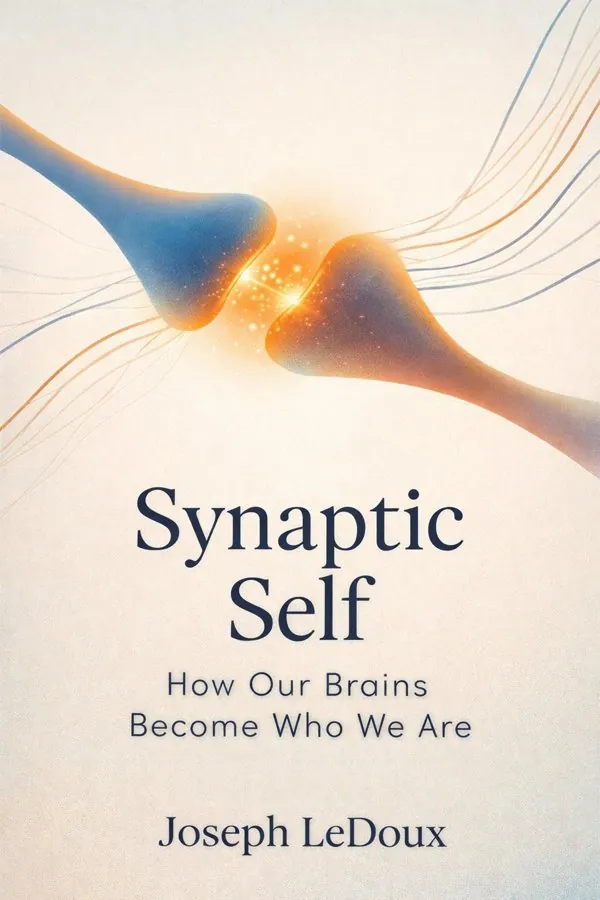
Synaptic Self: How Our Brains Become Who We Are: Summary & Key Insights
 10 min10 chaptersAudio available
Key Takeaways from Synaptic Self: How Our Brains Become Who We Are
The most important fact about the brain is also the easiest to overlook: it is not a static object but a living communication system.
If identity were built on unchanging brain structures, growth would be limited.
Who would you be without memory?
We often like to imagine that reason runs the show, but LeDoux’s work on emotion demonstrates how quickly emotional systems can shape experience and behavior.
One of LeDoux’s most intriguing claims is that consciousness is only part of the mind, not its master.
What Is Synaptic Self: How Our Brains Become Who We Are About?
Synaptic Self: How Our Brains Become Who We Are by Joseph LeDoux is a neuroscience book spanning 10 pages. What makes you the particular person you are? Joseph LeDoux’s Synaptic Self argues that the answer lies not in an immaterial essence, but in the living circuitry of the brain. In this ambitious and accessible work, LeDoux explains how identity emerges from billions of neurons linked by synapses that constantly change with experience. Memory, emotion, habits, personality, and even our feeling of being a self are shaped by these shifting neural connections. The book matters because it bridges one of the oldest human questions—who am I?—with modern neuroscience. Rather than treating the self as mystical or fixed, LeDoux shows it as biological, dynamic, and continuously updated by learning. This perspective has powerful implications for education, parenting, therapy, mental health, and personal growth. LeDoux writes with unusual authority. A leading neuroscientist at New York University, he is especially known for his groundbreaking research on emotion, fear, and the amygdala. In Synaptic Self, he brings together decades of scientific work to offer a compelling idea: to understand the self, we must understand how the brain changes through experience.
This FizzRead summary covers all 10 key chapters of Synaptic Self: How Our Brains Become Who We Are in approximately 10 minutes, distilling the most important ideas, arguments, and takeaways from Joseph LeDoux's work. Also available as an audio summary and Key Quotes Podcast.
Synaptic Self: How Our Brains Become Who We Are
What makes you the particular person you are? Joseph LeDoux’s Synaptic Self argues that the answer lies not in an immaterial essence, but in the living circuitry of the brain. In this ambitious and accessible work, LeDoux explains how identity emerges from billions of neurons linked by synapses that constantly change with experience. Memory, emotion, habits, personality, and even our feeling of being a self are shaped by these shifting neural connections.
The book matters because it bridges one of the oldest human questions—who am I?—with modern neuroscience. Rather than treating the self as mystical or fixed, LeDoux shows it as biological, dynamic, and continuously updated by learning. This perspective has powerful implications for education, parenting, therapy, mental health, and personal growth.
LeDoux writes with unusual authority. A leading neuroscientist at New York University, he is especially known for his groundbreaking research on emotion, fear, and the amygdala. In Synaptic Self, he brings together decades of scientific work to offer a compelling idea: to understand the self, we must understand how the brain changes through experience.
Who Should Read Synaptic Self: How Our Brains Become Who We Are?
This book is perfect for anyone interested in neuroscience and looking to gain actionable insights in a short read. Whether you're a student, professional, or lifelong learner, the key ideas from Synaptic Self: How Our Brains Become Who We Are by Joseph LeDoux will help you think differently.
- ✓Readers who enjoy neuroscience and want practical takeaways
- ✓Professionals looking to apply new ideas to their work and life
- ✓Anyone who wants the core insights of Synaptic Self: How Our Brains Become Who We Are in just 10 minutes
Want the full summary?
Get instant access to this book summary and 100K+ more with Fizz Moment.
Get Free SummaryAvailable on App Store • Free to download
Key Chapters
The most important fact about the brain is also the easiest to overlook: it is not a static object but a living communication system. LeDoux begins with the idea that the brain is made of neurons linked by synapses, and that the patterns of communication across this network are what make perception, thought, emotion, and action possible. A single neuron means little on its own. What matters is how huge numbers of neurons connect, fire, inhibit, and reinforce one another in coordinated circuits.
This network perspective changes how we think about the mind. Instead of imagining memory or personality as things stored in neat mental boxes, LeDoux shows that they emerge from distributed activity across many brain systems. Vision, language, fear, reward, planning, and bodily regulation each rely on specialized circuits, but these systems also interact constantly. The self, in this view, is not a single command center hidden somewhere in the skull. It is an organized pattern produced by many networks working together over time.
This has practical value. If brains are networks, then repeated experiences matter enormously because they shape which pathways become efficient and which remain weak. A child learning music, an adult practicing meditation, or someone recovering from trauma is literally changing patterns of neural communication through repetition and attention.
LeDoux’s network model also encourages humility. There is rarely one simple cause behind a behavior or feeling, because multiple systems contribute to any moment of experience. Actionable takeaway: start viewing your habits, moods, and abilities as products of trainable brain networks, and use repetition deliberately to strengthen the patterns you want to live by.
If identity were built on unchanging brain structures, growth would be limited. LeDoux’s central insight is the opposite: synapses are plastic. They strengthen, weaken, form, and disappear based on use, chemistry, development, and experience. This capacity for change—synaptic plasticity—is the biological foundation of learning. We become who we are because life leaves traces in the connections among neurons.
LeDoux explains that when certain neural pathways are repeatedly activated, the synapses involved often become more effective. This is the basis of long-term potentiation and related mechanisms that help encode learning. In simpler terms, practice leaves a physical mark. Skills improve because relevant circuits become more efficient. Emotional reactions become more automatic when the same cues repeatedly trigger the same responses. Beliefs can feel deeply ingrained because the pathways supporting them have been reinforced over years.
Plasticity is hopeful, but it is also sobering. Harmful experiences can become embedded too. Chronic stress, repeated fear, destructive self-talk, and compulsive routines can strengthen patterns that later feel like personality. Yet because synapses remain modifiable, change is possible. Therapy, education, relationships, sleep, and new routines can all alter how brain circuits function.
Consider everyday life: learning a language, practicing public speaking, or trying to become less reactive in conflict. None of these changes happen by insight alone. They require repeated experiences that reshape synaptic strength. LeDoux makes clear that transformation is biological, not merely motivational.
Actionable takeaway: choose one behavior you want to change and pair it with consistent repetition, because enduring personal change happens when new experiences are repeated enough to rewire old synaptic patterns.
Who would you be without memory? LeDoux argues that memory is not just something the self possesses; it is one of the main ingredients from which the self is built. Our sense of identity depends on accumulated traces of experience stored in distributed neural systems. These traces shape what we expect, what we notice, what we fear, what we value, and how we interpret the present.
The book distinguishes among different forms of memory. Some memories are explicit and conscious, such as facts and personal episodes. Others are implicit, expressed in habits, bodily responses, emotional reactions, and learned skills without requiring conscious recall. This distinction matters because much of who we are operates beneath awareness. You may not remember every event that taught you caution, confidence, or distrust, but your brain may still carry those lessons in its circuitry.
LeDoux is especially insightful in showing that memory is not a perfect recording device. The brain reconstructs rather than replays the past. As memories are retrieved, modified, and stored again, they can change. This means identity is partly stable and partly revisable. The stories we tell about ourselves matter, but so do the nonverbal emotional and procedural memories that shape behavior outside conscious narration.
In practical terms, this helps explain why someone can “know” logically that they are safe and still feel anxious, or why an old song can instantly revive forgotten feelings. Memory networks link past and present continuously. To work on the self, we must work with memory systems, not against them.
Actionable takeaway: reflect on both your conscious life story and your recurring automatic reactions, because lasting self-understanding comes from recognizing how explicit and implicit memories together shape who you are.
We often like to imagine that reason runs the show, but LeDoux’s work on emotion demonstrates how quickly emotional systems can shape experience and behavior. A major focus of Synaptic Self is the amygdala, a key brain structure involved in detecting threat and assigning emotional significance to events. LeDoux famously shows that emotional responses can be triggered before conscious awareness fully catches up.
This does not mean emotions are irrational noise. It means they are adaptive systems designed to help organisms survive. The brain continuously evaluates the environment for opportunity and danger, and emotional circuits mobilize the body accordingly. Fear can sharpen attention, speed up reaction, and bias interpretation. These responses are useful when danger is real, but they can become maladaptive when learned associations generalize too broadly.
LeDoux explains that emotional learning is often durable because it is tied to survival. A frightening event can create long-lasting associations between cues and bodily alarm. That is why people may react strongly to situations that only resemble an earlier threat. Understanding this helps make sense of phobias, trauma, anxiety, and everyday overreactions.
The practical lesson is not to suppress emotion but to understand how it is learned and how it can be retrained. Exposure therapy, calming practices, cognitive reframing, and safe repeated experiences can help weaken harmful emotional associations and build new ones. Emotions are biological events shaped by history.
Actionable takeaway: when a strong feeling seems disproportionate, ask what your brain may have learned to associate with the situation, then gradually create new experiences that teach your emotional system a different response.
One of LeDoux’s most intriguing claims is that consciousness is only part of the mind, not its master. Much of brain processing happens outside awareness, and conscious experience emerges from underlying neural activity that has already done a great deal of work. The self we can describe in words is therefore only one layer of the larger synaptic self.
LeDoux challenges the comforting idea of a single inner observer directing everything from a central seat of command. Instead, he presents consciousness as a higher-order construction arising when brain systems represent and integrate information in particular ways. The conscious self helps us narrate, reflect, plan, and report our experience, but many emotional, perceptual, and behavioral processes unfold automatically before they become part of conscious awareness.
This has major implications. It means people are often less transparent to themselves than they assume. We confabulate reasons, rationalize actions, and discover motives only after behavior has already been influenced by deeper systems. Yet this does not reduce us to machines. Consciousness still matters because it allows monitoring, meaning-making, social communication, and intentional practice that can feed back into the brain.
Think of habit change. You may become conscious of a destructive pattern only after it has repeatedly occurred. That awareness alone may not stop it, but it is the first step in designing new routines that gradually reshape the nonconscious circuitry driving the behavior. Consciousness is not all-powerful, but it is strategically important.
Actionable takeaway: treat self-awareness as a tool rather than a complete explanation—notice your patterns consciously, then build environments and routines that help retrain the deeper systems beneath awareness.
Personality can feel fixed, as though people are born with a permanent emotional style. LeDoux offers a more nuanced view. Biological predispositions matter, but personality is also the product of repeated interactions among genes, brain development, experience, memory, and social context. Over time, stable patterns of perception, feeling, and behavior emerge because certain neural pathways are used more than others.
This perspective helps explain both continuity and change. A person may show long-standing tendencies toward caution, impulsivity, sociability, or sensitivity because their neural systems have developed in particular ways. Early temperament, family life, stress exposure, reinforcement, and culture all help consolidate those traits. The result is not a mysterious essence but a durable organization of synaptic patterns.
Importantly, durability is not destiny. Personality feels stable because patterns become self-reinforcing. For example, someone with strong social anxiety avoids social situations, gains short-term relief, and thereby reinforces the anxious circuit. Someone praised for persistence keeps practicing and strengthens confidence. Repetition turns tendencies into traits.
This view is empowering because it suggests that change requires more than wishing to be different. If you want to become calmer, more disciplined, or more open, you need repeated behaviors and environments that support those qualities. Journaling, therapy, coaching, and deliberate practice can all help, but only if they produce new behavioral and emotional repetitions.
Actionable takeaway: identify one trait you consider “just who I am,” then test whether it is actually a repeated pattern—if it is, begin changing it through small, consistent actions that give your brain evidence for a new way of being.
The old debate between nature and nurture breaks down in LeDoux’s account because brains are built by both biological inheritance and lived experience. Genes influence how neural systems are assembled and how easily certain kinds of learning occur, but genes do not specify a finished self. Experience shapes which potentials are realized, which circuits are strengthened, and which behavioral styles become dominant.
LeDoux presents the self as the outcome of ongoing interaction. Genes provide the materials and constraints for brain development, while environment supplies the input that sculpts synaptic organization. This includes family relationships, education, trauma, nutrition, culture, stress, opportunity, and chance encounters. The result is a dynamic developmental process, not a fixed blueprint.
This framework avoids two common mistakes. First, it rejects genetic fatalism, the idea that we are simply programmed. Second, it rejects naive environmentalism, the idea that experience alone can fully rewrite biology at will. Human beings are plastic, but plasticity itself is biologically grounded and unevenly distributed.
In practical life, this means compassion and responsibility must go together. People differ in temperament and vulnerability for reasons partly beyond their control, yet supportive environments can still make enormous differences. Parenting, schooling, therapy, and public policy matter because they affect developing brains when plasticity is high.
For adults, the message remains relevant: your past shaped your brain, but current experience still matters. The self is constrained, not sealed. Actionable takeaway: stop asking whether a trait is caused by genes or environment, and instead ask how biology and experience are interacting right now—and what environmental changes could shift that interaction in a healthier direction.
Mental suffering often feels moral or personal, but LeDoux frames many disorders in neural terms: when synaptic systems process emotion, memory, reward, or regulation in distorted ways, symptoms emerge. Anxiety, depression, addiction, and trauma-related conditions are not merely bad attitudes or weak character. They often involve maladaptive patterns in brain circuits that have become deeply learned and biologically entrenched.
This does not mean disorders are simple mechanical defects. LeDoux avoids reductionism by showing that brains exist in bodies, relationships, and cultures. Still, the synaptic perspective is useful because it explains why symptoms can be persistent, involuntary, and difficult to change through willpower alone. A panic response, compulsive urge, or depressive bias reflects real patterns of neural activity shaped by genetics, stress, history, and learning.
The encouraging side of this view is that treatment can work because brains can change. Medication may alter neurochemical conditions that affect synaptic communication. Psychotherapy can build new associations, narratives, and regulation strategies. Behavioral interventions can retrain habit loops. Social support can reduce stress and create conditions for healthier plasticity. Recovery often requires repeated corrective experiences that slowly reshape brain networks.
LeDoux’s framework also reduces shame. If symptoms are rooted in learned and biological circuitry, then seeking help is not a weakness but a form of neural rehabilitation. The goal is not becoming a different species of person, but helping the brain establish more adaptive patterns.
Actionable takeaway: if you struggle with recurring emotional or behavioral symptoms, approach them as changeable brain-based patterns and seek structured support that provides repeated experiences of regulation, safety, and new learning.
We often talk about the self as though it were purely private, but LeDoux makes clear that no brain develops in isolation. Social interaction and culture help shape synaptic organization from the beginning. Language, norms, expectations, rituals, stories, and relationships all provide patterned input that the brain encodes. The self is biological, but it is also socially constructed through biology.
This means even our most personal experiences are influenced by collective frameworks. What we learn to fear, admire, suppress, desire, or consider normal depends partly on the social worlds we inhabit. Families teach emotional styles. Schools reinforce attention and self-control in particular ways. Peer groups influence reward sensitivity. Cultural narratives shape how people interpret success, failure, gender, morality, and identity.
LeDoux’s synaptic account therefore connects neuroscience with sociology and anthropology. Brains are not detached computers processing neutral data. They are living organs tuned by human environments. A person raised in chronic instability may develop hypervigilant circuits. Someone raised in a nurturing and exploratory setting may develop stronger confidence and curiosity. Social inequality, trauma, and community support all leave neural traces.
This insight has practical consequences for how we think about change. Personal growth is not only a matter of internal discipline; it also depends on the environments that feed the brain day after day. The people around you are helping shape your nervous system, for better or worse.
Actionable takeaway: audit your social and cultural inputs—relationships, media, routines, and communities—and intentionally increase the ones that reinforce calm, curiosity, and resilience in your brain.
The deepest message of Synaptic Self is both unsettling and liberating: there is no finished self hidden behind your experiences. The self is an ongoing process, continually reconstructed as synapses change across the lifespan. Stability exists, but it is the stability of patterns, not of an unchanging core. We remain recognizably ourselves because many neural organizations persist, yet we are always being updated by learning, loss, reflection, relationship, and adaptation.
LeDoux’s dynamic model dissolves false opposites. You are neither a perfectly free creator of yourself nor a rigidly determined machine. Instead, you are a changing organism whose past is embedded in neural circuitry and whose future depends on what that circuitry encounters next. Every major life event—love, grief, education, trauma, success, failure—can alter the architecture that supports identity.
This view encourages realism. Change is possible, but usually gradual. Old patterns do not disappear because you make a resolution; they weaken when new pathways are repeatedly activated in meaningful contexts. It also encourages compassion. If people are dynamic systems shaped by history, then growth should be expected to take time, support, and repetition.
In everyday life, the dynamic self perspective can transform how you approach setbacks. A difficult period does not reveal your permanent essence. It reflects the current state of your brain’s learned patterns under present conditions. Change the conditions, repeat new responses, and the self can shift.
Actionable takeaway: replace the phrase “this is just who I am” with “this is the pattern my brain has learned so far,” and use that mindset to keep building experiences that move your identity in the direction you want.
All Chapters in Synaptic Self: How Our Brains Become Who We Are
About the Author
Joseph LeDoux is an American neuroscientist, author, and professor widely recognized for his pioneering research on emotion, memory, and the brain mechanisms of fear. Based for many years at New York University, he became especially influential through his work on the amygdala and the neural pathways involved in threat detection and emotional learning. LeDoux is known for combining rigorous laboratory science with clear, engaging writing for general readers. His books have helped shape public understanding of how the brain produces feelings, behavior, and conscious experience. In Synaptic Self, he brings together decades of research to examine one of the biggest questions in science and philosophy: how the brain gives rise to personal identity. His work stands at the crossroads of neuroscience, psychology, and the study of the self.
Get This Summary in Your Preferred Format
Read or listen to the Synaptic Self: How Our Brains Become Who We Are summary by Joseph LeDoux anytime, anywhere. FizzRead offers multiple formats so you can learn on your terms — all free.
Available formats: App · Audio · PDF · EPUB — All included free with FizzRead
Download Synaptic Self: How Our Brains Become Who We Are PDF and EPUB Summary
Key Quotes from Synaptic Self: How Our Brains Become Who We Are
“The most important fact about the brain is also the easiest to overlook: it is not a static object but a living communication system.”
“If identity were built on unchanging brain structures, growth would be limited.”
“LeDoux argues that memory is not just something the self possesses; it is one of the main ingredients from which the self is built.”
“We often like to imagine that reason runs the show, but LeDoux’s work on emotion demonstrates how quickly emotional systems can shape experience and behavior.”
“One of LeDoux’s most intriguing claims is that consciousness is only part of the mind, not its master.”
Frequently Asked Questions about Synaptic Self: How Our Brains Become Who We Are
Synaptic Self: How Our Brains Become Who We Are by Joseph LeDoux is a neuroscience book that explores key ideas across 10 chapters. What makes you the particular person you are? Joseph LeDoux’s Synaptic Self argues that the answer lies not in an immaterial essence, but in the living circuitry of the brain. In this ambitious and accessible work, LeDoux explains how identity emerges from billions of neurons linked by synapses that constantly change with experience. Memory, emotion, habits, personality, and even our feeling of being a self are shaped by these shifting neural connections. The book matters because it bridges one of the oldest human questions—who am I?—with modern neuroscience. Rather than treating the self as mystical or fixed, LeDoux shows it as biological, dynamic, and continuously updated by learning. This perspective has powerful implications for education, parenting, therapy, mental health, and personal growth. LeDoux writes with unusual authority. A leading neuroscientist at New York University, he is especially known for his groundbreaking research on emotion, fear, and the amygdala. In Synaptic Self, he brings together decades of scientific work to offer a compelling idea: to understand the self, we must understand how the brain changes through experience.
More by Joseph LeDoux
You Might Also Like
Anxious
Joseph LeDoux
10 min
Hallucinations
Oliver Sacks
10 min
The Biological Mind: How Brain, Body, and Environment Collaborate to Make Us Who We Are
Alan Jasanoff
10 min
The Feeling of Life Itself: Why Consciousness Is Widespread but Can't Be Computed
Christof Koch
10 min
The No-Nonsense Meditation Book
Steven Laureys
10 min
A General Theory of Love
Thomas Lewis, Fari Amini, Richard Lannon
10 minBrowse by Category
Ready to read Synaptic Self: How Our Brains Become Who We Are?
Get the full summary and 100K+ more books with Fizz Moment.