
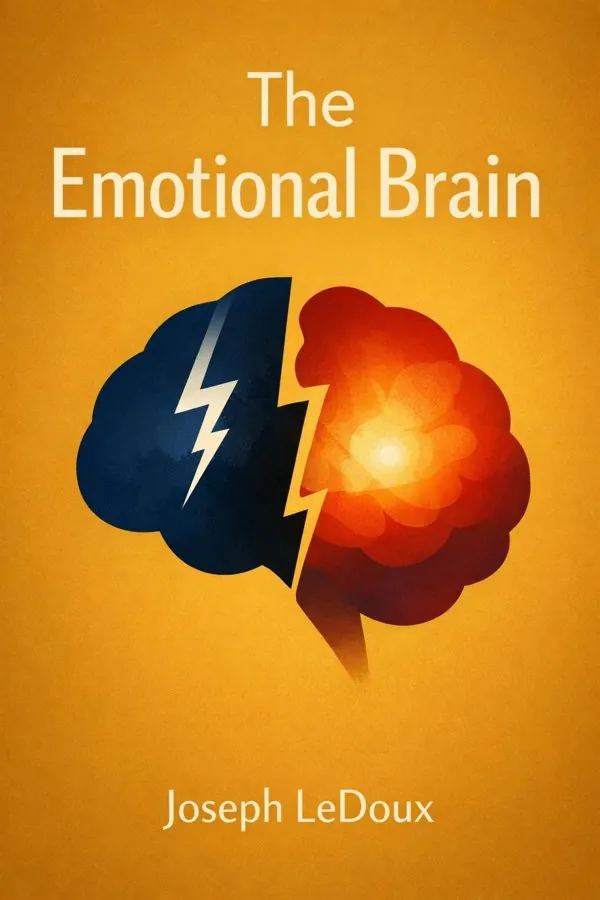
The Emotional Brain: The Mysterious Underpinnings of Emotional Life: Summary & Key Insights
 10 min5 chaptersAudio available
What Is The Emotional Brain: The Mysterious Underpinnings of Emotional Life About?
The Emotional Brain: The Mysterious Underpinnings of Emotional Life by Joseph LeDoux is a neuroscience book spanning 5 pages. In this groundbreaking work, neuroscientist Joseph LeDoux explores how emotions are created in the brain, focusing on the mechanisms of fear and the amygdala’s role in emotional processing. Drawing on decades of research, LeDoux explains how emotional memories shape behavior and how understanding the brain’s emotional systems can illuminate human experience and mental health.
This FizzRead summary covers all 5 key chapters of The Emotional Brain: The Mysterious Underpinnings of Emotional Life in approximately 10 minutes, distilling the most important ideas, arguments, and takeaways from Joseph LeDoux's work. Also available as an audio summary and Key Quotes Podcast.
The Emotional Brain: The Mysterious Underpinnings of Emotional Life
In this groundbreaking work, neuroscientist Joseph LeDoux explores how emotions are created in the brain, focusing on the mechanisms of fear and the amygdala’s role in emotional processing. Drawing on decades of research, LeDoux explains how emotional memories shape behavior and how understanding the brain’s emotional systems can illuminate human experience and mental health.
Who Should Read The Emotional Brain: The Mysterious Underpinnings of Emotional Life?
This book is perfect for anyone interested in neuroscience and looking to gain actionable insights in a short read. Whether you're a student, professional, or lifelong learner, the key ideas from The Emotional Brain: The Mysterious Underpinnings of Emotional Life by Joseph LeDoux will help you think differently.
- ✓Readers who enjoy neuroscience and want practical takeaways
- ✓Professionals looking to apply new ideas to their work and life
- ✓Anyone who wants the core insights of The Emotional Brain: The Mysterious Underpinnings of Emotional Life in just 10 minutes
Want the full summary?
Get instant access to this book summary and 100K+ more with Fizz Moment.
Get Free SummaryAvailable on App Store • Free to download
Key Chapters
Early attempts to localize emotion in the brain produced what we now call the 'limbic system' theory — an ensemble of structures thought to mediate feelings. While this framework helped guide inquiry, it eventually became clear that the limbic system is neither a single emotion center nor spatially distinct from cognition. Instead, emotion arises from circuits distributed across multiple regions, interacting dynamically with sensory, motor, and cognitive systems.
Central among these circuits is the amygdala, a small almond-shaped structure buried within the temporal lobe. Initially discovered through animal lesion studies, the amygdala emerged as crucial for recognizing and responding to emotionally significant stimuli, particularly threats. It acts as a hub where sensory information converges and is rapidly evaluated for emotional relevance. When danger looms, this tiny structure can activate before conscious awareness — triggering physiological responses that prepare the body for action.
Understanding this architecture also requires acknowledging how emotion and cognition intertwine. The prefrontal cortex, for instance, regulates emotional reactions by integrating context and goals, shaping whether an amygdala-triggered fear leads to panic or restraint. Likewise, the hippocampus contributes memory-based information that helps distinguish a genuinely threatening situation from a harmless reminder of one.
In exploring these interactions, I came to see emotion not as a single process but as a networked orchestration of perception, memory, and action. The amygdala’s efficiency — honed across evolution — ensures that danger is detected before deliberation. Yet its interplay with cortical regions allows higher reasoning to refine instinct. This balance between speed and reflection defines our emotional intelligence and our vulnerability alike.
To truly understand emotion scientifically, we needed a behavioral model that was both measurable and meaningful. This is why I centered much of my work on fear conditioning — pairing a neutral stimulus (like a tone) with an aversive one (such as a mild shock) until the tone alone elicits fear responses. What seems a simple paradigm opened a window into the emotional brain. By recording neural activity during such learning, we discovered precise pathways through which sensory input reaches the amygdala.
Two paths in particular emerged: the 'low road' and the 'high road.' The low road sends information directly from the sensory thalamus to the amygdala, allowing extremely fast, albeit crude, assessments of danger. The high road, by contrast, routes information through the cortex, enabling detail, context, and conscious evaluation. These dual systems explain how one can jump at a shadow before realizing it’s harmless — the amygdala has already sounded the alarm before the cortex has time to analyze.
My experiments and those of colleagues showed that the amygdala not only detects threat but stores emotional memories of fear. When its connections are disrupted, fear conditioning fails; when stimulated, fear can be triggered without external danger. This work transformed our understanding of memory: emotional memory operates through mechanisms distinct from declarative, consciously recalled memory. You may not remember why you fear something, yet your body and brain still do.
This discovery also holds profound implications for mental health. Disorders like phobias, post-traumatic stress, and generalized anxiety stem from maladaptive fear memories. By identifying the circuits that encode them, we can design therapies — behavioral and pharmacological — to weaken or recontextualize these responses. Understanding emotion scientifically thus redirects our approach to suffering: it suggests that to change our feelings, we must address the neural systems that sustain them.
+ 3 more chapters — available in the FizzRead app
All Chapters in The Emotional Brain: The Mysterious Underpinnings of Emotional Life
About the Author
Joseph LeDoux is an American neuroscientist and professor at New York University, known for his pioneering research on the brain mechanisms of emotion and memory, particularly the neural circuits underlying fear and anxiety.
Get This Summary in Your Preferred Format
Read or listen to the The Emotional Brain: The Mysterious Underpinnings of Emotional Life summary by Joseph LeDoux anytime, anywhere. FizzRead offers multiple formats so you can learn on your terms — all free.
Available formats: App · Audio · PDF · EPUB — All included free with FizzRead
Download The Emotional Brain: The Mysterious Underpinnings of Emotional Life PDF and EPUB Summary
Key Quotes from The Emotional Brain: The Mysterious Underpinnings of Emotional Life
“Early attempts to localize emotion in the brain produced what we now call the 'limbic system' theory — an ensemble of structures thought to mediate feelings.”
“To truly understand emotion scientifically, we needed a behavioral model that was both measurable and meaningful.”
Frequently Asked Questions about The Emotional Brain: The Mysterious Underpinnings of Emotional Life
The Emotional Brain: The Mysterious Underpinnings of Emotional Life by Joseph LeDoux is a neuroscience book that explores key ideas across 5 chapters. In this groundbreaking work, neuroscientist Joseph LeDoux explores how emotions are created in the brain, focusing on the mechanisms of fear and the amygdala’s role in emotional processing. Drawing on decades of research, LeDoux explains how emotional memories shape behavior and how understanding the brain’s emotional systems can illuminate human experience and mental health.
More by Joseph LeDoux
You Might Also Like
Anxious
Joseph LeDoux
10 min
Hallucinations
Oliver Sacks
10 min
The Biological Mind: How Brain, Body, and Environment Collaborate to Make Us Who We Are
Alan Jasanoff
10 min
The Feeling of Life Itself: Why Consciousness Is Widespread but Can't Be Computed
Christof Koch
10 min
The No-Nonsense Meditation Book
Steven Laureys
10 min
A General Theory of Love
Thomas Lewis, Fari Amini, Richard Lannon
10 minBrowse by Category
Ready to read The Emotional Brain: The Mysterious Underpinnings of Emotional Life?
Get the full summary and 100K+ more books with Fizz Moment.