
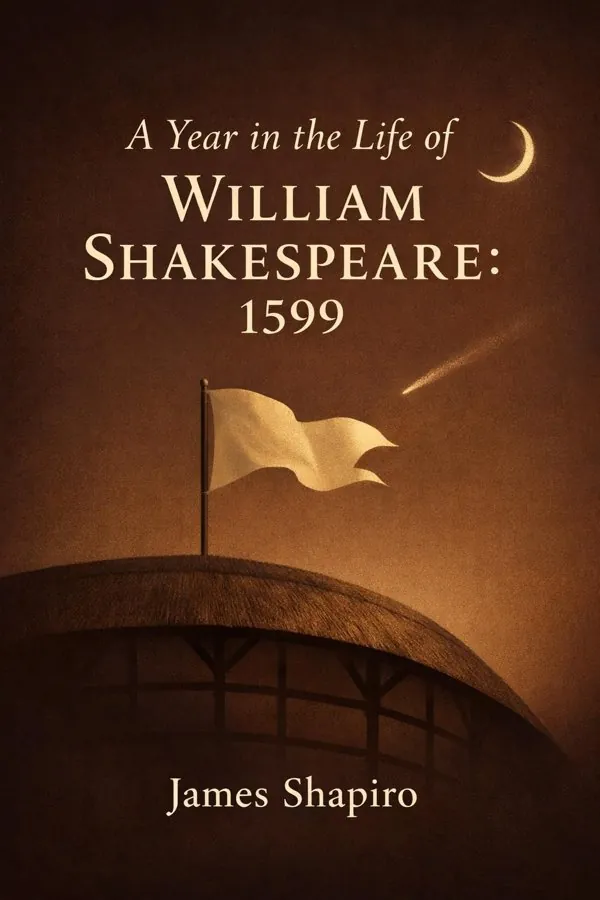
A Year in the Life of William Shakespeare: 1599: Summary & Key Insights
 10 min9 chaptersAudio available
What Is A Year in the Life of William Shakespeare: 1599 About?
A Year in the Life of William Shakespeare: 1599 by James Shapiro is a world_history book spanning 9 pages. In this acclaimed work of literary history, James Shapiro reconstructs the pivotal year 1599 in the life of William Shakespeare, when the playwright wrote some of his most enduring works, including 'Henry V', 'Julius Caesar', 'As You Like It', and 'Hamlet'. Shapiro situates these plays within the political, social, and cultural upheavals of Elizabethan England, offering a vivid portrait of how the events of that year shaped Shakespeare’s imagination and artistry.
This FizzRead summary covers all 9 key chapters of A Year in the Life of William Shakespeare: 1599 in approximately 10 minutes, distilling the most important ideas, arguments, and takeaways from James Shapiro's work. Also available as an audio summary and Key Quotes Podcast.
A Year in the Life of William Shakespeare: 1599
In this acclaimed work of literary history, James Shapiro reconstructs the pivotal year 1599 in the life of William Shakespeare, when the playwright wrote some of his most enduring works, including 'Henry V', 'Julius Caesar', 'As You Like It', and 'Hamlet'. Shapiro situates these plays within the political, social, and cultural upheavals of Elizabethan England, offering a vivid portrait of how the events of that year shaped Shakespeare’s imagination and artistry.
Who Should Read A Year in the Life of William Shakespeare: 1599?
This book is perfect for anyone interested in world_history and looking to gain actionable insights in a short read. Whether you're a student, professional, or lifelong learner, the key ideas from A Year in the Life of William Shakespeare: 1599 by James Shapiro will help you think differently.
- ✓Readers who enjoy world_history and want practical takeaways
- ✓Professionals looking to apply new ideas to their work and life
- ✓Anyone who wants the core insights of A Year in the Life of William Shakespeare: 1599 in just 10 minutes
Want the full summary?
Get instant access to this book summary and 100K+ more with Fizz Moment.
Get Free SummaryAvailable on App Store • Free to download
Key Chapters
The Globe was born not from opportunity alone, but from crisis. When the lease on the Lord Chamberlain’s Men’s previous playhouse, The Theatre, expired late in 1598, the actors faced ruin. Yet what followed was both audacious and emblematic of Shakespeare’s epoch. In the dead of winter, the company literally dismantled The Theatre, plank by plank, ferried its timbers across the Thames, and reconstructed it on the Bankside, thereby creating the Globe.
The Globe was not merely a new building—it was a declaration of identity. In an era when playing companies were constantly at the mercy of landlords and censors, the Globe represented autonomy, a space built and owned by the actors themselves. Its circular, open-air form symbolized inclusion, providing a stage from which England could see itself reflected through comedy, tragedy, and history alike.
What mattered most was not its physical scope but its imaginative one. Inside the Globe, Shakespeare found new freedom to experiment with theatrical form. The flexibility of the stage allowed complex interactions between actor and audience, encouraging Shakespeare to write dramas that depended on public engagement—plays that spoke directly to the crowd’s passions and fears. That vitality would define the works of 1599.
The construction of the Globe thus prefigures Shakespeare’s transformation. The sheer labor, risk, and vision involved mirror the creative energy necessary for his most lasting works. When we think of *Henry V* performed before cheering groundlings or *Hamlet* contemplating existence under the same sky, the Globe becomes a metaphor for national imagination—an arena where England itself could confront its own contradictions.
In *Henry V*, Shakespeare captured a nation’s dream of unity at a moment when disunity threatened everywhere. The play’s central figure, King Henry, embodies decisive leadership and national purpose—qualities England sought but scarcely found as Essex’s forces faltered in Ireland. The resonance between Henry’s conquest of France and England’s beleaguered expedition against Irish rebellion is unmistakable.
Writing in 1599, Shakespeare understood that audiences wanted reassurance that England could still act heroically. Yet beneath the patriotic surface, he seeded questions about the cost of glory. Henry’s stirring speeches celebrate valor, but the play also acknowledges mortality and moral ambiguity. The execution of traitors, the rough deaths of soldiers, the uneasy humor around warfare—all these temper triumph with introspection.
This duality reflects Shakespeare’s sensitivity to his age. The queen’s government preached unity, but succession loomed unresolved; England’s faith in itself was fracturing. Through *Henry V*, Shakespeare gave form to both the aspiration and anxiety of nationhood. The king’s rhetoric—his appeal to comradeship and conviction—was an echo of what subjects longed to hear from their own rulers.
For me, exploring *Henry V* means exploring the heartbeat of Elizabethan nationalism. It is not simply a play about leading men to battle; it is about the fragile making of an English identity amid conflict and self-doubt. Written as the Globe first opened, it became a rallying performance for a country facing the threshold between its medieval certainties and a modern consciousness.
+ 7 more chapters — available in the FizzRead app
All Chapters in A Year in the Life of William Shakespeare: 1599
About the Author
James Shapiro is an American scholar and professor of English and Comparative Literature at Columbia University, specializing in Shakespeare and early modern literature. He is known for his accessible and deeply researched works on Shakespeare’s life and times, including '1599: A Year in the Life of William Shakespeare' and 'Contested Will: Who Wrote Shakespeare?'.
Get This Summary in Your Preferred Format
Read or listen to the A Year in the Life of William Shakespeare: 1599 summary by James Shapiro anytime, anywhere. FizzRead offers multiple formats so you can learn on your terms — all free.
Available formats: App · Audio · PDF · EPUB — All included free with FizzRead
Download A Year in the Life of William Shakespeare: 1599 PDF and EPUB Summary
Key Quotes from A Year in the Life of William Shakespeare: 1599
“The Globe was born not from opportunity alone, but from crisis.”
“In *Henry V*, Shakespeare captured a nation’s dream of unity at a moment when disunity threatened everywhere.”
Frequently Asked Questions about A Year in the Life of William Shakespeare: 1599
A Year in the Life of William Shakespeare: 1599 by James Shapiro is a world_history book that explores key ideas across 9 chapters. In this acclaimed work of literary history, James Shapiro reconstructs the pivotal year 1599 in the life of William Shakespeare, when the playwright wrote some of his most enduring works, including 'Henry V', 'Julius Caesar', 'As You Like It', and 'Hamlet'. Shapiro situates these plays within the political, social, and cultural upheavals of Elizabethan England, offering a vivid portrait of how the events of that year shaped Shakespeare’s imagination and artistry.
More by James Shapiro
You Might Also Like
The Age of Capital
Eric Hobsbawm
10 min
The Gulag Archipelago
Aleksandr Solzhenitsyn
10 min
Jerusalem: The Biography
Simon Sebag Montefiore
10 min
The Anglo-Saxons
James Campbell
10 min
The Boer War
Thomas Pakenham
10 min
The Industrial Revolutionaries: The Making of the Modern World 1776–1914
Gavin Weightman
10 minFeatured In
Browse by Category
Ready to read A Year in the Life of William Shakespeare: 1599?
Get the full summary and 100K+ more books with Fizz Moment.