
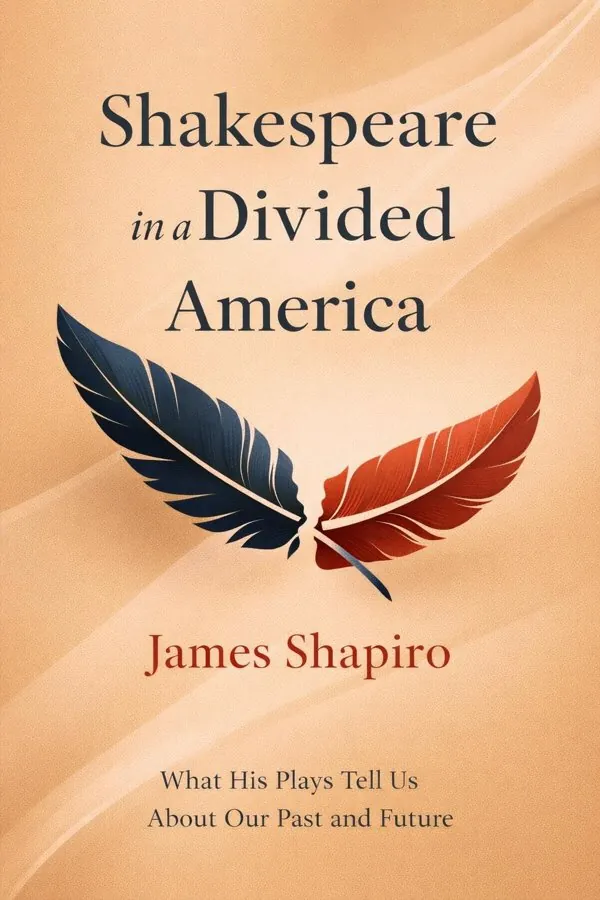
Shakespeare in a Divided America: What His Plays Tell Us About Our Past and Future: Summary & Key Insights
 10 min8 chaptersAudio available
What Is Shakespeare in a Divided America: What His Plays Tell Us About Our Past and Future About?
Shakespeare in a Divided America: What His Plays Tell Us About Our Past and Future by James Shapiro is a civilization book spanning 8 pages. A timely exploration by Shakespeare scholar James Shapiro of how the plays of William Shakespeare have reflected and shaped American political and cultural divisions from the founding era to the present day. Through episodes involving figures such as John Quincy Adams, Abraham Lincoln, and contemporary controversies, Shapiro reveals how Shakespeare’s works have served as a mirror for America’s struggles with race, gender, and identity.
This FizzRead summary covers all 8 key chapters of Shakespeare in a Divided America: What His Plays Tell Us About Our Past and Future in approximately 10 minutes, distilling the most important ideas, arguments, and takeaways from James Shapiro's work. Also available as an audio summary and Key Quotes Podcast.
Shakespeare in a Divided America: What His Plays Tell Us About Our Past and Future
A timely exploration by Shakespeare scholar James Shapiro of how the plays of William Shakespeare have reflected and shaped American political and cultural divisions from the founding era to the present day. Through episodes involving figures such as John Quincy Adams, Abraham Lincoln, and contemporary controversies, Shapiro reveals how Shakespeare’s works have served as a mirror for America’s struggles with race, gender, and identity.
Who Should Read Shakespeare in a Divided America: What His Plays Tell Us About Our Past and Future?
This book is perfect for anyone interested in civilization and looking to gain actionable insights in a short read. Whether you're a student, professional, or lifelong learner, the key ideas from Shakespeare in a Divided America: What His Plays Tell Us About Our Past and Future by James Shapiro will help you think differently.
- ✓Readers who enjoy civilization and want practical takeaways
- ✓Professionals looking to apply new ideas to their work and life
- ✓Anyone who wants the core insights of Shakespeare in a Divided America: What His Plays Tell Us About Our Past and Future in just 10 minutes
Want the full summary?
Get instant access to this book summary and 100K+ more with Fizz Moment.
Get Free SummaryAvailable on App Store • Free to download
Key Chapters
In the early decades of the Republic, Shakespeare stood as a paradoxical cultural figure. He was the Old World poet par excellence, yet no American writer could yet rival his breadth or linguistic power. Figures like John Quincy Adams wrestled with what that meant. Adams was among the most erudite of the Founding generation, but his response to *Othello* was colored by the racial politics of his age. He could not reconcile the idea of a noble black hero romantically linked to a white Venetian woman. His essays and correspondence reveal a discomfort that went beyond aesthetics—it reflected the racial hierarchy that was becoming institutionalized in American life. For Adams, Desdemona’s love was a moral error, and Othello’s tragic fall seemed to confirm that interracial desire was unnatural.
What fascinates me is not Adams’s prejudice per se, but how early Americans mapped their racial anxiety onto Shakespeare’s characters. Othello was enlisted to perform a moral drama about race, purity, and civilization. At a time when the young nation was deciding whether to expand slavery or curtail it, debates about Shakespeare became debates about who belonged in America. Staging *Othello* publicly raised questions that private conscience could not avoid. The fact that white actors played Othello in dark makeup only deepened the contradictions; theatre both exposed and disguised the racial tensions fermenting in the Republic.
Through Adams’s reaction, we glimpse how Shakespeare became interwoven with the American racial imagination. He was used to justify prejudice even as his words undermined it, showing the terrible and productive power of art when filtered through the moral lens of a developing nation.
Few presidents read Shakespeare as deeply as Abraham Lincoln. During the crisis of the Union, Lincoln found solace and reckoning in the tragedies, particularly *Macbeth* and *Hamlet*. He quoted them in his letters and even in everyday conversation. To me, Lincoln’s engagement with these works reveals not only his literary sensitivity but also his insight into moral conflict. He saw in Macbeth’s tortured conscience and Hamlet’s divided will the embodiment of a fractured nation.
When John Wilkes Booth, himself a Shakespearean actor and Confederate sympathizer, assassinated Lincoln, the tragedy unfolded with eerie theatrical symmetry. Booth had performed *Julius Caesar* with his brothers; he saw himself as Brutus, striking down a tyrant in the name of liberty. The intertwining of art and life was complete. Shakespeare’s explorations of ambition, tyranny, and legitimacy had become the script by which Americans acted out their politics.
What this moment exposes is Shakespeare’s double power: his capacity to humanize and to weaponize. Lincoln’s empathetic reading of the plays deepened his sense of universal suffering and forgiveness; Booth’s self-aggrandizing misreading turned those same verses into justification for murder. Shakespeare functioned as a common language through which Americans grappled with the moral crises of civil war, yet that very commonality intensified the conflict, for each side claimed him as its own prophet.
+ 6 more chapters — available in the FizzRead app
All Chapters in Shakespeare in a Divided America: What His Plays Tell Us About Our Past and Future
About the Author
James Shapiro is a professor of English and Comparative Literature at Columbia University and one of the leading Shakespeare scholars in the United States. He is known for works such as '1599: A Year in the Life of William Shakespeare' and 'The Year of Lear: Shakespeare in 1606', both of which won major literary awards.
Get This Summary in Your Preferred Format
Read or listen to the Shakespeare in a Divided America: What His Plays Tell Us About Our Past and Future summary by James Shapiro anytime, anywhere. FizzRead offers multiple formats so you can learn on your terms — all free.
Available formats: App · Audio · PDF · EPUB — All included free with FizzRead
Download Shakespeare in a Divided America: What His Plays Tell Us About Our Past and Future PDF and EPUB Summary
Key Quotes from Shakespeare in a Divided America: What His Plays Tell Us About Our Past and Future
“In the early decades of the Republic, Shakespeare stood as a paradoxical cultural figure.”
“Few presidents read Shakespeare as deeply as Abraham Lincoln.”
Frequently Asked Questions about Shakespeare in a Divided America: What His Plays Tell Us About Our Past and Future
Shakespeare in a Divided America: What His Plays Tell Us About Our Past and Future by James Shapiro is a civilization book that explores key ideas across 8 chapters. A timely exploration by Shakespeare scholar James Shapiro of how the plays of William Shakespeare have reflected and shaped American political and cultural divisions from the founding era to the present day. Through episodes involving figures such as John Quincy Adams, Abraham Lincoln, and contemporary controversies, Shapiro reveals how Shakespeare’s works have served as a mirror for America’s struggles with race, gender, and identity.
More by James Shapiro
You Might Also Like
The Structure of Scientific Revolutions
Thomas S. Kuhn
10 min
Genius
Harold Bloom
10 min
A Cultural History of the Medieval Age
Various Editors
10 min
A History of God: The 4,000-Year Quest of Judaism, Christianity and Islam
Karen Armstrong
10 min
A History of the World in 10½ Chapters
Julian Barnes
10 min
A Short History of Progress
Ronald Wright
10 minBrowse by Category
Ready to read Shakespeare in a Divided America: What His Plays Tell Us About Our Past and Future?
Get the full summary and 100K+ more books with Fizz Moment.