
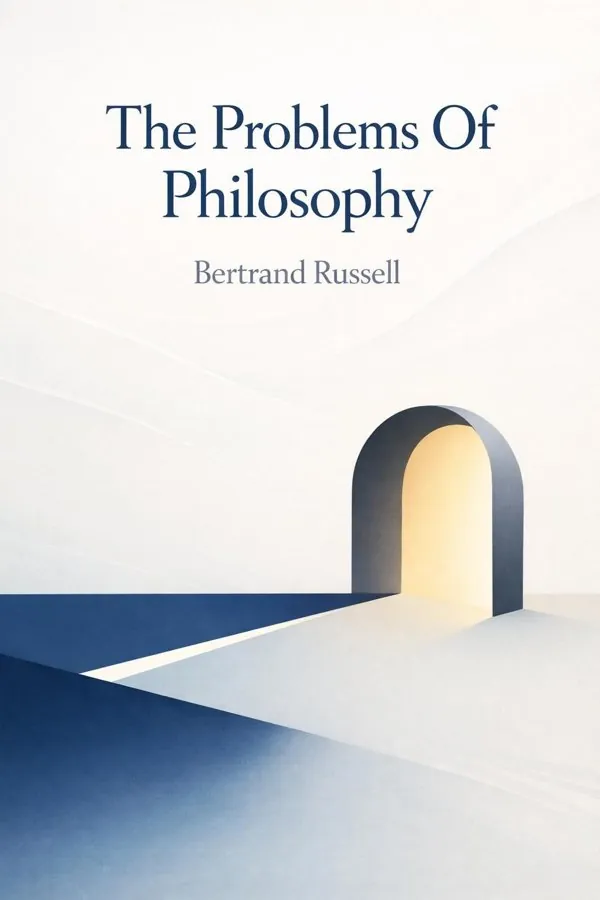
The Problems Of Philosophy: Summary & Key Insights
 10 min9 chaptersAudio available
Key Takeaways from The Problems Of Philosophy
What if the most familiar objects in your life are not quite what they seem?
We live as though the world continues when no one is looking, but can we actually prove it?
Some of the boldest philosophical ideas begin by questioning what everyone else takes for granted.
Not all knowledge has the same intimacy.
Every plan for tomorrow rests on a leap that logic alone cannot guarantee.
What Is The Problems Of Philosophy About?
The Problems Of Philosophy by Bertrand Russell is a western_phil book spanning 13 pages. Bertrand Russell’s The Problems Of Philosophy is one of the clearest and most influential introductions to philosophy ever written. In a remarkably compact work, Russell takes readers straight to the heart of the subject: How do we know anything? What is real beyond what appears to us? What makes a belief true or false? And what are the limits of human certainty? Rather than offering a system filled with jargon, Russell guides readers through philosophy’s central puzzles with precision, calm reasoning, and memorable examples, such as the famous discussion of the table that looks different under changing light. The book matters because it shows philosophy not as empty speculation, but as disciplined thinking about the foundations of knowledge, science, and everyday belief. Russell was uniquely qualified to write it. A pioneering logician and one of the founders of analytic philosophy, he combined technical brilliance with unusual clarity. The result is a book that remains fresh more than a century later: rigorous enough to challenge serious readers, yet accessible enough to awaken philosophical curiosity in anyone willing to question what seems obvious.
This FizzRead summary covers all 9 key chapters of The Problems Of Philosophy in approximately 10 minutes, distilling the most important ideas, arguments, and takeaways from Bertrand Russell's work. Also available as an audio summary and Key Quotes Podcast.
The Problems Of Philosophy
Bertrand Russell’s The Problems Of Philosophy is one of the clearest and most influential introductions to philosophy ever written. In a remarkably compact work, Russell takes readers straight to the heart of the subject: How do we know anything? What is real beyond what appears to us? What makes a belief true or false? And what are the limits of human certainty? Rather than offering a system filled with jargon, Russell guides readers through philosophy’s central puzzles with precision, calm reasoning, and memorable examples, such as the famous discussion of the table that looks different under changing light. The book matters because it shows philosophy not as empty speculation, but as disciplined thinking about the foundations of knowledge, science, and everyday belief. Russell was uniquely qualified to write it. A pioneering logician and one of the founders of analytic philosophy, he combined technical brilliance with unusual clarity. The result is a book that remains fresh more than a century later: rigorous enough to challenge serious readers, yet accessible enough to awaken philosophical curiosity in anyone willing to question what seems obvious.
Who Should Read The Problems Of Philosophy?
This book is perfect for anyone interested in western_phil and looking to gain actionable insights in a short read. Whether you're a student, professional, or lifelong learner, the key ideas from The Problems Of Philosophy by Bertrand Russell will help you think differently.
- ✓Readers who enjoy western_phil and want practical takeaways
- ✓Professionals looking to apply new ideas to their work and life
- ✓Anyone who wants the core insights of The Problems Of Philosophy in just 10 minutes
Want the full summary?
Get instant access to this book summary and 100K+ more with Fizz Moment.
Get Free SummaryAvailable on App Store • Free to download
Key Chapters
What if the most familiar objects in your life are not quite what they seem? Russell begins philosophy with a deceptively simple observation: the world as it appears to us is unstable. A table may look brown in one light, shiny in another, rectangular from one angle, oddly shaped from another. If its color, texture, and even shape shift with perspective, then what exactly are we perceiving? Russell uses this puzzle to distinguish between appearance and reality. What we directly experience are sense-data: colors, sounds, textures, and other immediate contents of consciousness. But the physical object itself, if it exists, is something inferred beyond those shifting appearances. This is not just an abstract issue. In everyday life, we already rely on the difference between how things seem and how they are. A stick looks bent in water, but we know it is straight. A person’s text message may sound rude, but the reality may be neutral or affectionate. Science itself proceeds by correcting appearances through deeper inquiry. Russell’s point is not that our senses are useless, but that they do not deliver reality in a simple, final form. They give us clues, not certainty. Philosophy begins when we stop taking immediate experience as the whole truth and start asking what must lie behind it. Actionable takeaway: when something seems obvious, pause and ask whether you are encountering reality itself or only one perspective on it.
We live as though the world continues when no one is looking, but can we actually prove it? After distinguishing appearance from reality, Russell turns to the existence of matter. We do not directly encounter physical objects in themselves; we encounter sense-data. Yet we naturally believe that tables, trees, and stars exist independently of our perception. Russell argues that this belief is not irrational, but neither is it immediate. It is an inference: the best explanation of our experiences is that there are enduring external objects causing them. If you leave a room and return to find the table where it was, you assume it continued to exist in your absence. If several people report similar experiences of the same object, that strengthens the case for a shared external world. Russell rejects the naive view that matter is simply given to us directly, but he also resists skepticism that denies matter altogether. Instead, he adopts a careful realism: we are justified in believing in matter because it makes coherent sense of the order and continuity of experience. This way of thinking is still highly relevant. When evaluating information, we often move from effects to causes. A doctor infers disease from symptoms; a detective infers events from evidence; a scientist infers invisible particles from observable results. Russell shows that our belief in matter works similarly. Actionable takeaway: recognize that many of your strongest beliefs rest not on direct certainty, but on well-grounded inference from consistent experience.
Some of the boldest philosophical ideas begin by questioning what everyone else takes for granted. Russell engages seriously with idealism, the view that reality is fundamentally mental rather than material. Philosophers such as Berkeley argued that what we call physical objects are really collections of ideas or experiences. Since we only ever know what appears in consciousness, why posit a material world beyond it? Russell does not dismiss this view as absurd; he acknowledges its power. Idealism forces us to confront an uncomfortable truth: our access to the world is mediated by experience. We never step entirely outside consciousness to compare our perceptions with reality as it is in itself. Still, Russell finds idealism ultimately unconvincing because it overreaches. The fact that we know the world through experience does not prove that nothing exists beyond experience. A photograph is mediated by a camera lens, but that does not mean the photographed scene is imaginary. Russell prefers a position that accepts the role of mind in knowledge without collapsing all reality into mind. This debate has modern parallels. Social media feeds, virtual reality, and algorithmic curation remind us that what we experience is often filtered, selected, and constructed. Yet the existence of mediation does not mean there is no independent world. Russell’s treatment of idealism teaches intellectual humility: common sense needs examination, but critique must not become dogmatic denial. Actionable takeaway: when a theory exposes a weakness in ordinary thinking, appreciate the challenge without assuming it has overturned reality altogether.
Not all knowledge has the same intimacy. Russell draws a foundational distinction between knowledge by acquaintance and knowledge by description. Knowledge by acquaintance is direct awareness: the redness you now see, the pain you now feel, the sound you now hear. It does not depend on inference or language in the same way. Knowledge by description, by contrast, is indirect. You know about Rome without seeing it, about electrons without perceiving them, about historical figures through testimony and records. Much of what we call knowledge belongs to this second category. This distinction matters because it clarifies both the strength and the limits of human understanding. Direct acquaintance gives vivid immediacy but is narrow. Description vastly expands our reach but depends on concepts, testimony, and inference. For example, you may be directly acquainted with the sight of smoke, but know by description that combustion is occurring. You are directly aware of anxiety, but may know by description that it is linked to stress hormones or life circumstances. Russell shows that modern life constantly moves between these two forms. Education itself is largely the organized expansion of knowledge by description, built on a small base of direct experience. At the same time, bad descriptions can distort reality, which is why critical thinking matters. We should ask what descriptions are grounded in and how securely they connect to experience. Actionable takeaway: distinguish what you know firsthand from what you know through reports, theories, or labels, and weigh each kind of knowledge accordingly.
Every plan for tomorrow rests on a leap that logic alone cannot guarantee. Russell explores inductive knowledge, the kind of reasoning that moves from past experience to future expectation. We believe the sun will rise, bread will nourish us, and gravity will keep working because similar things have happened before. But can past regularity prove future regularity? Russell argues that it cannot. There is no purely logical contradiction in imagining that nature might suddenly behave differently. This is the famous problem of induction: one of the pillars of science and everyday life cannot be justified with absolute certainty. Yet Russell is not recommending paralysis. Induction remains practically indispensable. Without it, we could not conduct experiments, make forecasts, or navigate ordinary existence. If a medicine has repeatedly reduced fever, doctors reasonably expect it to do so again, while still allowing for exceptions. If a friend has shown reliability over years, you trust them, though not with mathematical certainty. Russell’s insight is liberating because it teaches us to treat many beliefs as probable rather than infallible. Good thinking often means acting on the best available evidence while remaining open to revision. In a world of data analysis, predictive models, and risk management, this is more relevant than ever. We should not demand impossible certainty before acting, but neither should we confuse repeated success with guaranteed truth. Actionable takeaway: base decisions on strong patterns and evidence, but always leave room for surprise, correction, and better information.
Some truths seem to hold regardless of what experience happens to show us. Russell examines a priori knowledge, or knowledge that does not depend entirely on observation. Mathematical truths such as two plus two equals four are not established by counting every pair of objects in the universe. Logical principles, too, seem to possess necessity that experience alone cannot supply. Russell argues that these truths reveal a different dimension of knowledge from empirical facts. While experience tells us what is the case, a priori reasoning helps us grasp what must be the case given certain concepts or relations. This matters because it explains why logic and mathematics can be both abstract and powerfully applicable. Engineers design bridges using mathematical principles not because they have physically tested every possible bridge, but because certain relations hold necessarily. In daily life, a priori thinking appears whenever we recognize contradictions, clarify definitions, or identify valid reasoning. If all mammals are warm-blooded and whales are mammals, then whales are warm-blooded; no field trip is required to validate the logic. Russell does not claim that all supposedly self-evident truths are beyond challenge, but he insists that reason has genuine authority alongside sense experience. Human knowledge is not built from sensation alone. Actionable takeaway: strengthen your thinking by separating empirical questions, which require evidence, from logical or conceptual questions, which require careful analysis of what must follow from what.
A belief can feel compelling and still be false. Russell analyzes truth and falsehood by focusing on judgment: the mind does not merely receive isolated sensations, it forms beliefs about how things are related. Truth arises when a belief corresponds appropriately to facts; falsehood occurs when the relation asserted by the belief does not obtain. This sounds simple, but Russell’s achievement lies in showing how complex beliefs can still be assessed in terms of structure and reference. If you believe that a friend is at home because their car is outside, your judgment may be true or false depending on the actual situation. If you think someone is angry when they are merely tired, your internal conviction does not create truth. Russell’s account helps explain why error is not a rare failure but a normal possibility built into thinking itself. The mind goes beyond immediate data, and whenever it does, it risks misconnection. This is why evidence, precision, and revisability matter. In journalism, science, law, and personal relationships, many disputes arise not from lack of information alone but from faulty judgment about how pieces of information fit together. Russell also emphasizes probable opinion: much of life operates in a zone between certainty and ignorance. We often hold beliefs that are reasonable though not final. Actionable takeaway: treat your judgments as candidates for truth, not automatic truth itself, and test whether the relations you believe actually match the facts.
If every experience were utterly particular, thinking itself would collapse into chaos. Russell introduces the world of universals to explain how we can understand sameness, relation, and generality. Universals are entities such as whiteness, similarity, before, larger than, or justice. They are not individual objects like this chair or that cloud, but repeatable features or relations that many particulars can share. When you say two shirts are the same color, or that one event happened before another, you are relying on universals. Russell argues that they are indispensable to knowledge, logic, and language. Without them, we could not classify things, recognize patterns, formulate laws, or communicate abstract thought. A child learning the word “dog” is not just memorizing one animal, but grasping a universal that applies across many instances. A scientist identifying a law of motion is not describing one event only, but relations that hold generally. Russell also maintains that we can know some universals directly, especially through reflection on what our judgments involve. This is one of his most important contributions, because it expands philosophy beyond objects and sensations to the structures that make meaning possible. In practical terms, awareness of universals helps us think more clearly. It reminds us that words often refer not just to things, but to shared properties and relations that organize experience. Actionable takeaway: when reasoning or arguing, identify the general concepts and relations you are using, because clarity about universals often resolves confusion about particular cases.
Philosophy rarely gives final answers, yet it can transform the way we live. In the later movement of the book, Russell examines intuitive knowledge, the limits of philosophical knowledge, and the ultimate value of philosophy itself. Intuitive knowledge refers to forms of immediate insight, especially regarding self-evident truths and logical relations. But even with such insights, human knowledge remains limited. We cannot achieve total certainty about the external world, other minds, or the deepest structure of reality. For some readers, this might sound disappointing. Russell sees it differently. The true value of philosophy lies not in dogmatic conclusion, but in disciplined enlargement of thought. Philosophy weakens the tyranny of unexamined assumptions, broadens our sense of what is possible, and replaces complacent certainty with reflective openness. It trains the mind to live with complexity without surrendering to confusion. This is deeply practical. In personal life, philosophical humility can make us less defensive and more curious. In public life, it can reduce fanaticism by showing how often conviction outruns evidence. In intellectual life, it encourages the pursuit of truth without premature closure. Russell’s final message is that philosophy matters because it liberates the self from narrow habits and connects us to larger questions than immediate utility. Actionable takeaway: make room in your life for questions that do not yield easy answers, because wrestling with them can enlarge your judgment, character, and freedom of thought.
All Chapters in The Problems Of Philosophy
About the Author
Bertrand Russell (1872–1970) was a British philosopher, logician, mathematician, and public intellectual whose work shaped twentieth-century thought. He was a central founder of analytic philosophy and made lasting contributions to logic, epistemology, and the philosophy of language. With Alfred North Whitehead, he co-authored Principia Mathematica, one of the most important works in modern logic. Russell was also an extraordinary essayist who wrote for broad audiences on education, politics, religion, science, and social reform. Known for his clarity, wit, and intellectual courage, he combined technical precision with a strong commitment to freedom of thought and humanitarian values. In 1950, he received the Nobel Prize in Literature in recognition of his wide-ranging writings and defense of reason, individuality, and humane ideals.
Get This Summary in Your Preferred Format
Read or listen to the The Problems Of Philosophy summary by Bertrand Russell anytime, anywhere. FizzRead offers multiple formats so you can learn on your terms — all free.
Available formats: App · Audio · PDF · EPUB — All included free with FizzRead
Download The Problems Of Philosophy PDF and EPUB Summary
Key Quotes from The Problems Of Philosophy
“What if the most familiar objects in your life are not quite what they seem?”
“We live as though the world continues when no one is looking, but can we actually prove it?”
“Some of the boldest philosophical ideas begin by questioning what everyone else takes for granted.”
“Not all knowledge has the same intimacy.”
“Every plan for tomorrow rests on a leap that logic alone cannot guarantee.”
Frequently Asked Questions about The Problems Of Philosophy
The Problems Of Philosophy by Bertrand Russell is a western_phil book that explores key ideas across 9 chapters. Bertrand Russell’s The Problems Of Philosophy is one of the clearest and most influential introductions to philosophy ever written. In a remarkably compact work, Russell takes readers straight to the heart of the subject: How do we know anything? What is real beyond what appears to us? What makes a belief true or false? And what are the limits of human certainty? Rather than offering a system filled with jargon, Russell guides readers through philosophy’s central puzzles with precision, calm reasoning, and memorable examples, such as the famous discussion of the table that looks different under changing light. The book matters because it shows philosophy not as empty speculation, but as disciplined thinking about the foundations of knowledge, science, and everyday belief. Russell was uniquely qualified to write it. A pioneering logician and one of the founders of analytic philosophy, he combined technical brilliance with unusual clarity. The result is a book that remains fresh more than a century later: rigorous enough to challenge serious readers, yet accessible enough to awaken philosophical curiosity in anyone willing to question what seems obvious.
More by Bertrand Russell

You Might Also Like
A Little History of Philosophy
Nigel Warburton
10 min
Areopagitica
John Milton
10 min
How To Think Like A Philosopher: Essential Principles For Clear Thinking
Peter Cave
10 min
Language, Truth and Logic
A. J. Ayer
10 min
The Age of Reason
Thomas Paine
10 min
The Essays
Michel De Montaigne
10 minBrowse by Category
Ready to read The Problems Of Philosophy?
Get the full summary and 100K+ more books with Fizz Moment.