
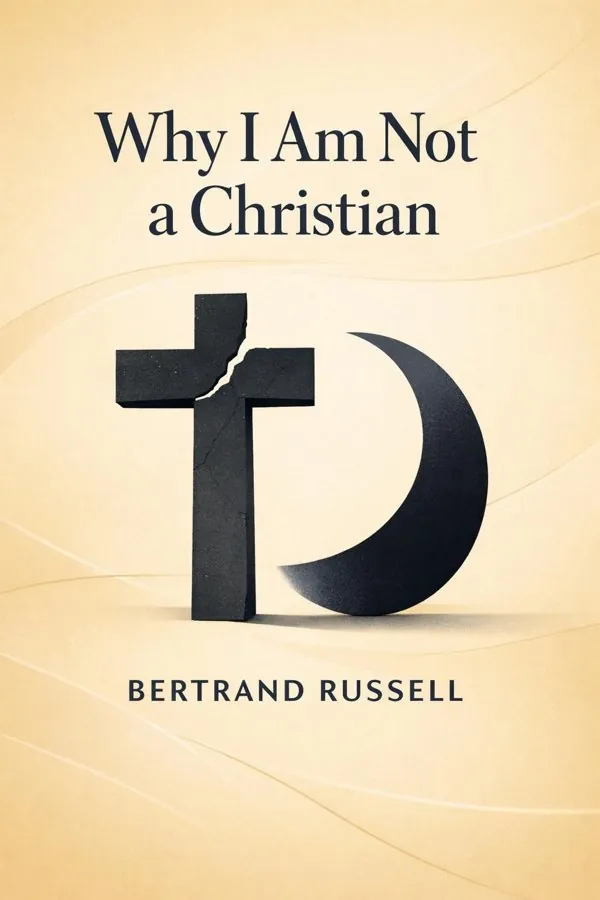
Why I Am Not a Christian: And Other Essays on Religion and Related Subjects: Summary & Key Insights
 10 min9 chaptersAudio available
Key Takeaways from Why I Am Not a Christian: And Other Essays on Religion and Related Subjects
The oldest religious arguments often survive not because they are strong, but because they are familiar.
A moral reputation should not be treated as exempt from criticism.
Behind many confident religious declarations lies a quieter and more powerful force: fear.
One of the most persistent claims in religious debate is that without God, morality collapses.
Ideas should be judged not only by how noble they sound, but by what they authorize in practice.
What Is Why I Am Not a Christian: And Other Essays on Religion and Related Subjects About?
Why I Am Not a Christian: And Other Essays on Religion and Related Subjects by Bertrand Russell is a western_phil book spanning 9 pages. Why I Am Not a Christian: And Other Essays on Religion and Related Subjects is Bertrand Russell’s sharp, elegant, and still startlingly relevant examination of religion, belief, morality, and intellectual freedom. Built around his famous 1927 lecture and expanded through related essays, the book asks a disarmingly simple question: what reasons do people really have for religious belief, and do those reasons withstand rational scrutiny? Russell approaches this question not as a casual skeptic, but as one of the twentieth century’s greatest philosophers and logicians. With clarity, wit, and disciplined argument, he evaluates traditional proofs for God’s existence, questions the moral perfection often attributed to Christ, and explores how fear, authority, and habit sustain religious institutions. Yet this is not merely a book of negation. Russell also defends free inquiry, moral responsibility without superstition, and a humane civilization guided by evidence rather than dogma. For readers interested in philosophy, secular thought, ethics, or the cultural power of religion, this collection remains a foundational and provocative work—one that challenges inherited assumptions and invites intellectual courage.
This FizzRead summary covers all 9 key chapters of Why I Am Not a Christian: And Other Essays on Religion and Related Subjects in approximately 10 minutes, distilling the most important ideas, arguments, and takeaways from Bertrand Russell's work. Also available as an audio summary and Key Quotes Podcast.
Why I Am Not a Christian: And Other Essays on Religion and Related Subjects
Why I Am Not a Christian: And Other Essays on Religion and Related Subjects is Bertrand Russell’s sharp, elegant, and still startlingly relevant examination of religion, belief, morality, and intellectual freedom. Built around his famous 1927 lecture and expanded through related essays, the book asks a disarmingly simple question: what reasons do people really have for religious belief, and do those reasons withstand rational scrutiny? Russell approaches this question not as a casual skeptic, but as one of the twentieth century’s greatest philosophers and logicians. With clarity, wit, and disciplined argument, he evaluates traditional proofs for God’s existence, questions the moral perfection often attributed to Christ, and explores how fear, authority, and habit sustain religious institutions. Yet this is not merely a book of negation. Russell also defends free inquiry, moral responsibility without superstition, and a humane civilization guided by evidence rather than dogma. For readers interested in philosophy, secular thought, ethics, or the cultural power of religion, this collection remains a foundational and provocative work—one that challenges inherited assumptions and invites intellectual courage.
Who Should Read Why I Am Not a Christian: And Other Essays on Religion and Related Subjects?
This book is perfect for anyone interested in western_phil and looking to gain actionable insights in a short read. Whether you're a student, professional, or lifelong learner, the key ideas from Why I Am Not a Christian: And Other Essays on Religion and Related Subjects by Bertrand Russell will help you think differently.
- ✓Readers who enjoy western_phil and want practical takeaways
- ✓Professionals looking to apply new ideas to their work and life
- ✓Anyone who wants the core insights of Why I Am Not a Christian: And Other Essays on Religion and Related Subjects in just 10 minutes
Want the full summary?
Get instant access to this book summary and 100K+ more with Fizz Moment.
Get Free SummaryAvailable on App Store • Free to download
Key Chapters
The oldest religious arguments often survive not because they are strong, but because they are familiar. Russell begins with a central claim of the title essay: many people inherit belief in God through culture and emotion, then later reach for philosophical arguments as if they were the real foundation. He turns to the classic proofs—the First Cause argument, the Natural Law argument, the argument from design, and moral arguments—and examines them with the precision of a logician.
His method is simple but devastating: ask whether each argument actually proves what it claims to prove. If everything must have a cause, why exempt God? If nature follows laws, are these commands issued by a lawgiver, or simply descriptions of how things behave? If the world shows design, how do we explain waste, suffering, cruelty, and imperfection? And if morality requires God, why have moral standards changed across history, often in spite of religious institutions rather than because of them?
Russell’s deeper point is not just that these arguments fail technically. It is that people often confuse emotional comfort with logical proof. A belief can be psychologically reassuring and still intellectually unsupported. This distinction matters far beyond religion. We see the same mistake in politics, health fads, conspiracy theories, and charismatic leadership: people accept what feels meaningful before testing whether it is true.
In practical terms, Russell offers a model for intellectual self-defense. When confronted with a grand claim, identify its premises, test for exceptions, and ask whether the conclusion really follows. The takeaway: do not accept inherited arguments because they are ancient or respectable; examine whether they actually withstand reason.
A moral reputation should not be treated as exempt from criticism. Russell challenges the popular concession that even if Christianity’s doctrines are doubtful, Christ’s moral teaching remains beyond question. He does not deny that Jesus expressed profound ethical ideas, especially concerning compassion, humility, and care for the vulnerable. But he refuses to treat this as the end of inquiry.
Russell asks whether Christ, as portrayed in the Gospels, consistently embodies the highest moral ideal. He points to teachings about eternal punishment, the destruction of unbelievers, and apocalyptic expectations that have not aged well under modern ethical standards. A figure who threatens everlasting torment, Russell argues, cannot simply be assumed morally perfect. Nor should moral insight be judged only by memorable sayings while ignoring harsher elements of the record.
What makes this discussion important is Russell’s refusal to let reverence replace analysis. Great teachers can offer wisdom without being infallible. In ordinary life, we already accept this principle. A beloved parent may teach generosity while holding prejudiced views. A famous thinker may write brilliantly in one area and carelessly in another. Mature moral judgment requires discrimination, not hero worship.
Russell also encourages readers to compare Christian ethics with broader human moral progress. Ideas such as tolerance, opposition to cruelty, and respect for freedom often developed through social struggle, philosophical reflection, and scientific understanding, not solely through religious instruction.
The practical application is powerful: whenever someone invokes a revered authority—religious, political, or intellectual—separate the admirable teachings from the harmful ones. The actionable takeaway: respect wisdom where it appears, but never surrender your moral judgment to tradition or sanctity.
One of the most persistent claims in religious debate is that without God, morality collapses. Russell rejects this as both philosophically weak and historically misleading. He argues that moral conduct does not require divine commands, eternal rewards, or threats of punishment. In fact, morality becomes more meaningful when it arises from human sympathy, social responsibility, and thoughtful reflection rather than obedience.
If an action is good only because an authority commands it, then goodness becomes arbitrary. If cruelty were commanded, would it become right? If not, then moral standards must exist independently of command. Russell’s criticism anticipates a classic ethical problem: either God commands what is good because it is good, in which case morality is not created by God, or things are good merely because God commands them, in which case morality becomes arbitrary.
Russell sees moral progress as a human achievement. Societies change their views on slavery, punishment, women’s rights, freedom of conscience, and child welfare through experience, debate, and growing empathy. Religious institutions have often resisted such changes before eventually adapting to them. This suggests that conscience is not simply handed down from above.
Practically, Russell’s view invites people to build ethics on consequences, compassion, fairness, and evidence about human flourishing. In modern life, we do this constantly. We assess whether policies reduce suffering, whether schools help children thrive, whether workplaces are just, and whether laws protect dignity. These are moral questions, but they do not require theology to be answered.
The takeaway is liberating and demanding at once: instead of borrowing morality from authority, take responsibility for examining what helps human beings live better together.
Ideas should be judged not only by how noble they sound, but by what they authorize in practice. Russell distinguishes between private spiritual feeling and organized religion as a social force. His criticism is aimed especially at institutions that claim unquestionable authority over belief, education, sexuality, politics, and conscience. When certainty is combined with power, he argues, cruelty often follows.
Russell points to religion’s historical role in persecution, censorship, suppression of scientific discovery, sexual guilt, and the sanctification of suffering. Institutions that insist they possess final truth tend to distrust inquiry and punish dissent. This is not an accidental side effect but a structural temptation: if salvation depends on correct belief, then coercion can be presented as kindness.
His argument remains relevant because the same pattern appears whenever institutions claim moral infallibility. Whether in churches, political movements, or ideological communities, the result can be shaming, silencing, and the dehumanization of outsiders. Consider how dogmatic cultures discourage questioning in schools, stigmatize natural human experiences, or pressure individuals to conform at the expense of mental health.
Russell does not deny that religious communities can also inspire charity, belonging, and comfort. But he insists that good intentions do not erase harmful systems. A hospital may contain kind doctors and still have destructive policies. Likewise, a religion may include sincere believers while promoting doctrines that produce fear or repression.
The practical lesson is to evaluate institutions empirically. Do they encourage independent thought? Do they protect freedom of conscience? Do they reduce suffering or increase it? The actionable takeaway: judge beliefs and organizations by their real-world effects on human flourishing, not by their sacred status or sentimental image.
To think freely is not merely an intellectual luxury; for Russell, it is an ethical obligation. He believes that human progress depends on the willingness to question authority, revise belief, and follow evidence wherever it leads. The enemy of this process is dogmatism—the insistence that some conclusions must remain immune from criticism.
Russell’s defense of free thought emerges from both philosophy and history. Scientific breakthroughs, political reforms, and social improvements have often required individuals to challenge accepted opinion. Copernicus, Darwin, and countless reformers faced opposition not simply because they were wrong or right, but because they threatened systems built on unquestioned certainty. Free inquiry is therefore not just about academic debate; it is a condition of civilization.
In practical life, this means resisting pressures to conform intellectually. A student may repeat fashionable opinions to avoid conflict. An employee may stay silent about a flawed decision because leadership appears untouchable. A citizen may inherit beliefs about religion, nation, or morality without ever testing them. Russell asks readers to replace passive acceptance with active examination.
Importantly, free thought does not mean believing nothing. It means proportioning belief to evidence, remaining open to revision, and distinguishing confidence from certainty. It also requires intellectual humility: the courage to say “I do not know.” In a world of social media outrage and instant opinions, this virtue is even more valuable.
A useful application is to practice steelmanning views you reject, reading serious critics of your position, and asking what evidence would make you change your mind. The takeaway: treat independent thinking not as rebellion for its own sake, but as a disciplined habit necessary for truth and freedom.
Certainty is often admired as strength, yet Russell sees doubt as one of the highest forms of intellectual honesty. Human beings naturally want firm answers, especially about ultimate questions—why we are here, what happens after death, whether justice rules the universe. But wanting an answer is not the same as having one. Russell argues that mature thinking begins when we accept this gap.
Doubt, in his account, is not paralysis or cynicism. It is the refusal to pretend knowledge we do not possess. This stance protects us from fanaticism because it leaves room for correction. Once a person believes their worldview is absolutely guaranteed, criticism becomes an insult, opponents become enemies, and inquiry becomes unnecessary. Doubt softens this rigidity.
The value of doubt is visible across ordinary decisions. A doctor who remains open to new evidence is safer than one who clings to outdated certainty. A policymaker who admits uncertainty can test solutions and adapt. A friend who says, “I may be wrong—help me understand,” is easier to trust than one who never revises a judgment. Russell’s philosophical point therefore has immediate practical force.
He also suggests that uncertainty need not ruin meaning. One can love, create, work, and act morally without possessing final metaphysical guarantees. In fact, life may become more vivid when we stop waiting for cosmic assurances and instead take responsibility for finite human purposes.
To apply this, replace premature conclusions with better questions: What do I know? What am I assuming? What evidence is missing? The actionable takeaway: treat uncertainty not as a failure of thought, but as the starting point of deeper understanding.
Russell sees science not as a rival religion, but as humanity’s most reliable method for discovering how the world works. Its power lies in disciplined doubt, public testing, and willingness to be proven wrong. Unlike dogma, science does not ask for reverence; it asks for evidence. This makes it an engine of both knowledge and practical improvement.
In the essays, Russell contrasts scientific inquiry with religious explanations that stop investigation by appealing to mystery or authority. If thunder is attributed to divine anger, inquiry ends. If disease is treated as punishment, medicine stalls. But when causes are investigated naturally, knowledge grows and suffering can be reduced. Modern readers can see this clearly in public health, engineering, climate science, and technology: progress depends on methods that correct error rather than sanctify it.
Still, Russell is not naively triumphalist. Science gives power, but it does not automatically provide wisdom about how power should be used. Humanity may learn to split the atom and still choose war. It may master production and still tolerate injustice. This is why Russell pairs scientific intelligence with humanistic values. We need evidence to understand reality, and compassion to decide what kind of future to build.
The practical application is to adopt a scientific attitude beyond laboratories. Test assumptions. Prefer data over rumor. Distinguish correlation from causation. Be ready to update your views. For instance, if a school policy is meant to improve learning, evaluate the results rather than defending the idea because it sounded noble.
The takeaway: trust methods that invite correction and produce results, while ensuring that knowledge is guided by humane ends rather than blind power.
All Chapters in Why I Am Not a Christian: And Other Essays on Religion and Related Subjects
About the Author
Bertrand Russell (1872–1970) was a British philosopher, logician, mathematician, and social critic whose work helped define modern analytic philosophy. Born into an aristocratic family, he combined elite education with an unusually independent mind, going on to make major contributions to logic, epistemology, philosophy of language, and the foundations of mathematics. Alongside his technical work, Russell became one of the twentieth century’s most influential public intellectuals, writing widely on religion, education, politics, war, and ethics. He was a fierce defender of free thought and an outspoken critic of dogma and authoritarianism. Russell also campaigned for peace and nuclear disarmament and was briefly imprisoned for his activism during World War I. In 1950, he received the Nobel Prize in Literature for his lucid and humane writing.
Get This Summary in Your Preferred Format
Read or listen to the Why I Am Not a Christian: And Other Essays on Religion and Related Subjects summary by Bertrand Russell anytime, anywhere. FizzRead offers multiple formats so you can learn on your terms — all free.
Available formats: App · Audio · PDF · EPUB — All included free with FizzRead
Download Why I Am Not a Christian: And Other Essays on Religion and Related Subjects PDF and EPUB Summary
Key Quotes from Why I Am Not a Christian: And Other Essays on Religion and Related Subjects
“The oldest religious arguments often survive not because they are strong, but because they are familiar.”
“A moral reputation should not be treated as exempt from criticism.”
“Behind many confident religious declarations lies a quieter and more powerful force: fear.”
“One of the most persistent claims in religious debate is that without God, morality collapses.”
“Ideas should be judged not only by how noble they sound, but by what they authorize in practice.”
Frequently Asked Questions about Why I Am Not a Christian: And Other Essays on Religion and Related Subjects
Why I Am Not a Christian: And Other Essays on Religion and Related Subjects by Bertrand Russell is a western_phil book that explores key ideas across 9 chapters. Why I Am Not a Christian: And Other Essays on Religion and Related Subjects is Bertrand Russell’s sharp, elegant, and still startlingly relevant examination of religion, belief, morality, and intellectual freedom. Built around his famous 1927 lecture and expanded through related essays, the book asks a disarmingly simple question: what reasons do people really have for religious belief, and do those reasons withstand rational scrutiny? Russell approaches this question not as a casual skeptic, but as one of the twentieth century’s greatest philosophers and logicians. With clarity, wit, and disciplined argument, he evaluates traditional proofs for God’s existence, questions the moral perfection often attributed to Christ, and explores how fear, authority, and habit sustain religious institutions. Yet this is not merely a book of negation. Russell also defends free inquiry, moral responsibility without superstition, and a humane civilization guided by evidence rather than dogma. For readers interested in philosophy, secular thought, ethics, or the cultural power of religion, this collection remains a foundational and provocative work—one that challenges inherited assumptions and invites intellectual courage.
More by Bertrand Russell
You Might Also Like
A Little History of Philosophy
Nigel Warburton
10 min
Areopagitica
John Milton
10 min
How To Think Like A Philosopher: Essential Principles For Clear Thinking
Peter Cave
10 min
Language, Truth and Logic
A. J. Ayer
10 min
The Age of Reason
Thomas Paine
10 min
The Essays
Michel De Montaigne
10 minBrowse by Category
Ready to read Why I Am Not a Christian: And Other Essays on Religion and Related Subjects?
Get the full summary and 100K+ more books with Fizz Moment.