
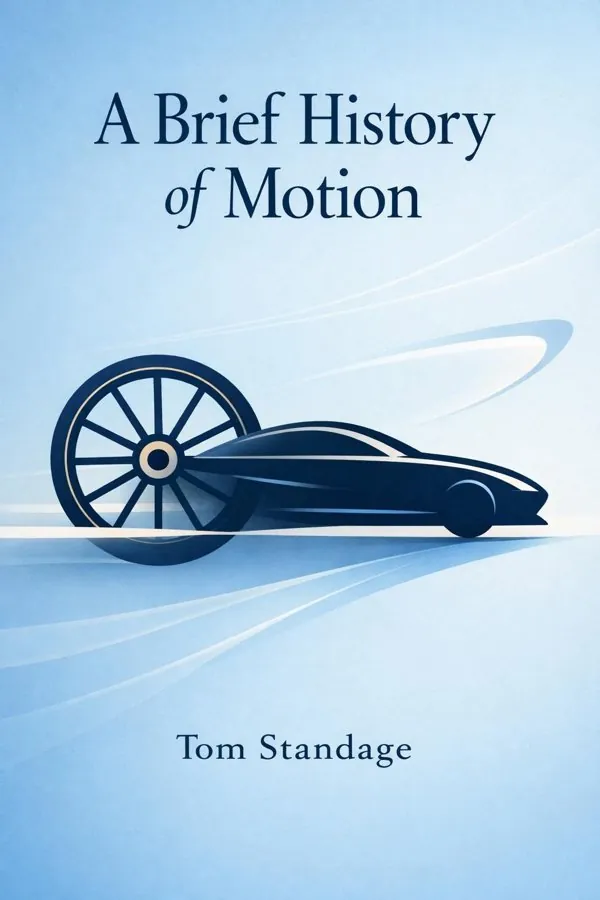
A Brief History of Motion: From the Wheel, to the Car, to What Comes Next: Summary & Key Insights
by Tom Standage
 10 min10 chaptersAudio available
What Is A Brief History of Motion: From the Wheel, to the Car, to What Comes Next About?
A Brief History of Motion: From the Wheel, to the Car, to What Comes Next by Tom Standage is a world_history book spanning 10 pages. A Brief History of Motion explores 5,500 years of human transportation, from the invention of the wheel to the rise of the automobile and the uncertain future of mobility. Tom Standage examines how innovations in motion have shaped societies, economies, and the environment, offering a sweeping narrative that connects ancient technologies to modern challenges such as urban congestion and climate change.
This FizzRead summary covers all 10 key chapters of A Brief History of Motion: From the Wheel, to the Car, to What Comes Next in approximately 10 minutes, distilling the most important ideas, arguments, and takeaways from Tom Standage's work. Also available as an audio summary and Key Quotes Podcast.
A Brief History of Motion: From the Wheel, to the Car, to What Comes Next
A Brief History of Motion explores 5,500 years of human transportation, from the invention of the wheel to the rise of the automobile and the uncertain future of mobility. Tom Standage examines how innovations in motion have shaped societies, economies, and the environment, offering a sweeping narrative that connects ancient technologies to modern challenges such as urban congestion and climate change.
Who Should Read A Brief History of Motion: From the Wheel, to the Car, to What Comes Next?
This book is perfect for anyone interested in world_history and looking to gain actionable insights in a short read. Whether you're a student, professional, or lifelong learner, the key ideas from A Brief History of Motion: From the Wheel, to the Car, to What Comes Next by Tom Standage will help you think differently.
- ✓Readers who enjoy world_history and want practical takeaways
- ✓Professionals looking to apply new ideas to their work and life
- ✓Anyone who wants the core insights of A Brief History of Motion: From the Wheel, to the Car, to What Comes Next in just 10 minutes
Want the full summary?
Get instant access to this book summary and 100K+ more with Fizz Moment.
Get Free SummaryAvailable on App Store • Free to download
Key Chapters
The story begins in Mesopotamia around 3500 BCE, where the simple, circular disk became one of humankind’s greatest inventions. The wheel was not born from idle curiosity but necessity: early city-states needed to move heavy goods across land. The first wheels appeared on potters’ tables, but soon someone realized that the same rotational motion could carry loads. When attached to carts pulled by oxen, the solid wooden disk transformed both trade and warfare.
The wheel’s importance cannot be overstated. It extended the physical reach of cities, allowing surpluses to circulate and armies to project power far from home. With it came a network of exchange that tied regions together, setting the pattern for civilization itself. Yet it was not a universal solution—many societies, from the Andes to sub-Saharan Africa, flourished without wheels because terrain, animals, and climate made them impractical. This reminds us that mobility is always a local expression of available technology and environment. The wheel was only revolutionary because it fit its context; its significance came from the web of social, economic, and political systems it enabled.
After wheels came another leap: the domestication of animals that multiplied human range and speed. Horses, camels, and oxen became the engines of empire, turning energy from muscle into momentum for entire civilizations. The chariot, especially, transformed ancient warfare into choreography of motion. It symbolized prestige in Egypt, Mesopotamia, and beyond, marrying the wheel to animal strength.
But not all mobility was martial. The camel let trade flourish across deserts; its ability to carry water and cargo across immense distances made it the ‘ship of the desert.’ Horses carried messages across the Persian Empire and later across Mongol Asia, binding vast territories together through courier systems that presaged the logistics networks of later centuries.
In these developments we glimpse a theme that will recur again and again: that the expansion of human mobility brings both connection and control. Empires moved on hooves, and motion meant power. Yet each time, the infrastructure of support—roads, stables, rest stations—became as transformative as the animals themselves. The principle that would later sustain railways and highways was already being tested: movement requires systems.
+ 8 more chapters — available in the FizzRead app
All Chapters in A Brief History of Motion: From the Wheel, to the Car, to What Comes Next
About the Author
Tom Standage is Deputy Editor of The Economist and editor of its annual publication The World Ahead. He is the author of several acclaimed works of popular history, including A History of the World in 6 Glasses and The Victorian Internet. His writing often explores the intersection of technology, history, and society.
Get This Summary in Your Preferred Format
Read or listen to the A Brief History of Motion: From the Wheel, to the Car, to What Comes Next summary by Tom Standage anytime, anywhere. FizzRead offers multiple formats so you can learn on your terms — all free.
Available formats: App · Audio · PDF · EPUB — All included free with FizzRead
Download A Brief History of Motion: From the Wheel, to the Car, to What Comes Next PDF and EPUB Summary
Key Quotes from A Brief History of Motion: From the Wheel, to the Car, to What Comes Next
“The story begins in Mesopotamia around 3500 BCE, where the simple, circular disk became one of humankind’s greatest inventions.”
“After wheels came another leap: the domestication of animals that multiplied human range and speed.”
Frequently Asked Questions about A Brief History of Motion: From the Wheel, to the Car, to What Comes Next
A Brief History of Motion: From the Wheel, to the Car, to What Comes Next by Tom Standage is a world_history book that explores key ideas across 10 chapters. A Brief History of Motion explores 5,500 years of human transportation, from the invention of the wheel to the rise of the automobile and the uncertain future of mobility. Tom Standage examines how innovations in motion have shaped societies, economies, and the environment, offering a sweeping narrative that connects ancient technologies to modern challenges such as urban congestion and climate change.
More by Tom Standage

You Might Also Like
The Age of Capital
Eric Hobsbawm
10 min
The Gulag Archipelago
Aleksandr Solzhenitsyn
10 min
Jerusalem: The Biography
Simon Sebag Montefiore
10 min
The Anglo-Saxons
James Campbell
10 min
The Boer War
Thomas Pakenham
10 min
The Industrial Revolutionaries: The Making of the Modern World 1776–1914
Gavin Weightman
10 minFeatured In
Browse by Category
Ready to read A Brief History of Motion: From the Wheel, to the Car, to What Comes Next?
Get the full summary and 100K+ more books with Fizz Moment.