
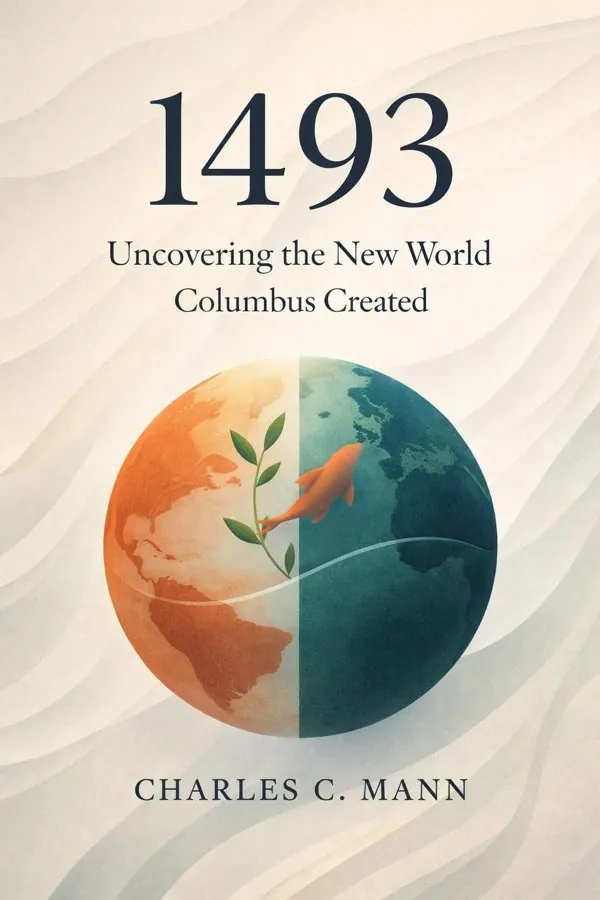
1493: Uncovering the New World Columbus Created: Summary & Key Insights
 10 min10 chaptersAudio available
Key Takeaways from 1493: Uncovering the New World Columbus Created
A coastline can become a turning point in human history.
History is often told through kings, battles, and treaties, but Mann insists that seeds, pigs, weeds, and microbes can be just as important.
A humble tuber can change the fate of nations.
Empires often win before battles begin.
One metal tied together continents, empires, and markets.
What Is 1493: Uncovering the New World Columbus Created About?
1493: Uncovering the New World Columbus Created by Charles C. Mann is a world_history book spanning 10 pages. Charles C. Mann’s 1493 is not simply a book about Christopher Columbus or the age of exploration. It is a sweeping account of how the meeting of the Old World and the New World triggered one of the greatest transformations in human history. Mann argues that after 1492, plants, animals, microbes, people, commodities, and ideas began moving across oceans at a scale never seen before, creating the foundations of the modern globalized world. The result was not just conquest or trade, but a deep reshaping of ecosystems, economies, diets, labor systems, and empires on every continent. What makes this book so powerful is Mann’s ability to connect large historical forces with vivid, concrete stories: silver from the Americas flowing into China, African slavery powering plantation economies, tobacco and sugar changing land use, and invasive species remaking entire landscapes. A seasoned journalist and the acclaimed author of 1491, Mann brings together environmental history, economics, epidemiology, and political history with rare clarity. 1493 matters because it shows that globalization did not begin in the internet age. It began when previously isolated worlds collided, and we are still living with the consequences.
This FizzRead summary covers all 10 key chapters of 1493: Uncovering the New World Columbus Created in approximately 10 minutes, distilling the most important ideas, arguments, and takeaways from Charles C. Mann's work. Also available as an audio summary and Key Quotes Podcast.
1493: Uncovering the New World Columbus Created
Charles C. Mann’s 1493 is not simply a book about Christopher Columbus or the age of exploration. It is a sweeping account of how the meeting of the Old World and the New World triggered one of the greatest transformations in human history. Mann argues that after 1492, plants, animals, microbes, people, commodities, and ideas began moving across oceans at a scale never seen before, creating the foundations of the modern globalized world. The result was not just conquest or trade, but a deep reshaping of ecosystems, economies, diets, labor systems, and empires on every continent.
What makes this book so powerful is Mann’s ability to connect large historical forces with vivid, concrete stories: silver from the Americas flowing into China, African slavery powering plantation economies, tobacco and sugar changing land use, and invasive species remaking entire landscapes. A seasoned journalist and the acclaimed author of 1491, Mann brings together environmental history, economics, epidemiology, and political history with rare clarity. 1493 matters because it shows that globalization did not begin in the internet age. It began when previously isolated worlds collided, and we are still living with the consequences.
Who Should Read 1493: Uncovering the New World Columbus Created?
This book is perfect for anyone interested in world_history and looking to gain actionable insights in a short read. Whether you're a student, professional, or lifelong learner, the key ideas from 1493: Uncovering the New World Columbus Created by Charles C. Mann will help you think differently.
- ✓Readers who enjoy world_history and want practical takeaways
- ✓Professionals looking to apply new ideas to their work and life
- ✓Anyone who wants the core insights of 1493: Uncovering the New World Columbus Created in just 10 minutes
Want the full summary?
Get instant access to this book summary and 100K+ more with Fizz Moment.
Get Free SummaryAvailable on App Store • Free to download
Key Chapters
A coastline can become a turning point in human history. Mann begins by showing that Columbus’s voyage did more than connect two landmasses; it linked previously separated biological and cultural worlds into a single system. Before 1492, the Americas were largely isolated from Eurasia and Africa. After contact, the Atlantic was no longer a barrier. It became a corridor through which ships carried crops, animals, diseases, enslaved people, metals, beliefs, and institutions.
This emerging Atlantic world was not just a space of exploration. It was the engine room of early modern globalization. Spanish and Portuguese expansion opened routes that bound Europe, Africa, and the Americas together in a network of exchange and extraction. Ports, plantations, mines, and colonies became connected parts of a larger economic order. Mann emphasizes that this new system created immense wealth for some while unleashing catastrophe for others, especially Indigenous peoples and Africans forced into slavery.
A practical way to understand this idea is to think about modern supply chains. Today, a smartphone might rely on minerals from Africa, design from California, and assembly in Asia. In the sixteenth century, silver from the Andes, labor from Africa, and consumer demand from Europe and China created a similarly interconnected system, though with brutal human costs.
The key insight is that globalization began as an ecological and imperial process, not merely a commercial one. To better understand the present, trace the origins of connection back to the Atlantic world and ask who benefited, who paid the price, and how those patterns still shape global inequality.
History is often told through kings, battles, and treaties, but Mann insists that seeds, pigs, weeds, and microbes can be just as important. One of the book’s central ideas is the Columbian Exchange: the transfer of species between the Eastern and Western Hemispheres after 1492. Because the two worlds had evolved separately for millions of years, their reunion set off ecological upheaval on a planetary scale.
European settlers and traders brought horses, cattle, pigs, wheat, sugarcane, and countless weeds to the Americas. At the same time, American crops such as maize, potatoes, tomatoes, cassava, and cacao spread abroad. These transfers transformed both landscapes and livelihoods. Horses altered Indigenous mobility and warfare on the Great Plains. European livestock changed soils and vegetation patterns. Imported weeds often thrived in disturbed colonial environments, displacing native species and helping settlers recreate familiar agricultural systems.
Mann’s point is not simply that new species appeared in new places. It is that ecologies are networks, and when new organisms enter them, the effects cascade outward. A crop can alter diets, settlement patterns, labor needs, and trade. An animal can transform transport, conflict, and land use.
You can apply this insight today by noticing how environmental change is rarely isolated. Introduced species, global food systems, and climate pressures still restructure local ecologies in unexpected ways. Mann encourages readers to see that human history and natural history are inseparable. The actionable takeaway is to examine any major social change through an ecological lens: ask what organisms moved, what habitats changed, and what long-term consequences followed.
A humble tuber can change the fate of nations. Mann shows that crops from the Americas did not merely enrich global cuisine; they reshaped demographics, state power, and economic development across the world. The potato, maize, and cassava were especially consequential because they produced abundant calories, adapted to varied soils, and could support rapid population growth.
In Europe, the potato gradually became a nutritional powerhouse. It yielded more calories per acre than many Old World grains and could sustain dense populations. Historians have linked its spread to population growth, urbanization, and labor expansion in parts of Europe. In Africa, cassava and maize became important because they could grow in difficult conditions and help communities survive environmental stress. In China, American crops expanded cultivation into upland and marginal lands, enabling population booms that altered the empire’s social and political balance.
Mann’s broader argument is that food history is power history. States become stronger when they can feed more people. Armies grow, cities expand, and markets deepen when calorie supplies rise. This means that the global impact of 1492 cannot be measured only by conquest or trade routes. It must also be measured in diets, field systems, and population curves.
A modern application is clear: food security remains one of the hidden foundations of political stability. Innovations in agriculture can produce effects far beyond the farm, influencing migration, wages, and conflict. The takeaway is to treat staple crops as strategic forces. When you want to understand the rise of a society, ask not only what it believed or traded, but also what it ate and how that food reached the table.
Empires often win before battles begin. One of Mann’s most sobering themes is the role of disease in the making of the post-1492 world. When Europeans crossed the Atlantic, they brought pathogens into populations that had little or no prior exposure. Smallpox, measles, influenza, and other diseases spread with devastating force, contributing to demographic collapse in many Indigenous societies across the Americas.
Mann does not reduce conquest to biology alone, but he makes clear that disease was central to the balance of power. Entire communities were destabilized before they could mount sustained resistance. Labor systems changed because populations shrank. Colonizers often interpreted this disaster as a sign of divine favor or civilizational superiority, when in fact epidemic disease had done much of the work.
The importance of this idea goes beyond the sixteenth century. Disease shaped settlement patterns, military outcomes, labor shortages, and land appropriation. In many regions, depopulation opened space for colonial agriculture and extractive systems. The human tragedy was inseparable from the economic transformation that followed.
Recent global pandemics make Mann’s argument feel newly relevant. Disease is never purely a medical issue; it is also social, political, and economic. Public trust, mobility, inequality, and governance all determine how pathogens spread and how societies respond.
The actionable takeaway is to reject simple heroic narratives of conquest and progress. When evaluating historical change, ask what hidden biological factors were at work. More broadly, support public health systems and historical literacy, because societies that ignore the power of disease are often caught unprepared by it.
One metal tied together continents, empires, and markets. Mann highlights silver as a crucial link in the first truly global economy. Massive deposits in Spanish America, especially at places like Potosí, generated astonishing wealth. But that wealth did not stay in the Americas or even in Europe. It moved across oceans into a worldwide trading system in which China played a central role.
The Ming economy had a powerful demand for silver, partly because tax systems and commerce increasingly depended on it. Spanish America supplied that demand. Silver extracted by coerced labor in the New World traveled through Europe and across the Pacific via Manila, where it was exchanged for Chinese goods such as silk and porcelain. In this way, Latin American mines, European empires, Asian markets, and Pacific shipping routes became integrated components of one system.
Mann uses this story to overturn narrow, Eurocentric accounts of globalization. Europe did not simply dominate a passive world. Rather, global trade emerged through interaction among regions with different needs, capacities, and institutions. China’s demand helped structure the flow of bullion, just as imperial violence structured its extraction.
The modern parallel is the way commodities today move according to global demand rather than national borders alone. Oil, semiconductors, and rare earth minerals all link distant producers and consumers in webs of dependency.
The practical takeaway is to follow money and materials, not just flags and armies. If you want to understand how world history works, examine where strategic resources come from, who extracts them, who profits from them, and which distant market ultimately drives the system.
Some of the world’s most profitable landscapes were also among its most brutal. Mann shows that the Columbian Exchange did not involve only plants and animals. It also involved the violent movement of millions of human beings. As disease, conquest, and labor demands transformed the Americas, colonists turned increasingly to enslaved Africans to work plantations producing sugar, tobacco, and other export commodities.
This was not a side story to globalization; it was one of its foundations. Plantation agriculture depended on huge tracts of land, ecological simplification, and relentless labor extraction. Sugar in particular became a world-changing commodity because European demand was high and profits were enormous. But behind every sweetened cup or luxury purchase stood a system of kidnapping, forced transport, terror, and hereditary bondage.
Mann’s treatment of the African diaspora reveals how the Atlantic world was built through both exchange and coercion. Enslaved Africans brought agricultural knowledge, cultural practices, and survival strategies that shaped the Americas in lasting ways. Yet their presence resulted from one of history’s greatest crimes.
This idea has present-day relevance because modern consumers still rely on supply chains that can obscure exploitation. Whether in agriculture, textiles, or electronics, distance can hide labor abuse from the end buyer, just as Atlantic commerce once hid the human cost of sugar.
The actionable takeaway is to connect consumption with labor history. Ask what systems of coercion or inequality make cheap goods possible. Mann’s lesson is clear: economic growth should never be evaluated only by output and profits, but also by the human suffering built into the system.
The history of the Americas cannot be understood by looking west from Europe alone. Mann broadens the frame by showing how Asia, especially China, India, and the Pacific trade sphere, was deeply entangled in the world Columbus helped create. The usual story of discovery often runs from Europe to the Americas, but Mann reveals a far more complex web in which Asian demand, products, and labor systems shaped global outcomes.
The Manila galleons are a vivid example. These ships connected Spanish America to the Philippines, carrying American silver into Asian markets and bringing back luxury goods and commercial influences. This Pacific circuit made the New World part of an Afro-Eurasian commercial world that extended far beyond the Atlantic. It also shows that globalization after 1492 was never a simple one-way spread of European power. It was a negotiated, uneven, and deeply interconnected process.
Mann’s insight helps correct a common distortion in world history. Europe was important, but it was not the sole center of gravity. Chinese consumption patterns, Asian manufacturing strength, and long-established trade networks all mattered enormously. The “New World” became meaningful partly because it was inserted into older, wider systems.
A useful application today is to resist single-region explanations for global events. Economic shifts usually emerge from interaction among multiple centers of power. Whether considering climate policy, trade tensions, or technological change, it helps to think in networks rather than national silos.
The takeaway is to widen your historical lens. Whenever a story seems to revolve around one civilization alone, look for the distant markets, foreign actors, and cross-oceanic links that made the system function.
Wherever humans move at scale, landscapes are forced to change with them. Mann demonstrates that post-1492 expansion was not only political and commercial; it was profoundly environmental. Colonists cleared forests, planted monocultures, introduced grazing animals, diverted water, and remade soils. The result was not temporary disruption but enduring ecological transformation.
Plantation zones are one striking example. Sugar and tobacco production often required the destruction of diverse ecosystems and their replacement with simplified, profit-oriented landscapes. Livestock trampled native vegetation, while imported species spread beyond farms into wild spaces. In many cases, colonial land use created new ecological regimes that persisted for centuries. Mann shows that empire was written not just in laws and borders, but in forests cut down, rivers altered, and species displaced.
This matters because environmental change is often treated as a modern problem when it has deep historical roots. The climate crisis may be contemporary in form, but the mindset of extracting wealth from nature at continental scale has a long history. Mann helps readers see early globalization as an environmental event as much as an economic one.
A present-day application is to examine development projects with long-term ecological thinking. Short-term profits can conceal durable damage to soil, biodiversity, and water systems.
The actionable takeaway is to connect land use with historical memory. When evaluating agriculture, urban growth, or trade policy, ask how ecosystems are being simplified, what species are being displaced, and who will bear the cost decades from now.
When worlds meet, they do not merely exchange goods; they transform identities. Mann shows that the aftermath of 1492 produced new cultures, hybrid practices, and altered social hierarchies across the globe. Colonization was violent, but it did not create simple replicas of Europe overseas. Instead, people adapted, resisted, borrowed, and improvised under new conditions.
Foods offer an accessible example. Italian cuisine without tomatoes, Indian food without chilies, or African farming without maize would be almost unrecognizable today. These changes reveal how deeply the Columbian Exchange entered daily life. But Mann also points to more structural shifts: mixed populations, new racial classifications, syncretic religions, and colonial institutions that organized status through ancestry, labor, and access to land.
Culture in 1493 is not a soft backdrop to hard economic history. It is part of the machinery of globalization. Systems of hierarchy had to be justified. New social worlds had to be made intelligible. People used language, religion, law, and custom to define who belonged, who ruled, and who could be exploited.
This insight is useful in the present because many cultural practices we think of as timeless are actually products of historical mixing. Recognizing this can challenge rigid ideas of purity, identity, or tradition.
The takeaway is to approach culture as dynamic rather than fixed. When you encounter modern debates over migration, identity, or national heritage, remember Mann’s lesson: much of what societies cherish was created through contact, adaptation, and conflict across boundaries.
The modern world did not emerge all at once; it assembled itself through exchanges that began after Columbus. Mann’s largest argument is that 1492 inaugurated a new planetary era in which isolated regions were drawn into sustained interaction. This was the beginning of globalization in a meaningful historical sense: a world where events in one continent could reshape labor, diets, ecologies, politics, and wealth on another.
What makes Mann’s account compelling is that globalization here is not treated as an abstract idea. It is tangible. You can see it in silver mined in Bolivia and spent in China, in potatoes from the Andes feeding European workers, in African captives forced into Caribbean plantations, and in microbes crossing oceans faster than institutions could respond. Globalization appears as a system of circulation, but also as a system of unequal power.
This framing helps explain why the world today remains deeply interconnected and deeply unequal. The structures formed in the centuries after 1492 distributed risks and rewards unevenly. Some regions became centers of finance and consumption; others became zones of extraction and coerced labor. Mann suggests that our current world economy still bears the imprint of that origin story.
A modern application is to evaluate globalization with both curiosity and moral seriousness. Interconnection can create innovation, abundance, and exchange, but it can also magnify exploitation and environmental stress.
The actionable takeaway is to think historically about every global system you rely on. Whether food, energy, migration, or trade, ask how this network began, whose labor sustains it, and what older patterns of exchange still shape its inequalities.
All Chapters in 1493: Uncovering the New World Columbus Created
About the Author
Charles C. Mann is an American journalist and author celebrated for making complex subjects in history, science, and the environment accessible to broad audiences. He has written for major publications including The Atlantic, Science, and Wired, and is known for combining deep research with vivid storytelling. Mann gained wide recognition for 1491: New Revelations of the Americas Before Columbus, which challenged long-held assumptions about the pre-Columbian Americas. He followed it with 1493, an ambitious account of how contact after Columbus reshaped the world through ecological exchange, trade, disease, and migration. Across his work, Mann often explores how human societies interact with nature, technology, and global systems, earning a reputation as one of the most engaging interpreters of big historical change.
Get This Summary in Your Preferred Format
Read or listen to the 1493: Uncovering the New World Columbus Created summary by Charles C. Mann anytime, anywhere. FizzRead offers multiple formats so you can learn on your terms — all free.
Available formats: App · Audio · PDF · EPUB — All included free with FizzRead
Download 1493: Uncovering the New World Columbus Created PDF and EPUB Summary
Key Quotes from 1493: Uncovering the New World Columbus Created
“A coastline can become a turning point in human history.”
“History is often told through kings, battles, and treaties, but Mann insists that seeds, pigs, weeds, and microbes can be just as important.”
“A humble tuber can change the fate of nations.”
“One of Mann’s most sobering themes is the role of disease in the making of the post-1492 world.”
“One metal tied together continents, empires, and markets.”
Frequently Asked Questions about 1493: Uncovering the New World Columbus Created
1493: Uncovering the New World Columbus Created by Charles C. Mann is a world_history book that explores key ideas across 10 chapters. Charles C. Mann’s 1493 is not simply a book about Christopher Columbus or the age of exploration. It is a sweeping account of how the meeting of the Old World and the New World triggered one of the greatest transformations in human history. Mann argues that after 1492, plants, animals, microbes, people, commodities, and ideas began moving across oceans at a scale never seen before, creating the foundations of the modern globalized world. The result was not just conquest or trade, but a deep reshaping of ecosystems, economies, diets, labor systems, and empires on every continent. What makes this book so powerful is Mann’s ability to connect large historical forces with vivid, concrete stories: silver from the Americas flowing into China, African slavery powering plantation economies, tobacco and sugar changing land use, and invasive species remaking entire landscapes. A seasoned journalist and the acclaimed author of 1491, Mann brings together environmental history, economics, epidemiology, and political history with rare clarity. 1493 matters because it shows that globalization did not begin in the internet age. It began when previously isolated worlds collided, and we are still living with the consequences.
More by Charles C. Mann
You Might Also Like
The Age of Capital
Eric Hobsbawm
10 min
The Gulag Archipelago
Aleksandr Solzhenitsyn
10 min
Jerusalem: The Biography
Simon Sebag Montefiore
10 min
The Anglo-Saxons
James Campbell
10 min
The Boer War
Thomas Pakenham
10 min
The Industrial Revolutionaries: The Making of the Modern World 1776–1914
Gavin Weightman
10 minFeatured In
Browse by Category
Ready to read 1493: Uncovering the New World Columbus Created?
Get the full summary and 100K+ more books with Fizz Moment.