
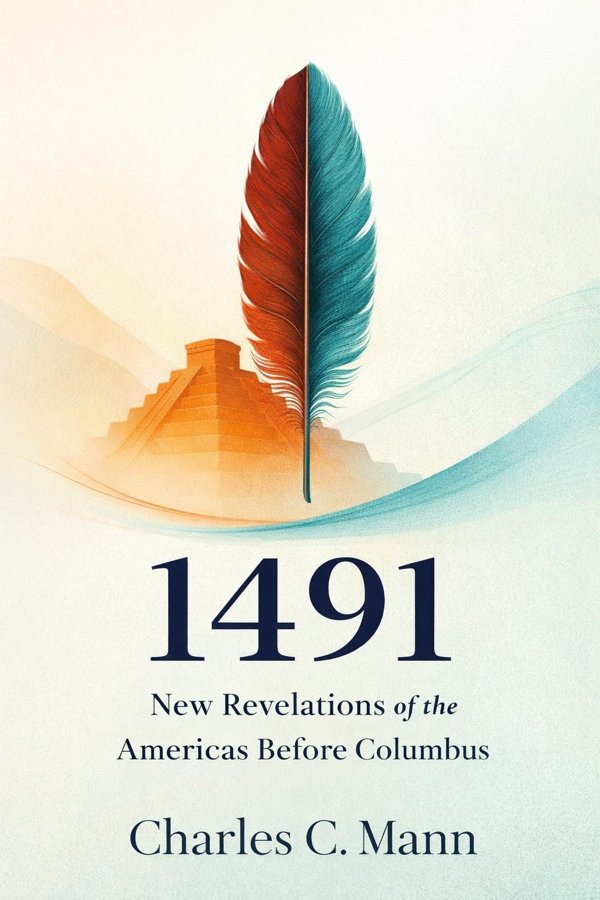
1491: New Revelations of the Americas Before Columbus: Summary & Key Insights
 10 min9 chaptersAudio available
Key Takeaways from 1491: New Revelations of the Americas Before Columbus
The most dangerous historical myths are often the ones that feel obvious.
Population estimates are not dry statistics; they determine the scale of history.
A single skeleton can overturn an entire worldview.
Civilization does not begin when Europeans start paying attention.
Human beings rarely arrive in a landscape without changing it.
What Is 1491: New Revelations of the Americas Before Columbus About?
1491: New Revelations of the Americas Before Columbus by Charles C. Mann is a world_history book spanning 7 pages. Charles C. Mann’s 1491 is a powerful rethinking of the pre-Columbian Americas. Drawing on archaeology, anthropology, ecology, genetics, and early colonial accounts, Mann challenges the old idea that the Western Hemisphere in 1492 was a sparsely populated, largely untouched wilderness inhabited by small, isolated groups. Instead, he presents a continent shaped by millions of people, complex societies, long-distance trade, political innovation, and deliberate environmental management. From the cities of Mesoamerica to the engineered landscapes of Amazonia and the agricultural achievements of North America, Mann reveals a world far richer and more dynamic than conventional history once allowed. What makes the book so important is not just its revision of the past, but its lesson about how history gets made. Much of what later Europeans described as “empty land” had been emptied by disease, warfare, and social collapse that followed contact. Mann, an accomplished journalist with a talent for translating scientific debate into vivid narrative, guides readers through competing theories with clarity and intellectual honesty. The result is a deeply engaging book that changes how we see indigenous history, colonialism, and the human relationship with the environment.
This FizzRead summary covers all 9 key chapters of 1491: New Revelations of the Americas Before Columbus in approximately 10 minutes, distilling the most important ideas, arguments, and takeaways from Charles C. Mann's work. Also available as an audio summary and Key Quotes Podcast.
1491: New Revelations of the Americas Before Columbus
Charles C. Mann’s 1491 is a powerful rethinking of the pre-Columbian Americas. Drawing on archaeology, anthropology, ecology, genetics, and early colonial accounts, Mann challenges the old idea that the Western Hemisphere in 1492 was a sparsely populated, largely untouched wilderness inhabited by small, isolated groups. Instead, he presents a continent shaped by millions of people, complex societies, long-distance trade, political innovation, and deliberate environmental management. From the cities of Mesoamerica to the engineered landscapes of Amazonia and the agricultural achievements of North America, Mann reveals a world far richer and more dynamic than conventional history once allowed.
What makes the book so important is not just its revision of the past, but its lesson about how history gets made. Much of what later Europeans described as “empty land” had been emptied by disease, warfare, and social collapse that followed contact. Mann, an accomplished journalist with a talent for translating scientific debate into vivid narrative, guides readers through competing theories with clarity and intellectual honesty. The result is a deeply engaging book that changes how we see indigenous history, colonialism, and the human relationship with the environment.
Who Should Read 1491: New Revelations of the Americas Before Columbus?
This book is perfect for anyone interested in world_history and looking to gain actionable insights in a short read. Whether you're a student, professional, or lifelong learner, the key ideas from 1491: New Revelations of the Americas Before Columbus by Charles C. Mann will help you think differently.
- ✓Readers who enjoy world_history and want practical takeaways
- ✓Professionals looking to apply new ideas to their work and life
- ✓Anyone who wants the core insights of 1491: New Revelations of the Americas Before Columbus in just 10 minutes
Want the full summary?
Get instant access to this book summary and 100K+ more with Fizz Moment.
Get Free SummaryAvailable on App Store • Free to download
Key Chapters
The most dangerous historical myths are often the ones that feel obvious. For centuries, many readers were taught to imagine the Americas before Columbus as a vast, thinly populated wilderness populated by scattered tribes living outside history. Mann begins by dismantling that picture. He shows that early European impressions were shaped by ignorance, arrogance, and timing. Explorers arrived after waves of epidemic disease had already devastated many indigenous communities, making once-crowded regions appear strangely empty.
This matters because first impressions became official history. If Europeans saw abandoned villages, overgrown fields, or fragmented polities, they assumed the land had always been that way. Mann argues that this was a catastrophic misunderstanding. The Americas were not waiting to be discovered; they were inhabited, managed, farmed, traded across, and politically organized in ways Europeans often failed to recognize.
He highlights how indigenous societies varied enormously. Some were urban and centralized, others mobile and decentralized, but none fit neatly into the simplistic category of “primitive.” The deeper lesson is that unfamiliar forms of complexity are often mistaken for absence of complexity. That mistake did not stay academic—it justified conquest, seizure of land, and the erasure of indigenous achievement.
A practical application of this idea is to question any historical narrative that presents colonized land as empty, unused, or underdeveloped. Similar assumptions still shape debates about land rights, conservation, and national identity today. If we misunderstand the past, we make poor moral and political judgments in the present.
Actionable takeaway: whenever a history describes a place as “untouched” or “empty,” ask who lived there, how they shaped it, and whose perspective is missing from the record.
Population estimates are not dry statistics; they determine the scale of history. One of Mann’s most consequential arguments concerns how many people lived in the Americas before 1492. For a long time, standard histories offered low estimates—sometimes only a few million across two continents. These numbers reinforced the image of a sparsely settled hemisphere. Mann reviews a growing body of evidence suggesting that the true number was far higher, perhaps in the tens of millions.
Why does this debate matter so much? Because population size changes our understanding of everything else: agriculture, governance, trade, warfare, engineering, and environmental impact. Large populations imply extensive food systems, social institutions, and technological adaptation. They also make the post-contact collapse far more staggering. If tens of millions lived in the Americas before sustained European colonization, then the demographic catastrophe that followed was one of the greatest in human history.
Mann pulls evidence from colonial tribute records, settlement patterns, pollen studies, and archaeological remains. None of these sources is perfect on its own, but together they point toward a world that was crowded in many regions. In practical terms, this resembles how modern researchers reconstruct hidden realities from partial data—using multiple imperfect indicators to reach a more accurate picture.
For readers, the broader lesson is about skepticism toward inherited “common sense.” Numbers in textbooks may look authoritative, but they often reflect ideological comfort as much as evidence. Underestimating indigenous populations made colonization seem less destructive and made native societies appear less capable.
Actionable takeaway: when evaluating claims about the past, ask what assumptions the numbers support and whether newer evidence might radically alter the story those numbers tell.
A single skeleton can overturn an entire worldview. In examining the first peopling of the Americas, Mann enters one of the most contested areas of archaeology: when and how humans first arrived in the Western Hemisphere. The old textbook model was tidy. It suggested that people crossed the Bering land bridge near the end of the last Ice Age, moved through an ice-free corridor, and spread southward, with the Clovis culture treated as the earliest clear evidence.
Mann shows how this neat narrative has been challenged by discoveries of older sites, disputed dating methods, and growing evidence for multiple migration patterns. The issue is not merely technical. It reveals how scientific consensus can harden prematurely around elegant but incomplete explanations. New excavations, genetic research, and reanalysis of artifacts suggest a more complex story: perhaps multiple waves of migration, perhaps coastal routes, and perhaps human presence earlier than once believed.
What makes this chapter compelling is Mann’s attention to uncertainty. He does not replace one rigid dogma with another. Instead, he demonstrates how knowledge progresses through argument, evidence, and revision. This is useful far beyond archaeology. In business, policy, and education, people often cling to simple origin stories because they are easy to teach and remember. Reality is usually messier.
A practical way to apply this idea is to become comfortable with provisional knowledge. The most responsible conclusions are often those that leave room for future evidence. Mann’s treatment of ancient migration is a reminder that humility is not weakness; it is a condition of serious inquiry.
Actionable takeaway: prefer explanations that can absorb new evidence over those that feel complete only because they ignore what remains uncertain.
Civilization does not begin when Europeans start paying attention. In tracing the age and development of indigenous societies, Mann challenges another persistent misconception: that the peoples of the Americas were culturally young or socially immature compared with Europe, Asia, or Africa. He shows instead that many American societies emerged from long histories of experimentation, adaptation, and institution-building.
This becomes especially clear in discussions of Mesoamerica and the Andes, where agriculture, urban centers, astronomy, architecture, and state formation developed over millennia. But Mann’s point is broader than celebrating a few famous civilizations. He emphasizes that complexity took many forms. Some societies built monumental cities; others created durable regional networks, sophisticated farming systems, and flexible political arrangements suited to local ecologies.
The phrase “very old people” captures both antiquity and continuity. Indigenous societies were not temporary preludes to European settlement. They were heirs to deep traditions and creators of their own futures. Mann also pushes readers to reconsider the meaning of progress. A society without wheeled transport or iron tools may still possess remarkable expertise in botany, hydrology, governance, or landscape management.
In practical terms, this idea helps us avoid ranking cultures by a narrow technological checklist. Modern organizations make similar mistakes when they judge capability only by visible markers such as scale, formal titles, or familiar systems. Valuable knowledge often develops in forms outsiders fail to recognize.
Actionable takeaway: when comparing cultures or institutions, look beyond the standards you inherited and ask what kinds of intelligence, resilience, and sophistication may be hidden in unfamiliar structures.
Human beings rarely arrive in a landscape without changing it. Mann explores the debate over whether the first Americans contributed to the extinction of large Ice Age mammals such as mammoths, mastodons, and giant ground sloths. This controversy, sometimes associated with the “blitzkrieg” hypothesis, asks whether human hunters rapidly drove megafauna to extinction, or whether climate change played the dominant role.
Mann does not present a simplistic verdict. Instead, he shows how scholars weigh evidence from kill sites, climate records, fossil distribution, and ecological timing. The deeper insight is that humans have long been agents of environmental transformation. The idea of ancient people living in total harmony with untouched nature is as misleading as the colonial fantasy of empty wilderness. Indigenous peoples could be skillful stewards of ecosystems while also reshaping them significantly.
This matters today because environmental debates often swing between two extremes: humans as pure destroyers or humans as invisible participants in nature. Mann suggests a more realistic middle ground. People are ecological actors. Our technologies may differ in scale across eras, but our capacity to alter landscapes, species composition, and ecological balance is ancient.
A practical application is to rethink conservation policy. If many ecosystems were already shaped by human fire regimes, hunting patterns, and cultivation practices, then “restoring nature” may not mean returning to a prehuman baseline. It may require understanding long-term human-environment interaction rather than removing people from the picture entirely.
Actionable takeaway: approach environmental problems historically—before proposing what nature should look like, ask how humans have been influencing that ecosystem for thousands of years.
What if the rainforest we call pristine is partly a human creation? One of Mann’s most striking sections examines Amazonia, long portrayed as an ecological barrier that could support only small, scattered populations. Traditional scholarship argued that poor soils and difficult conditions made large-scale settlement impossible. Mann presents evidence that overturns this assumption.
Archaeologists and ecologists have found signs of extensive human modification across the Amazon basin: geometric earthworks, managed forests, causeways, mounds, and especially terra preta, a remarkably fertile anthropogenic soil created through deliberate mixing of charcoal, organic waste, and other materials. These discoveries suggest that many parts of Amazonia were not untouched wilderness but cultural landscapes shaped over generations.
This argument expands the meaning of technology. Indigenous Amazonians may not have built stone cities like the Maya, but they engineered ecosystems with sophistication. They altered plant distribution, improved soils, and designed settlements adapted to flood cycles and forest conditions. In modern language, they practiced long-horizon ecological design.
The practical significance is enormous. Sustainable agriculture, regenerative land use, and climate-resilient planning can all learn from societies that improved ecosystems rather than exhausting them. Terra preta, for example, has inspired contemporary interest in biochar and soil restoration. Mann’s point is not that the past offers a simple blueprint, but that indigenous innovation deserves to be studied as real science and engineering.
Actionable takeaway: when thinking about sustainability, look for models of long-term landscape management in indigenous knowledge systems rather than assuming innovation only comes from modern industrial methods.
Nature and culture are not opposites; in much of the Americas, they were partners. In the book’s later sections, Mann argues that many landscapes Europeans considered wild had in fact been intensively managed by indigenous communities. Forest composition, grassland patterns, game abundance, riverine systems, and even fire cycles often reflected human choices accumulated over centuries.
This perspective changes how we interpret beauty and abundance. A seemingly natural meadow may have been maintained by controlled burning. A forest rich in useful species may have been selectively cultivated. A fertile floodplain may reflect generations of water management and settlement design. In other words, landscapes can preserve human intention long after populations collapse or disappear from written memory.
Mann’s insight is highly relevant to current discussions about conservation and land stewardship. Modern environmentalism sometimes imagines the best landscape as one emptied of people. But if many ecosystems reached their historical forms through human management, then excluding local communities may damage rather than preserve them. Indigenous fire practices, crop diversity, and habitat management have become increasingly important in discussions of wildfire prevention, biodiversity, and climate adaptation.
The practical application is straightforward: policymakers, planners, and citizens should view land not only as scenery or resource but as a living record of human interaction. Good stewardship means understanding those interactions before imposing new rules. Mann encourages a shift from preservation-as-freezing to stewardship-as-informed participation.
Actionable takeaway: whenever you encounter a “natural” landscape, ask what long-term human practices may have shaped it and what present-day management could learn from that history.
Sometimes the greatest conqueror is invisible. One of the book’s most haunting themes is that epidemic disease often preceded direct European control. Smallpox, measles, influenza, and other pathogens traveled faster than settlers, armies, and missionaries, tearing through populations with no prior exposure. Mann shows that by the time many Europeans entered inland regions, they were not encountering stable pre-contact societies but societies already shattered by demographic collapse.
This helps explain many puzzles in the historical record: why some regions seemed underpopulated, why political structures looked fragile, and why colonial victories sometimes appeared easier than expected. Disease did not simply reduce numbers; it broke chains of memory, leadership, trade, ritual, and food production. Entire knowledge systems could be lost within a generation.
The practical lesson is about historical timing. If observers arrive after a collapse, they may mistake the aftermath for the original condition. This error is common outside history too. Leaders may judge a struggling institution without understanding the crisis that preceded them. Analysts may interpret symptoms as normal structure. Mann’s reconstruction reminds us to ask what happened just before the visible moment.
The chapter also deepens the moral understanding of colonization. Conquest was not merely a story of superior weapons or strategy. It was amplified by biological catastrophe on a scale difficult to grasp. Acknowledging this does not reduce human responsibility; it clarifies the full dimensions of the disaster.
Actionable takeaway: when evaluating any society or system, distinguish between its long-term baseline and the damaged condition in which outsiders first observed it.
The past becomes distorted when we use the wrong measuring tools. Throughout 1491, Mann challenges readers to reconsider what counts as civilization. Western narratives often equated advancement with features familiar to Europe: large stone cities, metal tools, centralized states, written alphabets, and domesticated draft animals. By those standards, many indigenous societies were dismissed as incomplete versions of “real” civilization.
Mann exposes the narrowness of that framework. A society can be highly organized without resembling a European kingdom. It can master agriculture without plows, govern effectively without monarchy, and transform ecosystems without factories. Some American societies prioritized dispersion over dense urbanism, consensus over rigid hierarchy, and ecological fit over monumental permanence. These were not failures to evolve; they were different choices and adaptations.
This is more than a historical correction. It is a warning against cultural arrogance in any era. Institutions often judge others by metrics that reward resemblance to themselves. Nations do it in foreign policy. Companies do it in management. Schools do it in testing. Mann encourages a broader lens: understand systems on their own terms before ranking them.
The practical application is to diversify the criteria by which we assess success. Resilience, sustainability, local knowledge, social cohesion, and environmental fit may matter as much as scale or visible infrastructure. This richer vocabulary allows us to see achievement that older categories concealed.
Actionable takeaway: when comparing people, cultures, or organizations, first ask whether your standards measure genuine capability or merely familiarity with your preferred model.
All Chapters in 1491: New Revelations of the Americas Before Columbus
About the Author
Charles C. Mann is an American journalist and bestselling author whose work explores the intersections of history, science, technology, and the environment. Known for his ability to synthesize complex research into vivid, accessible narratives, he has written for publications including The Atlantic, Science, and Wired. Mann gained wide recognition for 1491 and its companion volume 1493, both of which challenge conventional understandings of world history and the Columbian exchange. His writing is distinguished by intellectual curiosity, careful attention to scientific debate, and a talent for showing how new evidence can transform old assumptions. Rather than writing narrowly academic histories, Mann creates big-picture works that help general readers understand how human societies and natural systems have shaped one another across time.
Get This Summary in Your Preferred Format
Read or listen to the 1491: New Revelations of the Americas Before Columbus summary by Charles C. Mann anytime, anywhere. FizzRead offers multiple formats so you can learn on your terms — all free.
Available formats: App · Audio · PDF · EPUB — All included free with FizzRead
Download 1491: New Revelations of the Americas Before Columbus PDF and EPUB Summary
Key Quotes from 1491: New Revelations of the Americas Before Columbus
“The most dangerous historical myths are often the ones that feel obvious.”
“Population estimates are not dry statistics; they determine the scale of history.”
“A single skeleton can overturn an entire worldview.”
“Civilization does not begin when Europeans start paying attention.”
“Human beings rarely arrive in a landscape without changing it.”
Frequently Asked Questions about 1491: New Revelations of the Americas Before Columbus
1491: New Revelations of the Americas Before Columbus by Charles C. Mann is a world_history book that explores key ideas across 9 chapters. Charles C. Mann’s 1491 is a powerful rethinking of the pre-Columbian Americas. Drawing on archaeology, anthropology, ecology, genetics, and early colonial accounts, Mann challenges the old idea that the Western Hemisphere in 1492 was a sparsely populated, largely untouched wilderness inhabited by small, isolated groups. Instead, he presents a continent shaped by millions of people, complex societies, long-distance trade, political innovation, and deliberate environmental management. From the cities of Mesoamerica to the engineered landscapes of Amazonia and the agricultural achievements of North America, Mann reveals a world far richer and more dynamic than conventional history once allowed. What makes the book so important is not just its revision of the past, but its lesson about how history gets made. Much of what later Europeans described as “empty land” had been emptied by disease, warfare, and social collapse that followed contact. Mann, an accomplished journalist with a talent for translating scientific debate into vivid narrative, guides readers through competing theories with clarity and intellectual honesty. The result is a deeply engaging book that changes how we see indigenous history, colonialism, and the human relationship with the environment.
More by Charles C. Mann
You Might Also Like
The Age of Capital
Eric Hobsbawm
10 min
The Gulag Archipelago
Aleksandr Solzhenitsyn
10 min
Jerusalem: The Biography
Simon Sebag Montefiore
10 min
The Anglo-Saxons
James Campbell
10 min
The Boer War
Thomas Pakenham
10 min
The Industrial Revolutionaries: The Making of the Modern World 1776–1914
Gavin Weightman
10 minFeatured In
Browse by Category
Ready to read 1491: New Revelations of the Americas Before Columbus?
Get the full summary and 100K+ more books with Fizz Moment.