
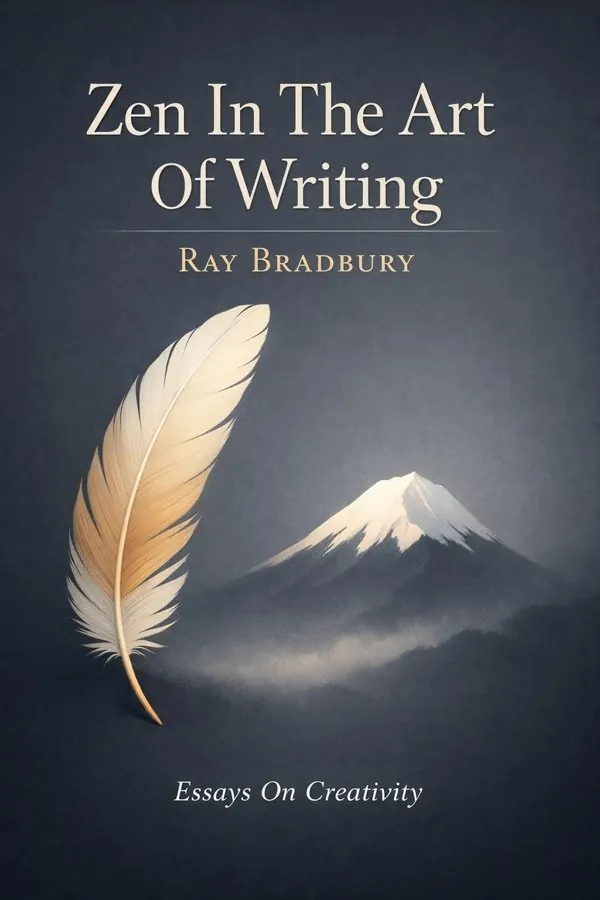
Zen In The Art Of Writing: Essays On Creativity: Summary & Key Insights
by Ray Bradbury
 10 min10 chaptersAudio available
Key Takeaways from Zen In The Art Of Writing: Essays On Creativity
The strongest writing rarely starts with strategy; it starts with delight.
Creativity depends on speed and stillness at the same time.
Inspiration is not a magical visitor you passively wait for; it is a living force you must nourish.
Bradbury’s famously playful phrase about being “drunk” captures an essential truth: good writing often requires temporary liberation from self-consciousness.
A creative career is often built not through grand gestures but through small, repeated acts of commitment.
What Is Zen In The Art Of Writing: Essays On Creativity About?
Zen In The Art Of Writing: Essays On Creativity by Ray Bradbury is a writing book spanning 11 pages. Zen In The Art Of Writing: Essays On Creativity is Ray Bradbury’s exuberant manifesto on what it means to live as a writer. Rather than offering a dry handbook of rules, Bradbury gathers personal essays, reflections, and practical wisdom about inspiration, discipline, imagination, and the emotional courage required to create. He writes about the habits that sustained him, the passions that fueled his stories, and the deep connection between joy and artistic excellence. For Bradbury, writing is not a technical exercise first and foremost; it is an act of vitality, curiosity, and wholehearted engagement with life. The book matters because it reminds writers that craft is inseparable from feeling. In an age obsessed with productivity hacks and market trends, Bradbury argues that the best work comes from enthusiasm, play, and fearless self-expression. His authority is hard to question: over a career spanning decades, he produced classics such as Fahrenheit 451 and The Martian Chronicles while becoming one of the most beloved literary voices in American fiction. This collection distills his philosophy into energetic, memorable lessons for anyone who wants to write with more honesty, originality, and delight.
This FizzRead summary covers all 10 key chapters of Zen In The Art Of Writing: Essays On Creativity in approximately 10 minutes, distilling the most important ideas, arguments, and takeaways from Ray Bradbury's work. Also available as an audio summary and Key Quotes Podcast.
Zen In The Art Of Writing: Essays On Creativity
Zen In The Art Of Writing: Essays On Creativity is Ray Bradbury’s exuberant manifesto on what it means to live as a writer. Rather than offering a dry handbook of rules, Bradbury gathers personal essays, reflections, and practical wisdom about inspiration, discipline, imagination, and the emotional courage required to create. He writes about the habits that sustained him, the passions that fueled his stories, and the deep connection between joy and artistic excellence. For Bradbury, writing is not a technical exercise first and foremost; it is an act of vitality, curiosity, and wholehearted engagement with life.
The book matters because it reminds writers that craft is inseparable from feeling. In an age obsessed with productivity hacks and market trends, Bradbury argues that the best work comes from enthusiasm, play, and fearless self-expression. His authority is hard to question: over a career spanning decades, he produced classics such as Fahrenheit 451 and The Martian Chronicles while becoming one of the most beloved literary voices in American fiction. This collection distills his philosophy into energetic, memorable lessons for anyone who wants to write with more honesty, originality, and delight.
Who Should Read Zen In The Art Of Writing: Essays On Creativity?
This book is perfect for anyone interested in writing and looking to gain actionable insights in a short read. Whether you're a student, professional, or lifelong learner, the key ideas from Zen In The Art Of Writing: Essays On Creativity by Ray Bradbury will help you think differently.
- ✓Readers who enjoy writing and want practical takeaways
- ✓Professionals looking to apply new ideas to their work and life
- ✓Anyone who wants the core insights of Zen In The Art Of Writing: Essays On Creativity in just 10 minutes
Want the full summary?
Get instant access to this book summary and 100K+ more with Fizz Moment.
Get Free SummaryAvailable on App Store • Free to download
Key Chapters
The strongest writing rarely starts with strategy; it starts with delight. Bradbury’s most enduring lesson is that writing must come from a place of real emotional excitement. If a story is built only to impress, sell, or imitate, readers can sense the strain. But when a writer is genuinely fascinated—by an image, memory, fear, joke, dream, or question—the work gains vitality. Bradbury treats joy not as something sentimental or soft, but as creative fuel. Even dark stories can emerge from joy if the writer feels intensely alive while exploring them.
This idea challenges the common belief that serious writing must be grim, tortured, or dutiful. Bradbury insists that love for the subject is what gives language energy. A writer obsessed with haunted houses, small-town nostalgia, carnivals, rockets, autumn nights, or childhood wonder will always have more power than one trying to sound literary. Joy sharpens attention. It makes details vivid. It gives rhythm to sentences because the writer is pursuing something personally meaningful.
In practice, this means paying attention to what excites you before paying attention to what seems respectable. If you keep returning to strange dreams, family legends, old photographs, or half-forgotten fears, those are not distractions; they are clues. A poem about a hallway you feared as a child may carry more life than a calculated essay on an approved topic. Bradbury’s own career was built by honoring his enthusiasms instead of suppressing them.
Actionable takeaway: make a list of ten subjects, images, or memories that instantly energize you, and write from one of them before you write from obligation.
Creativity depends on speed and stillness at the same time. Bradbury describes the writer’s work as a paradox: first, you must run fast enough to catch ideas before they vanish; then you must stand still long enough to understand what you’ve caught. Many writers fail because they overthink too early or because they never reflect at all. Bradbury’s method honors both instinct and awareness.
Running fast means drafting with urgency. When an idea arrives—a phrase, title, image, character voice—you move before the rational mind edits it into silence. This is why Bradbury valued free association, spontaneous lists, and quick first drafts. Ideas often appear in flashes, and hesitation can weaken them. Standing still comes later, when you ask what the image means, what emotional truth lies beneath it, and how the material wants to grow. Reflection transforms raw impulse into shaped art.
This balance is useful well beyond fiction. A nonfiction writer may brainstorm headings rapidly, then pause to identify the central argument. A screenwriter may race through dialogue in one sitting, then return to refine structure. Even journaling works this way: first spill the thought, then study it. The danger of only running fast is chaos. The danger of only standing still is paralysis.
A practical application is to divide your process into stages. Spend 20 minutes writing without censorship on a prompt like “The room I still remember” or “A night I cannot explain.” Then spend 10 minutes underlining recurring patterns, emotional triggers, and surprising images. Bradbury’s genius lay in treating both motion and contemplation as essential partners.
Actionable takeaway: separate drafting from judging—write quickly first, then revisit later to discover what your subconscious was trying to say.
Inspiration is not a magical visitor you passively wait for; it is a living force you must nourish. Bradbury’s view of the muse is practical, playful, and demanding. He recommends feeding the creative mind with rich, varied material: poems, essays, stories, comics, films, memories, conversations, libraries, landscapes, and obsessions. The muse grows stronger when it is regularly offered images, ideas, and sensations. It weakens when starved by routine, cynicism, or overstimulation without reflection.
What makes this advice powerful is that Bradbury does not separate reading from writing. He sees them as part of the same cycle. When you read deeply and widely, your imagination absorbs rhythms, structures, and possibilities. When you remain curious about the world, you collect emotional and sensory ingredients for future work. The muse also feeds on attention. Noticing the smell of rain on pavement, the silence after an argument, or the color of a carnival sign at dusk becomes creative inventory.
For modern writers, this matters because passive consumption is easy to confuse with nourishment. Endless scrolling may fill time, but it rarely feeds imagination in the way an intentional reading habit or a long walk does. To feed the muse, choose quality, variety, and presence. Keep notebooks. Copy sentences that move you. Visit places that provoke feeling. Revisit the books that first awakened your love of language.
A practical routine might include reading one poem each morning, recording five unusual observations during the day, and listing ten nouns at night that sparked curiosity. Over time, such habits create a reservoir from which original work can emerge. Bradbury reminds us that fertile writing grows from a fertile inner life.
Actionable takeaway: build a daily “muse diet” of reading, observation, and note-taking so your imagination always has something vivid to transform.
Bradbury’s famously playful phrase about being “drunk” captures an essential truth: good writing often requires temporary liberation from self-consciousness. He does not mean recklessness without craft; he means surrendering, for a while, to energy, appetite, and emotional momentum. Writers are frequently stopped not by lack of talent but by excessive caution. They worry about taste, judgment, marketability, originality, and whether the draft sounds intelligent. Bradbury argues that this fear dries out the language before it has a chance to live.
To write “drunk” is to enter the page with abandon. It is to follow the strange metaphor, the excessive image, the unruly voice, the memory that embarrasses you, the joke that feels too odd, the dream that makes no immediate sense. Many of these elements can be shaped later. What matters first is that they appear. The writer who is overly sober at the beginning often produces safe, polite work with no pulse.
This idea is especially useful during first drafts, brainstorming sessions, and experimental writing. Suppose you are writing an essay about grief. A controlled outline may help eventually, but perhaps the first true sentence arrives only when you admit that grief felt like hearing footsteps in a house where no one lived anymore. That image may be irrational, but it is emotionally accurate. Bradbury would say: follow it.
The practical challenge is creating conditions where fear loosens its grip. Timed writing sprints, drafting by hand, writing before checking messages, or composing in private with no intention of immediate sharing can all help. The point is not chaos forever; the point is access. Once the living material is on the page, craft can refine it.
Actionable takeaway: in your next draft, forbid yourself from editing for the first 15 minutes and chase the most vivid, surprising impulse instead of the safest one.
A creative career is often built not through grand gestures but through small, repeated acts of commitment. Bradbury’s notion of “investing dimes” points to the humble, cumulative nature of becoming a writer. Tiny investments of time, money, attention, and effort—buying a notebook, spending hours in a library, submitting one story, writing one page, reading one more poem—compound over years into mastery. This is encouraging because it makes writing more accessible. You do not need perfect conditions to begin; you need consistency.
Bradbury’s own life reflects this principle. He was shaped by libraries, relentless practice, and devotion to his craft long before fame arrived. The message is clear: stop waiting for the ideal retreat, schedule, office, or contract. Invest what you can now. Ten serious minutes a day will teach you more than endless fantasies about someday writing full-time.
This lesson is particularly helpful for people balancing work, family, or financial pressure. A parent may write in fragments during early mornings. A student may draft stories between classes. A professional may keep a running document of metaphors and scene ideas during commutes. These modest acts may seem insignificant, but over months they accumulate into finished work and stronger instincts.
Financial investment matters too, though not extravagantly. Buying books, attending a workshop, printing drafts, or taking a train to a place that stimulates your imagination can all reinforce identity and seriousness. The key is intentionality. Writers become writers by repeatedly choosing the craft.
Actionable takeaway: define one small daily investment—200 words, 15 minutes, one observation list, or one page of reading—and protect it as the foundation of your long-term creative life.
Every writing career is also a voyage into the self. Bradbury presents authorship not merely as production but as discovery. The writer sets out thinking the goal is to create stories, essays, or novels, but along the way finds buried memories, hidden fears, recurring symbols, unresolved longings, and unexpected truths. In this sense, writing is both outward communication and inward excavation. The page becomes a map of the psyche.
This explains why certain themes keep returning in a writer’s work. One person repeatedly writes about abandoned houses, another about trains, another about brothers, storms, or vanished summers. These are not random fixations. They are personal coordinates. Bradbury encourages writers to trust them because recurring images often lead to the deepest material. They reveal what the subconscious is trying to say long before the conscious mind can explain it.
In practical terms, this means paying close attention to patterns across your work. If your stories keep circling loneliness, spectacle, childhood, exile, or transformation, do not dismiss that repetition as lack of variety. Ask what emotional territory you are charting. A memoirist might realize that every anecdote involves performance and hiding. A novelist might notice that all antagonists embody a fear of conformity. Such awareness helps writers deepen their work instead of merely repeating themselves unconsciously.
This inner voyage also requires courage. Self-discovery through writing can be unsettling because it reveals contradictions. Yet Bradbury treats this as part of the artistic reward. By writing honestly, you become more available to your own mind—and therefore more capable of reaching others.
Actionable takeaway: review your last five pieces of writing and identify recurring images or themes; use those patterns as clues to the deeper work you are meant to pursue.
Originality is not born from isolation. Bradbury celebrates the importance of standing on the shoulders of giants—reading beloved writers intensely, absorbing their strengths, and allowing them to enlarge your possibilities. This is not imitation in the shallow sense of copying style. It is apprenticeship through admiration. Great writers teach courage, rhythm, image-making, structure, humor, scale, and emotional precision. By loving them, you sharpen your own standards and expand your sense of what language can do.
Bradbury openly acknowledges his influences, and this honesty is liberating. Many aspiring writers feel pressured to sound wholly unique from the beginning, as if influence were a weakness. In reality, every writer begins by echoing voices that moved them. Through repetition, experimentation, and lived experience, those echoes slowly become a distinct voice. The path to originality often runs through devotion.
A practical approach is to read diagnostically. Do not simply admire a story; ask why it works. What kind of verbs create momentum? How does the writer begin scenes? How are metaphors introduced? How much is said directly, and how much is implied? You can also imitate temporarily as training. Write a paragraph in the spirit of a writer you love, then rewrite it in your own natural voice. This teaches flexibility and awareness.
Bradbury’s broader point is that influences should energize rather than intimidate. The giants are not there to crush you but to carry you higher. Reading widely across genres can also prevent narrowness. Poets can teach concision to novelists; playwrights can teach dialogue to essayists; science fiction can teach wonder to memoirists.
Actionable takeaway: choose one writer you admire this week, study a single page closely, and borrow one technique consciously in your next piece.
Much of the writer’s real work happens below conscious awareness. Bradbury repeatedly points toward the “secret mind,” the intuitive and associative layer of thought that produces startling images, emotional connections, and symbolic patterns without explaining itself in advance. Writers often make the mistake of demanding that every idea justify itself too early. Bradbury argues instead for trust. The unconscious frequently knows where the work needs to go before the intellect catches up.
This does not mean abandoning thought. It means recognizing sequence. First the hidden mind offers material; then the conscious mind shapes it. A title suddenly appears. A character walks into a room. A memory resurfaces at the wrong time. A metaphor insists on repeating itself. Rather than dismissing these moments as random, Bradbury treats them as signals from the deeper self. Many of the richest stories begin this way.
Writers can cultivate this relationship by creating conditions for intuition to speak. Freewriting, dream notes, walks without devices, and writing prompts based on nouns or sensory fragments all help bypass rigid control. So does keeping a list of surprising words or images and letting them generate stories. If the phrase “the blue staircase” haunts you, write toward it before asking why. Meaning often arrives through motion.
This principle is especially valuable when writers feel stuck. Instead of forcing a solution analytically, you can ask your subconscious for help by changing form. Write a letter from one character to another. Describe the setting as if it were a person. Start from the last image you remember. Such methods invite hidden associations to surface.
Actionable takeaway: keep a dedicated notebook for dreams, odd phrases, and recurring images, and use one entry each week as the seed for a fresh piece of writing.
Writers do not merely report reality; they reveal it through metaphor. Bradbury treats images as keys to emotional truth. A strong metaphor does more than decorate prose—it exposes hidden relationships, intensifies feeling, and makes abstract experience tangible. Writers often know what they feel before they know how to explain it. Metaphor bridges that gap. It allows fear to become a locked carnival at midnight, loneliness to become snow falling in an empty theater, or desire to become a match flaring in wind.
Bradbury’s work is famous for this sensory and metaphorical richness, and he urges writers to chase images that carry emotional charge. Rather than beginning with an abstract theme like mortality or freedom, begin with the image that embodies it. A dandelion clock, a burning library, a train disappearing at dusk—such images can organize an entire piece of writing. They attract scenes, memories, and language around them.
This approach is practical across genres. In essays, metaphor can clarify ideas that might otherwise remain vague. In memoir, it can help articulate complicated feelings. In fiction, it gives recurring symbolic coherence. A writer working on burnout might repeatedly use images of dimming bulbs, overheated wires, or empty fuel tanks. Those metaphors not only enrich style but also guide structure and insight.
The skill improves with deliberate practice. Keep a notebook of comparisons. Ask what a feeling resembles physically, visually, or musically. If jealousy were weather, what weather would it be? If relief were architecture, what room would it create? Bradbury shows that metaphor is not ornamental excess; it is one of the mind’s native ways of understanding.
Actionable takeaway: when writing about any emotion or idea, force yourself to generate three concrete images for it before drafting your final paragraph.
Bradbury’s idea of “Zen” is not withdrawal from life but complete absorption in meaningful work. The highest creative state, in his view, combines enthusiasm, regular practice, trust in intuition, and freedom from unnecessary self-interference. Zen in writing means showing up consistently, listening deeply, and entering so fully into the act that effort becomes joyful concentration. It is discipline without deadness, seriousness without heaviness.
This matters because many writers split creativity into false opposites: either wild inspiration or rigid routine. Bradbury refuses that split. He argues that routine can protect inspiration, and that joy becomes stronger when given structure. Daily practice trains the mind to be available. Lists, notebooks, reading habits, and deadlines are not enemies of imagination; they are containers that help it flourish. At the same time, discipline must remain connected to love. Mechanical output alone is not enough.
In everyday practice, Zen writing might look like beginning each session with a brief ritual, writing from a vivid noun list, drafting without interruption, and ending by noting tomorrow’s next step. It might also mean refusing perfectionism, because perfectionism pulls attention away from the work and toward the ego. When fully engaged, the writer stops performing and starts discovering.
Bradbury’s final contribution is philosophical as much as practical: the writing life is not just about producing books. It is about living alertly, emotionally, and imaginatively. To write well is to be awake to the world and to your own responses to it. That alertness is both an artistic method and a way of being.
Actionable takeaway: create a simple repeatable writing ritual—same time, same notebook, same opening prompt—and use it to make joyful discipline part of your daily life.
All Chapters in Zen In The Art Of Writing: Essays On Creativity
About the Author
Ray Bradbury (1920–2012) was one of America’s most beloved and imaginative writers, known for blending science fiction, fantasy, horror, and literary fiction with poetic language and deep human feeling. Over a career that lasted more than seventy years, he wrote classic works such as Fahrenheit 451, The Martian Chronicles, Dandelion Wine, and Something Wicked This Way Comes. Bradbury was largely self-educated through libraries, and that lifelong love of reading shaped both his art and his philosophy of creativity. In addition to novels and short stories, he wrote plays, screenplays, essays, and speeches. His work consistently celebrated wonder, memory, imagination, and the emotional power of storytelling. Zen In The Art Of Writing captures his role not just as a master storyteller, but as an inspiring advocate for a joyful and disciplined creative life.
Get This Summary in Your Preferred Format
Read or listen to the Zen In The Art Of Writing: Essays On Creativity summary by Ray Bradbury anytime, anywhere. FizzRead offers multiple formats so you can learn on your terms — all free.
Available formats: App · Audio · PDF · EPUB — All included free with FizzRead
Download Zen In The Art Of Writing: Essays On Creativity PDF and EPUB Summary
Key Quotes from Zen In The Art Of Writing: Essays On Creativity
“The strongest writing rarely starts with strategy; it starts with delight.”
“Creativity depends on speed and stillness at the same time.”
“Inspiration is not a magical visitor you passively wait for; it is a living force you must nourish.”
“Bradbury’s famously playful phrase about being “drunk” captures an essential truth: good writing often requires temporary liberation from self-consciousness.”
“A creative career is often built not through grand gestures but through small, repeated acts of commitment.”
Frequently Asked Questions about Zen In The Art Of Writing: Essays On Creativity
Zen In The Art Of Writing: Essays On Creativity by Ray Bradbury is a writing book that explores key ideas across 10 chapters. Zen In The Art Of Writing: Essays On Creativity is Ray Bradbury’s exuberant manifesto on what it means to live as a writer. Rather than offering a dry handbook of rules, Bradbury gathers personal essays, reflections, and practical wisdom about inspiration, discipline, imagination, and the emotional courage required to create. He writes about the habits that sustained him, the passions that fueled his stories, and the deep connection between joy and artistic excellence. For Bradbury, writing is not a technical exercise first and foremost; it is an act of vitality, curiosity, and wholehearted engagement with life. The book matters because it reminds writers that craft is inseparable from feeling. In an age obsessed with productivity hacks and market trends, Bradbury argues that the best work comes from enthusiasm, play, and fearless self-expression. His authority is hard to question: over a career spanning decades, he produced classics such as Fahrenheit 451 and The Martian Chronicles while becoming one of the most beloved literary voices in American fiction. This collection distills his philosophy into energetic, memorable lessons for anyone who wants to write with more honesty, originality, and delight.
More by Ray Bradbury
You Might Also Like
The Art of Perspective
Christopher Castellani
10 min
Making a Point: The Persnickety Story of English Punctuation
David Crystal
10 min
The Elements Of Eloquence: How To Turn The Perfect English Phrase
Mark Forsyth
10 min
The Pocket Muse: Ideas and Inspirations for Writing
Monica Wood
10 min
A Little Book on Form: An Exploration into the Formal Imagination of Poetry
Robert Hass
10 min
Adventures In The Screen Trade: A Personal View Of Hollywood And Screenwriting
William Goldman
10 minBrowse by Category
Ready to read Zen In The Art Of Writing: Essays On Creativity?
Get the full summary and 100K+ more books with Fizz Moment.