
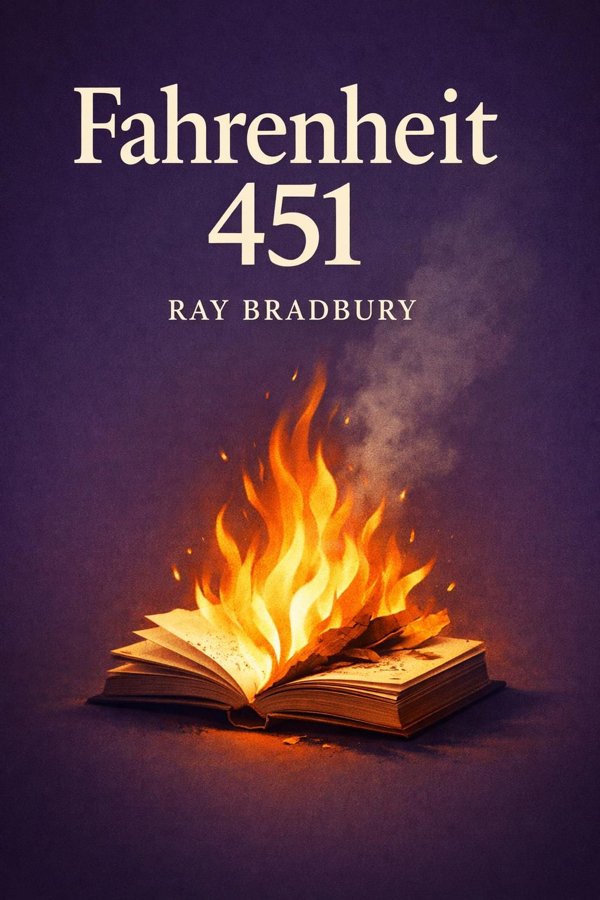
Fahrenheit 451: Summary & Key Insights
by Ray Bradbury
 10 min10 chaptersAudio available
Key Takeaways from Fahrenheit 451
People often participate in harmful systems not because they are evil, but because those systems make them feel useful, powerful, and normal.
A single honest question can do what arguments often cannot: awaken a sleeping mind.
A society can appear comfortable while becoming spiritually vacant.
We understand the value of something most clearly when we see what someone is willing to sacrifice for it.
Change often begins in secrecy, before it becomes visible action.
What Is Fahrenheit 451 About?
Fahrenheit 451 by Ray Bradbury is a scifi_fantasy book spanning 10 pages. Fahrenheit 451 is Ray Bradbury’s haunting dystopian novel about a future where books are outlawed, independent thought is suspect, and “firemen” are tasked not with putting out fires but with starting them. At the center of the story is Guy Montag, a loyal book burner who begins to sense that something is deeply wrong in a culture obsessed with speed, entertainment, and emotional numbness. As his certainty erodes, Montag is pulled into a dangerous search for meaning, memory, and truth. What makes the novel enduring is not only its dramatic premise, but its unsettling relevance. Bradbury explores censorship, mass distraction, shallow media culture, and the social pressure to avoid difficult ideas. His warning is larger than government repression alone: societies can also destroy books and thought by choosing comfort over curiosity. First published in 1953, the novel still feels urgently modern in an age of endless screens, algorithmic feeds, and shrinking attention spans. Bradbury was one of the twentieth century’s most imaginative literary voices, blending poetic language with sharp social criticism. In Fahrenheit 451, he created a powerful defense of reading, reflection, and the inner life.
This FizzRead summary covers all 10 key chapters of Fahrenheit 451 in approximately 10 minutes, distilling the most important ideas, arguments, and takeaways from Ray Bradbury's work. Also available as an audio summary and Key Quotes Podcast.
Fahrenheit 451
Fahrenheit 451 is Ray Bradbury’s haunting dystopian novel about a future where books are outlawed, independent thought is suspect, and “firemen” are tasked not with putting out fires but with starting them. At the center of the story is Guy Montag, a loyal book burner who begins to sense that something is deeply wrong in a culture obsessed with speed, entertainment, and emotional numbness. As his certainty erodes, Montag is pulled into a dangerous search for meaning, memory, and truth.
What makes the novel enduring is not only its dramatic premise, but its unsettling relevance. Bradbury explores censorship, mass distraction, shallow media culture, and the social pressure to avoid difficult ideas. His warning is larger than government repression alone: societies can also destroy books and thought by choosing comfort over curiosity. First published in 1953, the novel still feels urgently modern in an age of endless screens, algorithmic feeds, and shrinking attention spans.
Bradbury was one of the twentieth century’s most imaginative literary voices, blending poetic language with sharp social criticism. In Fahrenheit 451, he created a powerful defense of reading, reflection, and the inner life.
Who Should Read Fahrenheit 451?
This book is perfect for anyone interested in scifi_fantasy and looking to gain actionable insights in a short read. Whether you're a student, professional, or lifelong learner, the key ideas from Fahrenheit 451 by Ray Bradbury will help you think differently.
- ✓Readers who enjoy scifi_fantasy and want practical takeaways
- ✓Professionals looking to apply new ideas to their work and life
- ✓Anyone who wants the core insights of Fahrenheit 451 in just 10 minutes
Want the full summary?
Get instant access to this book summary and 100K+ more with Fizz Moment.
Get Free SummaryAvailable on App Store • Free to download
Key Chapters
People often participate in harmful systems not because they are evil, but because those systems make them feel useful, powerful, and normal. That is where Fahrenheit 451 begins. Guy Montag is a fireman, but in Bradbury’s world firemen burn books instead of saving homes. He takes pride in the ritual. Fire is exciting, absolute, and theatrical. It turns complexity into ash in seconds. At first, Montag experiences his work as beauty and certainty rather than brutality.
This matters because Bradbury shows how dangerous roles can become attractive when a society rewards obedience over reflection. Montag’s identity is built on performance: the uniform, the machinery, the approved mission. He does not have to think deeply about what books contain or what is lost when they disappear. His job shields him from moral responsibility by making destruction feel like civic duty.
The idea extends far beyond the novel. In real life, people may defend policies, workplace norms, or digital habits simply because they are institutionalized. A person may spread misinformation, ignore nuance, or mock learning not from conviction, but from social momentum. The lesson is that destructive behavior often comes wrapped in efficiency, status, and belonging.
Bradbury asks us to notice the emotional appeal of simplification. Burning books is not only censorship; it is the fantasy of eliminating confusion. Yet societies need difficulty, debate, and contradiction in order to remain humane.
Actionable takeaway: Examine one role or routine in your life that feels unquestioned, and ask what values it quietly serves. Comfort and righteousness are not proof that something is good.
A single honest question can do what arguments often cannot: awaken a sleeping mind. Clarisse McClellan changes Montag’s life not by preaching to him, but by noticing what everyone else has stopped noticing. She asks whether he is happy. She talks about dew, moonlight, conversation, and walking for no reason. In a society that prizes stimulation over awareness, Clarisse’s attention feels almost revolutionary.
Her importance lies in what she represents. Clarisse is not powerful in a political sense. She has no official status, no grand plan, no weapon. What she possesses is presence. She observes the world directly rather than through screens and slogans. Because of that, she exposes the emptiness of a culture that has confused constant activity with real living.
Bradbury uses Clarisse to suggest that intellectual freedom begins with sensory and emotional freedom. Before Montag can love books, he must relearn how to see, listen, and wonder. Curiosity is the first rebellion. If people no longer ask why things are arranged as they are, they become easy to govern and easy to distract.
This idea applies strongly today. We live amid endless prompts to react quickly, scroll constantly, and reduce attention to fragments. Clarisse reminds us that thoughtfulness often starts in small acts: taking a walk without headphones, having an unhurried conversation, or asking a question that breaks routine. The goal is not nostalgia, but wakefulness.
Her method is practical as well as philosophical. Instead of fighting noise with more noise, she reintroduces depth through observation. That is why she affects Montag so deeply.
Actionable takeaway: Ask yourself one Clarisse-like question today: Am I living attentively, or merely staying occupied? Then spend ten minutes noticing your environment without a screen.
A society can appear comfortable while becoming spiritually vacant. Mildred Montag embodies this condition. She spends her days absorbed in wall-sized television dramas and seashell radios that fill every silence. She is not physically deprived, yet she is emotionally inaccessible, restless, and profoundly detached from herself. Her attempted overdose early in the novel reveals the hidden despair beneath her dependence on entertainment.
Bradbury’s insight is subtle and devastating: numbness can masquerade as happiness. Mildred does not think of herself as oppressed, because she is surrounded by amusement, consumer ease, and social approval. But her pleasures are passive and engineered. She consumes noise rather than experiences meaning. She refers to television characters as her “family,” suggesting that simulated companionship has replaced intimacy.
This critique remains strikingly current. Modern life offers endless mechanisms for self-distraction: autoplay video, constant notifications, algorithmic feeds, and curated identities. None of these are inherently evil, but when they replace reflection, conversation, and memory, they hollow out the inner life. Mildred’s tragedy is not that she lacks content to watch; it is that she lacks a self sturdy enough to stand without it.
Bradbury also shows how emotional emptiness supports censorship. People who cannot tolerate silence or discomfort are less likely to seek complex ideas. They may prefer entertainment that confirms rather than challenges them. In that way, cultural shallowness becomes a political vulnerability.
Mildred is not merely a foil to Montag. She is a warning about what happens when convenience becomes our highest value. Comfort without consciousness eventually becomes confinement.
Actionable takeaway: Identify one form of distraction you use to avoid silence. Replace fifteen minutes of it this week with reading, journaling, or a real conversation.
We understand the value of something most clearly when we see what someone is willing to sacrifice for it. One of the novel’s most pivotal moments occurs when Montag and the other firemen raid a house filled with hidden books. Instead of fleeing, the unnamed woman chooses to die with her library, igniting the fire herself. Her act shocks Montag because it makes visible what his society has worked hard to conceal: books must contain something powerful if a person would rather burn than surrender them.
This scene transforms censorship from abstraction into moral crisis. Until then, Montag has treated books as contraband objects. The woman forces him to confront them as vessels of conviction, memory, identity, and freedom. Her death suggests that literature is not merely information storage. It holds lived experience, dissent, faith, doubt, and the stubborn complexity of being human.
Bradbury does not romanticize suffering, but he does insist that ideas matter enough to live and die for. In an age that often treats all content as interchangeable, this is a radical claim. A book is not just another media unit. The best books demand patience, invite disagreement, and alter the reader’s interior life.
In practical terms, the episode asks what we defend when social pressure urges conformity. What truths, values, or sources of wisdom do we protect when they become inconvenient? The point is not that everyone must become a martyr. It is that we should recognize which things in our lives have irreplaceable meaning.
For Montag, the woman’s choice ignites conscience. For readers, it raises a lasting question: what would it mean to treat reading as something more than a hobby?
Actionable takeaway: Choose one book that has deeply shaped you and write down why it matters. Naming its value strengthens your ability to defend what nourishes your mind.
Change often begins in secrecy, before it becomes visible action. After years of compliance, Montag starts hiding books and reading them in private. This is not yet heroic rebellion. It is confused, fearful, and inconsistent. He does not instantly become wise. Instead, Bradbury shows the uncomfortable reality of awakening: once a person begins to question a false world, he must endure uncertainty, contradiction, and grief.
Montag’s private reading marks the shift from passive existence to inner freedom. By opening books, he opens himself to complexity. He realizes that his culture has trained people to fear difficult thoughts because difficult thoughts slow them down, unsettle certainty, and generate disagreement. Yet those very effects are necessary for maturity. Reading teaches Montag that truth is rarely simple and that a meaningful life cannot be built on distraction alone.
This key idea is especially relevant because many people experience intellectual change in similarly messy ways. A person may begin by quietly exploring unfamiliar viewpoints, challenging inherited assumptions, or returning to neglected practices like deep reading. At first this can feel lonely. Old identities no longer fit, but new ones are not fully formed. Bradbury treats that discomfort as a necessary stage of growth rather than a sign of failure.
Montag’s revolt also underscores that resistance is internal before it becomes external. Laws and institutions matter, but so do attention, memory, and conscience. A censored society is sustained partly by people who stop cultivating an inner life.
Books do not save Montag magically. They provoke him, destabilize him, and force him to become someone new. That is precisely their power.
Actionable takeaway: Start a small practice of deliberate reading. Spend twenty minutes with a challenging book and note one idea that disrupts your usual way of thinking.
The most effective defenders of oppressive systems are often those who understand them best. Captain Beatty, Montag’s superior, is one of the novel’s most fascinating characters because he is intelligent, articulate, and deeply cynical. He knows literature, history, and argument, yet he uses that knowledge to justify book burning. According to Beatty, censorship arose not only from top-down control but from a society that wanted life to be easier, faster, and less offensive. Books created conflicting ideas, hurt feelings, and unequal levels of thought, so they became inconvenient.
Bradbury’s point is crucial: censorship can grow from the public’s appetite for comfort as much as from the state’s appetite for domination. Beatty argues that people prefer digestible amusement to serious reflection. If no one wants to be disturbed, challenged, or made to feel inadequate, then intellectual life shrinks. Over time, a culture can censor itself by rewarding only what is fast, simple, and agreeable.
This makes Beatty disturbingly modern. He understands how mass culture flattens nuance and how institutions exploit that tendency. His speeches reveal that the destruction of books is not just a legal policy; it is the endpoint of habits already embraced by the majority. The danger, then, is not only authoritarian force but voluntary shallowness.
In everyday life, this appears when organizations silence difficult conversations to avoid tension, when people dismiss books they have not read, or when public discourse is reduced to slogans designed for instant emotional effect. Beatty reminds us that intellectual freedom requires tolerance for discomfort.
His brilliance is corrupted by contempt, but his diagnosis contains truth. That is what makes him dangerous.
Actionable takeaway: The next time an idea irritates or unsettles you, resist the urge to dismiss it instantly. Ask whether your discomfort signals falsehood, or simply complexity.
Information alone is not enough; what matters is the quality of attention we bring to it. Professor Faber, the retired English teacher whom Montag seeks out, gives the novel one of its clearest philosophies of reading. He explains that it is not books as physical objects that matter most, but the qualities they contain: texture of life, leisure to think, and the freedom to act on what we learn. In other words, wisdom depends on content, reflection, and courage.
Faber is essential because he moves the novel beyond simple book worship. Bradbury is not arguing that printed paper is sacred in itself. He is arguing that serious reading preserves depth, contradiction, and lived reality in ways mass entertainment often does not. Faber understands that without time to absorb ideas, even access to books becomes meaningless. A person can own a library and remain intellectually asleep.
This insight has practical force today. We are flooded with information yet starved for digestion. People skim headlines, save articles they never read, and confuse exposure with understanding. Faber’s framework offers a corrective. First, seek material with richness and honesty. Second, create leisure, meaning undistracted time, to think about it. Third, translate insight into action, whether through conversation, civic engagement, or personal change.
Faber himself is imperfect; he is wise but timid. Bradbury shows that knowledge without courage can become another form of passivity. Still, he provides Montag with language for what has been missing from his life.
In a distracted culture, Faber’s lesson is simple but demanding: read deeply, think slowly, and live accordingly.
Actionable takeaway: After finishing any meaningful article or chapter, pause for five minutes and write what it says, why it matters, and what it asks you to do.
Once you see a lie clearly, continuing to live by it becomes almost impossible. As Montag’s awakening intensifies, his rebellion turns outward. He reads poetry aloud to Mildred and her friends, exposing the emotional poverty hidden beneath their chatter. He clashes with Beatty, destroys his old life, and is forced into flight. These scenes show that truth is not merely enlightening; it is disruptive. It can damage relationships built on denial and provoke systems built on control.
Bradbury refuses to portray resistance as neat or glamorous. Montag’s defiance is impulsive, imperfect, and dangerous. He lacks strategy and often acts from desperation. Yet that messiness makes his transformation believable. People emerging from conformity do not become polished revolutionaries overnight. They stumble, overreach, and face consequences.
One important lesson here is that suppressed truth often returns first as emotional intensity. The women listening to poetry are shaken not because they fully understand it, but because it reaches parts of themselves they have long buried. Meaning can hurt when a person has been trained to avoid feeling. Likewise, authoritarian or anti-intellectual cultures react violently to genuine thought because thought destabilizes the emotional habits that keep people compliant.
In contemporary life, speaking honestly can carry social costs even in less extreme settings. A person may challenge manipulative workplace norms, call attention to addictive technology habits, or defend careful thinking in environments that reward instant certainty. Such actions rarely produce immediate applause.
Montag’s path reminds us that integrity is costly, but evasion has its own cost: the slow destruction of the self. Courage is not the absence of fear. It is the willingness to act despite the collapse of old comforts.
Actionable takeaway: Name one truth you have been softening to keep others comfortable, and consider one respectful but direct way to express it.
When institutions destroy written culture, memory becomes a form of survival. After fleeing the city, Montag encounters a group of exiles led by Granger. These men have each memorized books or parts of books, preserving literature not through possession but through embodiment. They are not romantic eccentrics hiding in the woods; they are custodians of civilization, carrying forward what their society has chosen to erase.
This idea broadens the novel’s vision of resistance. Saving books is not only about protecting objects from fire. It is about internalizing wisdom so deeply that it cannot be easily confiscated. The book people understand that culture lives in human beings, in memory, speech, and transmission across generations. Their practice is humble yet profound: learn, remember, and wait for a time when rebuilding is possible.
Bradbury’s emphasis on memory feels especially relevant in a world that increasingly outsources recall to devices. External storage is useful, but dependence on it can weaken personal and cultural continuity. What we truly remember shapes our character. The words, stories, and principles we carry within us become resources in moments of crisis.
The exiles also model a non-destructive form of hope. They do not seek vengeance. They preserve. Their resistance is patient rather than theatrical. This is an important corrective to the idea that meaningful action must always be loud or immediate. Sometimes the most radical work is conservation: keeping alive what a culture is forgetting.
Their example invites readers to ask what they are carrying forward. Which ideas, poems, histories, or moral insights are worth remembering in a distracted age?
Actionable takeaway: Memorize a short passage, poem, or principle that matters to you. Internalized wisdom is available even when screens, systems, or circumstances fail.
Civilizations do not collapse only because they are attacked; they also collapse because they have hollowed themselves out from within. In the novel’s final movement, war destroys the city Montag has escaped. The destruction is sudden, but Bradbury has prepared us for it all along. A society that abandoned reflection, trivialized human connection, and numbed itself with entertainment was already fragile. The bombs merely reveal that inner decay has outer consequences.
Yet Fahrenheit 451 does not end in pure despair. Out of catastrophe emerges the possibility of renewal. Montag and the book people turn back toward the ruined city with the intention of helping rebuild. This closing note is modest rather than triumphant. Bradbury does not promise that humanity will finally learn its lesson forever. He offers something more credible: the chance to begin again, armed with memory, humility, and language.
Renewal matters because the novel is ultimately not just about what is lost, but about what can be recovered. Reflection can return. Communities can be rebuilt on better terms. People can remember that they are more than consumers and spectators. Bradbury’s hope is rooted not in technology or political systems alone, but in the enduring human capacities to remember, speak, teach, and imagine.
For modern readers, this final idea is deeply practical. Even if we cannot fix entire cultures, we can participate in renewal locally: through reading seriously, discussing ideas honestly, mentoring others, and protecting spaces where thought can flourish.
The ending asks us not merely to admire books, but to become the kind of people who can help rebuild a thoughtful world after periods of confusion and noise.
Actionable takeaway: Contribute to cultural renewal in one small way this week: recommend a meaningful book, host a thoughtful conversation, or create time for shared reading.
All Chapters in Fahrenheit 451
About the Author
Ray Bradbury (1920–2012) was an American author whose work helped define modern science fiction and fantasy. Born in Waukegan, Illinois, he developed a love of storytelling early and became known for combining imaginative premises with lyrical prose and humanistic themes. Although often grouped with science fiction writers, Bradbury’s work ranged across fantasy, horror, literary fiction, and essays. He is best known for Fahrenheit 451, his classic novel about censorship and the dangers of anti-intellectual culture, as well as The Martian Chronicles and Something Wicked This Way Comes. Bradbury wrote hundreds of short stories, plays, and screenplays over a long career. His enduring appeal lies in his ability to blend wonder, nostalgia, fear, and social criticism into stories that remain emotionally vivid and intellectually relevant.
Get This Summary in Your Preferred Format
Read or listen to the Fahrenheit 451 summary by Ray Bradbury anytime, anywhere. FizzRead offers multiple formats so you can learn on your terms — all free.
Available formats: App · Audio · PDF · EPUB — All included free with FizzRead
Download Fahrenheit 451 PDF and EPUB Summary
Key Quotes from Fahrenheit 451
“People often participate in harmful systems not because they are evil, but because those systems make them feel useful, powerful, and normal.”
“A single honest question can do what arguments often cannot: awaken a sleeping mind.”
“A society can appear comfortable while becoming spiritually vacant.”
“We understand the value of something most clearly when we see what someone is willing to sacrifice for it.”
“Change often begins in secrecy, before it becomes visible action.”
Frequently Asked Questions about Fahrenheit 451
Fahrenheit 451 by Ray Bradbury is a scifi_fantasy book that explores key ideas across 10 chapters. Fahrenheit 451 is Ray Bradbury’s haunting dystopian novel about a future where books are outlawed, independent thought is suspect, and “firemen” are tasked not with putting out fires but with starting them. At the center of the story is Guy Montag, a loyal book burner who begins to sense that something is deeply wrong in a culture obsessed with speed, entertainment, and emotional numbness. As his certainty erodes, Montag is pulled into a dangerous search for meaning, memory, and truth. What makes the novel enduring is not only its dramatic premise, but its unsettling relevance. Bradbury explores censorship, mass distraction, shallow media culture, and the social pressure to avoid difficult ideas. His warning is larger than government repression alone: societies can also destroy books and thought by choosing comfort over curiosity. First published in 1953, the novel still feels urgently modern in an age of endless screens, algorithmic feeds, and shrinking attention spans. Bradbury was one of the twentieth century’s most imaginative literary voices, blending poetic language with sharp social criticism. In Fahrenheit 451, he created a powerful defense of reading, reflection, and the inner life.
More by Ray Bradbury
You Might Also Like
Red Rising
Pierce Brown
10 min
Stranger in a Strange Land
Robert A. Heinlein
10 min
AI Valley
Chen Qiufan
10 min
Bloodchild
Octavia E. Butler
10 min
Do Androids Dream of Electric Sheep?
Philip K. Dick
10 min
Jujutsu Kaisen, Vol. 24
Gege Akutami
10 minBrowse by Category
Ready to read Fahrenheit 451?
Get the full summary and 100K+ more books with Fizz Moment.