
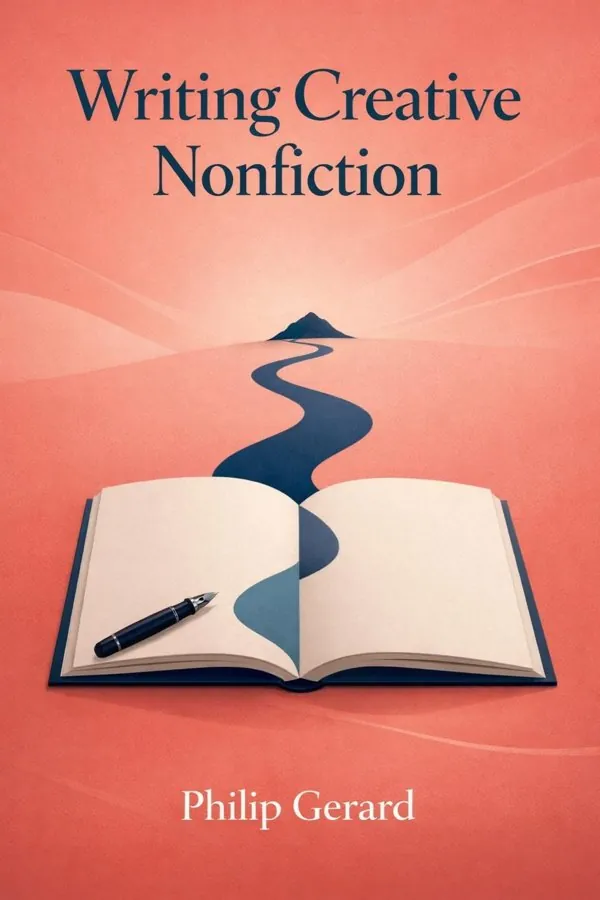
Writing Creative Nonfiction: Summary & Key Insights
 10 min10 chaptersAudio available
Key Takeaways from Writing Creative Nonfiction
The central challenge of creative nonfiction is that the writer must serve two masters at once: truth and narrative.
Not every true event deserves to become creative nonfiction.
In creative nonfiction, research is not a bureaucratic obligation; it is a creative engine.
Life happens in disorder, but stories require shape.
Facts may establish credibility, but voice creates intimacy.
What Is Writing Creative Nonfiction About?
Writing Creative Nonfiction by Philip Gerard is a writing book spanning 10 pages. Writing Creative Nonfiction by Philip Gerard is a practical and inspiring guide to one of the most demanding forms of writing: telling true stories with the narrative power of fiction. Gerard shows that strong nonfiction is not just a matter of gathering facts and arranging them clearly. It requires the writer to shape experience, research, memory, and observation into scenes, characters, tension, and meaning—without violating the truth. The book explores how writers can balance accuracy with artistry, using techniques such as structure, point of view, sensory detail, pacing, and revision to create work that feels alive on the page. What makes Gerard especially persuasive is his dual authority as both accomplished writer and longtime teacher of the craft. He understands the practical struggles writers face: choosing the right subject, finding a voice, handling research, and navigating ethical dilemmas. For memoirists, essayists, journalists, and anyone who wants to write fact-based work that readers cannot put down, this book offers both a philosophy of truth-telling and a toolbox for making nonfiction vivid, intimate, and memorable.
This FizzRead summary covers all 10 key chapters of Writing Creative Nonfiction in approximately 10 minutes, distilling the most important ideas, arguments, and takeaways from Philip Gerard's work. Also available as an audio summary and Key Quotes Podcast.
Writing Creative Nonfiction
Writing Creative Nonfiction by Philip Gerard is a practical and inspiring guide to one of the most demanding forms of writing: telling true stories with the narrative power of fiction. Gerard shows that strong nonfiction is not just a matter of gathering facts and arranging them clearly. It requires the writer to shape experience, research, memory, and observation into scenes, characters, tension, and meaning—without violating the truth. The book explores how writers can balance accuracy with artistry, using techniques such as structure, point of view, sensory detail, pacing, and revision to create work that feels alive on the page. What makes Gerard especially persuasive is his dual authority as both accomplished writer and longtime teacher of the craft. He understands the practical struggles writers face: choosing the right subject, finding a voice, handling research, and navigating ethical dilemmas. For memoirists, essayists, journalists, and anyone who wants to write fact-based work that readers cannot put down, this book offers both a philosophy of truth-telling and a toolbox for making nonfiction vivid, intimate, and memorable.
Who Should Read Writing Creative Nonfiction?
This book is perfect for anyone interested in writing and looking to gain actionable insights in a short read. Whether you're a student, professional, or lifelong learner, the key ideas from Writing Creative Nonfiction by Philip Gerard will help you think differently.
- ✓Readers who enjoy writing and want practical takeaways
- ✓Professionals looking to apply new ideas to their work and life
- ✓Anyone who wants the core insights of Writing Creative Nonfiction in just 10 minutes
Want the full summary?
Get instant access to this book summary and 100K+ more with Fizz Moment.
Get Free SummaryAvailable on App Store • Free to download
Key Chapters
The central challenge of creative nonfiction is that the writer must serve two masters at once: truth and narrative. Philip Gerard argues that this is not a contradiction but the defining discipline of the form. A nonfiction writer is first a witness—someone responsible for seeing carefully, researching honestly, and representing reality without invention. But the writer is also a storyteller, responsible for selecting details, shaping scenes, and creating meaning so that readers experience facts as lived human reality rather than dead information.
This distinction matters because many beginning writers assume that if something truly happened, it is automatically interesting. Gerard insists that truth alone does not create art. Raw experience becomes compelling only when the writer interprets it through craft. A profile of a fisherman, for instance, becomes more than a list of biographical details when the writer places him on the water at dawn, shows the rhythm of his labor, reveals his private fears, and connects his life to larger questions about work, weather, or survival.
At the same time, Gerard warns against the temptation to improve reality. The creative nonfiction writer cannot invent dialogue, combine characters, or change chronology just to make a stronger scene unless such choices are explicitly framed and ethically justified. The art lies in discovering the drama already embedded in truth.
A useful way to apply this idea is to ask two questions while drafting: What happened? and Why does it matter? The first keeps the work honest; the second keeps it alive. Actionable takeaway: when writing nonfiction, commit to factual accuracy first, then use the tools of story to reveal the deeper significance of what is true.
Not every true event deserves to become creative nonfiction. Gerard emphasizes that strong material begins with urgency: a subject that continues to trouble, fascinate, or haunt the writer. The best pieces often emerge where personal curiosity meets broader human significance. In other words, the writer needs both heat and perspective. A topic may be factually rich, but if it does not provoke a genuine emotional or intellectual response, the writing will likely feel dutiful rather than compelling.
Gerard encourages writers to search for stories that contain tension, contradiction, transformation, or unresolved meaning. A family memory may become an essay not because it is sentimental, but because it raises difficult questions about loyalty, class, grief, or identity. A travel narrative becomes memorable not because the place is exotic, but because the journey alters the writer’s understanding of self or world. Literary journalism gains force when it uses one event or one life to illuminate a larger social reality.
A practical test is whether the material holds both story and theme. Story gives movement—something happens, changes, or is discovered. Theme gives resonance—the event points beyond itself. For example, writing about learning to care for an aging parent can become more than memoir if it also explores dependence, reversal of roles, and the fear of mortality.
Writers can generate stronger subjects by listing experiences they cannot stop thinking about, then asking what deeper issue each one contains. Why this event? Why now? Why would another person care? Actionable takeaway: choose a topic only when it carries both personal urgency and a larger question that readers can enter.
In creative nonfiction, research is not a bureaucratic obligation; it is a creative engine. Gerard shows that good research deepens authority, sharpens detail, and often reveals the hidden shape of a story. Even memoirists, who might assume memory is enough, need to test recollection against documents, interviews, photographs, timelines, maps, and the memories of others. Research protects the writer from false certainty while expanding the world of the piece beyond private impression.
Gerard treats immersion as especially important. To write convincingly, the author must spend time in places, observe routines, ask questions, and notice textures that cannot be guessed from a distance. A piece about a courtroom, for example, gains life when the writer hears the scrape of benches, notices the rituals of clerks and attorneys, and understands the procedural language that shapes the day. A historical essay becomes more credible when archival facts are matched with an understanding of material conditions, social context, and competing viewpoints.
Research also produces surprises, and surprises often improve structure. A writer may begin with a simple portrait and discover a hidden conflict, a family secret, or a historical force reshaping the personal story. In that sense, research is not separate from imagination; it feeds it by providing real constraints and unexpected turns.
To apply this, writers can create a research map with three categories: what I know, what I think I know, and what I need to verify. Interview living sources, collect primary materials, and record sensory observations in the field. Actionable takeaway: treat research as part of storytelling, using it not only to confirm facts but to uncover depth, complexity, and narrative possibility.
Life happens in disorder, but stories require shape. Gerard argues that one of the writer’s most important jobs is to discover the structure that allows readers to follow events and feel their significance. Structure is not just a container for information; it is a way of thinking. The order in which facts appear changes what they mean.
Creative nonfiction can take many structural forms: chronological narrative, braided essay, segmented reflection, quest story, frame narrative, or a movement between present and past. Gerard encourages writers to choose structure based on the material rather than forcing every piece into a linear sequence. A memoir chapter about a childhood incident may be stronger if interrupted by adult reflection. An essay on illness may gain power by alternating medical scenes with memories that reveal what is being threatened. A reported piece may begin in the middle of a dramatic moment, then widen into context once the reader is hooked.
Scenes are crucial building blocks because they let readers experience events rather than merely hear about them. Characters matter too, even in nonfiction, because readers need to understand who wants what, who resists, and what changes. Gerard’s insight is that structure arises from relationships among these elements: scene, summary, reflection, and revelation.
A practical approach is to storyboard the piece. Write each major moment or section on a separate note and ask: where does the tension begin, where does understanding deepen, and where does the emotional or intellectual turn occur? Remove anything that repeats without adding movement. Actionable takeaway: stop asking only what happened next and start asking what arrangement of events creates the strongest journey for the reader.
Facts may establish credibility, but voice creates intimacy. Gerard sees voice as the audible presence of the writer on the page—the distinctive tone, rhythm, perspective, and attitude that make nonfiction feel spoken by an actual mind rather than assembled by a machine. In creative nonfiction, voice matters because readers are not only evaluating information; they are deciding whether to trust the consciousness presenting it.
Voice is shaped by choices in diction, syntax, point of view, and distance. A reflective memoir voice may be vulnerable, lyrical, and self-questioning. A literary journalist may adopt a more restrained voice, allowing observed detail to carry the emotional weight. A humorous essayist may use wit and exaggeration of emphasis, while still staying faithful to underlying facts. Gerard reminds writers that voice should emerge from subject and temperament, not from imitation. Borrowing someone else’s style may produce elegant sentences, but it rarely produces authority.
Point of view is part of this. First person can create immediacy, but it can also become self-absorbed if every sentence circles back to the writer’s feelings. Third person can provide range and perspective, but it may lose intimacy if overused. Gerard’s advice implies that the writer should ask not “Which point of view is more literary?” but “Which point of view best serves this material?”
One practical exercise is to draft the same scene in two or three voices: intimate first person, restrained observer, reflective essayist. Compare which version feels truest and most alive. Read aloud to hear false notes. Actionable takeaway: develop a voice readers can trust by matching tone and point of view to the demands of the subject rather than to literary fashion.
Readers believe what they can see, hear, smell, touch, and feel. Gerard emphasizes that creative nonfiction becomes vivid when the writer moves beyond abstract explanation and grounds the narrative in concrete sensory detail. This is not decoration. Specific detail creates credibility, emotional texture, and dramatic presence. It allows a reader to inhabit the moment rather than merely understand it intellectually.
A weak sentence might say, “My grandfather’s house felt lonely.” A stronger version might describe the ticking clock in the hallway, the dust on the piano keys, the smell of cedar and old coffee, the television muttering to an empty room. The emotional truth is carried by observed particulars. Gerard’s key point is that detail should not be random; it must be selective and meaningful. The right detail reveals character, mood, or tension. A politician smoothing his tie before answering a question tells us more than a paragraph of summary about nervousness.
Gerard also distinguishes emotional truth from melodrama. Strong nonfiction does not insist on emotion through exaggerated language. Instead, it trusts scenes. If a writer accurately renders the pause before a diagnosis, the shuffle of papers, the doctor not meeting the patient’s eyes, readers will feel the dread without being instructed to do so.
To apply this, writers can revisit every major scene and ask: what did the place look like, what sounds were present, what physical actions mattered, and which one or two details best suggest the emotional climate? Replace general adjectives with observed particulars. Actionable takeaway: build scenes from precise, purposeful sensory details that reveal what the moment meant without overexplaining it.
Even the truest story can lose readers if it moves at the wrong speed. Gerard stresses that pacing is the pulse of creative nonfiction—the management of time, emphasis, and suspense that keeps a narrative alive. Pacing is not simply about making writing fast. Some moments should linger; others should pass quickly. The craft lies in deciding where readers need immersion and where they need compression.
Scenes generally slow time down. They place readers inside dialogue, action, and sensory detail. Summary speeds time up by condensing stretches of experience, background, or repetitive action. Reflection pauses external movement so the writer can interpret events, ask questions, or connect the personal to the universal. Gerard’s insight is that effective nonfiction depends on balance among these modes. Too much scene and the piece may feel bloated; too much summary and it becomes flat; too much reflection and it stalls.
Dramatic arc also matters. Readers need reasons to keep going: uncertainty, conflict, discovery, stakes, or an unanswered question. In memoir, the arc may concern inner change rather than external plot. In reportage, the arc may emerge from an unfolding event or investigation. Either way, the writer should know where tension rises, where expectations shift, and what kind of resolution is earned.
A practical method is to chart the energy of the draft. Mark sections as high tension, background, or reflection, and see whether long low-energy stretches need interruption. Begin later, cut repetition, and end scenes at the point of strongest implication rather than after everything is explained. Actionable takeaway: control pacing deliberately by alternating scene, summary, and reflection so the reader experiences steady momentum toward deeper understanding.
Gerard treats first drafts as acts of discovery, not final performances. This is liberating because it shifts the writer’s goal from immediate perfection to honest exploration. In creative nonfiction, revision is where the material is tested, shaped, clarified, and deepened. What seemed vivid while drafting may prove confusing; what felt essential may turn out to be repetition or self-indulgence. Revision is the stage at which the writer becomes both architect and skeptic.
Gerard encourages writers to revise on multiple levels. At the large scale, ask structural questions: Does the piece begin in the right place? Is the central tension clear? Are the transitions earned? Does the ending open insight rather than merely stop? At the paragraph and sentence level, examine voice, rhythm, specificity, and excess explanation. Strong nonfiction often improves when the writer cuts the line that tells readers what to feel and lets the scene carry the emotion.
Revision also demands ethical review. Have you represented people fairly? Have you exaggerated certainty where memory is unstable? Have you omitted context that would alter the reader’s understanding? Gerard suggests that craft and integrity are inseparable. A beautifully written scene that misleads is not successful nonfiction.
Useful revision practices include reading aloud, printing the draft to see it afresh, reverse outlining after completion, and asking trusted readers where they were confused, unconvinced, or especially engaged. Leave time between drafts so attachment cools and judgment improves. Actionable takeaway: approach revision as a process of sharpening both art and truth, cutting whatever weakens clarity, credibility, or emotional force.
Creative nonfiction gains its power from a pact with the reader: this happened, and I am telling it as truthfully as I can. Gerard insists that this pact is sacred. Because the genre borrows the suspense, scene-building, and character focus of fiction, it is especially vulnerable to distortion. Writers may feel tempted to merge minor events, tidy chronology, reconstruct dialogue too confidently, or heighten scenes that seem flat. Gerard’s message is clear: once the writer starts inventing, the moral ground of the form begins to erode.
Ethics extends beyond factual accuracy. It also includes fairness, humility, and awareness of power. Writing about family, vulnerable subjects, or private pain raises difficult questions. Does the writer have the right to tell the story? What responsibilities are owed to real people who may be hurt by publication? How should uncertainty be handled when memory is incomplete? Gerard does not offer simplistic rules, but he urges writers to examine motive and consequence alongside craft.
For example, if a memoirist cannot remember exact dialogue from childhood, the ethical solution is not to create polished speeches but to paraphrase, signal uncertainty, or rely more heavily on scene, gesture, and documented fact. If reporting on trauma, the writer should avoid using another person’s suffering merely as narrative fuel. Respectful representation often requires patience, corroboration, and self-scrutiny.
Writers can build ethical habits by keeping detailed notes, distinguishing memory from verified fact, and asking of each questionable choice: does this clarify truth, or simply improve drama? Actionable takeaway: protect the reader’s trust by treating ethical accuracy not as a limitation on creativity but as the condition that makes creative nonfiction meaningful.
Gerard’s book is not only about producing a single essay or memoir chapter; it is about sustaining a long-term practice. He recognizes that writers must live with uncertainty, rejection, unfinished drafts, and periods when the work seems resistant or shapeless. The difference between those who want to write and those who become writers often lies less in talent than in endurance, curiosity, and discipline.
Creative nonfiction includes many forms—memoir, personal essay, literary journalism, travel writing, profile, history, nature writing—and Gerard encourages writers to read widely among them. Exposure to different forms expands technical possibilities. A memoirist may learn compression from journalism; an essayist may learn scene-building from narrative history. Genre should be a set of options, not a cage.
He also suggests that publication is not the only measure of value. Audience matters, and writers should understand markets and editors, but the deeper practice involves attention: keeping notebooks, observing people, listening for language, following obsessions, and returning repeatedly to subjects that still have life in them. A sustainable writing life depends on habits more than inspiration. Setting regular work time, collecting material consistently, and revising patiently are what allow occasional inspiration to become finished work.
For writers building a career, it helps to think in terms of process goals rather than only publication goals: finish one essay a month, conduct two interviews a week, revise for an hour each morning, submit work regularly without tying self-worth to immediate acceptance. Actionable takeaway: build a durable creative nonfiction practice by reading broadly, writing consistently, and measuring progress by commitment to the craft as much as by external recognition.
All Chapters in Writing Creative Nonfiction
About the Author
Philip Gerard (1955–2022) was an American author, essayist, and longtime professor of creative writing at the University of North Carolina Wilmington. He played an important role in shaping the teaching and practice of creative nonfiction, especially through his emphasis on combining literary craft with factual integrity. Gerard wrote across genres, including essays, memoir, history, and narrative nonfiction, often blending careful research with vivid storytelling. His work reflected a deep interest in place, memory, culture, and the moral responsibilities of the writer. As a teacher, he was widely respected for helping students understand how true stories could be structured with the drama and texture of fiction without sacrificing honesty. Writing Creative Nonfiction remains one of his most influential contributions to writers and writing teachers alike.
Get This Summary in Your Preferred Format
Read or listen to the Writing Creative Nonfiction summary by Philip Gerard anytime, anywhere. FizzRead offers multiple formats so you can learn on your terms — all free.
Available formats: App · Audio · PDF · EPUB — All included free with FizzRead
Download Writing Creative Nonfiction PDF and EPUB Summary
Key Quotes from Writing Creative Nonfiction
“The central challenge of creative nonfiction is that the writer must serve two masters at once: truth and narrative.”
“Not every true event deserves to become creative nonfiction.”
“In creative nonfiction, research is not a bureaucratic obligation; it is a creative engine.”
“Life happens in disorder, but stories require shape.”
“Facts may establish credibility, but voice creates intimacy.”
Frequently Asked Questions about Writing Creative Nonfiction
Writing Creative Nonfiction by Philip Gerard is a writing book that explores key ideas across 10 chapters. Writing Creative Nonfiction by Philip Gerard is a practical and inspiring guide to one of the most demanding forms of writing: telling true stories with the narrative power of fiction. Gerard shows that strong nonfiction is not just a matter of gathering facts and arranging them clearly. It requires the writer to shape experience, research, memory, and observation into scenes, characters, tension, and meaning—without violating the truth. The book explores how writers can balance accuracy with artistry, using techniques such as structure, point of view, sensory detail, pacing, and revision to create work that feels alive on the page. What makes Gerard especially persuasive is his dual authority as both accomplished writer and longtime teacher of the craft. He understands the practical struggles writers face: choosing the right subject, finding a voice, handling research, and navigating ethical dilemmas. For memoirists, essayists, journalists, and anyone who wants to write fact-based work that readers cannot put down, this book offers both a philosophy of truth-telling and a toolbox for making nonfiction vivid, intimate, and memorable.
More by Philip Gerard
You Might Also Like
The Art of Perspective
Christopher Castellani
10 min
Making a Point: The Persnickety Story of English Punctuation
David Crystal
10 min
The Elements Of Eloquence: How To Turn The Perfect English Phrase
Mark Forsyth
10 min
The Pocket Muse: Ideas and Inspirations for Writing
Monica Wood
10 min
A Little Book on Form: An Exploration into the Formal Imagination of Poetry
Robert Hass
10 min
Adventures In The Screen Trade: A Personal View Of Hollywood And Screenwriting
William Goldman
10 minBrowse by Category
Ready to read Writing Creative Nonfiction?
Get the full summary and 100K+ more books with Fizz Moment.