
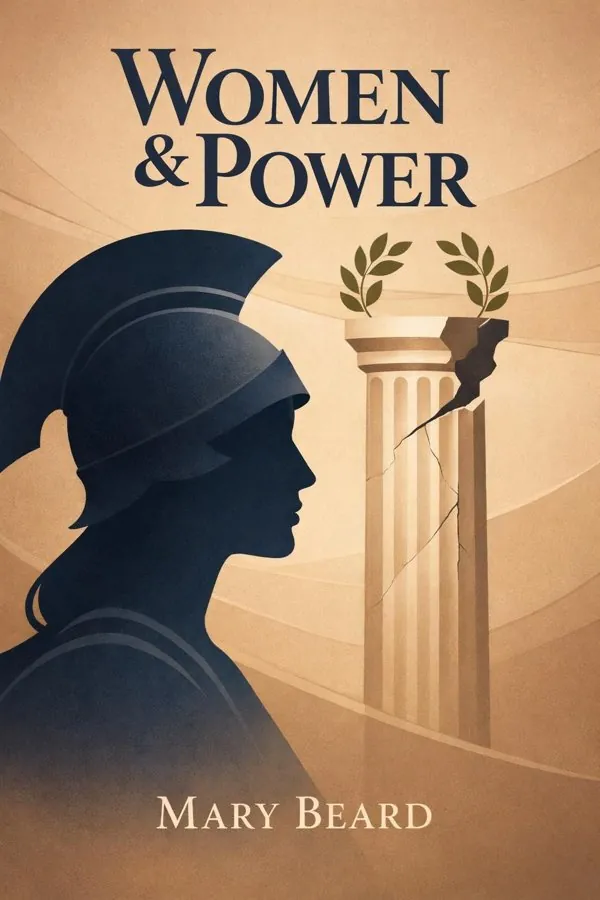
Women & Power: A Manifesto: Summary & Key Insights
by Mary Beard
 10 min8 chaptersAudio available
What Is Women & Power: A Manifesto About?
Women & Power: A Manifesto by Mary Beard is a civilization book spanning 8 pages. In this powerful manifesto, classicist Mary Beard explores the roots of misogyny and the ways in which history has shaped the exclusion of women from positions of power. Drawing on examples from ancient Greece and Rome to modern politics, Beard examines how cultural narratives have silenced women’s voices and offers a compelling argument for rethinking power itself.
This FizzRead summary covers all 8 key chapters of Women & Power: A Manifesto in approximately 10 minutes, distilling the most important ideas, arguments, and takeaways from Mary Beard's work. Also available as an audio summary and Key Quotes Podcast.
Women & Power: A Manifesto
In this powerful manifesto, classicist Mary Beard explores the roots of misogyny and the ways in which history has shaped the exclusion of women from positions of power. Drawing on examples from ancient Greece and Rome to modern politics, Beard examines how cultural narratives have silenced women’s voices and offers a compelling argument for rethinking power itself.
Who Should Read Women & Power: A Manifesto?
This book is perfect for anyone interested in civilization and looking to gain actionable insights in a short read. Whether you're a student, professional, or lifelong learner, the key ideas from Women & Power: A Manifesto by Mary Beard will help you think differently.
- ✓Readers who enjoy civilization and want practical takeaways
- ✓Professionals looking to apply new ideas to their work and life
- ✓Anyone who wants the core insights of Women & Power: A Manifesto in just 10 minutes
Want the full summary?
Get instant access to this book summary and 100K+ more with Fizz Moment.
Get Free SummaryAvailable on App Store • Free to download
Key Chapters
The story begins, as so many Western stories do, with Homer’s *Odyssey*. I have always been struck by the episode where Telemachus, the young son of Odysseus and Penelope, tells his mother to be silent and return to her room, for public speech is the business of men. This single moment, written thousands of years ago, encapsulates a cultural boundary that continues to shape our world: speech defines authority, and authority is coded male.
The scene is not accidental. The *Odyssey* is filled with the tension between private and public spheres, between home and assembly. When Penelope’s voice enters the hall, it disrupts the structure. Her son’s rebuke reinstates it. From the earliest literature, women’s speech was linked with disorder, and therefore needed controlling. Homer, perhaps unconsciously, reflected a world where a woman’s voice was either domestic—comforting, mourning, weaving—or transgressive.
In my analysis, I use this foundational myth to identify a pattern stretching through antiquity: women’s speech was either silenced or reframed as dangerous. Whether it was Pythia speaking in ambiguities or Cassandra cursed never to be believed, female utterance was both powerful and suspect. To grasp the burden of this legacy, one must see how mythology, moral instruction, and public rhetoric consistently reinforced the same line—that to speak publicly, to command attention, was to step outside proper femininity.
Understanding this Greek foundation is essential because it did not vanish with time. It crystallized into the philosophical and political systems that followed, shaping how authority itself was conceptualized. Thus, when we encounter later history, we are not seeing new prejudice but the repetition of ancient order.
+ 6 more chapters — available in the FizzRead app
All Chapters in Women & Power: A Manifesto
About the Author
Mary Beard is a British classicist and professor of Classics at the University of Cambridge. She is known for her accessible scholarship on ancient Rome and her contributions to public discourse on gender, history, and culture. Beard has written numerous acclaimed books and is a Fellow of the British Academy.
Get This Summary in Your Preferred Format
Read or listen to the Women & Power: A Manifesto summary by Mary Beard anytime, anywhere. FizzRead offers multiple formats so you can learn on your terms — all free.
Available formats: App · Audio · PDF · EPUB — All included free with FizzRead
Download Women & Power: A Manifesto PDF and EPUB Summary
Key Quotes from Women & Power: A Manifesto
“The story begins, as so many Western stories do, with Homer’s *Odyssey*.”
“In the classical world, voice and authority were almost synonymous.”
Frequently Asked Questions about Women & Power: A Manifesto
Women & Power: A Manifesto by Mary Beard is a civilization book that explores key ideas across 8 chapters. In this powerful manifesto, classicist Mary Beard explores the roots of misogyny and the ways in which history has shaped the exclusion of women from positions of power. Drawing on examples from ancient Greece and Rome to modern politics, Beard examines how cultural narratives have silenced women’s voices and offers a compelling argument for rethinking power itself.
More by Mary Beard
You Might Also Like
The Structure of Scientific Revolutions
Thomas S. Kuhn
10 min
Genius
Harold Bloom
10 min
A Cultural History of the Medieval Age
Various Editors
10 min
A History of God: The 4,000-Year Quest of Judaism, Christianity and Islam
Karen Armstrong
10 min
A History of the World in 10½ Chapters
Julian Barnes
10 min
A Short History of Progress
Ronald Wright
10 minBrowse by Category
Ready to read Women & Power: A Manifesto?
Get the full summary and 100K+ more books with Fizz Moment.