
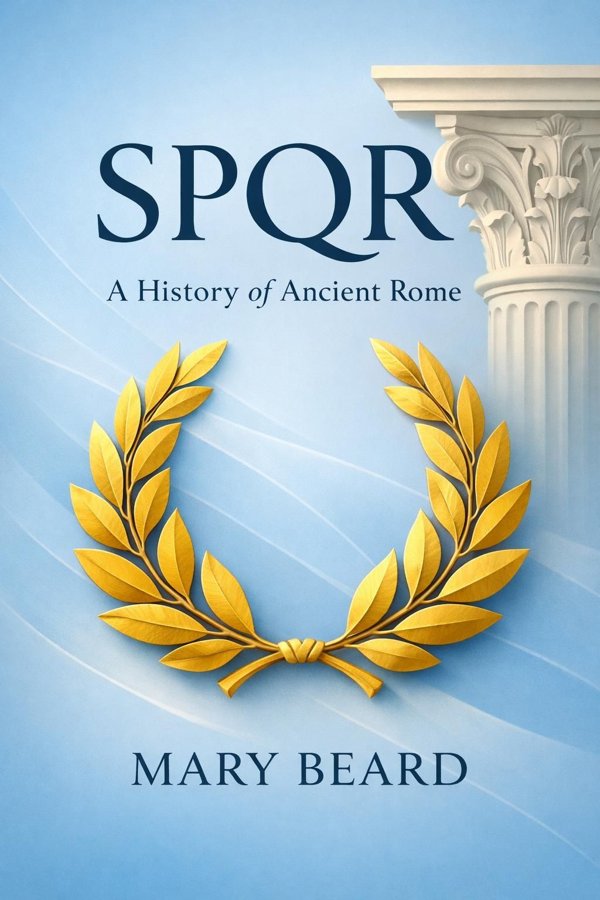
SPQR: A History of Ancient Rome: Summary & Key Insights
by Mary Beard
 10 min9 chaptersAudio available
Key Takeaways from SPQR: A History of Ancient Rome
Every civilization invents a story about itself, and Rome’s earliest story was designed as much to explain Roman values as to record historical fact.
Rome’s Republic endured not because it eliminated conflict, but because it turned conflict into a political system.
Empires do not simply conquer others; they are transformed by conquest themselves.
Political collapse rarely begins with a single villain.
The Roman Empire did not begin with a clean constitutional reset.
What Is SPQR: A History of Ancient Rome About?
SPQR: A History of Ancient Rome by Mary Beard is a world_history book spanning 12 pages. SPQR: A History of Ancient Rome is Mary Beard’s sweeping, revisionist account of how Rome grew from a cluster of settlements into one of the most powerful political systems the world has ever seen. But this is not a simple tale of military glory, great men, and inevitable conquest. Beard asks harder, more interesting questions: How did Romans understand power? Who counted as a citizen? How did ordinary people experience a state that stretched across continents? And how much of what we “know” about Rome is really based on later mythmaking rather than evidence? Drawing on literary sources, inscriptions, archaeology, political speeches, and social history, Beard reconstructs Rome as a noisy, contested, and often contradictory society. She moves beyond emperors and battles to explore law, identity, class conflict, public debate, provincial life, and the voices of people usually left out of grand histories. As one of the world’s leading classicists, Beard combines deep scholarship with unusual clarity and wit, making complex history feel urgent and alive. The result is a book that not only explains ancient Rome, but also invites us to rethink citizenship, populism, empire, and political belonging in our own world.
This FizzRead summary covers all 9 key chapters of SPQR: A History of Ancient Rome in approximately 10 minutes, distilling the most important ideas, arguments, and takeaways from Mary Beard's work. Also available as an audio summary and Key Quotes Podcast.
SPQR: A History of Ancient Rome
SPQR: A History of Ancient Rome is Mary Beard’s sweeping, revisionist account of how Rome grew from a cluster of settlements into one of the most powerful political systems the world has ever seen. But this is not a simple tale of military glory, great men, and inevitable conquest. Beard asks harder, more interesting questions: How did Romans understand power? Who counted as a citizen? How did ordinary people experience a state that stretched across continents? And how much of what we “know” about Rome is really based on later mythmaking rather than evidence?
Drawing on literary sources, inscriptions, archaeology, political speeches, and social history, Beard reconstructs Rome as a noisy, contested, and often contradictory society. She moves beyond emperors and battles to explore law, identity, class conflict, public debate, provincial life, and the voices of people usually left out of grand histories. As one of the world’s leading classicists, Beard combines deep scholarship with unusual clarity and wit, making complex history feel urgent and alive. The result is a book that not only explains ancient Rome, but also invites us to rethink citizenship, populism, empire, and political belonging in our own world.
Who Should Read SPQR: A History of Ancient Rome?
This book is perfect for anyone interested in world_history and looking to gain actionable insights in a short read. Whether you're a student, professional, or lifelong learner, the key ideas from SPQR: A History of Ancient Rome by Mary Beard will help you think differently.
- ✓Readers who enjoy world_history and want practical takeaways
- ✓Professionals looking to apply new ideas to their work and life
- ✓Anyone who wants the core insights of SPQR: A History of Ancient Rome in just 10 minutes
Want the full summary?
Get instant access to this book summary and 100K+ more with Fizz Moment.
Get Free SummaryAvailable on App Store • Free to download
Key Chapters
Every civilization invents a story about itself, and Rome’s earliest story was designed as much to explain Roman values as to record historical fact. The famous tale of Romulus and Remus, the twins abandoned and raised by a she-wolf, is not simply a charming legend. It introduces themes that would define Rome’s self-image: violence, survival, divine favor, family conflict, and the creation of political order through struggle. Beard shows that the origins of Rome lie somewhere between myth and archaeology. Instead of asking whether the legend is literally true, she asks what Romans wanted the story to mean.
This matters because Rome’s founding narrative justified key features of Roman life. Romulus becomes the founder not despite killing his brother, but in part through that act, suggesting that conflict was embedded in Roman ideas of state formation. At the same time, archaeological evidence reveals a much messier reality: early Rome was not born in a single dramatic moment, but emerged gradually from villages, trade networks, and political alliances. The gap between story and evidence is not a flaw in the history. It is one of Beard’s main insights.
In practical terms, this helps modern readers think more critically about national origin stories. Many states still rely on selective myths to create unity and legitimacy. Beard’s treatment of Rome reminds us that founding narratives often reveal more about a culture’s aspirations than its actual beginnings.
Actionable takeaway: whenever you encounter a society’s “origin story,” ask not only whether it is true, but what political values it is trying to defend.
Rome’s Republic endured not because it eliminated conflict, but because it turned conflict into a political system. Beard emphasizes that the Roman Republic was not a neat constitutional machine in the modern sense. It was a tangled arrangement of offices, assemblies, customs, family influence, public ritual, and elite competition. Consuls, senators, tribunes, magistrates, and popular assemblies all claimed some share of authority, and their powers overlapped in ways that constantly produced tension.
What made the Republic distinctive was that the Romans did not necessarily see disagreement as a sign of collapse. Public argument was normal. Competition among aristocrats was relentless. Political ambition was expected. Even street-level clashes between factions were part of the landscape. Yet this instability was balanced by traditions, legal habits, and shared assumptions about Rome’s continuity. Beard resists presenting the Republic as either a democratic ideal or a purely oligarchic sham. It was both participatory and unequal. Ordinary citizens could vote, protest, and influence outcomes, but elite families dominated the most prestigious paths to power.
This mixed system helps explain why Rome was so resilient for centuries. It could absorb pressure because power was distributed across institutions, personalities, and rituals. For modern readers, the Roman example illustrates that functioning politics does not require perfect consensus. It requires accepted ways of contesting power.
You can apply this insight when evaluating today’s institutions. Political noise is not always evidence of failure. Sometimes visible disagreement is a sign that competing interests still have channels through which they can be heard.
Actionable takeaway: judge a political system not by how peaceful it looks, but by whether it can manage conflict without destroying itself.
Empires do not simply conquer others; they are transformed by conquest themselves. One of Beard’s central themes is that Roman expansion across Italy and the wider Mediterranean was not just a sequence of military victories. It changed Rome’s economy, political expectations, social hierarchies, and sense of identity. Success abroad brought wealth, land, tribute, enslaved labor, and prestige, but it also created new strains that the old republican framework struggled to contain.
As Rome defeated rivals and absorbed territories, military service became more central to public life, ambitious generals gained larger followings, and elite competition intensified. Expansion also brought the Romans into contact with Greek culture, eastern religions, and new forms of luxury, prompting anxieties about moral decline and foreign influence. Beard resists the simple view that Rome expanded according to a master plan. Often, expansion was improvised, opportunistic, and reactive. But even if empire was not fully intended at the start, its consequences were enormous.
This chapter has practical relevance because it highlights a recurring historical pattern: institutions designed for a smaller political community often struggle when scale changes dramatically. A city-state’s habits cannot easily govern a transregional empire. The same problem appears today when organizations, businesses, or governments grow faster than their systems can adapt.
A useful example is any modern institution facing sudden success. Rapid growth can expose weaknesses that were invisible at a smaller scale. Rome’s victories created problems its founders had never designed the system to solve.
Actionable takeaway: when success expands your reach, do not assume old structures will still work; redesign systems before growth turns into crisis.
Political collapse rarely begins with a single villain. In Beard’s account, the crisis of the late Republic emerged from structural tensions, personal ambition, social inequality, and the inability of existing norms to cope with new realities. Figures such as the Gracchi, Marius, Sulla, Pompey, Cicero, and Julius Caesar did not appear in a vacuum. They operated in a political world already under pressure from widening wealth gaps, disputes over land, military loyalty, citizenship, and the rights of Rome’s Italian allies.
What makes Beard’s interpretation compelling is her refusal to reduce the Republic’s fall to melodrama. Caesar matters, of course, but he is part of a longer story of institutions losing their authority. Informal customs that once restrained ambition became weaker. Generals relied more on personal armies. Violence entered politics more openly. Compromise became harder to sustain. Even idealistic reform efforts triggered escalation rather than stability.
This is useful far beyond Roman history. Organizations and states often depend on unwritten norms as much as written rules. When those norms erode, formal institutions may remain in place while actual behavior changes radically. Beard helps readers see how systems decay from within before they visibly break.
You can apply this insight in any group setting, from workplaces to public institutions. If a culture of restraint, trust, and shared rules disappears, procedures alone may not save the system.
Actionable takeaway: pay attention to the health of informal norms, because once people stop believing in the spirit of the rules, the rules themselves quickly lose power.
The Roman Empire did not begin with a clean constitutional reset. One of Beard’s most illuminating points is that Augustus, Rome’s first emperor in all but name, built his power by preserving the language and appearance of the Republic. Offices remained, the Senate still met, elections continued in some form, and old political vocabulary survived. Yet beneath that continuity, authority had shifted decisively. Rome had moved from competitive oligarchic politics to a system centered on one dominant figure.
This transition matters because it shows how political systems can change profoundly without abandoning familiar symbols. Augustus presented himself not as a king, a title Romans hated, but as the restorer of order after civil war. He accumulated powers gradually, distributed favors strategically, and cultivated legitimacy through ritual, military success, building programs, and moral messaging. Beard stresses that the new order was not merely imposed by force. Many Romans accepted it because it offered stability after generations of violence.
The lesson is strikingly modern. Institutions can retain their names while their substance changes. Constitutions, assemblies, and elections may survive, but their role can be transformed if real power moves elsewhere. This is why Beard pays close attention to political language: words often conceal transitions as much as they reveal them.
In practical terms, readers can use this framework to examine modern systems that claim continuity while centralizing authority. Stability can be attractive, especially after disorder, but it may come at the cost of meaningful participation.
Actionable takeaway: look beyond official titles and ask where power actually sits, how it is exercised, and who can truly challenge it.
History often remembers emperors, but empires are lived by ordinary people. Beard broadens the picture of Rome by examining daily life across the empire: crowded cities, rural estates, military camps, workshops, households, temples, baths, and marketplaces. Roman society was intensely hierarchical. Class, legal status, gender, and freedom shaped almost every aspect of life. Senators, equestrians, freedpeople, slaves, soldiers, traders, women, and provincial subjects inhabited the same imperial system, but not on equal terms.
Beard is especially good at showing how material evidence helps recover these lives. Graffiti, tombstones, legal texts, household objects, and inscriptions reveal ambitions, frustrations, humor, grief, and social mobility. Rome was not a static pyramid. Some freed slaves became wealthy. Some provincials rose into imperial service. Urban life created opportunities as well as insecurity. Yet exploitation remained fundamental, especially the vast dependence on slavery and labor extraction.
For modern readers, this key idea is a reminder not to confuse imperial grandeur with general well-being. Monumental architecture and political stability can coexist with deep inequality. Looking at the lived experience behind official glory is one of Beard’s most important contributions.
This perspective can be applied whenever we assess a society by its headlines or monuments. A flourishing capital city does not necessarily represent the lives of most people. The same principle applies to modern nations, companies, or institutions that project success while hiding unequal realities.
Actionable takeaway: when evaluating any powerful system, ask how ordinary people live within it, not just how impressive it appears from the top.
One of the most powerful ideas in SPQR is that Rome’s durability depended not only on conquest, but on its flexible and expanding concept of citizenship. Beard argues that Rome was unusual in the ancient world because it repeatedly found ways to incorporate outsiders. This process was uneven, contested, and often self-interested, but it allowed Rome to turn former enemies, allied communities, and provincial elites into participants in the Roman system.
Citizenship in Rome was never a simple badge. It involved legal rights, obligations, political identity, military service, and social aspiration. At different times, some communities received partial rights, others full citizenship, and still others remained subordinate. The extension of citizenship after the Social War was especially significant, because it acknowledged that Rome could no longer function as if it were merely one city ruling passive dependents in Italy. Later, the spread of citizenship across the empire further reshaped what “Roman” meant.
Beard’s broader point is that Roman identity was not based solely on ethnicity or birthplace. It was also civic and legal. That flexibility helped Rome build loyalty across distance. It did not erase inequality or oppression, but it offered a framework for integration that many empires lacked.
This idea has clear modern relevance. Debates over migration, belonging, legal status, and national identity still revolve around the question Rome faced: who gets included in the political community, and on what terms?
Actionable takeaway: treat citizenship not as a fixed inheritance, but as a political tool that can strengthen a society when it expands participation without abandoning shared rules.
In Rome, religion was not a separate private sphere; it was woven into politics, public life, and social order. Beard shows that Roman religion was less about personal belief in the modern sense and more about practice, ritual, precedent, and maintaining proper relations between the human and divine worlds. Priests were political figures. Public ceremonies reinforced civic identity. Omens, sacrifices, festivals, and temples were part of governance itself.
This matters because it helps explain how Roman power was legitimized. Victories were framed as signs of divine favor. Leaders sponsored temples and games to display piety and authority. Foreign cults entered Rome and were sometimes embraced, sometimes feared, depending on how they fit the existing order. Cultural exchange was constant: Greek literature, philosophy, art, and education deeply influenced Roman elites, even as Romans insisted on their own distinct identity. Rome absorbed external influences while recasting them as Roman.
Beard encourages readers to resist tidy divisions between politics, religion, and culture. In many societies, those boundaries are historically recent. Understanding Rome requires seeing how symbols, rituals, and stories help stabilize power and shape belonging.
This insight is practical in a contemporary sense because modern public life also relies on ceremony, symbolic language, and cultural narratives. National holidays, memorials, constitutional rituals, and public mourning all carry political meaning, even in secular states.
Actionable takeaway: pay attention to a society’s rituals and symbols, because they often reveal how authority is justified more clearly than official policy documents do.
The most enduring political systems are not the most rigid, but the most adaptable. Beard’s Rome survives for centuries because it keeps changing: from monarchy to republic, from city-state to Mediterranean hegemon, from republican oligarchy to imperial monarchy, and from a local civic identity to a vast legal and cultural framework. These transformations were not smooth or peaceful, but they show that Rome’s strength lay partly in its ability to absorb shocks, revise structures, and redefine what it meant to be Roman.
At the same time, Beard refuses to romanticize endurance. Reinvention often came through crisis, civil war, exclusion, and coercion. Rome’s adaptability was real, but so were its costs. The empire that could integrate local elites also exploited provinces. The state that expanded citizenship also relied on slavery. The government that provided order also concentrated power. This balance is what makes Beard’s interpretation so valuable: Rome was durable not because it was virtuous, but because it was politically inventive.
For modern readers, the larger lesson is that legacy should not be confused with moral superiority. Powerful systems often endure because they are flexible, strategic, and skilled at absorbing opposition. That is true of states, institutions, and even corporate organizations.
If there is a practical application here, it is to study long-lasting systems with both admiration and skepticism. Ask not just how they survive, but who pays the price of that survival and what compromises make it possible.
Actionable takeaway: when you analyze any successful institution, examine both its adaptability and its hidden costs, because durability alone is never proof of justice.
All Chapters in SPQR: A History of Ancient Rome
About the Author
Mary Beard is a British classicist, historian, and public intellectual best known for her work on ancient Rome. She has long been associated with the University of Cambridge, where she taught Classics and helped bring the ancient world to new generations of students and readers. Beard is widely admired for combining deep scholarship with an engaging, accessible style, making complex classical history understandable without oversimplifying it. Her books, essays, television documentaries, and journalism have made her one of the most recognizable voices in the field of classical studies. She is especially interested in Roman politics, public life, mythology, and the way later societies reinterpret antiquity. In SPQR, Beard draws on decades of research to offer a fresh, provocative account of Rome that challenges clichés while preserving the excitement of the ancient past.
Get This Summary in Your Preferred Format
Read or listen to the SPQR: A History of Ancient Rome summary by Mary Beard anytime, anywhere. FizzRead offers multiple formats so you can learn on your terms — all free.
Available formats: App · Audio · PDF · EPUB — All included free with FizzRead
Download SPQR: A History of Ancient Rome PDF and EPUB Summary
Key Quotes from SPQR: A History of Ancient Rome
“Every civilization invents a story about itself, and Rome’s earliest story was designed as much to explain Roman values as to record historical fact.”
“Rome’s Republic endured not because it eliminated conflict, but because it turned conflict into a political system.”
“Empires do not simply conquer others; they are transformed by conquest themselves.”
“Political collapse rarely begins with a single villain.”
“The Roman Empire did not begin with a clean constitutional reset.”
Frequently Asked Questions about SPQR: A History of Ancient Rome
SPQR: A History of Ancient Rome by Mary Beard is a world_history book that explores key ideas across 9 chapters. SPQR: A History of Ancient Rome is Mary Beard’s sweeping, revisionist account of how Rome grew from a cluster of settlements into one of the most powerful political systems the world has ever seen. But this is not a simple tale of military glory, great men, and inevitable conquest. Beard asks harder, more interesting questions: How did Romans understand power? Who counted as a citizen? How did ordinary people experience a state that stretched across continents? And how much of what we “know” about Rome is really based on later mythmaking rather than evidence? Drawing on literary sources, inscriptions, archaeology, political speeches, and social history, Beard reconstructs Rome as a noisy, contested, and often contradictory society. She moves beyond emperors and battles to explore law, identity, class conflict, public debate, provincial life, and the voices of people usually left out of grand histories. As one of the world’s leading classicists, Beard combines deep scholarship with unusual clarity and wit, making complex history feel urgent and alive. The result is a book that not only explains ancient Rome, but also invites us to rethink citizenship, populism, empire, and political belonging in our own world.
More by Mary Beard
You Might Also Like
The Age of Capital
Eric Hobsbawm
10 min
The Gulag Archipelago
Aleksandr Solzhenitsyn
10 min
Jerusalem: The Biography
Simon Sebag Montefiore
10 min
The Anglo-Saxons
James Campbell
10 min
The Boer War
Thomas Pakenham
10 min
The Industrial Revolutionaries: The Making of the Modern World 1776–1914
Gavin Weightman
10 minBrowse by Category
Ready to read SPQR: A History of Ancient Rome?
Get the full summary and 100K+ more books with Fizz Moment.