
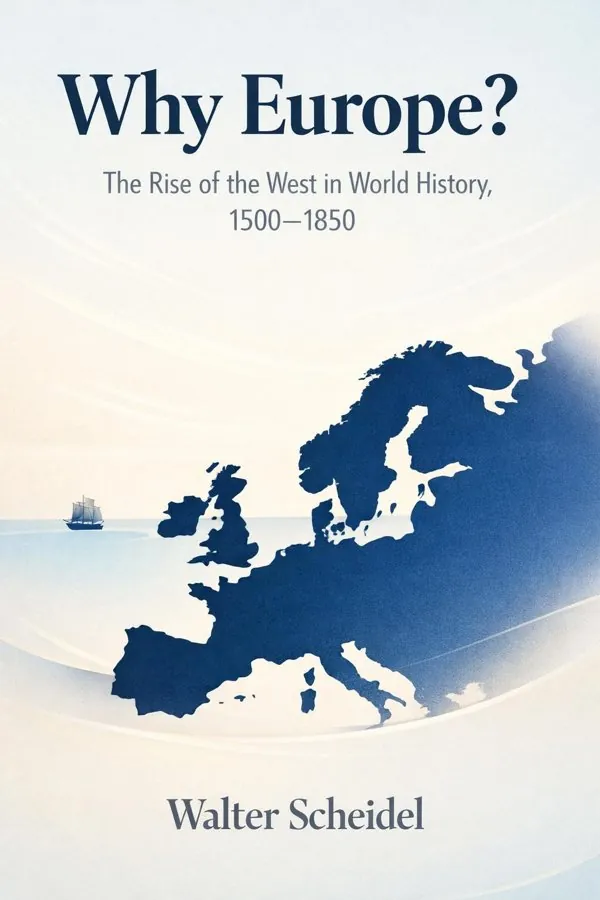
Why Europe? The Rise of the West in World History, 1500–1850: Summary & Key Insights
 10 min9 chaptersAudio available
Key Takeaways from Why Europe? The Rise of the West in World History, 1500–1850
A continent’s map does not write its history, but it can shape the range of choices available to the people living on it.
Political weakness can sometimes become a source of collective strength.
History is often changed not by resources alone but by the rules that govern how resources are used.
Population trends are rarely dramatic on a single day, yet over centuries they can redirect entire civilizations.
Great economic revolutions often begin as a patchwork of small changes rather than a single sudden breakthrough.
What Is Why Europe? The Rise of the West in World History, 1500–1850 About?
Why Europe? The Rise of the West in World History, 1500–1850 by Walter Scheidel is a world_history book spanning 11 pages. Why did Europe, long divided by wars, rival kingdoms, and competing religions, become the center of global power between 1500 and 1850? In Why Europe? The Rise of the West in World History, 1500–1850, Walter Scheidel tackles one of the biggest questions in world history with a careful comparative approach. Rather than offering a single dramatic cause, he shows how geography, political fragmentation, institutional evolution, military competition, demography, commerce, and overseas expansion combined to give Europe unusual momentum at a decisive historical moment. The book matters because it resists simplistic triumphalist stories. Europe’s rise was not inevitable, nor was it the result of cultural superiority alone. It emerged from interacting advantages, pressures, and historical contingencies that distinguished Europe from other major civilizations, especially China and parts of the Islamic world. Scheidel is especially well suited to this task: as a historian of comparative societies, demography, state formation, and long-run economic change, he brings analytical rigor and broad historical range. The result is a concise but powerful explanation of how the West rose and why that transformation reshaped the modern world.
This FizzRead summary covers all 9 key chapters of Why Europe? The Rise of the West in World History, 1500–1850 in approximately 10 minutes, distilling the most important ideas, arguments, and takeaways from Walter Scheidel's work. Also available as an audio summary and Key Quotes Podcast.
Why Europe? The Rise of the West in World History, 1500–1850
Why did Europe, long divided by wars, rival kingdoms, and competing religions, become the center of global power between 1500 and 1850? In Why Europe? The Rise of the West in World History, 1500–1850, Walter Scheidel tackles one of the biggest questions in world history with a careful comparative approach. Rather than offering a single dramatic cause, he shows how geography, political fragmentation, institutional evolution, military competition, demography, commerce, and overseas expansion combined to give Europe unusual momentum at a decisive historical moment. The book matters because it resists simplistic triumphalist stories. Europe’s rise was not inevitable, nor was it the result of cultural superiority alone. It emerged from interacting advantages, pressures, and historical contingencies that distinguished Europe from other major civilizations, especially China and parts of the Islamic world. Scheidel is especially well suited to this task: as a historian of comparative societies, demography, state formation, and long-run economic change, he brings analytical rigor and broad historical range. The result is a concise but powerful explanation of how the West rose and why that transformation reshaped the modern world.
Who Should Read Why Europe? The Rise of the West in World History, 1500–1850?
This book is perfect for anyone interested in world_history and looking to gain actionable insights in a short read. Whether you're a student, professional, or lifelong learner, the key ideas from Why Europe? The Rise of the West in World History, 1500–1850 by Walter Scheidel will help you think differently.
- ✓Readers who enjoy world_history and want practical takeaways
- ✓Professionals looking to apply new ideas to their work and life
- ✓Anyone who wants the core insights of Why Europe? The Rise of the West in World History, 1500–1850 in just 10 minutes
Want the full summary?
Get instant access to this book summary and 100K+ more with Fizz Moment.
Get Free SummaryAvailable on App Store • Free to download
Key Chapters
A continent’s map does not write its history, but it can shape the range of choices available to the people living on it. Scheidel argues that Europe’s geography was not a magical explanation for Western success, yet it created a setting unusually favorable to diversity, resilience, and experimentation. Europe’s mountain chains, river systems, varied coastlines, peninsulas, and nearby islands made it difficult for any single power to dominate the whole region for long. At the same time, these features encouraged maritime trade, regional specialization, and dense interaction among neighboring societies.
This mattered because geography influenced how power, markets, and ideas moved. Coastal access supported commercial expansion from Venice to Lisbon to Amsterdam and London. Internal waterways lowered transport costs and helped integrate local economies. Ecological variety encouraged different patterns of agriculture, production, and exchange. Europe’s position at the western end of Eurasia also gave it indirect access to older centers of innovation while pushing it to seek alternative routes to wealth when traditional trade networks were constrained.
Scheidel’s point is comparative. Other regions had impressive resources and sophisticated states, but Europe’s fragmented and accessible geography made sustained pluralism more likely. That pluralism became historically important when linked to interstate rivalry, commercial competition, and institutional adaptation. Geography alone did not produce capitalism, science, or empire. It provided a stage on which those developments became more plausible.
A practical way to apply this idea is to think less in terms of "natural advantages" and more in terms of how environments shape incentives. Whether analyzing nations, businesses, or organizations, ask what structural conditions encourage experimentation, decentralization, and exchange. The actionable takeaway: do not treat geography or structure as destiny, but look closely at how constraints can generate strategic opportunities.
Political weakness can sometimes become a source of collective strength. One of Scheidel’s central claims is that Europe’s political fragmentation, often seen as a liability, became a major driver of its long-term dynamism. Between the sixteenth and eighteenth centuries, Europe was divided among kingdoms, republics, principalities, and empires that competed constantly for territory, resources, talent, and prestige. Unlike more unified imperial systems, this decentralized order made exit possible. If rulers overtaxed merchants, censored thinkers, or persecuted minorities, people and capital could often move elsewhere.
This competition had several effects. States improved taxation, military organization, and administration because survival required it. Rulers borrowed techniques from rivals, creating a process of institutional learning. Merchants benefited because governments sought revenue from trade and often supported infrastructure, naval power, and chartered companies. Intellectual life also gained from pluralism: ideas suppressed in one place could reappear in another.
Scheidel does not romanticize fragmentation. Europe’s rival states fought devastating wars, and competition often intensified violence. But he shows that the inability of one empire to impose durable continental uniformity preserved a system in which innovation had multiple centers. The Dutch Republic, England, and later Britain did not rise in isolation; they emerged within a wider arena of constant comparison and emulation.
The broader application is clear: monopolies can suffocate adaptation, while rivalry can sharpen performance. In modern terms, ecosystems with multiple competing institutions often generate faster learning than systems controlled by a single dominant actor. The actionable takeaway: when evaluating progress, ask whether a system allows competition, mobility, and comparison, because these are often the hidden engines of innovation.
History is often changed not by resources alone but by the rules that govern how resources are used. Scheidel emphasizes that Europe’s rise depended heavily on institutional development: the evolving arrangements through which states raised taxes, enforced contracts, protected property, financed war, and coordinated economic life. Institutions in Europe were far from perfect, but in some regions they became flexible enough to mobilize capital and constrain rulers more effectively than in many rival polities.
A key example is fiscal capacity. States that could tax more reliably could sustain armies and navies, defend trade routes, and project power abroad. But fiscal extraction was most durable where rulers had to bargain with elites, assemblies, or urban interests. In places like England and the Dutch Republic, this bargaining produced stronger public credit. Investors were more willing to lend when they believed governments would honor debts. That confidence helped fund war, commerce, and imperial expansion on an unprecedented scale.
Institutional diversity mattered as much as institutional quality. Europe contained city-states, merchant republics, monarchies, and composite empires, each experimenting with different solutions to governance and economic coordination. Successes could be copied; failures could be avoided. Over time, this competitive institutional environment strengthened legal predictability and commercial trust in parts of Europe.
Scheidel’s lesson is not that Europe discovered a perfect model. Rather, some European societies built institutions capable of converting military pressure and commercial opportunity into cumulative growth. The practical implication extends beyond history. Organizations and states prosper when they create credible rules, stable expectations, and accountability mechanisms. The actionable takeaway: if you want long-term growth, focus not just on ambition or resources but on institutions that make cooperation, investment, and adaptation sustainable.
Population trends are rarely dramatic on a single day, yet over centuries they can redirect entire civilizations. Scheidel highlights demographic patterns as a crucial but often underappreciated element in Europe’s ascent. Europe’s marriage behavior, household formation, mortality patterns, and labor allocation differed in meaningful ways from those of some other world regions. These differences affected the supply of labor, the role of women in the economy, and the timing of economic pressure.
One important feature was the so-called European marriage pattern, in which many people married relatively late and a notable share never married at all. This tended to moderate fertility compared with systems of earlier and more universal marriage. Lower fertility could reduce pressure on land and household resources, while wage earners often spent longer in service or independent work before forming families. In some regions, this supported labor mobility and participation in market activity.
Demography also interacted with crisis. Disease, war, and food shortages repeatedly shook early modern societies. In Europe, population losses could temporarily raise wages where land was relatively abundant, altering incentives for labor-saving innovation or agricultural restructuring. These shifts did not automatically produce prosperity, but they could create conditions favorable to productivity gains in certain settings.
Scheidel’s argument is comparative rather than deterministic. Demographic patterns alone did not make Europe dominant, but they shaped economic behavior and social organization in ways that influenced later development. Today, the same principle applies when assessing labor markets, aging societies, or migration flows. Population structure changes what institutions and economies can do. The actionable takeaway: always include demographic incentives in any explanation of long-term change, because who works, marries, migrates, and survives can be as important as ideology or policy.
Great economic revolutions often begin as a patchwork of small changes rather than a single sudden breakthrough. Scheidel presents Europe’s economic transformation as a cumulative process shaped by agricultural improvement, urban growth, expanding trade, financial innovation, and rising specialization. Europe did not leap effortlessly into modernity. Instead, some of its regions gradually developed more productive economies capable of sustaining larger cities, more complex markets, and greater state capacity.
Agriculture remained fundamental. Improvements in land use, crop rotation, drainage, and commercialization increased output in parts of Europe, freeing labor for nonagricultural work. Urban centers became hubs of manufacturing, information exchange, and credit. Merchants linked regional markets to long-distance trade networks, while new financial practices lowered the risks and costs of large-scale enterprise. Insurance, bills of exchange, joint-stock companies, and public debt systems helped organize capital more effectively.
What made this process especially significant was its unevenness. The Dutch Republic and England often moved ahead first, while southern and eastern Europe developed differently. Scheidel uses this variation to show that “Europe” was never a uniform success story. The rise of the West depended on leading zones whose economic institutions and commercial orientation gave them disproportionate influence.
This perspective discourages simplistic narratives about civilizational superiority. Development came from interlocking changes in production, trade, finance, and governance, not from one national trait. The same logic is useful in modern analysis. Economic transformation usually requires multiple reinforcing shifts rather than one reform or one invention. The actionable takeaway: when studying growth, look for gradual compounding across sectors, because durable prosperity is usually built through interconnected change, not isolated miracles.
Brilliant ideas matter, but they spread and transform societies only when institutions, incentives, and networks allow them to do so. Scheidel argues that Europe’s technological and scientific advances were essential to its rise, yet they should not be understood as purely intellectual triumphs detached from politics and economics. Scientific inquiry, practical experimentation, artisanal knowledge, military demands, and commercial interests increasingly reinforced one another in early modern Europe.
The Scientific Revolution did not instantly create industrial dominance, but it changed habits of inquiry and standards of evidence. At the same time, Europe’s competitive states invested in fortifications, navigation, metallurgy, shipbuilding, and cartography. Merchants and naval powers demanded better instruments and more reliable knowledge. Printing accelerated the circulation of ideas, making it easier to preserve discoveries, criticize errors, and build cumulative knowledge communities.
A crucial part of Scheidel’s analysis is that Europe’s decentralized structure again played a role. Scholars, inventors, and dissidents could seek patrons across borders. Universities, academies, workshops, and trading cities formed overlapping channels through which theory and practice interacted. This helped turn knowledge into usable power, especially in warfare, navigation, and industry.
The broader lesson is that innovation thrives when knowledge is open enough to circulate but organized enough to accumulate. Modern organizations face a similar challenge: talent alone is not enough without systems for testing, sharing, and applying insight. The actionable takeaway: if you want innovation, build an ecosystem where inquiry, competition, funding, and practical use reinforce each other, because breakthroughs become historically decisive only when they are embedded in supportive institutions.
Europe did not rise in isolation; it rose by plugging itself into the wider world with extraordinary force. Scheidel stresses that colonial expansion and global integration were not side stories but central components of Western ascent. Overseas empires gave European powers access to land, labor, silver, plantation goods, commercial routes, and strategic ports. They also connected Europe more tightly to global circuits of exchange, allowing relatively small states to command resources far beyond their own territories.
Atlantic expansion transformed the scale of European possibilities. American silver reshaped world trade and fiscal power. Sugar, tobacco, cotton, and other plantation products generated huge profits, though at staggering human cost through slavery and coercion. Maritime empires allowed powers such as Portugal, Spain, the Netherlands, France, and Britain to combine trade, violence, and administration in ways that amplified their influence. Colonialism did not merely enrich Europe materially; it also expanded its geopolitical reach and deepened its commercial institutions.
Scheidel avoids reducing Europe’s rise to empire alone. Colonies were most beneficial to states already capable of naval projection, financial coordination, and administrative control. But once in place, overseas networks reinforced military strength, merchant capitalism, and strategic competition among European rivals.
This key idea also reminds readers that the rise of the West had profound victims as well as beneficiaries. Global dominance was built partly through dispossession, extraction, and forced labor. The actionable takeaway: any serious explanation of power must include external linkages and unequal exchange, because societies often gain strength not only from internal development but from the way they organize and exploit wider networks.
War is destructive, yet in some historical settings it can forge stronger states. Scheidel argues that Europe’s persistent military competition forced rulers to build institutions capable of mobilizing men, money, and materiel on an unprecedented scale. The so-called military revolution, with larger armies, improved firearms, fortified cities, and expensive navies, made warfare increasingly costly. States that failed to adapt risked decline or disappearance.
This pressure transformed governance. To wage war effectively, rulers expanded taxation, improved record-keeping, standardized administration, and negotiated more systematically with elites and creditors. In effect, violence stimulated state formation. Governments learned to extract resources more efficiently, but they also needed legitimacy and cooperation to sustain that extraction over time. In some places, especially Britain and the Dutch Republic, this produced durable fiscal-military systems that linked public finance, military capability, and commercial expansion.
Scheidel’s analysis is important because it shows that Europe’s rise was not powered only by peaceful trade or enlightened thought. Organized coercion was central. Naval supremacy protected commerce. Armies defended dynastic interests and colonial possessions. Domestic administrative growth often followed military need. The modern state, in this account, was shaped as much by conflict as by law or philosophy.
The practical value of this idea lies in recognizing that capacity often grows under pressure. Organizations and states reveal their strengths when forced to coordinate resources in high-stakes environments. Still, coercion without accountability can become predatory. The actionable takeaway: study how systems respond to sustained external pressure, because the ability to mobilize resources under stress is often what separates temporary success from lasting power.
The most important historical questions are often answered best by comparison. Scheidel repeatedly insists that Europe can only be understood against the backdrop of other major world regions, especially China. The rise of the West was not inevitable, and it was not obvious to contemporaries that Europe would dominate. For long stretches of history, China possessed superior wealth, scale, administrative sophistication, and technological accomplishments. The key issue, then, is not why Europe was always better, but why Europe eventually pulled ahead.
Scheidel’s answer highlights differences in political structure, incentives, and contingency. China’s long imperial unification created stability and coordination, but it could also reduce interstate rivalry and limit the multiplicity of institutional experiments seen in Europe. Europe’s fractured landscape generated inefficiency and war, yet also fostered competition, migration, innovation, and adaptation. Similar contrasts appear in discussions of the Islamic world, India, and other regions where varying combinations of empire, commerce, and state power produced different developmental paths.
This comparative perspective protects the reader from both Eurocentric celebration and anti-European simplification. Europe succeeded through a particular historical configuration, not through timeless civilizational essence. It benefited from pressures and opportunities that were unevenly distributed and often historically accidental.
That lesson remains relevant far beyond early modern history. When comparing institutions, companies, or countries today, the right question is rarely “Who is inherently superior?” but “What structures, constraints, and incentives produced different outcomes?” The actionable takeaway: use comparison to replace myth with analysis, because historical advantage usually emerges from specific configurations, not permanent cultural destiny.
All Chapters in Why Europe? The Rise of the West in World History, 1500–1850
About the Author
Walter Scheidel is an Austrian-born historian and professor of classics and history at Stanford University, widely known for his work on ancient societies, historical demography, inequality, and comparative world history. His scholarship often examines how large-scale social structures evolve over long periods, with special attention to state formation, economic development, violence, and the distribution of wealth. Scheidel is respected for combining deep historical knowledge with broad analytical comparisons across regions and eras. Although much of his early work focused on the ancient Mediterranean world, he has increasingly addressed global historical questions that connect antiquity to modernity. In Why Europe? he brings that comparative perspective to one of the central debates in world history: why Western Europe, rather than another major civilization, became globally dominant in the early modern period.
Get This Summary in Your Preferred Format
Read or listen to the Why Europe? The Rise of the West in World History, 1500–1850 summary by Walter Scheidel anytime, anywhere. FizzRead offers multiple formats so you can learn on your terms — all free.
Available formats: App · Audio · PDF · EPUB — All included free with FizzRead
Download Why Europe? The Rise of the West in World History, 1500–1850 PDF and EPUB Summary
Key Quotes from Why Europe? The Rise of the West in World History, 1500–1850
“A continent’s map does not write its history, but it can shape the range of choices available to the people living on it.”
“Political weakness can sometimes become a source of collective strength.”
“History is often changed not by resources alone but by the rules that govern how resources are used.”
“Population trends are rarely dramatic on a single day, yet over centuries they can redirect entire civilizations.”
“Great economic revolutions often begin as a patchwork of small changes rather than a single sudden breakthrough.”
Frequently Asked Questions about Why Europe? The Rise of the West in World History, 1500–1850
Why Europe? The Rise of the West in World History, 1500–1850 by Walter Scheidel is a world_history book that explores key ideas across 9 chapters. Why did Europe, long divided by wars, rival kingdoms, and competing religions, become the center of global power between 1500 and 1850? In Why Europe? The Rise of the West in World History, 1500–1850, Walter Scheidel tackles one of the biggest questions in world history with a careful comparative approach. Rather than offering a single dramatic cause, he shows how geography, political fragmentation, institutional evolution, military competition, demography, commerce, and overseas expansion combined to give Europe unusual momentum at a decisive historical moment. The book matters because it resists simplistic triumphalist stories. Europe’s rise was not inevitable, nor was it the result of cultural superiority alone. It emerged from interacting advantages, pressures, and historical contingencies that distinguished Europe from other major civilizations, especially China and parts of the Islamic world. Scheidel is especially well suited to this task: as a historian of comparative societies, demography, state formation, and long-run economic change, he brings analytical rigor and broad historical range. The result is a concise but powerful explanation of how the West rose and why that transformation reshaped the modern world.
More by Walter Scheidel

You Might Also Like
The Age of Capital
Eric Hobsbawm
10 min
The Gulag Archipelago
Aleksandr Solzhenitsyn
10 min
Jerusalem: The Biography
Simon Sebag Montefiore
10 min
The Anglo-Saxons
James Campbell
10 min
The Boer War
Thomas Pakenham
10 min
The Industrial Revolutionaries: The Making of the Modern World 1776–1914
Gavin Weightman
10 minBrowse by Category
Ready to read Why Europe? The Rise of the West in World History, 1500–1850?
Get the full summary and 100K+ more books with Fizz Moment.