
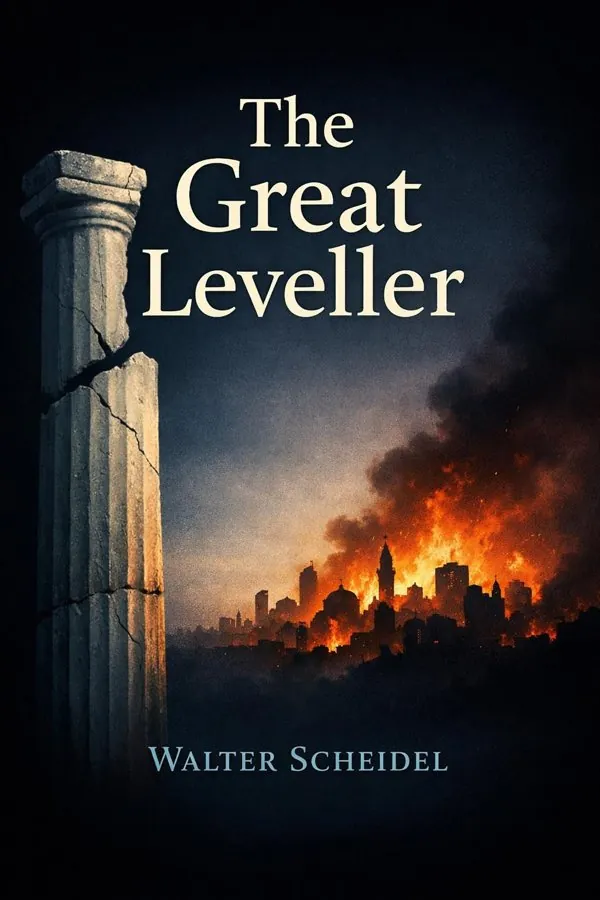
The Great Leveller: Violence and the History of Inequality from the Stone Age to the Twenty-First Century: Summary & Key Insights
 10 min10 chaptersAudio available
Key Takeaways from The Great Leveller: Violence and the History of Inequality from the Stone Age to the Twenty-First Century
The most important fact about inequality may be that it is not humanity’s default condition, but a product of specific social arrangements.
Civilizations often look permanent right up until the moment they fail.
War is usually remembered for destruction, but Scheidel argues that certain kinds of war also transform distribution.
Some of the sharpest reductions in inequality have come not from ballots, but from revolutions.
When states weaken enough, inequality can fall simply because no one can reliably hold on to concentrated wealth.
What Is The Great Leveller: Violence and the History of Inequality from the Stone Age to the Twenty-First Century About?
The Great Leveller: Violence and the History of Inequality from the Stone Age to the Twenty-First Century by Walter Scheidel is a world_history book spanning 11 pages. Why does inequality keep returning, even after periods of reform, growth, and democratic progress? In The Great Leveller, historian Walter Scheidel offers a stark and unsettling answer: across thousands of years of human history, major reductions in material inequality have rarely come through gradual policy improvements or moral enlightenment. Instead, they have most often followed catastrophe. Wars that mobilized entire societies, revolutions that destroyed elites, state collapses that shattered property systems, and pandemics that upended labor markets have been the most powerful forces for narrowing gaps between rich and poor. Drawing on evidence from ancient Mesopotamia, classical Rome, imperial China, medieval Europe, and the modern industrial world, Scheidel builds a sweeping comparative history of inequality and its disruption. His argument matters because it challenges one of modern society’s most comforting assumptions: that peaceful reform is usually enough to reverse entrenched concentration of wealth and power. A professor of classics and history at Stanford, Scheidel combines historical breadth with analytical rigor, making this book essential for anyone trying to understand the past, present, and future of inequality.
This FizzRead summary covers all 10 key chapters of The Great Leveller: Violence and the History of Inequality from the Stone Age to the Twenty-First Century in approximately 10 minutes, distilling the most important ideas, arguments, and takeaways from Walter Scheidel's work. Also available as an audio summary and Key Quotes Podcast.
The Great Leveller: Violence and the History of Inequality from the Stone Age to the Twenty-First Century
Why does inequality keep returning, even after periods of reform, growth, and democratic progress? In The Great Leveller, historian Walter Scheidel offers a stark and unsettling answer: across thousands of years of human history, major reductions in material inequality have rarely come through gradual policy improvements or moral enlightenment. Instead, they have most often followed catastrophe. Wars that mobilized entire societies, revolutions that destroyed elites, state collapses that shattered property systems, and pandemics that upended labor markets have been the most powerful forces for narrowing gaps between rich and poor. Drawing on evidence from ancient Mesopotamia, classical Rome, imperial China, medieval Europe, and the modern industrial world, Scheidel builds a sweeping comparative history of inequality and its disruption. His argument matters because it challenges one of modern society’s most comforting assumptions: that peaceful reform is usually enough to reverse entrenched concentration of wealth and power. A professor of classics and history at Stanford, Scheidel combines historical breadth with analytical rigor, making this book essential for anyone trying to understand the past, present, and future of inequality.
Who Should Read The Great Leveller: Violence and the History of Inequality from the Stone Age to the Twenty-First Century?
This book is perfect for anyone interested in world_history and looking to gain actionable insights in a short read. Whether you're a student, professional, or lifelong learner, the key ideas from The Great Leveller: Violence and the History of Inequality from the Stone Age to the Twenty-First Century by Walter Scheidel will help you think differently.
- ✓Readers who enjoy world_history and want practical takeaways
- ✓Professionals looking to apply new ideas to their work and life
- ✓Anyone who wants the core insights of The Great Leveller: Violence and the History of Inequality from the Stone Age to the Twenty-First Century in just 10 minutes
Want the full summary?
Get instant access to this book summary and 100K+ more with Fizz Moment.
Get Free SummaryAvailable on App Store • Free to download
Key Chapters
The most important fact about inequality may be that it is not humanity’s default condition, but a product of specific social arrangements. Scheidel begins deep in prehistory, showing that hunter-gatherer societies, while not perfectly equal, generally had limited and unstable hierarchies. Mobility mattered. If people could move away, if land could not be easily enclosed, and if food storage remained modest, durable wealth gaps were hard to maintain. The rise of agriculture changed everything. Sedentary life made land, livestock, granaries, and inheritance far more important. Once surplus could be stored and defended, power could also be stored and defended.
Early states amplified this transformation. Taxation, organized violence, legal systems, and aristocratic landholding turned advantage into structure. Elites could extract labor, command armies, and pass wealth across generations. This did not mean that every agrarian society looked the same, but it did mean that hierarchy became embedded in institutions rather than depending only on personal dominance. The shift from foraging bands to agricultural civilizations was therefore not just an economic revolution; it was a political revolution in who could own, command, and exclude.
This insight helps explain why inequality tends to reappear even after periods of disruption. When societies grow more complex, property rights strengthen, states stabilize, and markets deepen, concentration often accelerates. Modern readers can apply this lens by asking not only who earns more, but which systems make unequal outcomes durable: inheritance law, asset ownership, educational access, and political influence.
Actionable takeaway: To understand inequality today, look beyond income and examine the institutions that allow wealth and power to accumulate across generations.
Civilizations often look permanent right up until the moment they fail. Scheidel uses ancient examples, including the Late Bronze Age collapse around 1200 BCE, to show how sudden systemic breakdown can flatten hierarchy. Palace economies, aristocratic households, trade routes, and administrative centers once concentrated wealth and authority in the hands of narrow elites. When these systems were destroyed by invasion, internal conflict, famine, or cascading instability, elite privilege could be wiped out along with them.
This is one of the book’s most sobering lessons: levelling often happens not because justice finally prevails, but because institutions that sustain inequality disintegrate. In the ancient Eastern Mediterranean, large political systems and redistributive centers collapsed, records disappeared, monumental construction ceased, and elite lifestyles became harder to support. The rich did not voluntarily give up advantage; they lost the machinery that made advantage possible.
Yet collapse is a brutal equalizer. It reduces inequality by reducing prosperity, security, and life chances for nearly everyone. Scheidel is careful not to romanticize this process. A shattered world may contain fewer billionaires and fewer palaces, but it also contains fewer schools, fewer protections, and fewer functioning markets. In modern terms, state breakdown can erase concentrated wealth, but it also destroys public order, healthcare, and long-term investment.
For readers today, this chapter changes how we think about “reset” moments. Not every reset is renewal; some are simply ruin. Historical levelling through collapse should not be confused with humane redistribution.
Actionable takeaway: When evaluating social change, distinguish between reductions in inequality that come from shared uplift and reductions that come from shared devastation.
War is usually remembered for destruction, but Scheidel argues that certain kinds of war also transform distribution. Not every conflict does this. Limited dynastic wars often leave elite structures intact. The real leveller is mass mobilization warfare: conflicts so large that states must conscript ordinary citizens, tax the wealthy heavily, direct production, regulate prices, and justify sacrifice with promises of broader inclusion. The two world wars, especially in the first half of the twentieth century, dramatically weakened old fortunes and strengthened labor, taxation, and welfare institutions across many countries.
This process worked through multiple channels. Physical destruction erased capital. Inflation and taxation reduced private wealth. Political bargaining empowered workers and soldiers. Governments expanded social insurance to maintain legitimacy. In some societies, land reform, veterans’ benefits, and public education accelerated the compression. What mattered was not war alone, but war conducted at such scale that the entire social order had to be reorganized.
Scheidel’s point has major implications for how we interpret the relatively egalitarian decades after 1945. Those outcomes did not emerge naturally from capitalism becoming kinder. They followed extraordinary violence that destroyed wealth, discredited old elites, and normalized strong state intervention. This helps explain why later decades, after peace, deregulation, and globalization, saw inequality rise again.
A practical application is to think carefully about policy intensity. If historical compression required massive state capacity under extreme pressure, modest reforms may struggle against entrenched concentrations of capital unless they are similarly broad, coordinated, and durable.
Actionable takeaway: If you want to reduce inequality peacefully, study the scale, seriousness, and institutional reach that wartime governments once brought to redistribution.
Some of the sharpest reductions in inequality have come not from ballots, but from revolutions. Scheidel examines cases such as the French, Russian, and Chinese revolutions to show how violent upheaval can dismantle elite privilege through confiscation, land redistribution, execution, forced collectivization, and the destruction of inherited status. These events did not merely tax wealth; they often sought to erase the social classes that held it.
Revolutionary levelling works because it attacks both assets and authority. Aristocratic estates, commercial fortunes, and political monopolies can all be targeted at once. In rural societies, land redistribution has been especially powerful because land was the main productive resource. In urban-industrial settings, revolution can also nationalize industry, suppress rents, and centralize economic power under a new regime. The result is often a steep decline in measured inequality, at least for a time.
But Scheidel’s analysis is deliberately unsentimental. Revolutions can reduce inequality while producing repression, coercion, famine, and mass death. A society may become flatter in distributional terms even as freedom collapses. Moreover, once revolutionary regimes stabilize, new hierarchies frequently emerge inside the party, military, or bureaucracy. Equality of outcome may improve, but concentration of power often returns in another form.
For contemporary readers, this chapter is a warning against simplistic thinking. Radical redistribution is possible, but history suggests that when it occurs through violent revolution, the human cost is immense and the long-term results are mixed. The challenge is to imagine forms of structural reform that are forceful without becoming catastrophic.
Actionable takeaway: Support reforms that address wealth concentration early, before frustration hardens into revolutionary politics with far more destructive consequences.
When states weaken enough, inequality can fall simply because no one can reliably hold on to concentrated wealth. Scheidel treats state failure and systemic collapse as one of the four great levelling mechanisms. In stable societies, law courts, tax systems, police power, and military protection help preserve ownership and hierarchy. In failing states, those protections erode. Estates are seized, savings become worthless, trade contracts collapse, and elite networks lose their institutional backing.
This kind of levelling appears in episodes where empires fragment, governments lose territorial control, or prolonged civil war destroys the framework of accumulation. The rich often suffer heavily because their wealth is tied to records, titles, fixed property, long-distance commerce, and confidence in institutions. Once those disappear, differences may narrow rapidly. Yet this is hardly a victory for equality in any humane sense. The poor also lose livelihoods, safety, and access to public goods. Life may become more equal because nearly everyone is worse off.
The broader lesson is that inequality is inseparable from state capacity. Strong states can support elite extraction, but they also make large-scale prosperity possible. Weak states may undermine privilege, but they usually do so by undermining civilization itself. For modern policy debates, this suggests that anti-elite anger should not drift into contempt for institutions as such. The same state machinery that can entrench inequality is also what enables taxation, redistribution, education, and healthcare.
A practical example is contemporary fragility: when currencies collapse or property rights become violent contests, measured wealth concentration may fall, but social suffering rises sharply.
Actionable takeaway: Defend state capacity while demanding that it serve broad inclusion rather than concentrated privilege.
Disease can alter the balance between workers and owners more effectively than legislation. Scheidel highlights pandemics, especially the Black Death, as a major historical leveller. When a large share of the population dies, labor becomes scarce. Employers must compete for workers. Wages rise, rents can fall, and surviving peasants or laborers gain bargaining power. In societies where land was abundant relative to people, a sudden demographic shock could materially improve the position of ordinary households.
The Black Death in late medieval Europe is the central example. Massive mortality weakened landlords, reduced pressure on land, and disrupted customary obligations. Serfdom declined in parts of Western Europe as laborers demanded better terms or moved to where opportunities were greater. Governments and landlords often tried to stop this through wage controls and coercive laws, but scarcity shifted the underlying economics in favor of workers. In that sense, plague levelling was not moral progress; it was demographic arithmetic.
Scheidel also emphasizes that not all epidemics have equal distributional effects. The outcome depends on mortality levels, labor market structures, and political responses. A disease that kills mainly the poor without changing labor scarcity may worsen inequality. A highly lethal pandemic in a labor-intensive economy may compress it. This analytical distinction is essential for readers tempted to generalize from every public health crisis.
Modern application requires caution. Recent pandemics have often increased inequality because they were less demographically transformative and because financial assets remained protected. The historical comparison reminds us that the distributive impact of shocks depends on institutions, demographics, and whose wealth is shielded.
Actionable takeaway: In any crisis, ask who becomes scarce, whose assets are protected, and how policy choices shape the distributional aftermath.
Scheidel’s central framework is memorable precisely because it is so severe: across history, the biggest reductions in inequality have come from four forces he calls the horsemen of levelling—mass mobilization warfare, transformative revolution, state collapse, and lethal pandemics. This framework is the book’s organizing insight. It allows readers to compare wildly different eras and regions using a consistent question: what kinds of shocks have actually reduced entrenched disparities in income, wealth, and status?
The power of the framework lies in what it excludes. Commercial growth alone rarely levels. Technological progress does not necessarily do so. Stable democracy, legal reform, and moral appeals can help at the margins, but historically they have seldom produced the dramatic compression seen after major violence and disruption. By assembling evidence across centuries, Scheidel challenges the comforting belief that societies naturally become more equal as they become more modern.
The horsemen framework also sharpens our thinking about mechanism. Each horseman compresses inequality differently. War taxes and destroys capital. Revolution expropriates elites. State collapse erodes the institutional defense of wealth. Pandemic makes labor scarce. The details vary, but all four disrupt the normal processes by which advantages accumulate and reproduce themselves.
For practical use, this framework can guide how we evaluate proposed reforms. If a policy does not alter ownership structures, bargaining power, taxation, inheritance, or access to vital resources, its ability to meaningfully reduce inequality may be limited. The framework is not a prediction that violence must recur; it is a historical benchmark for how powerful levelling has needed to be.
Actionable takeaway: Use the four horsemen as a diagnostic tool to judge whether a reform is truly structural or merely symbolic.
Many people assume the mid-twentieth century proved that modern societies can become more equal through enlightened policy. Scheidel agrees that inequality fell dramatically in many countries after the world wars, but he insists that this period cannot be understood apart from the violence that preceded it. The postwar compression of incomes and wealth rested on destroyed fortunes, expanded taxation, stronger unions, controlled capital, welfare-state growth, and political pressure from mass societies shaped by war. Equality did not simply emerge from prosperity; it was built on the ruins of catastrophe.
This matters because the postwar era is often treated as a normal model to which advanced societies can easily return. Scheidel argues that it was historically exceptional. Once the extreme pressures of total war faded, many equalizing forces weakened. Capital regained mobility, organized labor declined, top tax rates fell, and inherited wealth recovered. In other words, the unusual flattening of the mid-century was not the new baseline of modernity. It was a temporary outcome of extraordinary circumstances.
The practical implication is sobering but useful. If we want broader prosperity without repeating past disasters, we cannot simply nostalgically invoke the postwar decades. We need to understand the institutional pillars that sustained them: progressive taxation, social insurance, labor power, public investment, and regulation of concentrated capital. These tools may be politically difficult, but history suggests they matter more than optimistic narratives about growth alone lifting all boats.
For citizens, this chapter helps reframe debates about the middle class. Its expansion was not inevitable and is not self-sustaining.
Actionable takeaway: Treat the postwar decades as a lesson in policy design and power balance, not as proof that equality maintains itself once achieved.
The book’s most controversial claim is also its most important: peaceful reform has rarely reduced inequality on the scale many people imagine. Scheidel does not deny that reforms can help. Minimum wages, progressive taxes, public education, social insurance, and labor protections all matter. But across long stretches of history, these measures have more often slowed the growth of inequality than decisively reversed it. Once wealth becomes concentrated, it buys influence, shapes law, and protects itself.
This is why Scheidel’s argument feels so unsettling. It challenges the hope that rational debate and incremental policy are usually enough. Historical evidence suggests otherwise. Elites rarely surrender core advantages voluntarily, especially when those advantages are embedded in property regimes, financial systems, and political institutions. Even democratic systems can struggle, because those with resources influence campaigns, media, lobbying, and agenda-setting.
Still, Scheidel’s point should not be misread as fatalism. He is not saying reform is pointless, only that its historical track record is modest compared with violent shocks. That distinction matters. If peaceful change is difficult, then delaying reform can make future conflict more likely. Stronger inheritance taxation, anti-monopoly policy, labor bargaining rights, affordable housing, and broad asset ownership may not create dramatic levelling overnight, but they can reduce the pressure that accumulates when disparities widen unchecked.
For readers in politics, business, or civil society, the lesson is to stop assuming that growth and goodwill will solve distributional problems automatically. Durable equality requires institutional design, sustained pressure, and a willingness to confront concentrated power directly.
Actionable takeaway: Pursue ambitious reform early and persistently, because the alternative to hard politics is often harder history.
If the past suggests that violence has been the great leveller, the pressing question becomes: what can the future do differently? Scheidel ends in a cautious, even uneasy, tone. He does not offer a simple blueprint for peaceful equality because the historical record gives him little reason for confidence. Yet the absence of easy precedent does not eliminate the necessity of trying. In fact, it raises the stakes. If societies want to avoid war, revolution, collapse, or plague-driven compression, they must deliberately build institutions capable of spreading opportunity and constraining accumulation before extremes become explosive.
This means thinking beyond income transfers alone. Future nonviolent levelling may require broader access to assets, stronger inheritance taxation, universal high-quality education, healthcare security, housing reform, labor-market bargaining power, and regulation of monopolistic and financial concentration. It may also require political reforms that reduce the conversion of wealth into influence. The challenge is not merely technical but civic: democracies must sustain solidarity even when elites can often insulate themselves from public costs.
Scheidel’s historical skepticism can be read not as a counsel of despair, but as a demand for seriousness. If peaceful reform has rarely worked at great scale, then half-measures should not be mistaken for solutions. The future will depend on whether societies can invent forms of structural redistribution powerful enough to matter, yet humane enough to preserve freedom and prosperity.
For modern readers, that is the book’s deepest use. It strips away comforting myths and forces a harder question: what institutions could achieve by design what history usually achieved by disaster?
Actionable takeaway: Build support for structural, preventive reform now, while societies still have the stability to choose change without violence.
All Chapters in The Great Leveller: Violence and the History of Inequality from the Stone Age to the Twenty-First Century
About the Author
Walter Scheidel is an Austrian-born historian and professor of classics and history at Stanford University. He is widely known for his work on ancient social and economic history, historical demography, comparative empire studies, and the long-term evolution of inequality. Scheidel’s scholarship often bridges ancient and modern worlds, using evidence from archaeology, economic history, and political analysis to explore how societies organize power, labor, and wealth over time. In addition to The Great Leveller, he has written and edited influential books on Roman history, state formation, and economic development. His interdisciplinary approach and wide historical range have made him a leading voice in debates about inequality, social structure, and the forces that reshape human societies.
Get This Summary in Your Preferred Format
Read or listen to the The Great Leveller: Violence and the History of Inequality from the Stone Age to the Twenty-First Century summary by Walter Scheidel anytime, anywhere. FizzRead offers multiple formats so you can learn on your terms — all free.
Available formats: App · Audio · PDF · EPUB — All included free with FizzRead
Download The Great Leveller: Violence and the History of Inequality from the Stone Age to the Twenty-First Century PDF and EPUB Summary
Key Quotes from The Great Leveller: Violence and the History of Inequality from the Stone Age to the Twenty-First Century
“The most important fact about inequality may be that it is not humanity’s default condition, but a product of specific social arrangements.”
“Civilizations often look permanent right up until the moment they fail.”
“War is usually remembered for destruction, but Scheidel argues that certain kinds of war also transform distribution.”
“Some of the sharpest reductions in inequality have come not from ballots, but from revolutions.”
“When states weaken enough, inequality can fall simply because no one can reliably hold on to concentrated wealth.”
Frequently Asked Questions about The Great Leveller: Violence and the History of Inequality from the Stone Age to the Twenty-First Century
The Great Leveller: Violence and the History of Inequality from the Stone Age to the Twenty-First Century by Walter Scheidel is a world_history book that explores key ideas across 10 chapters. Why does inequality keep returning, even after periods of reform, growth, and democratic progress? In The Great Leveller, historian Walter Scheidel offers a stark and unsettling answer: across thousands of years of human history, major reductions in material inequality have rarely come through gradual policy improvements or moral enlightenment. Instead, they have most often followed catastrophe. Wars that mobilized entire societies, revolutions that destroyed elites, state collapses that shattered property systems, and pandemics that upended labor markets have been the most powerful forces for narrowing gaps between rich and poor. Drawing on evidence from ancient Mesopotamia, classical Rome, imperial China, medieval Europe, and the modern industrial world, Scheidel builds a sweeping comparative history of inequality and its disruption. His argument matters because it challenges one of modern society’s most comforting assumptions: that peaceful reform is usually enough to reverse entrenched concentration of wealth and power. A professor of classics and history at Stanford, Scheidel combines historical breadth with analytical rigor, making this book essential for anyone trying to understand the past, present, and future of inequality.
More by Walter Scheidel
You Might Also Like
The Age of Capital
Eric Hobsbawm
10 min
The Gulag Archipelago
Aleksandr Solzhenitsyn
10 min
Jerusalem: The Biography
Simon Sebag Montefiore
10 min
The Anglo-Saxons
James Campbell
10 min
The Boer War
Thomas Pakenham
10 min
The Industrial Revolutionaries: The Making of the Modern World 1776–1914
Gavin Weightman
10 minBrowse by Category
Ready to read The Great Leveller: Violence and the History of Inequality from the Stone Age to the Twenty-First Century?
Get the full summary and 100K+ more books with Fizz Moment.