
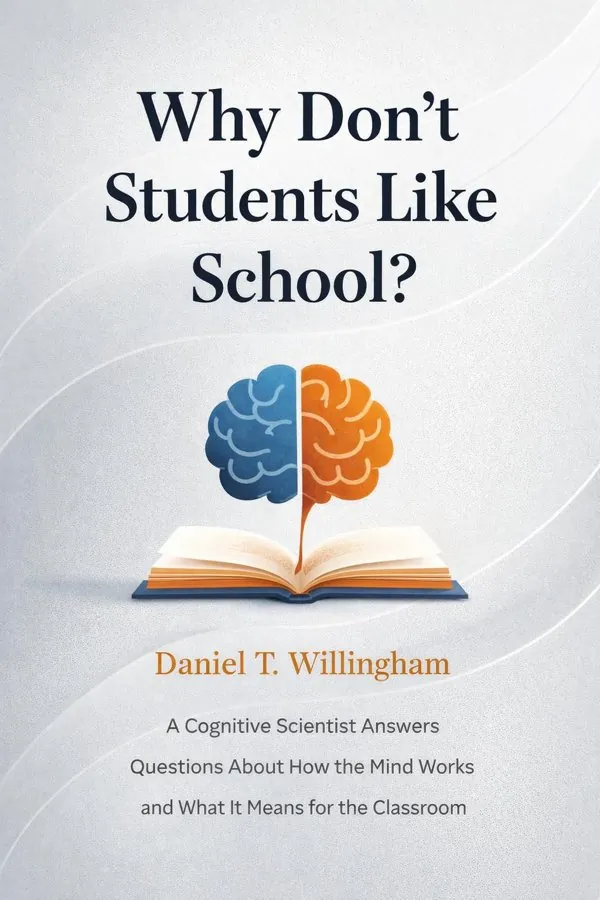
Why Don't Students Like School?: A Cognitive Scientist Answers Questions About How the Mind Works and What It Means for the Classroom: Summary & Key Insights
 10 min9 chaptersAudio available
What Is Why Don't Students Like School?: A Cognitive Scientist Answers Questions About How the Mind Works and What It Means for the Classroom About?
Why Don't Students Like School?: A Cognitive Scientist Answers Questions About How the Mind Works and What It Means for the Classroom by Daniel T. Willingham is a education book spanning 9 pages. In this influential work, cognitive scientist Daniel T. Willingham explains how insights from cognitive psychology can help teachers improve learning outcomes. The book explores how memory, attention, and motivation affect students’ ability to learn, and offers practical advice for designing lessons that align with how the mind actually works.
This FizzRead summary covers all 9 key chapters of Why Don't Students Like School?: A Cognitive Scientist Answers Questions About How the Mind Works and What It Means for the Classroom in approximately 10 minutes, distilling the most important ideas, arguments, and takeaways from Daniel T. Willingham's work. Also available as an audio summary and Key Quotes Podcast.
Why Don't Students Like School?: A Cognitive Scientist Answers Questions About How the Mind Works and What It Means for the Classroom
In this influential work, cognitive scientist Daniel T. Willingham explains how insights from cognitive psychology can help teachers improve learning outcomes. The book explores how memory, attention, and motivation affect students’ ability to learn, and offers practical advice for designing lessons that align with how the mind actually works.
Who Should Read Why Don't Students Like School?: A Cognitive Scientist Answers Questions About How the Mind Works and What It Means for the Classroom?
This book is perfect for anyone interested in education and looking to gain actionable insights in a short read. Whether you're a student, professional, or lifelong learner, the key ideas from Why Don't Students Like School?: A Cognitive Scientist Answers Questions About How the Mind Works and What It Means for the Classroom by Daniel T. Willingham will help you think differently.
- ✓Readers who enjoy education and want practical takeaways
- ✓Professionals looking to apply new ideas to their work and life
- ✓Anyone who wants the core insights of Why Don't Students Like School?: A Cognitive Scientist Answers Questions About How the Mind Works and What It Means for the Classroom in just 10 minutes
Want the full summary?
Get instant access to this book summary and 100K+ more with Fizz Moment.
Get Free SummaryAvailable on App Store • Free to download
Key Chapters
It sounds almost heretical to admit that thinking is unnatural for humans, but that’s precisely the starting point of our inquiry. The human brain evolved not for extended reasoning but for quick, efficient action that ensures survival. Most of the time, we rely on memory rather than deliberate thought; we retrieve what has worked before instead of puzzling anew each time. Thinking becomes necessary only when we encounter something novel or problematic—and that’s where both opportunity and frustration arise.
When I say the mind is designed to avoid thinking, I don’t mean that we are incapable of it—only that we avoid it when possible. Thinking demands effort, and effort without reward leads to avoidance. The hook, then, lies in curiosity: a cognitive itch provoked when we glimpse a solvable problem. A well-posed question—neither too simple nor too opaque—draws the mind forward. That’s why the most engaging classrooms are those that choreograph this balance. If material feels impossible, students give up; if it’s too easy, they tune out. The zone between, where struggle meets the possibility of success, is where learning thrives.
From this understanding flows a practical truth: teachers must design lessons around problems that invite thought. Presenting facts in isolation rarely works, because without context, no puzzle emerges. Curiosity hinges on incomplete patterns—what I know and what I almost know. By constructing lessons that highlight this gap and offering clues for resolution, teachers transform mere information into meaningful exploration. Students, in turn, begin to like school because it becomes a place that honors their natural drive to make sense of the world.
Education often splits along a false divide between facts and thinking skills. Teachers are urged to prioritize critical thinking, creativity, or problem-solving, yet lament that standardized tests seem to reward rote knowledge instead. The truth, illuminated by decades of cognitive research, is that these are not opposing aims. Thinking skills depend on knowledge; they are inseparable.
When you ask students to think critically about history, they must first know historical facts—the sequence of events, the motives of actors, the context of decisions. Without such knowledge held in long-term memory, working memory soon overloads. The mind cannot juggle multiple unknowns simultaneously. Knowledge frees cognitive resources; it’s what allows experts to reason fluidly. In contrast, when students lack foundational facts, even basic reasoning stalls. Thus, genuine critical thinking begins with automatic recall of factual material.
In very practical terms, this means that teachers should not apologize for teaching facts. Facts are the building blocks of comprehension, the scaffolding upon which complex thought rests. But the way they are taught matters immensely. Facts learned in meaningful contexts—through stories, comparisons, or problem-solving—stick, while disconnected lists evaporate. The more richly connected a fact is within a network of knowledge, the easier it is to retrieve and use creatively. The best learning environments therefore refuse to dichotomize memorization and interpretation. They weave them together until the distinction disappears.
+ 7 more chapters — available in the FizzRead app
All Chapters in Why Don't Students Like School?: A Cognitive Scientist Answers Questions About How the Mind Works and What It Means for the Classroom
About the Author
Daniel T. Willingham is a professor of psychology at the University of Virginia, specializing in cognitive psychology and education. His research focuses on the application of cognitive science to classroom teaching and learning.
Get This Summary in Your Preferred Format
Read or listen to the Why Don't Students Like School?: A Cognitive Scientist Answers Questions About How the Mind Works and What It Means for the Classroom summary by Daniel T. Willingham anytime, anywhere. FizzRead offers multiple formats so you can learn on your terms — all free.
Available formats: App · Audio · PDF · EPUB — All included free with FizzRead
Download Why Don't Students Like School?: A Cognitive Scientist Answers Questions About How the Mind Works and What It Means for the Classroom PDF and EPUB Summary
Key Quotes from Why Don't Students Like School?: A Cognitive Scientist Answers Questions About How the Mind Works and What It Means for the Classroom
“It sounds almost heretical to admit that thinking is unnatural for humans, but that’s precisely the starting point of our inquiry.”
“Education often splits along a false divide between facts and thinking skills.”
Frequently Asked Questions about Why Don't Students Like School?: A Cognitive Scientist Answers Questions About How the Mind Works and What It Means for the Classroom
Why Don't Students Like School?: A Cognitive Scientist Answers Questions About How the Mind Works and What It Means for the Classroom by Daniel T. Willingham is a education book that explores key ideas across 9 chapters. In this influential work, cognitive scientist Daniel T. Willingham explains how insights from cognitive psychology can help teachers improve learning outcomes. The book explores how memory, attention, and motivation affect students’ ability to learn, and offers practical advice for designing lessons that align with how the mind actually works.
More by Daniel T. Willingham
You Might Also Like

Bedtime Biography: Florence Nightingale
Isabel Thomas
10 min
Introduction To Museum Studies
Howard H. Hoyt
10 min
A Mind for Numbers: How to Excel at Math and Science (Even If You Flunked Algebra)
Barbara Oakley
10 min
AI for Educators: Learning Strategies, Teacher Empowerment, and the Future of Education
Matt Miller
10 min
Animation For Beginners
Morr Meroz
10 min
Artificial Intelligence for Learning
Donald Clark
10 minBrowse by Category
Ready to read Why Don't Students Like School?: A Cognitive Scientist Answers Questions About How the Mind Works and What It Means for the Classroom?
Get the full summary and 100K+ more books with Fizz Moment.