
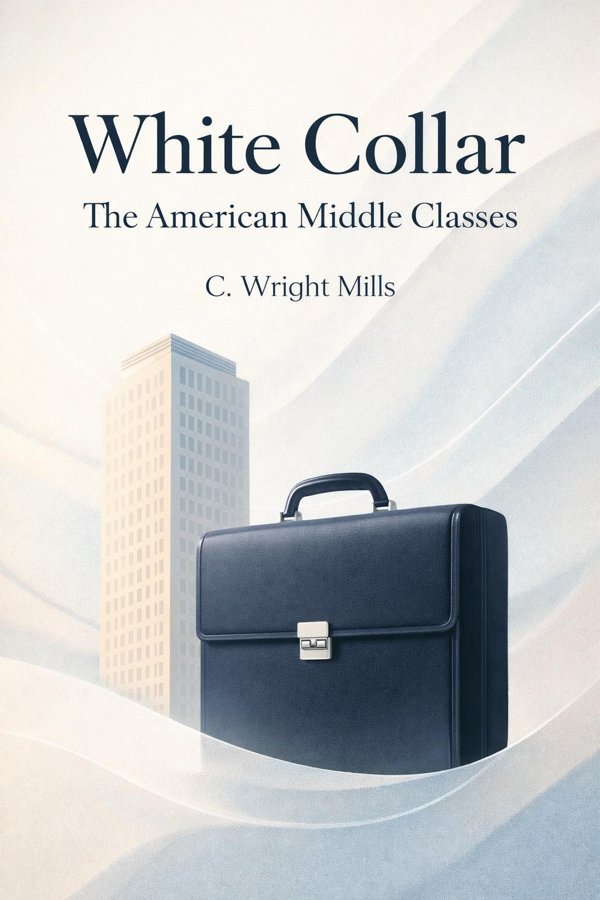
White Collar: The American Middle Classes: Summary & Key Insights
 10 min9 chaptersAudio available
What Is White Collar: The American Middle Classes About?
White Collar: The American Middle Classes by C. Wright Mills is a sociology book spanning 9 pages. White Collar: The American Middle Classes is a sociological study by C. Wright Mills that examines the rise of the white-collar worker in mid-20th-century America. Mills explores how the growth of bureaucratic organizations and corporate structures transformed the nature of work, class identity, and personal autonomy. The book provides a critical analysis of how middle-class employees became alienated within the modern capitalist system, losing both independence and a sense of purpose.
This FizzRead summary covers all 9 key chapters of White Collar: The American Middle Classes in approximately 10 minutes, distilling the most important ideas, arguments, and takeaways from C. Wright Mills's work. Also available as an audio summary and Key Quotes Podcast.
White Collar: The American Middle Classes
White Collar: The American Middle Classes is a sociological study by C. Wright Mills that examines the rise of the white-collar worker in mid-20th-century America. Mills explores how the growth of bureaucratic organizations and corporate structures transformed the nature of work, class identity, and personal autonomy. The book provides a critical analysis of how middle-class employees became alienated within the modern capitalist system, losing both independence and a sense of purpose.
Who Should Read White Collar: The American Middle Classes?
This book is perfect for anyone interested in sociology and looking to gain actionable insights in a short read. Whether you're a student, professional, or lifelong learner, the key ideas from White Collar: The American Middle Classes by C. Wright Mills will help you think differently.
- ✓Readers who enjoy sociology and want practical takeaways
- ✓Professionals looking to apply new ideas to their work and life
- ✓Anyone who wants the core insights of White Collar: The American Middle Classes in just 10 minutes
Want the full summary?
Get instant access to this book summary and 100K+ more with Fizz Moment.
Get Free SummaryAvailable on App Store • Free to download
Key Chapters
The origins of the white-collar class lie in the sweeping economic changes of nineteenth- and early-twentieth-century America. Once, the small producer—be he artisan, craftsman, or merchant—stood as the backbone of American society. His livelihood depended upon skill, judgment, and reputation; his independence gave him pride. The industrial revolution and the rise of corporate capitalism eroded this foundation. The factory system concentrated production, while mechanization reduced craftsmanship to routine. Administrative and clerical roles emerged to manage the new industrial scale.
In tracing this history, I saw a steady displacement of independence by organization. Small shops gave way to department stores; proprietors became branch managers; individual initiative was replaced by adherence to policy. The economic structure shifted from decentralized ownership to managerial control. What was once a republic of independent producers became a nation of employees. And in that change, the meaning of work itself transformed—from an activity expressing one’s capacities to a role performed in obedience to distant authority.
This historical perspective matters because it reveals that white-collar employment is not merely a neutral occupational shift. It represents a profound social reorientation. The American promise of self-made success now moves within bureaucratic channels, and while salaries may have replaced wages, the dependence that characterizes wage labor persists under a new guise.
By the middle of the twentieth century, the office had become the primary theater for middle-class life. The white-collar workforce—clerks, stenographers, accountants, and administrators—expanded rapidly. They were neither manual laborers nor true professionals; they existed to maintain the machinery of paperwork and communication that sustained the corporate economy. The office was not a place of invention but of coordination, where each employee occupied a cubicle within an impersonal system.
What struck me most was how thoroughly the culture of the office penetrated the personality of its members. The routines, the hierarchies, the subtle signals of status—all of these shaped an internal world of deference and calculation. The worker’s loyalty was not to a craft but to the firm; advancement depended not on mastery of work but on mastering relations. The office was a moral school, teaching restraint and docility as virtues, discouraging initiative except when it could be channeled into safe, bureaucratic ambition.
The tragedy of the office worker lies not in poverty but in spiritual surrender. To keep their jobs, they must play the game, blending into an institutional rhythm that erodes individuality. Their work yields little sense of creation or ownership. They manage, file, and report—but rarely build. In this way, the office becomes a metaphor for modern life: structured, secure, yet strangely hollow.
+ 7 more chapters — available in the FizzRead app
All Chapters in White Collar: The American Middle Classes
About the Author
C. Wright Mills (1916–1962) was an American sociologist best known for his works on the structure of power and class in the United States. A professor at Columbia University, Mills authored influential books such as The Power Elite and The Sociological Imagination, which challenged conventional sociological thought and emphasized the connection between personal experience and broader social forces.
Get This Summary in Your Preferred Format
Read or listen to the White Collar: The American Middle Classes summary by C. Wright Mills anytime, anywhere. FizzRead offers multiple formats so you can learn on your terms — all free.
Available formats: App · Audio · PDF · EPUB — All included free with FizzRead
Download White Collar: The American Middle Classes PDF and EPUB Summary
Key Quotes from White Collar: The American Middle Classes
“The origins of the white-collar class lie in the sweeping economic changes of nineteenth- and early-twentieth-century America.”
“By the middle of the twentieth century, the office had become the primary theater for middle-class life.”
Frequently Asked Questions about White Collar: The American Middle Classes
White Collar: The American Middle Classes by C. Wright Mills is a sociology book that explores key ideas across 9 chapters. White Collar: The American Middle Classes is a sociological study by C. Wright Mills that examines the rise of the white-collar worker in mid-20th-century America. Mills explores how the growth of bureaucratic organizations and corporate structures transformed the nature of work, class identity, and personal autonomy. The book provides a critical analysis of how middle-class employees became alienated within the modern capitalist system, losing both independence and a sense of purpose.
More by C. Wright Mills
You Might Also Like
Between the World and Me
Ta-Nehisi Coates
10 min
Half the Sky
Nicholas D. Kristof, Sheryl WuDunn
10 min
Men Explain Things To Me
Rebecca Solnit
10 min
Rational Ritual
Michael Suk-Young Chwe
10 min
The New Jim Crow
Michelle Alexander
10 min
Beyond Culture
Edward T. Hall
10 minBrowse by Category
Ready to read White Collar: The American Middle Classes?
Get the full summary and 100K+ more books with Fizz Moment.