
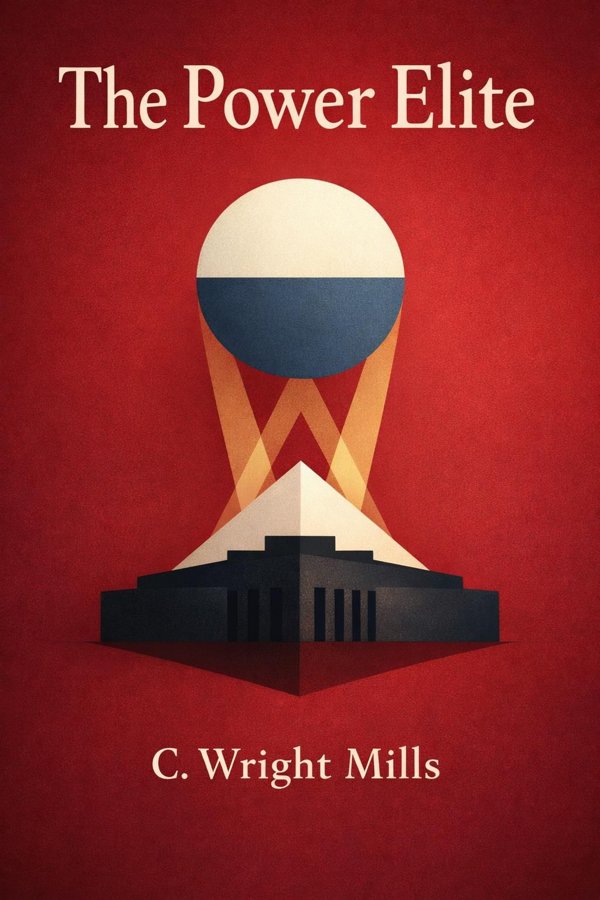
The Power Elite: Summary & Key Insights
 10 min9 chaptersAudio available
Key Takeaways from The Power Elite
Democracy can look open on the surface while real power narrows behind the scenes.
The most powerful groups matter most when they stop acting separately.
A public can become an audience before it realizes it has lost its voice.
Economic power does not stay in the economy; it spills into politics, culture, and everyday life.
Institutions created for protection can become central organizers of society.
What Is The Power Elite About?
The Power Elite by C. Wright Mills is a sociology book. What if the most important decisions in a democracy are not really made in public at all? In The Power Elite, C. Wright Mills argues that modern American society is not governed primarily by the will of ordinary citizens, but by a relatively small, interconnected group at the top of business, politics, and the military. First published in 1956, this landmark work remains one of the most influential critiques of concentrated power in the modern age. Mills shows how elites do not simply hold separate forms of authority; they increasingly overlap, share backgrounds, circulate through the same institutions, and shape national priorities together. The result is a society in which major decisions often happen far from public scrutiny. What makes this book endure is not just its bold thesis, but Mills's sociological imagination: his ability to connect private unease with large institutional forces. He wrote as a sharp, independent thinker willing to challenge comforting myths about American democracy. For readers trying to understand inequality, political influence, media narratives, and institutional power, The Power Elite remains startlingly relevant.
This FizzRead summary covers all 9 key chapters of The Power Elite in approximately 10 minutes, distilling the most important ideas, arguments, and takeaways from C. Wright Mills's work. Also available as an audio summary and Key Quotes Podcast.
The Power Elite
What if the most important decisions in a democracy are not really made in public at all? In The Power Elite, C. Wright Mills argues that modern American society is not governed primarily by the will of ordinary citizens, but by a relatively small, interconnected group at the top of business, politics, and the military. First published in 1956, this landmark work remains one of the most influential critiques of concentrated power in the modern age. Mills shows how elites do not simply hold separate forms of authority; they increasingly overlap, share backgrounds, circulate through the same institutions, and shape national priorities together. The result is a society in which major decisions often happen far from public scrutiny. What makes this book endure is not just its bold thesis, but Mills's sociological imagination: his ability to connect private unease with large institutional forces. He wrote as a sharp, independent thinker willing to challenge comforting myths about American democracy. For readers trying to understand inequality, political influence, media narratives, and institutional power, The Power Elite remains startlingly relevant.
Who Should Read The Power Elite?
This book is perfect for anyone interested in sociology and looking to gain actionable insights in a short read. Whether you're a student, professional, or lifelong learner, the key ideas from The Power Elite by C. Wright Mills will help you think differently.
- ✓Readers who enjoy sociology and want practical takeaways
- ✓Professionals looking to apply new ideas to their work and life
- ✓Anyone who wants the core insights of The Power Elite in just 10 minutes
Want the full summary?
Get instant access to this book summary and 100K+ more with Fizz Moment.
Get Free SummaryAvailable on App Store • Free to download
Key Chapters
Democracy can look open on the surface while real power narrows behind the scenes. This is the central insight of The Power Elite. Mills argues that in modern mass society, authority does not remain widely distributed among citizens, local communities, and competing groups. Instead, it becomes concentrated in a relatively small circle of people occupying top command positions in major institutions. These institutions are not marginal; they are the commanding heights of national life: large corporations, the federal government, and the military establishment. The people who lead them make decisions with enormous consequences for war, work, wealth, and public policy.
Mills is not simply saying that some people are more influential than others. That has always been true. His stronger claim is that the scale and organization of modern society allow a small set of decision-makers to affect the lives of millions, often without meaningful democratic control. As societies become larger and more bureaucratic, ordinary citizens gain less direct access to the centers where crucial decisions are made. Elections and public debate still matter, but they may operate around the edges of choices already shaped by elite institutions.
A practical way to understand this is to ask who can make decisions that others must live with. A local resident may vote, protest, or write opinions, but a cabinet official, a corporate executive, or a military commander can redirect resources, set agendas, and define what counts as a national priority. In workplaces, the same pattern appears when senior leaders make strategic choices that employees experience as fixed realities.
Actionable takeaway: When analyzing any public issue, do not stop at visible debate. Identify the institutions at the top, the people leading them, and the decisions they are uniquely able to make.
The most powerful groups matter most when they stop acting separately. One of Mills's most enduring arguments is that the corporate, political, and military orders increasingly overlap rather than compete in isolation. The leaders of these spheres often share common interests, move in the same social circles, and develop a similar worldview. This does not require a secret conspiracy. It can happen through routine patterns of recruitment, education, marriage, networking, and career mobility.
Mills shows that elites often come from comparable class backgrounds, attend prestigious schools, belong to the same clubs, and adopt the same assumptions about national interest and social order. As a result, they do not need to coordinate every decision explicitly to produce similar outcomes. Their shared outlook makes certain policies seem natural, practical, or inevitable. For example, a business leader entering government may prioritize economic stability in ways that align with corporate needs. A military official advising policymakers may frame international questions through security logic. A politician reliant on elite institutions may treat their preferences as realistic constraints.
This helps explain why major policy directions can remain stable even when personalities change. If institutions recruit from overlapping circles, the worldview at the top remains consistent. We still see versions of this pattern when executives rotate into government advisory roles, retired generals appear as public authorities, or policymakers depend on think tanks and donors from elite networks.
Actionable takeaway: To understand influence, track connections across institutions. Pay attention to shared educational backgrounds, revolving-door careers, social networks, and the assumptions that leaders carry from one sphere into another.
A public can become an audience before it realizes it has lost its voice. Mills distinguishes between an active public, where people can debate and influence decisions, and a mass society, where individuals are largely spectators. In smaller, more participatory settings, citizens can form opinions, organize, and meaningfully affect power. In a mass society, communication becomes one-way, institutions grow distant, and ordinary people feel increasingly unable to shape the major forces affecting their lives.
This argument is essential to the book because concentrated power thrives when the broader population is fragmented, distracted, or politically passive. Mills does not blame citizens for lacking intelligence or moral concern. Rather, he emphasizes structural conditions: large organizations, centralized media, bureaucratic complexity, and the sheer scale of modern life make effective participation difficult. People may care deeply, yet still struggle to connect private problems with public issues. They become informed in fragments but disempowered in practice.
Think of how many people consume news today. They may know something is wrong, but lack the time, tools, or institutional access to intervene. The same issue appears in workplaces and schools, where people often receive decisions from above rather than co-creating them. A sense of helplessness then reinforces disengagement: if nothing changes, why participate? Mills saw this as dangerous because it leaves elite decisions less examined and less accountable.
The practical lesson is that healthy democracy requires more than formal rights. It requires channels through which people can translate concerns into organized influence. Community groups, unions, local forums, professional associations, and independent media can help rebuild these channels.
Actionable takeaway: Move from passive awareness to collective participation. Join or support institutions that convert shared concerns into sustained public action.
Economic power does not stay in the economy; it spills into politics, culture, and everyday life. Mills argues that the rise of large corporations transformed the structure of American power. In earlier periods, property might have been dispersed among many smaller owners, but in the modern corporate era, decision-making shifts to executives who control vast bureaucratic organizations. These leaders command capital, employment, investment, and production on a scale that gives them immense leverage over national priorities.
Mills's point is not just that business is important. It is that corporate executives occupy strategic positions from which they can influence government policy, shape public assumptions, and define what is economically possible. If major firms decide to invest, relocate, automate, merge, or lobby, the consequences reach workers, consumers, communities, and lawmakers. Political leaders often respond to corporate expectations because employment, tax revenue, financial stability, and international competitiveness appear tied to business decisions.
This perspective remains useful when considering issues like labor conditions, healthcare costs, environmental regulation, or technological change. For instance, if a handful of firms dominate a sector, their internal choices can shape what options the public is offered. Even when no law forces a certain outcome, concentrated corporate decision-making can narrow what society experiences as realistic.
For individuals, this idea encourages a broader view of economic life. A paycheck, a product, or a local plant closure may seem private, but each can reflect strategic decisions made far above the local level. For civic life, it suggests that discussions of democracy must include workplace power, market concentration, and the political influence of large organizations.
Actionable takeaway: When evaluating social problems, ask how corporate structure and executive decisions influence the issue, not just how consumers or voters behave.
Institutions created for protection can become central organizers of society. Mills wrote during the Cold War, when the military establishment in the United States had expanded dramatically in size, prestige, and political significance. He observed that military leaders were no longer confined to narrow defense matters. They increasingly influenced budgets, foreign policy, industrial development, scientific research, and national identity. The military became a permanent, powerful institution woven into the logic of government and business.
This was a major shift. In older democratic ideals, military power was supposed to remain subordinate and limited. Mills believed that a permanent war footing changed this balance. Once military needs become a constant national priority, they shape alliances, spending decisions, public rhetoric, and industrial contracts. This creates powerful incentives linking military institutions with political leaders and corporate manufacturers. War preparation then becomes not just a response to threats, but a structuring principle of social organization.
Mills's analysis helps readers understand how security language can justify expanded authority. When issues are framed as urgent matters of survival, scrutiny often weakens and dissent can be marginalized. We can apply this insight to contemporary debates about surveillance, emergency powers, border enforcement, cyber conflict, and defense spending. The question is not whether security matters; it is how security institutions gain legitimacy and whether that legitimacy is balanced by accountability.
For citizens, the key challenge is learning to distinguish genuine public protection from institutional self-expansion. A society can support defense while still asking who benefits, what alternatives exist, and how military priorities affect education, healthcare, diplomacy, and civil liberties.
Actionable takeaway: Whenever policy is justified primarily in the name of security, examine the institutional interests, economic ties, and long-term tradeoffs hidden inside that framing.
Political office can appear powerful while actually operating within narrow boundaries. Mills argues that top political leaders are important not only because they make decisions, but because they sit at the intersection of other major institutions. Government is often presented as the sovereign arena where competing interests are balanced. Mills complicates this picture by showing how national politicians must work within pressures generated by corporate and military power, bureaucratic routines, and elite expectations.
This does not mean elected officials are puppets with no agency. Rather, their choices are structured by the institutional environment around them. Certain options are considered responsible, realistic, or patriotic, while others are dismissed before debate begins. Leaders may therefore spend much of their time managing crises, coordinating elite interests, and maintaining legitimacy rather than opening genuinely broad democratic alternatives.
This idea helps explain why campaign rhetoric can sound transformative while governance looks more constrained. Once in office, leaders face entrenched agencies, national security priorities, market reactions, legal precedents, donor networks, and expert communities that shape the menu of possible action. A policy can fail not because the public rejects it, but because institutional power quietly limits its feasibility.
In organizational life, the same dynamic appears when a CEO, school superintendent, or nonprofit director seems fully in charge but is actually constrained by boards, financial structures, regulators, and stakeholder expectations. Understanding this reduces naive faith in heroic leadership and shifts attention toward systems.
Actionable takeaway: Judge political outcomes not only by personalities and promises, but by the institutional constraints surrounding leaders and the alliances that make certain decisions possible.
Power becomes more durable when it looks natural, admirable, and deserved. Mills emphasizes that elites do not rule only through formal authority or economic control. They are also supported by systems of prestige and status. Titles, schools, manners, media visibility, and cultural recognition help mark certain people as competent, serious, and fit to lead. This symbolic layer matters because it teaches the wider public whom to trust and whose perspective counts.
Prestige works by turning inequality into legitimacy. If elite figures are seen as exceptionally refined, educated, patriotic, or practical, then their dominance can appear like a reasonable social fact rather than a political problem. Mills saw high-status circles as important not because every prestigious person has direct power, but because status creates a social environment that validates power. It opens doors, normalizes access, and shapes the standards by which leadership is judged.
A contemporary example is how media often rely on familiar insiders, elite credential holders, or established institutions to define what is credible. This may produce useful expertise, but it can also narrow debate by filtering out people with lived knowledge but less formal prestige. In workplaces, status hierarchies shape whose ideas are heard, whose mistakes are forgiven, and who is seen as leadership material.
The practical value of this insight is that it trains readers to notice symbols of authority, not just authority itself. A polished image, prestigious affiliation, or confident tone may create influence before any argument is examined. Democratic culture becomes stronger when people can separate status from substance.
Actionable takeaway: Evaluate ideas and leaders by evidence, accountability, and consequences, not by credentials, polish, or elite social standing alone.
Personal frustration often has a social structure behind it. Although The Power Elite focuses on institutions at the top, it reflects Mills's broader sociological method: linking private troubles to public issues. People may experience anxiety, insecurity, overwork, or political confusion as individual burdens. Mills invites readers to ask how these experiences are shaped by large organizations and elite decisions. Once that connection becomes visible, what felt personal also becomes political.
This is one reason the book remains powerful. It offers a way of thinking that cuts through isolation. A worker who fears layoffs may blame personal shortcomings, but corporate restructuring, trade policy, and executive strategy may be central causes. A citizen who feels ignored by politics may assume apathy is the problem, when institutional distance and media centralization are major barriers. Families stressed by housing, healthcare, or education costs are often responding to systems shaped far from their neighborhoods.
This habit of analysis has practical value beyond sociology. In leadership, it helps managers understand that employee burnout may not be just a resilience issue, but a structural one involving workload, incentives, and hierarchy. In civic life, it helps communities organize around patterns rather than isolated incidents. In personal life, it can reduce shame by revealing that many struggles are socially produced.
Mills does not deny personal responsibility. Instead, he broadens the frame so responsibility can be placed where it belongs, including on institutions. That shift matters because people are more likely to act effectively when they understand the real scale of the problem.
Actionable takeaway: When a problem feels purely personal, ask what larger institutional forces may be shaping it and whether others are experiencing the same pattern.
All Chapters in The Power Elite
About the Author
C. Wright Mills was an American sociologist and public intellectual born in 1916 and best known for his bold critiques of power in modern society. He taught primarily at Columbia University and wrote in a direct, forceful style that made complex sociological ideas accessible to a wide audience. Mills focused on how institutions shape individual lives, and he challenged both political complacency and detached academic thinking. His major works include White Collar, The Power Elite, and The Sociological Imagination, all of which helped define postwar social criticism. He believed sociology should equip people to connect personal troubles with public issues and historical forces. Though he died in 1962 at a relatively young age, Mills remains one of the most influential American sociologists of the 20th century.
Get This Summary in Your Preferred Format
Read or listen to the The Power Elite summary by C. Wright Mills anytime, anywhere. FizzRead offers multiple formats so you can learn on your terms — all free.
Available formats: App · Audio · PDF · EPUB — All included free with FizzRead
Download The Power Elite PDF and EPUB Summary
Key Quotes from The Power Elite
“Democracy can look open on the surface while real power narrows behind the scenes.”
“The most powerful groups matter most when they stop acting separately.”
“A public can become an audience before it realizes it has lost its voice.”
“Economic power does not stay in the economy; it spills into politics, culture, and everyday life.”
“Institutions created for protection can become central organizers of society.”
Frequently Asked Questions about The Power Elite
The Power Elite by C. Wright Mills is a sociology book that explores key ideas across 9 chapters. What if the most important decisions in a democracy are not really made in public at all? In The Power Elite, C. Wright Mills argues that modern American society is not governed primarily by the will of ordinary citizens, but by a relatively small, interconnected group at the top of business, politics, and the military. First published in 1956, this landmark work remains one of the most influential critiques of concentrated power in the modern age. Mills shows how elites do not simply hold separate forms of authority; they increasingly overlap, share backgrounds, circulate through the same institutions, and shape national priorities together. The result is a society in which major decisions often happen far from public scrutiny. What makes this book endure is not just its bold thesis, but Mills's sociological imagination: his ability to connect private unease with large institutional forces. He wrote as a sharp, independent thinker willing to challenge comforting myths about American democracy. For readers trying to understand inequality, political influence, media narratives, and institutional power, The Power Elite remains startlingly relevant.
More by C. Wright Mills
You Might Also Like

Between the World and Me
Ta-Nehisi Coates
10 min
Half the Sky
Nicholas D. Kristof, Sheryl WuDunn
10 min
Men Explain Things To Me
Rebecca Solnit
10 min
Rational Ritual
Michael Suk-Young Chwe
10 min
The New Jim Crow
Michelle Alexander
10 min
Beyond Culture
Edward T. Hall
10 minBrowse by Category
Ready to read The Power Elite?
Get the full summary and 100K+ more books with Fizz Moment.