
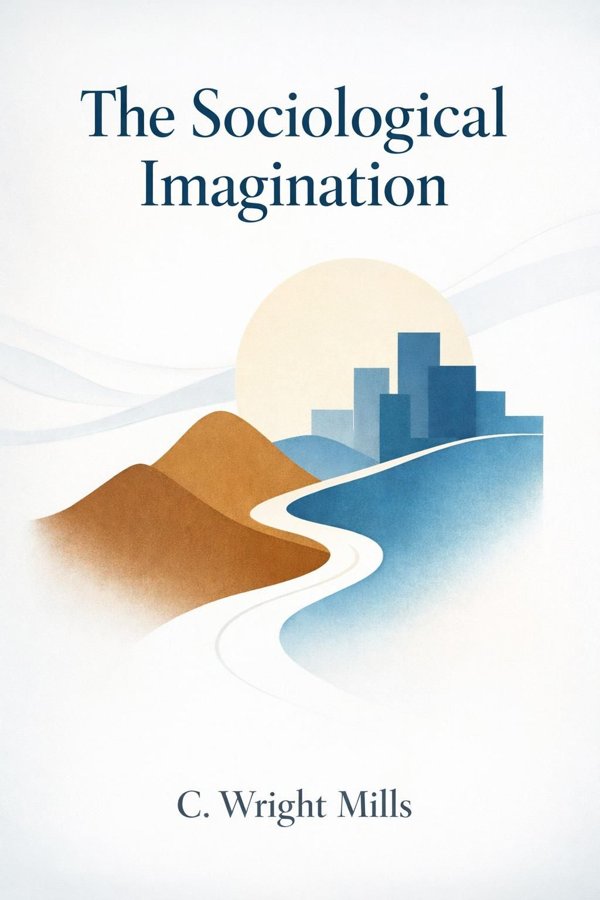
The Sociological Imagination: Summary & Key Insights
 10 min10 chaptersAudio available
Key Takeaways from The Sociological Imagination
A discipline loses its soul when it forgets why it exists.
People often feel their problems are uniquely personal when they are actually widely shared.
What feels private is often social in disguise.
To understand a life, you must know the era in which it is lived.
Freedom feels very different depending on the structure of the world around you.
What Is The Sociological Imagination About?
The Sociological Imagination by C. Wright Mills is a sociology book spanning 10 pages. Published in 1959, The Sociological Imagination is one of the most important books ever written about how to think sociologically. In it, C. Wright Mills argues that we cannot understand our lives by looking only inward. Our personal experiences—work, family stress, debt, ambition, loneliness, and even our private anxieties—are deeply shaped by larger historical forces and social institutions. Mills calls the ability to connect biography with history the “sociological imagination,” and he presents it as an essential habit of mind for anyone trying to make sense of modern life. What makes this book enduring is not only its central idea, but also its fierce critique of shallow scholarship. Mills challenges both overly abstract theory and sterile data collection that ignore real human problems. He calls instead for intellectually alive, morally serious social inquiry. As a leading American sociologist and the author of influential works such as The Power Elite and White Collar, Mills wrote with unusual clarity, urgency, and independence. This book remains vital for students, researchers, professionals, and general readers who want a sharper, more critical understanding of society.
This FizzRead summary covers all 10 key chapters of The Sociological Imagination in approximately 10 minutes, distilling the most important ideas, arguments, and takeaways from C. Wright Mills's work. Also available as an audio summary and Key Quotes Podcast.
The Sociological Imagination
Published in 1959, The Sociological Imagination is one of the most important books ever written about how to think sociologically. In it, C. Wright Mills argues that we cannot understand our lives by looking only inward. Our personal experiences—work, family stress, debt, ambition, loneliness, and even our private anxieties—are deeply shaped by larger historical forces and social institutions. Mills calls the ability to connect biography with history the “sociological imagination,” and he presents it as an essential habit of mind for anyone trying to make sense of modern life.
What makes this book enduring is not only its central idea, but also its fierce critique of shallow scholarship. Mills challenges both overly abstract theory and sterile data collection that ignore real human problems. He calls instead for intellectually alive, morally serious social inquiry. As a leading American sociologist and the author of influential works such as The Power Elite and White Collar, Mills wrote with unusual clarity, urgency, and independence. This book remains vital for students, researchers, professionals, and general readers who want a sharper, more critical understanding of society.
Who Should Read The Sociological Imagination?
This book is perfect for anyone interested in sociology and looking to gain actionable insights in a short read. Whether you're a student, professional, or lifelong learner, the key ideas from The Sociological Imagination by C. Wright Mills will help you think differently.
- ✓Readers who enjoy sociology and want practical takeaways
- ✓Professionals looking to apply new ideas to their work and life
- ✓Anyone who wants the core insights of The Sociological Imagination in just 10 minutes
Want the full summary?
Get instant access to this book summary and 100K+ more with Fizz Moment.
Get Free SummaryAvailable on App Store • Free to download
Key Chapters
A discipline loses its soul when it forgets why it exists. Mills opens with a forceful critique of the direction sociology had taken in mid-twentieth-century America. In his view, too much of the field had become either obsessed with prestige and technical language or content to produce narrow, disconnected findings. Instead of helping people understand the world they live in, sociology often drifted into professional routines that insulated scholars from urgent social questions.
Mills was especially troubled by the separation between academic work and public life. He believed sociology should illuminate how ordinary people’s struggles relate to institutions, power, and history. When sociologists become preoccupied with academic status, method for method’s sake, or conceptual systems detached from lived reality, they stop serving the public purpose of the discipline. For Mills, this was not just an intellectual problem but a moral one.
This critique still feels current. Today, many fields face similar pressures: publish quickly, specialize narrowly, and speak mainly to insiders. A researcher might produce highly technical analyses of workplace behavior, for example, without asking how economic insecurity, automation, or labor policy shape those behaviors in the first place. Mills warns us that useful knowledge requires relevance, clarity, and courage.
His challenge is not anti-intellectual. He does not reject rigor; he rejects empty rigor. Good sociology should ask large questions, remain empirically grounded, and stay connected to human concerns. It should help people understand why they feel trapped, confused, or powerless in changing social conditions.
Actionable takeaway: When reading social research—or producing it—ask a simple test question: does this help explain how real people’s lives are shaped by broader social forces?
People often feel their problems are uniquely personal when they are actually widely shared. Mills calls sociology’s great promise the ability to reveal that connection. The sociological imagination helps us see that many private troubles are linked to public issues, and that understanding this relationship can be liberating. It shifts our perspective from self-blame or confusion toward explanation and possibility.
For Mills, the promise of sociology lies in helping people locate themselves within a larger social and historical context. A person who cannot find stable work may think they have personally failed. But if unemployment rises across a region because industries have moved, wages have stagnated, or technology has changed labor demands, the issue is not simply individual weakness. It is structural. The same is true of student debt, housing insecurity, burnout, or delayed family formation. Sociology reveals patterns where individuals see only isolated misfortune.
This insight matters because it changes both understanding and action. If a problem is purely personal, the solution seems to be private adjustment: work harder, think differently, cope better. But if the problem reflects broader arrangements—economic policy, institutional design, cultural norms—then collective solutions become possible. Public debate, reform, and organized action enter the picture.
Mills believed this shift in perspective was intellectually clarifying and emotionally powerful. It helps people recover agency without indulging fantasy. You may not control history, but you can better understand the forces acting upon you and respond more intelligently.
Actionable takeaway: The next time you face a recurring problem, ask whether it might be shared by many others and what larger institutions or historical trends may be shaping it.
What feels private is often social in disguise. This is perhaps Mills’s most famous distinction: “personal troubles” occur within the character of the individual and their immediate relationships, while “public issues” involve the organization of institutions and the structure of society as a whole. The key task of sociology is not to erase the difference, but to understand how the two interact.
Consider divorce. If one marriage collapses because of a particular conflict, we might interpret it as a personal trouble. But if divorce rates rise dramatically across a society, the explanation cannot stop at individual compatibility. We must ask about gender roles, economic pressures, legal changes, expectations of intimacy, and cultural attitudes toward family life. The same event can be experienced personally and explained socially.
Mills’s distinction helps us avoid two common errors. The first is psychologizing everything: assuming every difficulty stems from personality, poor choices, or emotional weakness. The second is overgeneralizing: treating individuals as mere puppets of the system. Mills insists on a more balanced view. Human beings act, choose, and feel, but always within conditions they did not fully create.
This framework remains incredibly useful. Rising anxiety among young people, for example, may involve individual psychology, but it also raises public issues involving social media, educational pressure, job markets, family instability, and declining trust in institutions. Understanding only one level gives us an incomplete picture.
Mills’s brilliance lies in showing that social understanding begins when we stop taking private experience at face value. We ask: how many others share this? What institutions are involved? What historical changes are unfolding?
Actionable takeaway: When examining a personal challenge, map it at two levels—your immediate situation and the broader social conditions that may be producing or intensifying it.
To understand a life, you must know the era in which it is lived. Mills argues that biography cannot be separated from history. People do not simply have experiences; they have them within specific historical moments shaped by war, economic transformation, political conflict, technological change, and cultural shifts. The sociological imagination therefore requires historical awareness.
A career, for instance, means something different in different periods. Someone entering adulthood during economic expansion may experience opportunity, mobility, and optimism. Someone equally talented entering adulthood during recession, deindustrialization, or political instability may face precarious work and delayed milestones. Without history, these outcomes can look like personal success or failure. With history, they become intelligible as part of larger social change.
Mills wanted sociologists to ask how particular social structures emerged and how they are changing. Family patterns, class relations, bureaucracies, educational systems, and media environments all have histories. They are not natural or fixed. This matters because what has been made historically can also be altered historically.
Historical thinking also protects us from present-mindedness—the tendency to assume today’s arrangements are normal, inevitable, or universal. Remote work, mass higher education, consumer culture, and digital surveillance may feel ordinary now, but each has a social history. Understanding that history reveals how power operates and how alternatives become imaginable.
For readers, Mills offers a powerful mental shift: your life is not unfolding in a vacuum. Your ambitions, fears, and options are partly products of the time you were born into. This does not erase personal responsibility, but it does deepen self-understanding.
Actionable takeaway: Place any major life issue you face—career, family, debt, identity—into a timeline. Ask what historical events or long-term trends have shaped the conditions around it.
When theory becomes too abstract, it stops explaining the world and starts floating above it. Mills sharply criticizes what he calls “grand theory,” especially sociological writing that builds vast conceptual systems disconnected from concrete historical reality. His concern is not that theory is unimportant, but that theory becomes useless when it is so general, ornate, or self-referential that it no longer clarifies actual social life.
Grand theory often creates an illusion of depth through complexity of language. It may describe society using all-encompassing concepts, yet fail to illuminate specific institutions, conflicts, or lived experiences. Mills believed this style encouraged intellectual prestige without practical understanding. Readers may come away impressed, but not enlightened.
His criticism applies widely beyond sociology. In business, politics, and cultural commentary, frameworks can become fashionable for their sophistication while remaining vague in application. A leader might speak endlessly about “systems transformation” or “organizational synergy” without identifying who holds power, what incentives exist, or why people behave as they do. Mills urges us to ask whether concepts actually help us interpret real situations.
Importantly, Mills does not advocate abandoning theory. He wants middle-range, historically grounded, analytically sharp thinking—concepts tied to observable social realities. Good theory should simplify without distorting. It should help us ask better questions, compare cases, and identify causal connections.
For students and readers, this is a reminder not to confuse obscurity with insight. The best ideas often increase understanding by making patterns more visible, not by burying them in jargon. Theory earns its value when it clarifies the relationship between personal experience, institutions, and historical change.
Actionable takeaway: When you encounter a big theory, test it on a real case. If it cannot explain a concrete social situation clearly, treat it with skepticism.
Data can become a way of avoiding thought. Mills’s second major critique targets what he calls “abstracted empiricism,” the tendency to collect masses of data, surveys, and measurements without asking substantial questions about history, power, or meaning. In this mode, method becomes the master instead of the servant of inquiry.
Mills saw a growing fascination with technique—questionnaires, coding schemes, statistical routines—combined with a shrinking ambition about what research should explain. The result was often precise information about trivial matters or fragmented findings with no interpretive framework. You could know more and more about less and less. For Mills, this was not scientific seriousness; it was misplaced seriousness.
The problem still resonates in an age of analytics, dashboards, and big data. Organizations can track employee engagement scores, screen time, consumer clicks, or student performance in fine detail, yet remain unable to answer deeper questions. Why are workers disengaged? What kind of culture is technology creating? How are incentives shaping behavior? What historical changes have made these patterns possible? Data alone cannot answer these unless guided by meaningful sociological questions.
Mills does not reject empirical research. He insists that evidence is essential. But evidence should be gathered in service of understanding important problems. Facts matter most when interpreted in context. Methods should remain flexible, chosen for relevance rather than prestige.
This idea is deeply practical. If you are conducting research, evaluating reports, or making decisions at work, do not be dazzled by sophistication of method alone. Ask what the inquiry is actually trying to understand, whose lives it concerns, and what broader structure the evidence points toward.
Actionable takeaway: Before trusting any dataset or survey, ask what larger question it answers—and what crucial social realities it may leave unexplored.
Knowledge is never neutral in its consequences. Mills believes sociologists have a public responsibility: to clarify the social forces shaping people’s lives and to do so in ways that matter beyond academic circles. He sees the social scientist not as a detached technician but as an interpreter of society with ethical and civic obligations.
This does not mean turning scholarship into propaganda. Rather, it means refusing indifference. If research reveals how institutions distribute power, produce inequality, or narrow human freedom, scholars should not hide behind professional distance as though those findings carry no public implications. Mills worries that experts can become servants of bureaucracy, supplying tools and information without questioning the ends they serve.
The issue is highly relevant today. Data scientists, economists, policy researchers, and organizational experts often shape decisions that affect millions. If they study policing, education, hiring, health systems, or media platforms, their work influences who benefits and who bears costs. Mills asks intellectuals to be aware of this role and to communicate honestly about it.
He also argues that public responsibility includes clear writing. If social analysis is buried in inaccessible language, it cannot inform democratic life. Sociologists should help citizens think more clearly about the world, not simply impress other specialists. This ideal challenges the gap between expertise and public understanding.
At its core, Mills’s argument is about integrity. To study society seriously is to confront matters of power, conflict, and human possibility. That requires courage as well as competence. The scholar should not merely measure the world, but illuminate it.
Actionable takeaway: If you produce knowledge in any field, ask who it serves, who can understand it, and whether it helps people see their social world more clearly.
The most useful social analysis does not choose between big questions and careful evidence. Mills argues for an integration of theory and method guided by meaningful problems. He rejects the false choice between abstract conceptual systems on one side and narrow fact-gathering on the other. The best inquiry moves back and forth between ideas, evidence, biography, and history.
This integration is the practical heart of the sociological imagination. A researcher should begin with significant questions: What is happening in this society? How is it organized? Where does this historical moment place individuals? Then theory helps frame the problem, history provides context, and empirical work tests, refines, or complicates the analysis. None of these elements is sufficient alone.
Take the modern issue of remote work. A purely theoretical account might say it reflects broad changes in capitalism or bureaucracy, but remain too vague. A purely empirical account might count hours worked at home and compare productivity metrics, but miss larger meaning. An integrated sociological approach would ask how remote work affects identity, family life, urban space, managerial control, class differences, and the boundaries between personal troubles and public issues. It would connect lived experience to institutional transformation.
Mills’s larger lesson is methodological humility paired with intellectual ambition. Use the tools that fit the question. Do not let available techniques dictate what matters. At the same time, do not let grand claims outrun evidence. Good social inquiry remains alive to complexity without becoming evasive.
For readers, this idea offers a model for thinking clearly about any social problem. Look for concepts, facts, and historical context together. Meaning emerges in their combination.
Actionable takeaway: When analyzing a social issue, deliberately use three lenses at once—historical context, empirical evidence, and a clear conceptual question.
All Chapters in The Sociological Imagination
About the Author
Charles Wright Mills (1916–1962) was an American sociologist and public intellectual known for his sharp critiques of power, bureaucracy, and modern social life. He taught at Columbia University and became one of the most distinctive voices in twentieth-century sociology through his clear prose, independent thinking, and willingness to challenge both political elites and academic orthodoxies. Mills was deeply concerned with how large institutions shape individual experience, and he argued that social science should remain connected to public issues rather than retreat into abstraction or technical routine. His major books include White Collar, The Power Elite, and The Sociological Imagination, all of which helped establish him as a leading critic of modern American society. Though he died relatively young, his influence on sociology, political thought, and public debate remains profound.
Get This Summary in Your Preferred Format
Read or listen to the The Sociological Imagination summary by C. Wright Mills anytime, anywhere. FizzRead offers multiple formats so you can learn on your terms — all free.
Available formats: App · Audio · PDF · EPUB — All included free with FizzRead
Download The Sociological Imagination PDF and EPUB Summary
Key Quotes from The Sociological Imagination
“A discipline loses its soul when it forgets why it exists.”
“People often feel their problems are uniquely personal when they are actually widely shared.”
“What feels private is often social in disguise.”
“To understand a life, you must know the era in which it is lived.”
“Freedom feels very different depending on the structure of the world around you.”
Frequently Asked Questions about The Sociological Imagination
The Sociological Imagination by C. Wright Mills is a sociology book that explores key ideas across 10 chapters. Published in 1959, The Sociological Imagination is one of the most important books ever written about how to think sociologically. In it, C. Wright Mills argues that we cannot understand our lives by looking only inward. Our personal experiences—work, family stress, debt, ambition, loneliness, and even our private anxieties—are deeply shaped by larger historical forces and social institutions. Mills calls the ability to connect biography with history the “sociological imagination,” and he presents it as an essential habit of mind for anyone trying to make sense of modern life. What makes this book enduring is not only its central idea, but also its fierce critique of shallow scholarship. Mills challenges both overly abstract theory and sterile data collection that ignore real human problems. He calls instead for intellectually alive, morally serious social inquiry. As a leading American sociologist and the author of influential works such as The Power Elite and White Collar, Mills wrote with unusual clarity, urgency, and independence. This book remains vital for students, researchers, professionals, and general readers who want a sharper, more critical understanding of society.
More by C. Wright Mills
You Might Also Like

Between the World and Me
Ta-Nehisi Coates
10 min
Half the Sky
Nicholas D. Kristof, Sheryl WuDunn
10 min
Men Explain Things To Me
Rebecca Solnit
10 min
Rational Ritual
Michael Suk-Young Chwe
10 min
The New Jim Crow
Michelle Alexander
10 min
Beyond Culture
Edward T. Hall
10 minBrowse by Category
Ready to read The Sociological Imagination?
Get the full summary and 100K+ more books with Fizz Moment.