
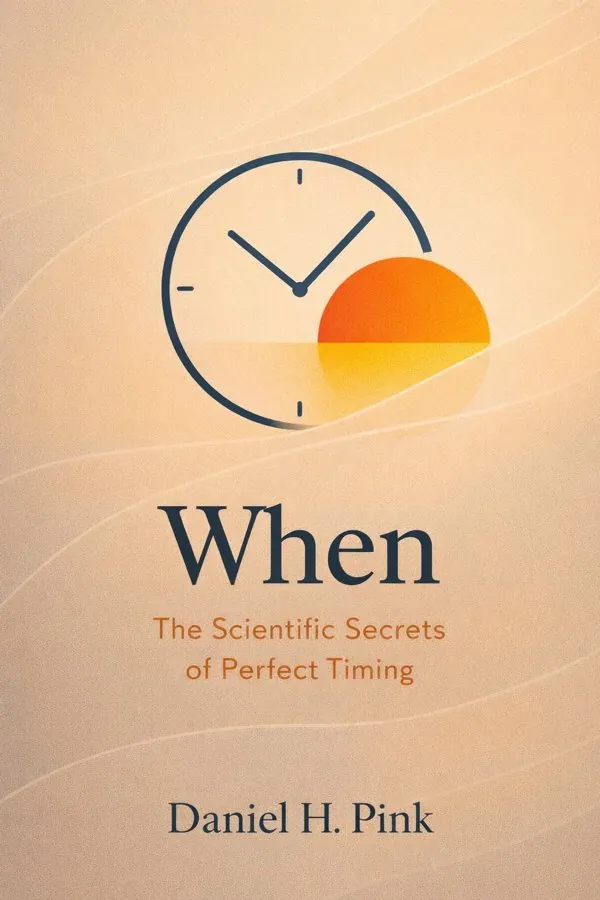
When: The Scientific Secrets of Perfect Timing: Summary & Key Insights
 10 min9 chaptersAudio available
Key Takeaways from When: The Scientific Secrets of Perfect Timing
A large part of daily success depends on a factor most people barely notice: the changing quality of their attention across the day.
The start of something often matters more than the middle because beginnings create psychological momentum.
Halfway through an experience, people often lose focus, become discouraged, or suddenly wake up.
People do not remember experiences evenly.
The modern workplace often treats breaks as indulgent interruptions, but Pink shows they are one of the simplest tools for sustaining performance.
What Is When: The Scientific Secrets of Perfect Timing About?
When: The Scientific Secrets of Perfect Timing by Daniel H. Pink is a productivity book spanning 8 pages. Most advice about performance focuses on strategy, talent, grit, or habits. Daniel H. Pink argues that one crucial variable is often ignored: timing. In When: The Scientific Secrets of Perfect Timing, he brings together research from psychology, chronobiology, behavioral economics, and organizational science to show that when we do something can be just as important as what we do. Across a day, a project, a career, or even a conversation, hidden temporal patterns shape our mood, judgment, creativity, motivation, and relationships. Pink’s central insight is both simple and powerful: timing is not merely intuitive or accidental. It follows patterns we can study and use. He explains why many people perform analytic work best at one point in the day, why breaks are not a luxury but a productivity tool, why midpoints can trigger slumps or surges, and why endings leave disproportionate emotional impact. Written in Pink’s accessible, research-driven style, this book turns abstract science into practical guidance. For anyone trying to work smarter, make better decisions, lead teams, or design a more intentional life, When offers a fresh and highly useful lens.
This FizzRead summary covers all 9 key chapters of When: The Scientific Secrets of Perfect Timing in approximately 10 minutes, distilling the most important ideas, arguments, and takeaways from Daniel H. Pink's work. Also available as an audio summary and Key Quotes Podcast.
When: The Scientific Secrets of Perfect Timing
Most advice about performance focuses on strategy, talent, grit, or habits. Daniel H. Pink argues that one crucial variable is often ignored: timing. In When: The Scientific Secrets of Perfect Timing, he brings together research from psychology, chronobiology, behavioral economics, and organizational science to show that when we do something can be just as important as what we do. Across a day, a project, a career, or even a conversation, hidden temporal patterns shape our mood, judgment, creativity, motivation, and relationships.
Pink’s central insight is both simple and powerful: timing is not merely intuitive or accidental. It follows patterns we can study and use. He explains why many people perform analytic work best at one point in the day, why breaks are not a luxury but a productivity tool, why midpoints can trigger slumps or surges, and why endings leave disproportionate emotional impact. Written in Pink’s accessible, research-driven style, this book turns abstract science into practical guidance. For anyone trying to work smarter, make better decisions, lead teams, or design a more intentional life, When offers a fresh and highly useful lens.
Who Should Read When: The Scientific Secrets of Perfect Timing?
This book is perfect for anyone interested in productivity and looking to gain actionable insights in a short read. Whether you're a student, professional, or lifelong learner, the key ideas from When: The Scientific Secrets of Perfect Timing by Daniel H. Pink will help you think differently.
- ✓Readers who enjoy productivity and want practical takeaways
- ✓Professionals looking to apply new ideas to their work and life
- ✓Anyone who wants the core insights of When: The Scientific Secrets of Perfect Timing in just 10 minutes
Want the full summary?
Get instant access to this book summary and 100K+ more with Fizz Moment.
Get Free SummaryAvailable on App Store • Free to download
Key Chapters
The start of something often matters more than the middle because beginnings create psychological momentum. Pink shows that whether it is the first day of a job, the opening minutes of a meeting, the launch of a new habit, or the start of a year, beginnings shape expectations, identity, and effort. They provide a frame through which we interpret what follows.
Research on temporal landmarks helps explain this effect. Dates such as birthdays, Mondays, New Year’s Day, or the start of a semester can produce a “fresh start effect,” making people feel separated from past failures and more capable of change. These moments encourage aspirational thinking. We become more willing to commit to goals because a new chapter feels like a chance to become a better version of ourselves. Pink also notes that transitions matter. Entering a new role, school, city, or stage of life can either leave us disoriented or serve as a powerful reset, depending on how consciously we use the moment.
Beginnings also need design. The opening of a project should not be left to chance. A team kickoff can establish norms, clarify purpose, and create a shared emotional tone. A teacher’s first week can shape classroom culture for months. Even a personal routine can benefit from deliberate starts: laying out gym clothes the night before, beginning the workday with one meaningful task, or starting a difficult conversation with a clear intention.
The key is to stop waiting for ideal conditions and instead use beginnings as leverage. Create intentional start points, pair them with a clear commitment, and use transitions as opportunities to reset behavior rather than drift.
Halfway through an experience, people often lose focus, become discouraged, or suddenly wake up. Pink highlights the surprising power of midpoints: they are not just markers on a timeline but emotional and motivational turning points. Whether in a project, a semester, a sales period, a marathon, or a life stage, the middle can become a slump or a catalyst.
One reason midpoints matter is that they make time visible. At the beginning, there is plenty of time and possibility. At the end, urgency is obvious. But the middle is ambiguous. People may feel stuck, fatigued, or uncertain about progress. Research shows that at midpoints, motivation can drop because the novelty has faded while the finish line still feels distant. This often produces a “midpoint slump.” Yet the same awareness can trigger a “midpoint spark.” Once people realize they are halfway, they may accelerate effort, re-evaluate priorities, and regain seriousness.
Pink connects this to the well-known “U-shape” in many experiences: happiness and satisfaction can dip in the middle of a vacation, a course, or even life itself. That dip is not necessarily failure. It may simply reflect the psychological demands of the midpoint. Good leaders, teachers, and individuals can use this knowledge to prevent drift. Mid-project reviews, scoreboards, milestone celebrations, and visible countdowns can transform a vague middle into a concrete moment of recommitment.
If you feel stalled halfway through something important, do not interpret the dip as proof you should quit. Instead, mark the midpoint, assess what has been learned, and create a short burst plan for the second half. Turning the middle into a checkpoint can restore momentum.
People do not remember experiences evenly. Endings carry outsized emotional weight, often shaping how we judge the entire event. Pink draws on research showing that memory is influenced heavily by peaks and endings rather than by an objective average of every moment. This means that the close of an experience can redefine what came before.
Endings are powerful because they sharpen attention. As time runs out, people become more aware of meaning, priorities, and unfinished business. Deadlines can increase effort, final days can intensify appreciation, and conclusions can clarify what truly mattered. In work settings, the end of a quarter or project often produces urgency and focus. In relationships, final conversations may become more sincere. In customer experience, the final interaction often determines whether the whole service is remembered positively or negatively.
Pink emphasizes that endings should be designed, not merely allowed to happen. A teacher can end a class with a question that prompts reflection. A manager can close a meeting by summarizing decisions and next steps. A family can create rituals for endings, such as gratitude at dinner or a meaningful annual tradition. Individuals can use endings to produce closure: finishing the workday with a written shutdown routine, ending a project with a lessons-learned review, or closing a chapter of life with a deliberate ceremony.
Strong endings often contain three elements: poignancy, because time is limited; elevation, because they rise above the ordinary; and significance, because they connect to meaning. Instead of rushing through conclusions, ask how you want an experience to be remembered. End intentionally, and the ending will improve both memory and meaning.
The modern workplace often treats breaks as indulgent interruptions, but Pink shows they are one of the simplest tools for sustaining performance. Human beings are not designed for endless, linear effort. Attention declines, errors increase, and mood worsens when we push too long without recovery. Short pauses are not the opposite of work; they are part of effective work.
Research across fields reveals that breaks improve concentration, reduce stress, and support better decision-making. The best breaks are usually taken before exhaustion becomes overwhelming, not after performance has already collapsed. Timing matters, but so does quality. A genuine break shifts mental state. Going outside, taking a brief walk, stretching, talking with a friend, meditating, or even having a few minutes of social connection can restore energy better than mindlessly scrolling through email or social media.
Pink also notes that collective breaks can be especially valuable. In hospitals, teams that pause together can improve communication and reduce mistakes. In offices, synchronized breaks can strengthen relationships and create a shared rhythm. Breaks should be seen as strategic reset points, especially during the daily trough when vigilance falls. Even microbreaks can help: standing for two minutes, breathing deeply between meetings, or stepping away from a screen after concentrated effort.
Many people believe they cannot afford to take breaks. The evidence suggests the opposite: they cannot afford not to. Build pauses into your schedule instead of relying on willpower. Use a simple rule such as taking a short break every 60 to 90 minutes, and make that break genuinely restorative rather than half-working through it.
Teams often focus on goals, roles, and communication, yet they overlook a crucial factor: synchronization. Pink argues that groups do better not only when members know what to do, but when they move together in time. Shared timing can increase trust, coordination, and a sense of belonging.
Humans are deeply responsive to synchrony. Singing together, marching together, dancing together, or even clapping in unison can create social cohesion. Research suggests that coordinated activity makes people more cooperative and more willing to help one another. This matters in organizations because teams function partly through rhythm. Meetings begin and end at certain times, projects unfold in phases, deadlines cluster, and routines either reinforce alignment or create friction.
Pink highlights that timing affects groups in practical ways. A poorly timed meeting held during everyone’s mental trough may generate bad decisions and low engagement. A team launch without a shared milestone structure may drift into confusion. By contrast, clear rhythms such as morning focus time, midday check-ins, end-of-week reviews, or regular retrospectives can help teams coordinate effort. Even simple rituals can improve collective performance: opening with a brief round of priorities, pausing together after intense work, or ending with one clear commitment from each person.
Leaders should think like conductors, not just commanders. The question is not only who does what, but when people act alone versus together. Audit your team’s temporal habits. Move high-stakes collaboration to times of stronger alertness, create shared pauses, and build recurring rituals that keep people in sync.
Life is punctuated by thresholds, and those thresholds often determine whether change feels chaotic or meaningful. Pink explores the timing of beginnings and transitions, showing that periods of movement from one role, place, or identity to another deserve far more attention than they usually receive. Graduating, changing jobs, becoming a parent, moving cities, retiring, or returning after a setback are all examples of transitions that reshape behavior.
Transitions are difficult because they unsettle routines and expectations. What once felt automatic becomes uncertain. But they are also powerful because they loosen the grip of old habits. During these periods, people are more open to redefining themselves. The same disruption that creates instability can also create possibility. Pink’s message is that transitions should be navigated consciously, with rituals, structure, and reflection.
One useful idea is to mark transitions with acts that acknowledge both ending and beginning. A farewell gathering, a written reflection, a symbolic object, or a first-day ritual can help people process change. Organizations can improve onboarding by recognizing that the earliest days strongly influence belonging and performance. Families can help children through school transitions by creating routines and naming expectations. Individuals can use personal transitions to ask identity-based questions: Who am I becoming? What should I carry forward, and what should I leave behind?
Too often, people rush through transitions and miss their developmental value. When change arrives, resist the urge to simply endure it. Mark the threshold, create a few stabilizing routines quickly, and define one intentional identity you want the next chapter to express.
Perhaps the most practical lesson in the book is that timing deserves a seat at the decision-making table. Pink encourages readers to move from vague awareness to deliberate application. We often ask what should I do, how should I do it, and who should do it. His addition is simple but transformative: when should it be done?
Applying timing science means treating calendars as strategic tools rather than containers for random obligations. Important conversations can be scheduled when people are less fatigued and more emotionally regulated. Medical procedures, negotiations, tests, and performance reviews may be influenced by the time they occur. Routine, lower-stakes work can be placed in periods of lower alertness. Recovery periods can be protected instead of squeezed in only when nothing else remains.
Pink does not promise perfect control. Life includes constraints, unpredictable events, and social obligations. But even within those limits, timing choices add up. A manager can move a high-consequence meeting from late afternoon to morning. A student can do problem-solving during peak hours and leave review tasks for later. A writer can reserve rebound periods for ideation. A family can choose the right moment for difficult conversations instead of raising them when everyone is depleted.
The real shift is mental. Time should not be treated as a passive backdrop. It is an active ingredient in performance and well-being. Before scheduling any significant task this week, ask a new question: what kind of mental state does this activity require, and when am I or my team most likely to have it?
One of Pink’s most encouraging insights is that better timing does not require a complete life overhaul. Modest adjustments in scheduling, sequencing, and recovery can produce meaningful improvements. Because time patterns affect cognition and emotion so reliably, even small changes can deliver disproportionate benefits.
Consider a few examples. Shifting analytical work to your peak period can reduce errors and speed completion. Taking a walk during the afternoon trough can prevent low-quality decisions. Starting a meeting with the central issue rather than burying it near the end can improve outcomes. Introducing milestone checkpoints during a long project can reignite motivation at the midpoint. Ending a customer interaction with clarity and warmth can improve the memory of the whole exchange.
The power of these changes comes from fit. Instead of forcing yourself to perform the same way at every hour, you shape tasks around human rhythms. This approach is especially useful for people who feel they lack discipline. Sometimes the issue is not character but timing. A student struggling with concentration late at night might thrive by moving hard study to the morning. A remote worker who feels perpetually drained may not need more grit, but better sequencing and more intentional breaks.
The book ultimately replaces a heroic model of productivity with a more intelligent one. Success is not only about pushing harder; it is about acting at better moments. Choose one recurring frustration in your schedule and make a single timing adjustment for two weeks. Measure the effect. Improvement often begins with one better-placed hour.
All Chapters in When: The Scientific Secrets of Perfect Timing
About the Author
Daniel H. Pink is an American author known for writing accessible, research-driven books about work, motivation, behavior, and human performance. Before becoming a bestselling writer, he worked in politics and public policy, including as chief speechwriter for U.S. Vice President Al Gore. He later turned to writing full time and built a reputation for translating insights from psychology, economics, and organizational science into practical ideas for everyday life and business. His best-known books include Drive, To Sell Is Human, A Whole New Mind, and When. Pink’s work has been widely translated and read by professionals, educators, leaders, and general readers around the world. His signature style combines strong storytelling, clear synthesis of research, and useful advice readers can immediately apply.
Get This Summary in Your Preferred Format
Read or listen to the When: The Scientific Secrets of Perfect Timing summary by Daniel H. Pink anytime, anywhere. FizzRead offers multiple formats so you can learn on your terms — all free.
Available formats: App · Audio · PDF · EPUB — All included free with FizzRead
Download When: The Scientific Secrets of Perfect Timing PDF and EPUB Summary
Key Quotes from When: The Scientific Secrets of Perfect Timing
“A large part of daily success depends on a factor most people barely notice: the changing quality of their attention across the day.”
“The start of something often matters more than the middle because beginnings create psychological momentum.”
“Halfway through an experience, people often lose focus, become discouraged, or suddenly wake up.”
“People do not remember experiences evenly.”
“The modern workplace often treats breaks as indulgent interruptions, but Pink shows they are one of the simplest tools for sustaining performance.”
Frequently Asked Questions about When: The Scientific Secrets of Perfect Timing
When: The Scientific Secrets of Perfect Timing by Daniel H. Pink is a productivity book that explores key ideas across 9 chapters. Most advice about performance focuses on strategy, talent, grit, or habits. Daniel H. Pink argues that one crucial variable is often ignored: timing. In When: The Scientific Secrets of Perfect Timing, he brings together research from psychology, chronobiology, behavioral economics, and organizational science to show that when we do something can be just as important as what we do. Across a day, a project, a career, or even a conversation, hidden temporal patterns shape our mood, judgment, creativity, motivation, and relationships. Pink’s central insight is both simple and powerful: timing is not merely intuitive or accidental. It follows patterns we can study and use. He explains why many people perform analytic work best at one point in the day, why breaks are not a luxury but a productivity tool, why midpoints can trigger slumps or surges, and why endings leave disproportionate emotional impact. Written in Pink’s accessible, research-driven style, this book turns abstract science into practical guidance. For anyone trying to work smarter, make better decisions, lead teams, or design a more intentional life, When offers a fresh and highly useful lens.
More by Daniel H. Pink

Drive: The Surprising Truth About What Motivates Us
Daniel H. Pink
10 min
The Power of Regret: How Looking Backward Moves Us Forward
Daniel H. Pink
10 min
A Whole New Mind: Why Right-Brainers Will Rule the Future
Daniel H. Pink
10 min
To Sell Is Human: The Surprising Truth About Moving Others
Daniel H. Pink
10 minYou Might Also Like



Browse by Category
Ready to read When: The Scientific Secrets of Perfect Timing?
Get the full summary and 100K+ more books with Fizz Moment.