
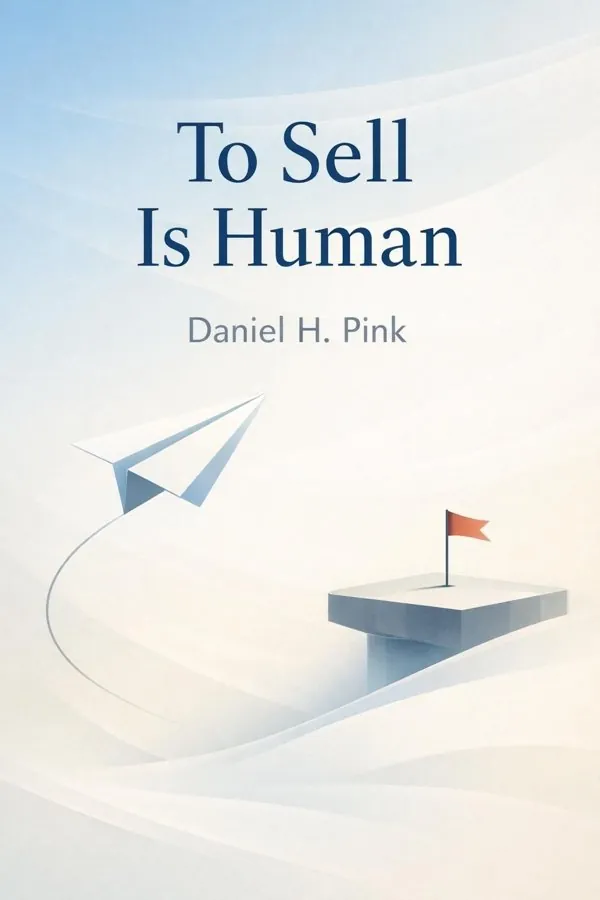
To Sell Is Human: The Surprising Truth About Moving Others: Summary & Key Insights
 10 min9 chaptersAudio available
Key Takeaways from To Sell Is Human: The Surprising Truth About Moving Others
One of Pink’s most important insights is that the information balance in selling has fundamentally changed.
A provocative claim sits at the heart of this book: like it or not, we are all in sales now.
The old sales motto was simple: “Always Be Closing.
If you cannot step into another person’s world, your influence will always be limited.
Any effort to move others comes with a difficult emotional reality: people will say no.
What Is To Sell Is Human: The Surprising Truth About Moving Others About?
To Sell Is Human: The Surprising Truth About Moving Others by Daniel H. Pink is a marketing book spanning 9 pages. In To Sell Is Human, Daniel H. Pink makes a bold but surprisingly intuitive claim: whether or not we work in formal sales, we all spend much of our lives trying to move other people. We persuade clients, influence coworkers, encourage children, pitch ideas, negotiate decisions, and help others act. Pink argues that in this broader sense, selling is no longer a narrow business function. It is a core human skill. Drawing on research from psychology, behavioral science, economics, and communication studies, he shows that the old image of the manipulative salesperson is outdated. In a world where information is widely available and trust is harder to earn, effective selling depends less on pressure and more on empathy, service, adaptability, and clarity. Pink, bestselling author of Drive and A Whole New Mind, combines rigorous research with practical tools to explain how people can persuade more ethically and effectively. The result is a refreshing guide for anyone who wants to influence others without coercion, communicate with purpose, and create value in everyday interactions.
This FizzRead summary covers all 9 key chapters of To Sell Is Human: The Surprising Truth About Moving Others in approximately 10 minutes, distilling the most important ideas, arguments, and takeaways from Daniel H. Pink's work. Also available as an audio summary and Key Quotes Podcast.
To Sell Is Human: The Surprising Truth About Moving Others
In To Sell Is Human, Daniel H. Pink makes a bold but surprisingly intuitive claim: whether or not we work in formal sales, we all spend much of our lives trying to move other people. We persuade clients, influence coworkers, encourage children, pitch ideas, negotiate decisions, and help others act. Pink argues that in this broader sense, selling is no longer a narrow business function. It is a core human skill. Drawing on research from psychology, behavioral science, economics, and communication studies, he shows that the old image of the manipulative salesperson is outdated. In a world where information is widely available and trust is harder to earn, effective selling depends less on pressure and more on empathy, service, adaptability, and clarity. Pink, bestselling author of Drive and A Whole New Mind, combines rigorous research with practical tools to explain how people can persuade more ethically and effectively. The result is a refreshing guide for anyone who wants to influence others without coercion, communicate with purpose, and create value in everyday interactions.
Who Should Read To Sell Is Human: The Surprising Truth About Moving Others?
This book is perfect for anyone interested in marketing and looking to gain actionable insights in a short read. Whether you're a student, professional, or lifelong learner, the key ideas from To Sell Is Human: The Surprising Truth About Moving Others by Daniel H. Pink will help you think differently.
- ✓Readers who enjoy marketing and want practical takeaways
- ✓Professionals looking to apply new ideas to their work and life
- ✓Anyone who wants the core insights of To Sell Is Human: The Surprising Truth About Moving Others in just 10 minutes
Want the full summary?
Get instant access to this book summary and 100K+ more with Fizz Moment.
Get Free SummaryAvailable on App Store • Free to download
Key Chapters
One of Pink’s most important insights is that the information balance in selling has fundamentally changed. For generations, the classic rule of commerce was caveat emptor, or “buyer beware.” Sellers usually knew more than buyers, which allowed weak products, exaggerated promises, and manipulative tactics to flourish. If customers lacked information, they had little choice but to trust, guess, or accept the risk. In that world, persuasion often rewarded the most aggressive voice rather than the most honest one.
But digital technology has shifted the ground beneath selling. Buyers can now compare prices instantly, read reviews, watch demonstrations, and consult peers before making decisions. Information asymmetry has narrowed. In many cases, customers arrive already informed, and sometimes they know nearly as much as the seller. That means old-school persuasion techniques are less effective and more visible when abused.
Pink argues that this new environment creates a different rule: caveat venditor, or “seller beware.” Sellers now operate under scrutiny. Their reputation can be damaged quickly, and empty promises are easier to expose. As a result, success depends on transparency, credibility, and real value. A salesperson who helps a customer interpret options honestly is more powerful than one who tries to overpower objections.
This shift applies beyond business. A manager proposing a new process, a teacher guiding students, or a founder pitching investors all face audiences that can verify, question, and compare. Influence now comes from trustworthiness and usefulness, not information control.
Actionable takeaway: Assume the people you want to persuade are informed and skeptical. Lead with honesty, reduce confusion, and focus on helping them make a better decision.
A provocative claim sits at the heart of this book: like it or not, we are all in sales now. Pink is not saying that everyone carries a quota or works in retail. He means that a large portion of modern work involves convincing, influencing, and persuading other people to exchange their time, attention, effort, or agreement. A lawyer sells a legal strategy. A doctor sells a treatment plan. An entrepreneur sells a vision. A parent sells the idea of homework before screen time.
Pink uses the phrase “non-sales selling” to describe this reality. In many jobs, people spend significant time moving others even when their title has nothing to do with sales. This matters because many people resist the label “sales” while doing sales-related work every day. That resistance can be costly. If you refuse to see persuasion as part of your role, you’re less likely to develop the skills needed to do it well.
Reframing selling in this way also helps remove some of its stigma. Selling is not inherently manipulative. At its best, it is the process of helping people make choices, solve problems, and take action. The goal is not simply to get your way. It is to create movement that benefits others as well as yourself.
This perspective is especially useful in modern organizations where hierarchy is flatter and authority is less automatic. You cannot rely only on your title to gain cooperation. You need to explain, invite, align, and inspire. Whether you are seeking buy-in for a budget, asking a client to commit, or encouraging a team to adopt a change, you are engaged in moving others.
Actionable takeaway: Identify where persuasion already exists in your daily life. Once you recognize that influence is part of your work, you can practice it more consciously and ethically.
The old sales motto was simple: “Always Be Closing.” Pink argues that this slogan belongs to an earlier era. In a world shaped by transparency, autonomy, and abundant information, pushing relentlessly toward a close can damage trust and reduce long-term results. Instead, he proposes a new set of ABCs: Attunement, Buoyancy, and Clarity.
Attunement is the ability to understand another person’s perspective, needs, and emotional state. It is not just empathy in a vague sense. It is the practical skill of tuning yourself to another person so you can communicate in a way that resonates. Without attunement, your message may be accurate but badly timed, badly framed, or tone-deaf.
Buoyancy is the capacity to remain motivated and resilient in the face of rejection, resistance, and uncertainty. Since moving others always involves possibility rather than control, setbacks are inevitable. Buoyancy keeps you from sinking emotionally after a “no,” a delay, or a failed attempt.
Clarity is the ability to make sense of complex situations and help others see what matters. In the past, access to information was valuable. Today, people are drowning in information. The truly useful person is the one who can filter noise, identify the real problem, and illuminate the path forward.
Together, these three capabilities redefine effective selling. They make persuasion less about pressure and more about alignment. A consultant uses attunement to understand a client, buoyancy to handle objections, and clarity to simplify options. A nonprofit leader uses the same sequence to inspire donors or volunteers.
Actionable takeaway: Before your next important conversation, prepare in three steps: understand the other person, expect some resistance, and simplify the decision you want them to make.
If you cannot step into another person’s world, your influence will always be limited. Pink presents attunement as one of the most essential modern selling skills because people are more likely to respond when they feel understood. Perspective taking helps you grasp not just what someone says, but what they fear, value, hope for, and need in order to move forward.
Pink distinguishes this from simple niceness. Attunement is active and strategic. It involves listening closely, noticing social cues, and asking better questions. It may also require adjusting your communication style. A data-driven executive may need evidence and structure, while a creative collaborator may respond more strongly to vision and possibility. The point is not manipulation but alignment.
Interestingly, Pink also notes that power can weaken attunement. When people feel powerful, they often become less accurate at reading others because they assume too much and listen too little. That means anyone in leadership should work especially hard to stay connected to how others see a situation. Humility becomes a practical advantage.
In daily life, attunement can improve almost any exchange. A teacher who notices when students are confused can explain more effectively. A customer service representative who hears frustration beneath a complaint can de-escalate a tense interaction. A startup founder who understands investor concerns can frame a pitch around risk reduction rather than enthusiasm alone.
Attunement also requires slowing down. Rather than rushing to defend your position, you pause to understand what would make the other person say yes. That simple shift changes the quality of persuasion.
Actionable takeaway: In your next persuasive conversation, spend the first part asking questions and summarizing the other person’s viewpoint before presenting your own case.
Any effort to move others comes with a difficult emotional reality: people will say no. They will ignore your message, question your motives, delay decisions, or choose a different path. Pink argues that the difference between effective persuaders and discouraged ones is often buoyancy, the ability to stay afloat amid rejection and uncertainty.
Buoyancy has both mental and emotional components. Before an interaction, people often engage in self-talk. Pink discusses research suggesting that interrogative self-talk, such as asking yourself “Can I do this?” may be more effective than blunt affirmations like “I can do this.” The question prompts preparation and agency rather than empty confidence. It encourages your mind to generate reasons for action.
During an interaction, buoyancy means staying present instead of becoming defensive. If a client objects, a colleague hesitates, or an audience looks unconvinced, you do not collapse or push harder in panic. You stay steady enough to respond thoughtfully. After the interaction, buoyancy helps you interpret setbacks constructively. A rejection becomes feedback, not a verdict on your worth.
This idea is crucial for people whose work includes outreach, pitching, interviewing, fundraising, teaching, or leading change. But it is equally useful in personal life. Asking for help, initiating difficult conversations, or proposing a new idea all require emotional resilience.
Buoyancy is not denial. It does not mean pretending failure feels good. It means building habits that keep one failure from defining the next attempt. Reflection, recovery, and continued effort matter more than perfect emotional control.
Actionable takeaway: Create a rejection routine: prepare with realistic self-questioning, respond calmly in the moment, and review each setback for one lesson you can use next time.
In an age of endless content, the scarcest resource is not information but meaning. Pink argues that the best persuaders are no longer simply providers of facts. They are curators and sense-makers who help others cut through overload. When everyone has access to data, what people need most is someone who can identify what is relevant, what is missing, and what problem actually needs solving.
This is why clarity is such a powerful capability. Many conversations fail not because people disagree, but because they are solving the wrong problem. A customer may think they need a cheaper tool when what they really need is a simpler workflow. A team may debate tactics when the real issue is a misaligned goal. A friend may ask for advice when what they truly need is reassurance or a clearer decision frame.
Pink highlights the importance of problem finding, not just problem solving. Clever people often rush to answers. Useful people ask better questions first. That shift can transform influence. When you reframe a situation accurately, you help others see possibilities they were missing.
Clarity is particularly valuable in leadership and consulting. Employees do not just need more reports; they need help understanding what to prioritize. Clients do not just need more options; they need guidance about which option fits their context. Even in everyday life, clarity can reduce conflict. A couple arguing about schedules may discover the real issue is fairness, not time management.
The person who offers clarity becomes trusted because they reduce cognitive load. They make progress feel possible.
Actionable takeaway: Before offering solutions, ask yourself: What is the real problem here? Then help the other person define the issue in simple, concrete terms.
Most people associate pitching with startup founders or sales professionals, but Pink treats pitching as a universal skill. A pitch is any short communication designed to spark interest and prompt a next step. In a world of limited attention, being able to express an idea clearly, briefly, and memorably is essential.
Pink explores several forms of pitch, showing that one size does not fit all. Sometimes a one-word pitch can anchor a message with unusual force. Sometimes a question pitch is more effective because it invites participation rather than passive listening. A rhyming phrase may increase memorability, while a subject-line pitch can determine whether a message is opened at all. The key principle is not cleverness for its own sake, but matching the pitch to the moment and the audience.
Good pitches respect attention. They do not overload listeners with background, features, or jargon. Instead, they emphasize relevance. Why should this person care right now? What tension does this idea resolve? What next action should follow?
For example, an employee proposing a new software system should not start with every technical detail. A better pitch might focus on one urgent outcome: fewer errors, faster turnaround, or better visibility. A freelancer reaching out to a prospect should craft a concise message tied to the prospect’s goals rather than a generic self-description.
Pitching well also requires practice. Brevity is harder than length because it forces clarity. If you cannot explain your idea simply, you may not understand it well enough yet.
Actionable takeaway: Build a short pitch for your work or idea that answers three questions: what it is, why it matters, and what should happen next.
Many people assume persuasion improves when you control the conversation tightly. Pink suggests the opposite: in modern selling, adaptability often matters more than memorization. He draws on principles of improvisational theater to show that effective influence depends on listening, responsiveness, and co-creation. When the other person is engaged, persuasion becomes something you build together rather than something you deliver at them.
A central principle of improv is “hear offers.” In conversation, an offer is anything the other person gives you: a concern, a question, a tone shift, a hint of interest, or a stated priority. Poor persuaders ignore these offers because they are too attached to their script. Strong persuaders notice and respond to them. They follow curiosity instead of forcing a sequence.
Another useful improv idea is “yes, and.” This does not mean agreeing with everything. It means acknowledging what is present and building from there rather than rejecting the conversation’s reality. If a prospect says, “This seems expensive,” a rigid reply might argue immediately. An improv-informed reply might be, “Yes, budget matters, and let’s look at what this would save over a year.” The exchange stays collaborative.
This approach works especially well in negotiations, interviews, coaching, and leadership. People want to feel heard before they are persuaded. Scripts can provide structure, but they should not replace real attention. The moment you stop listening, you stop attuning.
Improvisation also reduces fear. If your goal is not to perform perfectly but to engage honestly, you become more flexible and more persuasive.
Actionable takeaway: Go into important conversations with a clear objective but a loose script. Listen for cues, acknowledge them, and build your response around what the other person actually gives you.
The deepest argument in To Sell Is Human is that effective persuasion rests on service. Pink challenges the stereotype that selling is about getting people to do what benefits you, whether or not it helps them. In the new world of influence, that mindset is not only unethical but ineffective. When information is open and trust is fragile, people sense self-serving behavior quickly. Sustainable success comes from improving another person’s situation.
Pink suggests a simple test for any persuasive effort: if the person you are moving is not better off after the exchange, something is wrong. This standard changes the moral tone of selling. It turns influence from a contest of wills into an act of problem solving and contribution. A great salesperson is not someone who closes everyone. It is someone who helps the right people make the right choices.
This idea applies well beyond commerce. A manager serves employees by helping them succeed, not by extracting compliance. A health professional serves patients by guiding them toward treatment they can understand and follow. A marketer serves customers by clarifying how a product can genuinely improve their lives, while being honest about limitations.
Service also strengthens trust, and trust multiplies influence over time. Short-term manipulation may produce a win, but it erodes relationships and reputation. Service creates repeat business, referrals, loyalty, and stronger collaboration. It aligns ethics with performance.
Ultimately, Pink argues that moving others is most powerful when it is connected to purpose. If your work makes people healthier, wiser, safer, more capable, or more confident, persuasion becomes a way of advancing human well-being.
Actionable takeaway: Before making a pitch or request, ask: How will this help the other person? If you cannot answer clearly, refine the offer before you try to persuade.
All Chapters in To Sell Is Human: The Surprising Truth About Moving Others
About the Author
Daniel H. Pink is an American bestselling author known for translating social science research into practical insights about work, motivation, timing, and human behavior. He has written several widely read books, including Drive, A Whole New Mind, When, and To Sell Is Human. Pink’s writing stands out for its blend of psychology, business thinking, and accessible storytelling, making complex ideas useful to professionals and general readers alike. Before becoming a full-time author, he worked in politics and served as chief speechwriter to U.S. Vice President Al Gore. Over time, he built a reputation as one of the most influential contemporary writers on the changing nature of work and performance. His books are frequently recommended by leaders, entrepreneurs, educators, and knowledge workers seeking research-based guidance for modern professional life.
Get This Summary in Your Preferred Format
Read or listen to the To Sell Is Human: The Surprising Truth About Moving Others summary by Daniel H. Pink anytime, anywhere. FizzRead offers multiple formats so you can learn on your terms — all free.
Available formats: App · Audio · PDF · EPUB — All included free with FizzRead
Download To Sell Is Human: The Surprising Truth About Moving Others PDF and EPUB Summary
Key Quotes from To Sell Is Human: The Surprising Truth About Moving Others
“One of Pink’s most important insights is that the information balance in selling has fundamentally changed.”
“A provocative claim sits at the heart of this book: like it or not, we are all in sales now.”
“The old sales motto was simple: “Always Be Closing.”
“If you cannot step into another person’s world, your influence will always be limited.”
“Any effort to move others comes with a difficult emotional reality: people will say no.”
Frequently Asked Questions about To Sell Is Human: The Surprising Truth About Moving Others
To Sell Is Human: The Surprising Truth About Moving Others by Daniel H. Pink is a marketing book that explores key ideas across 9 chapters. In To Sell Is Human, Daniel H. Pink makes a bold but surprisingly intuitive claim: whether or not we work in formal sales, we all spend much of our lives trying to move other people. We persuade clients, influence coworkers, encourage children, pitch ideas, negotiate decisions, and help others act. Pink argues that in this broader sense, selling is no longer a narrow business function. It is a core human skill. Drawing on research from psychology, behavioral science, economics, and communication studies, he shows that the old image of the manipulative salesperson is outdated. In a world where information is widely available and trust is harder to earn, effective selling depends less on pressure and more on empathy, service, adaptability, and clarity. Pink, bestselling author of Drive and A Whole New Mind, combines rigorous research with practical tools to explain how people can persuade more ethically and effectively. The result is a refreshing guide for anyone who wants to influence others without coercion, communicate with purpose, and create value in everyday interactions.
More by Daniel H. Pink

Drive: The Surprising Truth About What Motivates Us
Daniel H. Pink
10 min
The Power of Regret: How Looking Backward Moves Us Forward
Daniel H. Pink
10 min
A Whole New Mind: Why Right-Brainers Will Rule the Future
Daniel H. Pink
10 min
When: The Scientific Secrets of Perfect Timing
Daniel H. Pink
10 minYou Might Also Like

Captivology: The Science of Capturing People's Attention
Ben Parr
10 min
Marketing 5.0: Technology for Humanity
Philip Kotler, Hermawan Kartajaya, Iwan Setiawan
10 min
Marketing Strategy
Paul Fifield
10 min
UnMarketing: Stop Marketing. Start Engaging.
Scott Stratten
10 min
$100M Leads: How to Get Strangers to Want to Buy Your Stuff
Alex Hormozi
10 min
80/20 Sales and Marketing: The Definitive Guide to Working Less and Making More
Perry Marshall
10 minBrowse by Category
Ready to read To Sell Is Human: The Surprising Truth About Moving Others?
Get the full summary and 100K+ more books with Fizz Moment.