
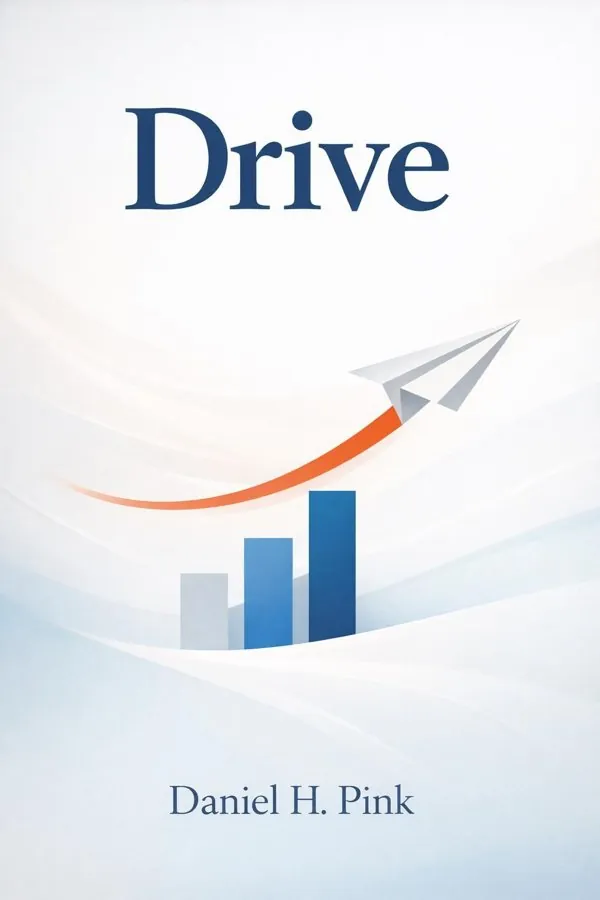
Drive: The Surprising Truth About What Motivates Us: Summary & Key Insights
 10 min3 chaptersAudio available
What Is Drive: The Surprising Truth About What Motivates Us About?
Drive: The Surprising Truth About What Motivates Us by Daniel H. Pink is a psychology book spanning 3 pages. In this influential work, Daniel H. Pink explores the science of motivation, arguing that traditional rewards like money are not the most effective drivers of human behavior. Drawing on decades of research in psychology and economics, Pink identifies autonomy, mastery, and purpose as the key elements that truly motivate people to perform at their best.
This FizzRead summary covers all 3 key chapters of Drive: The Surprising Truth About What Motivates Us in approximately 10 minutes, distilling the most important ideas, arguments, and takeaways from Daniel H. Pink's work. Also available as an audio summary and Key Quotes Podcast.
Drive: The Surprising Truth About What Motivates Us
In this influential work, Daniel H. Pink explores the science of motivation, arguing that traditional rewards like money are not the most effective drivers of human behavior. Drawing on decades of research in psychology and economics, Pink identifies autonomy, mastery, and purpose as the key elements that truly motivate people to perform at their best.
Who Should Read Drive: The Surprising Truth About What Motivates Us?
This book is perfect for anyone interested in psychology and looking to gain actionable insights in a short read. Whether you're a student, professional, or lifelong learner, the key ideas from Drive: The Surprising Truth About What Motivates Us by Daniel H. Pink will help you think differently.
- ✓Readers who enjoy psychology and want practical takeaways
- ✓Professionals looking to apply new ideas to their work and life
- ✓Anyone who wants the core insights of Drive: The Surprising Truth About What Motivates Us in just 10 minutes
Want the full summary?
Get instant access to this book summary and 100K+ more with Fizz Moment.
Get Free SummaryAvailable on App Store • Free to download
Key Chapters
The first part of *Drive* examines how our traditional models of motivation took shape and why they no longer serve us well. In the Industrial Age, when most jobs involved repetitive, mechanical tasks, the carrot-and-stick approach seemed efficient. Pay people more to make more widgets; threaten them with punishment to maintain discipline. This logic built factories, fueled early capitalism, and persisted because it worked—up to a point.
In Chapter 1, I trace the rise and fall of this Motivation 2.0 system. Originally, humans operated with what I call Motivation 1.0, driven by basic biological needs—food, safety, reproduction. As societies grew more complex, Motivation 2.0 evolved, focusing on external incentives. It was elegantly simple and predictable, but it wasn’t built for the challenges of creative and cognitive work. The cracks began to show as organizations demanded innovation and adaptability. Instead of inspiration, people felt manipulation. Instead of engagement, burnout spread.
Chapter 2 explores seven reasons why carrots and sticks often fail. Studies by researchers such as Edward Deci and Richard Ryan reveal that extrinsic motivators can crowd out intrinsic interest. The moment we start doing something for a reward, our natural curiosity diminishes. Rewards can narrow our thinking and make us risk-averse. They can foster unethical shortcuts—people doing what pays rather than what’s right. They can even reduce long-term performance, as motivation collapses once the reward disappears.
In Chapter 3, I distinguish between two behavioral types: Type X, driven by extrinsic desires, and Type I, driven by intrinsic interests. Type X individuals focus on external validation—status, money, praise—while Type I individuals find satisfaction in the activity itself. The difference is profound. Type I behavior leads to higher engagement, better well-being, and enduring achievement. Thankfully, Type I behavior isn’t an inherent trait; it can be nurtured through the right conditions.
By the end of Part I, it becomes clear that Motivation 2.0 is an outdated operating system. It still runs many of our workplaces, but it’s riddled with bugs when applied to creative, non-routine tasks. To thrive today, we need an upgrade—Motivation 3.0—anchored in our innate human drive to learn, create, and connect.
Autonomy, mastery, and purpose form the three pillars of intrinsic motivation. They work together to transform how we think about work, education, and even personal fulfillment.
In Chapter 4, I discuss autonomy—our desire to be self-directed. We perform better and feel more fulfilled when we have control over how we work. Traditional management assumes that people must be coerced or monitored, but autonomy assumes the opposite: that people want to do good work when given the freedom to do so. Autonomy can be expressed across four dimensions: task (what we do), time (when we do it), technique (how we do it), and team (with whom we do it). When companies like Atlassian and Google instituted policy experiments such as ‘20 percent time,’ allowing employees to pursue projects of their own choosing, creativity flourished, yielding innovations like Gmail and Google News. Autonomy not only improves performance; it enhances well-being and fosters trust.
Mastery, the focus of Chapter 5, is the deep desire to get better at something that matters. True mastery requires engagement, effort, and a mindset that embraces growth. Drawing on research from Mihaly Csikszentmihalyi’s concept of flow, I explain how we enter a state of deep focus when challenges match our abilities. Mastery is both exhilarating and frustrating, because it is a journey without end—there’s always more to learn. The key to mastery lies in what psychologist Carol Dweck calls a ‘growth mindset,’ the belief that abilities can be developed through effort. In contrast, a fixed mindset leads to stagnation, as people fear failure. Workplaces that encourage mastery—through deliberate practice, meaningful feedback, and opportunities to stretch—ignite genuine engagement.
Chapter 6 turns to purpose, our yearning to be part of something larger than ourselves. People seek meaning as much as money. Organizations that define their mission in human terms—helping others, improving lives, advancing knowledge—release a powerful source of motivation. Purpose transforms routine work into contribution, paycheck into pride. In fields as diverse as healthcare, technology, and education, teams oriented around a clear, higher goal consistently outperform those driven solely by profit. The science of motivation shows that we are wired not just to survive, but to serve.
+ 1 more chapters — available in the FizzRead app
All Chapters in Drive: The Surprising Truth About What Motivates Us
About the Author
Daniel H. Pink is an American author and speaker known for his books on business, work, and behavior. He has written several bestsellers, including 'A Whole New Mind' and 'When', and his work has been translated into dozens of languages. Pink’s research focuses on the intersection of psychology, economics, and management.
Get This Summary in Your Preferred Format
Read or listen to the Drive: The Surprising Truth About What Motivates Us summary by Daniel H. Pink anytime, anywhere. FizzRead offers multiple formats so you can learn on your terms — all free.
Available formats: App · Audio · PDF · EPUB — All included free with FizzRead
Download Drive: The Surprising Truth About What Motivates Us PDF and EPUB Summary
Key Quotes from Drive: The Surprising Truth About What Motivates Us
“The first part of *Drive* examines how our traditional models of motivation took shape and why they no longer serve us well.”
“Autonomy, mastery, and purpose form the three pillars of intrinsic motivation.”
Frequently Asked Questions about Drive: The Surprising Truth About What Motivates Us
Drive: The Surprising Truth About What Motivates Us by Daniel H. Pink is a psychology book that explores key ideas across 3 chapters. In this influential work, Daniel H. Pink explores the science of motivation, arguing that traditional rewards like money are not the most effective drivers of human behavior. Drawing on decades of research in psychology and economics, Pink identifies autonomy, mastery, and purpose as the key elements that truly motivate people to perform at their best.
Compare Drive: The Surprising Truth About What Motivates Us
More by Daniel H. Pink

The Power of Regret: How Looking Backward Moves Us Forward
Daniel H. Pink
10 min
A Whole New Mind: Why Right-Brainers Will Rule the Future
Daniel H. Pink
10 min
When: The Scientific Secrets of Perfect Timing
Daniel H. Pink
10 min
To Sell Is Human: The Surprising Truth About Moving Others
Daniel H. Pink
10 minYou Might Also Like
The Body Keeps the Score
Bessel van der Kolk
10 min
Surrounded by Idiots
Thomas Erikson
10 min
Emotional Intelligence
Daniel Goleman
10 min
Attached
Amir Levine
10 min
Why Does He Do That
Lundy Bancroft
10 min
Women Who Run with the Wolves
Clarissa Pinkola Estés
10 minBrowse by Category
Ready to read Drive: The Surprising Truth About What Motivates Us?
Get the full summary and 100K+ more books with Fizz Moment.