
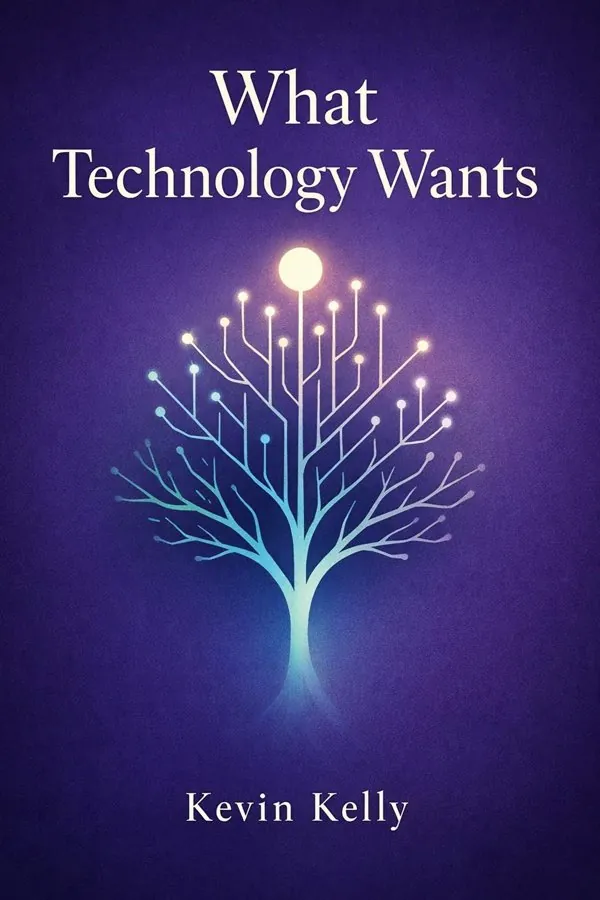
What Technology Wants: Summary & Key Insights
by Kevin Kelly
 10 min9 chaptersAudio available
Key Takeaways from What Technology Wants
A hammer may look simple, but it is never just a hammer.
The most powerful way to understand technology may be to stop thinking of it as static and start thinking of it as alive.
Some inventions feel less like choices than arrivals whose time has come.
The deepest purpose of technology, in Kelly’s view, is not convenience alone.
Progress becomes less bewildering when you learn to see its currents.
What Is What Technology Wants About?
What Technology Wants by Kevin Kelly is a future_trends book spanning 5 pages. What if technology is not just a collection of tools we invent, but a larger living system with its own direction, pressures, and possibilities? In What Technology Wants, Kevin Kelly argues exactly that. He introduces the idea of the “Technium,” the vast, interconnected web of inventions, institutions, processes, and knowledge that behaves less like a machine and more like an evolving ecosystem. Rather than treating technology as neutral hardware or a force entirely under human command, Kelly asks us to see it as something that co-evolves with civilization and expands what humans can become. This book matters because it reframes one of the defining questions of modern life: are we shaping technology, or is technology also shaping us? Kelly does not offer a simplistic celebration of innovation. Instead, he explores the tensions, trade-offs, inevitabilities, and moral responsibilities that come with technological progress. As a co-founder of Wired and one of the most influential thinkers on digital culture, Kelly brings decades of observation to this ambitious argument. The result is a provocative, future-focused book that helps readers understand not only where technology comes from, but where it may be trying to go.
This FizzRead summary covers all 9 key chapters of What Technology Wants in approximately 10 minutes, distilling the most important ideas, arguments, and takeaways from Kevin Kelly's work. Also available as an audio summary and Key Quotes Podcast.
What Technology Wants
What if technology is not just a collection of tools we invent, but a larger living system with its own direction, pressures, and possibilities? In What Technology Wants, Kevin Kelly argues exactly that. He introduces the idea of the “Technium,” the vast, interconnected web of inventions, institutions, processes, and knowledge that behaves less like a machine and more like an evolving ecosystem. Rather than treating technology as neutral hardware or a force entirely under human command, Kelly asks us to see it as something that co-evolves with civilization and expands what humans can become.
This book matters because it reframes one of the defining questions of modern life: are we shaping technology, or is technology also shaping us? Kelly does not offer a simplistic celebration of innovation. Instead, he explores the tensions, trade-offs, inevitabilities, and moral responsibilities that come with technological progress. As a co-founder of Wired and one of the most influential thinkers on digital culture, Kelly brings decades of observation to this ambitious argument. The result is a provocative, future-focused book that helps readers understand not only where technology comes from, but where it may be trying to go.
Who Should Read What Technology Wants?
This book is perfect for anyone interested in future_trends and looking to gain actionable insights in a short read. Whether you're a student, professional, or lifelong learner, the key ideas from What Technology Wants by Kevin Kelly will help you think differently.
- ✓Readers who enjoy future_trends and want practical takeaways
- ✓Professionals looking to apply new ideas to their work and life
- ✓Anyone who wants the core insights of What Technology Wants in just 10 minutes
Want the full summary?
Get instant access to this book summary and 100K+ more with Fizz Moment.
Get Free SummaryAvailable on App Store • Free to download
Key Chapters
A hammer may look simple, but it is never just a hammer. Behind it stands metallurgy, mining, trade, design knowledge, manufacturing systems, and the cultural need that gave it purpose. Kevin Kelly uses this insight to introduce the Technium: the totality of technology, including tools, techniques, infrastructure, scientific knowledge, legal systems, and organizational methods. The Technium is not merely a pile of inventions. It is an interdependent system in which each innovation enables others and increases the possibilities for what can come next.
To grasp this idea, Kelly asks us to trace technology back before the digital age. Early humans shaped stone tools, controlled fire, developed language, and created agriculture. Each step expanded the range of future options. Writing enabled bureaucracy, memory, and law. Roads enabled trade and empire. Printing accelerated literacy and science. Electricity transformed communication and labor. The internet did not appear from nowhere; it emerged from centuries of layered systems.
This perspective changes how we think about innovation. A smartphone is not a standalone object but the visible tip of a vast network of prior inventions and supporting structures. It depends on satellites, software standards, mineral supply chains, chip fabrication, interface design, and global education systems. The Technium grows through these cumulative relationships.
Practically, this means creators, entrepreneurs, and policymakers should focus less on isolated products and more on ecosystems. The most enduring innovations fit into larger webs and make new combinations possible. If you want to understand where change is heading, study the networks around inventions, not just the inventions themselves.
Actionable takeaway: When evaluating any technology, ask what larger system it belongs to, what it depends on, and what new possibilities it enables for the future.
The most powerful way to understand technology may be to stop thinking of it as static and start thinking of it as alive. Kelly does not mean that machines are biologically alive, but that technological systems evolve through processes strikingly similar to nature: variation, selection, adaptation, specialization, and increasing complexity. In biology, genes mutate and environments select. In technology, inventors experiment, markets respond, users adapt products, and successful designs spread.
The parallels are everywhere. Different versions of the same invention compete until one form becomes dominant, much like species occupying ecological niches. Consider how transportation evolved: horses, bicycles, trains, cars, and airplanes each solved movement in different contexts. Even within cars, designs competed for efficiency, affordability, safety, and style. The same happened in media formats, from vinyl to cassette to CD to streaming. Not every technology survives, but the ecosystem as a whole becomes more diverse and capable.
Kelly emphasizes that technological evolution also proceeds through recombination. New inventions often arise by combining older ones in novel ways. A smartphone merges telephony, computing, photography, GPS, touch interfaces, and internet connectivity. This mirrors biology, where complex organisms build on earlier structures rather than beginning from scratch.
For readers, the practical value of this idea is strategic. If technology evolves, then prediction should focus less on single breakthrough moments and more on patterns: where variation is increasing, where recombination is possible, and where user needs are creating selective pressure. Businesses that understand these dynamics are better positioned to experiment intelligently instead of betting everything on one rigid plan.
Actionable takeaway: Treat innovation like evolution by encouraging many small experiments, observing what gains traction, and recombining successful elements into better solutions.
Some inventions feel less like choices than arrivals whose time has come. Kelly argues that certain technologies are “inevitable” not because fate dictates every detail, but because once scientific knowledge, social need, and enabling systems converge, multiple people in different places often invent similar things at nearly the same time. This suggests that the Technium has directional tendencies. It pulls toward greater complexity, efficiency, connectivity, and opportunity.
Examples from history support this view. Calculus emerged independently through Newton and Leibniz. The telephone, radio, and airplane were pursued by several inventors simultaneously. Once electricity, materials science, and communication theory matured, these inventions became highly probable. The internet, too, can be seen as the outcome of many converging trends rather than the genius of one isolated moment.
This does not mean human agency disappears. Kelly is careful to argue that while broad technological directions may be difficult to stop, the forms they take remain open to influence. Nuclear energy can be used for destruction or power generation. Artificial intelligence can amplify surveillance or improve medicine. Social media can fragment attention or deepen community. We do not fully control whether a technological capability emerges, but we do shape the values and institutions around its adoption.
This idea has practical significance for leaders and citizens. Resisting inevitable technological trends outright is often less effective than guiding them responsibly. When automation advances, for instance, the wiser response is not denial but redesigning education, work, and safety nets to help people adapt.
Actionable takeaway: Instead of asking whether a major technological shift can be stopped, ask how it can be shaped so its benefits expand and its harms are constrained.
The deepest purpose of technology, in Kelly’s view, is not convenience alone. It is the expansion of possibilities. Every meaningful tool gives people more ways to act, think, create, connect, or become. A telescope extends sight. A book extends memory. A computer extends calculation. A network extends collaboration. Technology matters because it increases what humans can choose.
Kelly frames this as a moral argument for the Technium. If a new tool creates more opportunities for individuals to express their talents, solve problems, and pursue meaningful lives, then it can be considered a positive development. This does not imply every technology is good in every form. It means the broader arc of technological progress should be judged by whether it enlarges human potential.
Consider practical examples. Assistive technologies give people with disabilities greater independence. Online learning platforms democratize access to education. Mobile banking gives the unbanked access to financial systems. Creative software enables individuals to compose music, edit films, or publish writing without needing institutions that once controlled these activities. In each case, the value of the technology lies not just in efficiency but in opening doors that were previously shut.
This perspective also reframes debates about screen time, automation, and digital life. The right question is not whether technology is present, but whether it is helping people develop richer capabilities and more meaningful choices. A tool that narrows attention, dependency, or agency is less aligned with the best potential of the Technium.
Actionable takeaway: Judge technologies by one core test: does this tool increase real options, agency, and creative possibility for human beings?
Progress becomes less bewildering when you learn to see its currents. Kelly argues that the Technium has patterns and biases, and wise individuals and societies benefit by aligning with them rather than fighting them blindly. These biases include increasing complexity, specialization, ubiquity, interdependence, personalization, and the movement from fixed products toward fluid services and networks.
To align with the Technium does not mean surrendering critical thought. It means recognizing which developments are gathering momentum and positioning yourself to work with them constructively. For example, businesses that embraced digitization early were able to redesign entire industries, while those that treated the internet as a passing fad often collapsed. The same pattern now appears in artificial intelligence, renewable energy, remote collaboration, and biotechnology.
Alignment also requires humility. Since the Technium is larger than any one company or government, attempts to control it through rigid planning usually fail. More adaptive approaches work better: open standards, iterative design, regulatory frameworks that can evolve, and educational systems that teach learning agility rather than narrow technical routines.
For individuals, aligning with the flow might mean continually updating skills, joining networks of practice, using tools that compound learning, or paying attention to technologies that reduce friction and increase leverage in your field. For institutions, it means designing policies that encourage experimentation while protecting human dignity.
Kelly’s larger point is that the future favors those who can sense where possibility is widening. The goal is not to worship novelty but to move in the direction where new tools can create the most value.
Actionable takeaway: Regularly identify one major technological trend affecting your work or life and make one concrete adjustment that helps you benefit from it instead of being surprised by it.
No invention arrives bearing gifts alone. Kelly repeatedly stresses that every technology brings both benefits and new problems. The car gave mobility but also congestion, pollution, and accidents. Social media created connection but also distraction, manipulation, and status anxiety. Antibiotics saved millions of lives but contributed to resistant bacteria. This dual nature is not an exception; it is the rule.
Seeing trade-offs clearly is essential because technological optimism without moral realism becomes naive, while technological fear without perspective becomes paralyzing. Kelly’s approach is more balanced. He argues that new tools generate new kinds of harm, but they also often generate the tools needed to address those harms. Cars created traffic engineering. Industrial pollution led to environmental science and cleaner energy systems. Cyber threats produced encryption and cybersecurity industries.
This does not absolve society from responsibility. It means we should expect second-order effects and build systems that can respond. A practical example is AI in the workplace. It can raise productivity, automate repetitive tasks, and reveal patterns humans miss. But it can also displace workers, amplify bias, and centralize power. The right response is not blanket rejection or blind adoption. It is active design: transparency standards, retraining programs, human oversight, and clear accountability.
For readers, the key lesson is to abandon binary thinking. Technologies are rarely simply good or bad. They reshape the landscape of choices and consequences. Mature judgment involves asking what problems a tool solves, what new problems it creates, who benefits, who bears the cost, and how governance can improve the balance.
Actionable takeaway: Before adopting any major tool, list three likely benefits, three possible downsides, and one safeguard that can reduce the most serious risk.
At first glance, technology can seem homogenizing. Global platforms, mass-produced devices, and standardized systems often make the world look more uniform. Yet Kelly argues that the long-term trend of the Technium is actually toward greater diversity, specialization, and niche creation. As technological systems mature, they enable more differentiated roles, products, identities, and forms of expression.
Biology offers a useful analogy. Evolution does not only produce stronger organisms; it also produces an extraordinary variety of species adapted to different environments. Technology behaves similarly. As tools become more powerful and accessible, more people can create offerings tailored to specific needs. The internet did not just produce a few giant websites. It also enabled micro-communities, specialized software, niche businesses, independent creators, and personalized experiences.
Look at modern work. Digital tools have made it possible for people to build careers in fields that barely existed a generation ago: app design, podcast editing, e-commerce logistics, drone photography, virtual tutoring, creator marketing, and AI prompt architecture. In manufacturing, flexible production allows customized products at lower cost. In media, algorithmic distribution lets small creators find highly specific audiences across the world.
This matters because diversity in the Technium can increase resilience and opportunity. A richer ecosystem creates more pathways for participation and innovation. It also means education and career planning should no longer assume one-size-fits-all trajectories. The future belongs increasingly to those who can find or create a distinctive niche.
Actionable takeaway: Identify one narrow problem, audience, or skill area where technology allows you to specialize, then deepen your capability there instead of competing only in broad, crowded markets.
We shape our tools, and then our tools reshape us. This is one of Kelly’s most important insights. The relationship between humans and technology is not one-directional. We design systems based on our needs, values, and imagination, but once those systems are in use, they alter behavior, expectations, institutions, and even identity. The result is co-evolution: humanity and the Technium changing each other continuously.
Writing changed how humans remember and reason. Clocks changed our experience of time and labor. Search engines changed how we access knowledge. Smartphones changed habits of attention, navigation, social interaction, and availability. None of these effects are purely external. They become woven into daily life and human culture, influencing how children learn, how organizations coordinate, and how societies define normal behavior.
Kelly’s framework invites us to take this mutual shaping seriously. It is not enough to ask what a technology does; we must ask what kind of people it encourages us to become. Does it foster patience or impulsiveness? Independence or dependency? Curiosity or passivity? Shared understanding or tribal fragmentation? These are design and governance questions, not just personal preferences.
In practical terms, this means developers should build with human outcomes in mind, not just technical performance. Educators should teach digital habits as part of character formation. Families should create intentional norms around devices. Organizations should examine how their tools shape collaboration and decision-making.
If humans and technology co-evolve, then responsible use requires conscious participation. We are not just consumers of tools. We are becoming something through them.
Actionable takeaway: Choose one technology you use daily and reflect on how it is shaping your attention, habits, and relationships; then make one deliberate change to use it more intentionally.
The fantasy of total control over technology is seductive, but Kelly suggests a better model: stewardship. Because the Technium is vast, distributed, and evolving, no single actor can fully command it. Governments regulate parts of it, companies build pieces of it, and users adapt it in unexpected ways. The challenge, then, is not domination but guidance: cultivating the conditions under which technology serves human flourishing.
Stewardship combines optimism with responsibility. It recognizes that technological progress can generate abundance, health, creativity, and problem-solving capacity, yet also demands ethical reflection and institutional care. A steward does not panic at every novelty, nor worship every disruption. A steward asks how systems can be designed, governed, and corrected over time.
Examples are everywhere. Open-source communities steward software ecosystems through shared standards and collaborative maintenance. Public health institutions steward biotechnology through testing, ethics review, and regulation. Urban planners steward transportation technologies by balancing mobility with safety and environmental goals. Parents and teachers steward children’s digital environments through norms and boundaries rather than unrealistic bans.
This mindset is especially valuable in fast-moving fields like artificial intelligence, gene editing, and data systems. Since these technologies will likely continue developing, the central question becomes: what values, incentives, and accountability structures do we build around them? Good stewardship requires broad participation, not just technical expertise. Citizens, educators, artists, business leaders, and policymakers all help shape the moral ecology of the Technium.
Kelly ultimately offers a hopeful challenge. We may not be able to stop the river of invention, but we can build better channels for where it flows.
Actionable takeaway: Adopt a stewardship mindset by asking of every major innovation not “How do we control this completely?” but “How do we guide this wisely over time?”
All Chapters in What Technology Wants
About the Author
Kevin Kelly is an American author, futurist, photographer, and one of the most influential voices in technology culture. He is best known as a co-founder of Wired magazine, where he served as Executive Editor and helped shape public understanding of the digital revolution. Across his books and essays, Kelly explores how technology, networks, and human creativity interact over time. His work often blends systems thinking, cultural observation, and long-range forecasting, making complex technological shifts easier to understand. In addition to What Technology Wants, he has written on topics such as the future of the internet, artificial intelligence, and social organization. Kelly is widely respected for his thoughtful optimism, intellectual curiosity, and ability to connect technological change with deeper questions about human possibility and civilization.
Get This Summary in Your Preferred Format
Read or listen to the What Technology Wants summary by Kevin Kelly anytime, anywhere. FizzRead offers multiple formats so you can learn on your terms — all free.
Available formats: App · Audio · PDF · EPUB — All included free with FizzRead
Download What Technology Wants PDF and EPUB Summary
Key Quotes from What Technology Wants
“A hammer may look simple, but it is never just a hammer.”
“The most powerful way to understand technology may be to stop thinking of it as static and start thinking of it as alive.”
“Some inventions feel less like choices than arrivals whose time has come.”
“The deepest purpose of technology, in Kelly’s view, is not convenience alone.”
“Progress becomes less bewildering when you learn to see its currents.”
Frequently Asked Questions about What Technology Wants
What Technology Wants by Kevin Kelly is a future_trends book that explores key ideas across 9 chapters. What if technology is not just a collection of tools we invent, but a larger living system with its own direction, pressures, and possibilities? In What Technology Wants, Kevin Kelly argues exactly that. He introduces the idea of the “Technium,” the vast, interconnected web of inventions, institutions, processes, and knowledge that behaves less like a machine and more like an evolving ecosystem. Rather than treating technology as neutral hardware or a force entirely under human command, Kelly asks us to see it as something that co-evolves with civilization and expands what humans can become. This book matters because it reframes one of the defining questions of modern life: are we shaping technology, or is technology also shaping us? Kelly does not offer a simplistic celebration of innovation. Instead, he explores the tensions, trade-offs, inevitabilities, and moral responsibilities that come with technological progress. As a co-founder of Wired and one of the most influential thinkers on digital culture, Kelly brings decades of observation to this ambitious argument. The result is a provocative, future-focused book that helps readers understand not only where technology comes from, but where it may be trying to go.
More by Kevin Kelly

Excellent Advice for Living: Wisdom I Wish I'd Known Earlier
Kevin Kelly
10 min
The Inevitable: Understanding the 12 Technological Forces That Will Shape Our Future
Kevin Kelly
10 min
Out of Control: The New Biology of Machines, Social Systems, and the Economic World
Kevin Kelly
10 minYou Might Also Like
Futureproof: 9 Rules for Humans in the Age of Automation
Kevin Roose
10 min
The Third Wave
Alvin Toffler
10 min
2030: How Today's Biggest Trends Will Collide and Reshape the Future of Everything
Mauro F. Guillén
10 min
A Very Human Future: Enriching Humanity in a Digitized World
Rohit Talwar, Steve Wells, Alexandra Whittington
10 min
AI 2041: Ten Visions for Our Future
Kai-Fu Lee, Chen Qiufan
10 min
Abundance: The Future Is Better Than You Think
Peter H. Diamandis, Steven Kotler
10 minBrowse by Category
Ready to read What Technology Wants?
Get the full summary and 100K+ more books with Fizz Moment.