
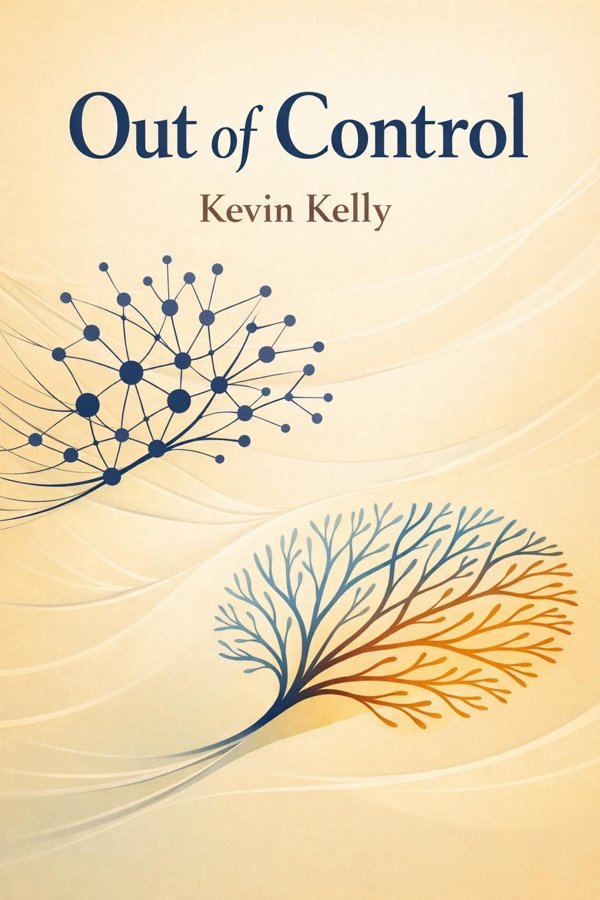
Out of Control: The New Biology of Machines, Social Systems, and the Economic World: Summary & Key Insights
by Kevin Kelly
 10 min10 chaptersAudio available
Key Takeaways from Out of Control: The New Biology of Machines, Social Systems, and the Economic World
A machine that can surprise you is no longer just a tool; it is becoming a participant in a larger system.
Some of the most impressive forms of order in the world exist precisely because no one is centrally directing them.
The smartest system in the room is often the one that has no single brain.
Trying to dominate a complex system often makes it less stable, not more.
The most powerful systems are rarely engineered into perfection all at once; they evolve through variation, selection, and accumulation.
What Is Out of Control: The New Biology of Machines, Social Systems, and the Economic World About?
Out of Control: The New Biology of Machines, Social Systems, and the Economic World by Kevin Kelly is a emerging_tech book spanning 10 pages. What if the most important technologies of the future are not the ones we command, but the ones that learn, adapt, and evolve on their own? In Out of Control, Kevin Kelly argues that the world is moving away from rigid, centrally managed systems and toward living networks of decentralized intelligence. Drawing from biology, cybernetics, economics, computing, and social organization, he shows how ants, immune systems, markets, neural networks, and digital platforms all reveal the same underlying pattern: complex order can emerge without a single mastermind in charge. This idea matters more now than ever. From AI systems and online communities to supply chains and global finance, modern life increasingly depends on distributed systems that cannot be fully controlled in the old industrial sense. Kelly’s book helps readers understand why flexibility, adaptation, redundancy, and feedback are becoming more valuable than top-down efficiency alone. As a founding executive editor of Wired and one of the most influential technology thinkers of his generation, Kelly brings rare authority to this sweeping argument. Out of Control is not just a technology book; it is a framework for understanding the future of machines, institutions, and human collaboration.
This FizzRead summary covers all 10 key chapters of Out of Control: The New Biology of Machines, Social Systems, and the Economic World in approximately 10 minutes, distilling the most important ideas, arguments, and takeaways from Kevin Kelly's work. Also available as an audio summary and Key Quotes Podcast.
Out of Control: The New Biology of Machines, Social Systems, and the Economic World
What if the most important technologies of the future are not the ones we command, but the ones that learn, adapt, and evolve on their own? In Out of Control, Kevin Kelly argues that the world is moving away from rigid, centrally managed systems and toward living networks of decentralized intelligence. Drawing from biology, cybernetics, economics, computing, and social organization, he shows how ants, immune systems, markets, neural networks, and digital platforms all reveal the same underlying pattern: complex order can emerge without a single mastermind in charge.
This idea matters more now than ever. From AI systems and online communities to supply chains and global finance, modern life increasingly depends on distributed systems that cannot be fully controlled in the old industrial sense. Kelly’s book helps readers understand why flexibility, adaptation, redundancy, and feedback are becoming more valuable than top-down efficiency alone.
As a founding executive editor of Wired and one of the most influential technology thinkers of his generation, Kelly brings rare authority to this sweeping argument. Out of Control is not just a technology book; it is a framework for understanding the future of machines, institutions, and human collaboration.
Who Should Read Out of Control: The New Biology of Machines, Social Systems, and the Economic World?
This book is perfect for anyone interested in emerging_tech and looking to gain actionable insights in a short read. Whether you're a student, professional, or lifelong learner, the key ideas from Out of Control: The New Biology of Machines, Social Systems, and the Economic World by Kevin Kelly will help you think differently.
- ✓Readers who enjoy emerging_tech and want practical takeaways
- ✓Professionals looking to apply new ideas to their work and life
- ✓Anyone who wants the core insights of Out of Control: The New Biology of Machines, Social Systems, and the Economic World in just 10 minutes
Want the full summary?
Get instant access to this book summary and 100K+ more with Fizz Moment.
Get Free SummaryAvailable on App Store • Free to download
Key Chapters
A machine that can surprise you is no longer just a tool; it is becoming a participant in a larger system. Kelly begins by challenging the industrial-era image of machines as fixed, obedient, predictable devices. In the old model, machines were designed to perform the same action repeatedly under tightly controlled conditions. But as computation, sensors, networking, and software grow more powerful, machines are beginning to resemble living things: adaptive, responsive, and capable of behavior that arises from interaction rather than direct instruction.
This does not mean machines are literally alive. It means the design logic behind them increasingly mirrors biological systems. A thermostat already uses feedback. A self-driving car combines perception, decision-making, and real-time adjustment. A data center routes traffic dynamically. A robot swarm can coordinate without a central commander. In each case, behavior emerges through sensing, feedback, and local decision-making rather than from one rigid script.
Kelly’s insight is that as systems become more complex, the biological model often outperforms the mechanical one. Living systems survive because they are flexible, redundant, and capable of learning. Machines designed this way may be less perfectly controllable, but they are often more resilient in changing environments.
We can see this in modern software development, where platforms are updated continuously, algorithms refine themselves from user behavior, and networked products improve through interaction. The more connected and dynamic the environment, the less useful static design becomes.
Actionable takeaway: when evaluating a technology or building a system, ask not only how efficiently it performs a fixed task, but also how well it senses change, adapts, and recovers from disruption.
Some of the most impressive forms of order in the world exist precisely because no one is centrally directing them. Kelly highlights self-organization as one of nature’s deepest principles. Flocks of birds turn in perfect synchrony, ant colonies solve foraging problems, and the human brain produces thought from billions of simple neuron interactions. In each case, large-scale order arises from local rules followed by many independent agents.
This idea overturns the assumption that complexity requires centralized planning. Self-organized systems work because agents respond to nearby information, feedback loops amplify useful patterns, and unsuccessful behaviors fade away. The result is not randomness but emergent structure. The internet itself is a powerful technological example: no single entity controls every route, server, and node, yet coherent communication persists through distributed protocols.
In business, this principle appears in teams that are given clear incentives and rules but not micromanaged. In cities, neighborhoods often evolve more intelligently through countless local decisions than through grand master plans. In software, open-source communities produce robust tools through decentralized contribution.
Of course, self-organization is not magic. It requires the right conditions: diversity of agents, communication, feedback, and simple rules that can scale. Too much control can choke adaptation; too little structure can produce noise. Kelly’s point is that good design often means shaping the conditions for emergence rather than dictating every outcome.
Actionable takeaway: instead of trying to control every detail, define simple rules, create strong feedback loops, and let capable parts interact. Often the best order is cultivated, not imposed.
The smartest system in the room is often the one that has no single brain. Kelly argues that distributed intelligence is one of the defining features of modern complexity. In nature, intelligence is spread across many units: ants, neurons, cells, and genes each contribute small actions that together produce adaptive behavior. The same principle increasingly shapes technology and institutions.
A centralized system can be efficient when conditions are stable, but it is vulnerable. If the center fails, the whole structure may collapse. Distributed systems, by contrast, are often messier and less elegant, yet they are more fault-tolerant. If one node goes down, others continue operating. If one pathway fails, traffic can be rerouted. This is why the internet was built as a decentralized network and why cloud systems replicate data across locations.
Kelly’s idea applies well beyond computing. Financial markets aggregate dispersed information, though imperfectly. Wikipedia is built by many contributors rather than a single editorial tower. Machine learning systems often gain power from massive distributed data rather than handcrafted commands. Even organizations function better when frontline workers can respond quickly instead of waiting for approval from a distant hierarchy.
But distributed intelligence requires trust in process. Leaders must accept that no single viewpoint can contain all necessary information. The goal shifts from command-and-control to coordination-and-response. That can feel uncomfortable because it reduces predictability, yet it often increases adaptability.
Actionable takeaway: if you are building a team, platform, or process, reduce dependence on single points of failure. Spread decision-making where information is richest, and design systems that can keep functioning when parts break.
Trying to dominate a complex system often makes it less stable, not more. One of Kelly’s most enduring arguments is that the old dream of total control becomes unrealistic as systems grow more interconnected, dynamic, and alive. In industrial settings, control meant standardization, supervision, and prediction. But in networked systems, social systems, and adaptive machines, excessive control can suppress learning, reduce resilience, and create catastrophic brittleness.
Kelly does not advocate surrendering to chaos. Instead, he proposes a new relationship to control: guided participation. Farmers do not command crops into existence; they create conditions for growth. Gardeners do not micromanage each leaf; they shape the environment. Likewise, leaders, engineers, and policymakers increasingly must steer rather than dictate.
Examples are everywhere. Social media platforms cannot manually script every interaction, so they rely on moderation rules, incentives, and algorithms. Traffic systems function better when signals and drivers adapt to conditions in real time. Agile companies use short feedback cycles and decentralized experimentation rather than rigid multi-year plans. Even parenting and teaching often work best when structure is balanced with autonomy.
The boundary of control matters because systems with too much rigidity break under stress. Supply chains optimized only for efficiency can fail during shocks. Institutions that forbid local judgment become slow and detached. Kelly’s point is that the highest form of control may be designing a system that can partially control itself.
Actionable takeaway: when facing complexity, stop asking, “How can I control everything?” Ask, “What conditions, incentives, and feedback will help this system regulate itself well?”
The most powerful systems are rarely engineered into perfection all at once; they evolve through variation, selection, and accumulation. Kelly sees evolution not just as a biological process but as a universal design method. Nature does not solve problems by creating flawless blueprints. It generates many possibilities, tests them against reality, and keeps what works. This is inefficient in the short term but incredibly effective over time.
Modern technology increasingly adopts this logic. Software products are released in beta, tested with users, and improved iteratively. Machine learning models are trained through repeated adjustment rather than explicit programming. Startups experiment with business models before settling on one. Even scientific progress often works through countless trials, dead ends, and refinements.
Kelly contrasts this with the industrial preference for upfront precision. In a world of uncertainty, perfection before deployment is often impossible. Evolving systems can adapt to surprises because they are built to learn. This requires accepting errors, noise, and temporary inefficiency as the cost of long-term fitness.
A practical example is A/B testing in digital platforms. Instead of debating which design is best, companies expose users to multiple versions and let evidence guide improvement. Biological immune systems do something similar by generating diversity and selecting effective responses. The broader lesson is that adaptability often matters more than elegance.
Actionable takeaway: replace the search for the perfect plan with a process of rapid experimentation. Generate options, gather feedback, preserve what works, and keep iterating. In uncertain environments, evolution outperforms rigid design.
An economy is not a machine to be switched on and tuned from a central dashboard; it is closer to a living ecosystem filled with interdependent actors. Kelly draws a rich parallel between ecological systems and economic systems, arguing that both are characterized by diversity, competition, cooperation, adaptation, niches, and continual change. This perspective helps explain why top-down economic control so often falls short and why innovation frequently emerges from the edges.
In an ecosystem, no species fully determines the whole. Stability comes from variety, feedback, and dynamic balance rather than rigid equilibrium. Economies behave similarly. Entrepreneurs explore new niches, firms interact in supply webs, consumers send signals through demand, and institutions shape the environment through rules and norms. Large players matter, but no one sees or governs the entire system.
This lens also changes how we think about health and growth. In an ecosystem, resilience depends on biodiversity. In an economy, resilience depends on diversity of firms, skills, suppliers, and ideas. Over-optimization can be dangerous. A monoculture crop may be efficient but vulnerable to disease; an economy dependent on one industry, one supplier, or one platform can suffer the same fate.
Kelly’s analogy is especially useful today, when digital economies, creator networks, platform businesses, and global supply chains operate as tangled webs rather than neat ladders of command. Policymakers and executives who treat economies like machines may miss the importance of emergence and adaptation.
Actionable takeaway: whether managing a company or studying a market, focus less on forcing uniformity and more on cultivating diversity, healthy competition, modular connections, and resilience against shocks.
A technology truly changes the world when it begins generating more technology. Kelly explores self-replication not only in the literal biological sense but also in the broader sense of systems that reproduce, extend, and upgrade themselves. Digital code can be copied instantly. Platforms can spawn ecosystems of apps. Factories can build machines that build other machines. Knowledge networks accelerate invention by making each new creation a building block for future ones.
This compounding quality gives modern technology a living character. Biological evolution advances because successful forms reproduce and mutate. Technology progresses similarly when ideas, designs, standards, and tools spread into new combinations. Open protocols enabled the growth of the web. APIs allowed software ecosystems to multiply. Generative AI now creates text, images, code, and designs that can feed other systems.
Kelly’s deeper point is that self-replicating systems increase speed and scale, but they also reduce central ownership of outcomes. Once a technology becomes a platform for further innovation, its trajectory is shaped by countless users, developers, and adjacent systems. This creates explosive creativity alongside new governance challenges. Misinformation spreads like a virus. Software bugs replicate globally. Productive tools can be repurposed in harmful ways.
Understanding technological self-replication means seeing innovation less as isolated invention and more as ecological propagation. The winners are often not the products with the most features, but the systems that can generate communities, modules, complements, and successors.
Actionable takeaway: if you want lasting impact, build technologies, processes, or ideas that others can extend. Design for reuse, interoperability, and community participation rather than one-off control.
The future is not a contest between humans and machines; it is a long process of mutual adaptation. Kelly rejects the simplistic view that technology is an external force acting on passive people. Instead, humans shape machines, and machines reshape human habits, institutions, expectations, and capabilities. This creates coevolution: as tools change us, we redesign tools to fit the new version of ourselves.
Consider how smartphones altered attention, communication, navigation, memory, and work. Those behavioral shifts then influenced app design, business models, and social norms. Similarly, artificial intelligence changes how professionals write, code, research, diagnose, and create. In response, education, law, management, and product design evolve around those new capabilities.
Kelly’s perspective is especially valuable because it avoids both techno-utopianism and technological panic. Machines will not simply replace us wholesale, nor will they remain neutral instruments. They become partners in a shared system. The key question is not whether to use such technologies, but how to shape the relationship so that human judgment, creativity, responsibility, and meaning remain central.
This idea also implies that the best technological future is symbiotic. Computers handle scale, speed, pattern detection, and repetition. Humans bring context, values, narrative, empathy, and moral choice. The most powerful systems combine these strengths instead of forcing one side to imitate the other.
Actionable takeaway: approach new tools by asking how they can augment distinctly human strengths. Use machines to expand perception and capacity, while preserving human responsibility for goals, values, and final judgment.
What we call “out of control” may actually be the birthplace of a richer, more adaptive order. Kelly’s conclusion is not that chaos should be celebrated for its own sake, but that the future belongs to systems able to thrive amid unpredictability. Industrial culture taught us to value standardization, centralization, and exact forecasting. But in a world of dense networks, rapid innovation, and global interdependence, these values are no longer enough.
The systems most likely to endure are those with the qualities of living organisms: decentralization, redundancy, feedback, continual learning, and openness to variation. This applies to organizations, technologies, economies, and even personal careers. A company with one rigid business model is vulnerable; a company that experiments continuously is more adaptive. A person with one narrow skill set may struggle; a person who learns across domains can evolve with the environment.
Kelly invites readers to replace the fantasy of static control with a discipline of ongoing adjustment. That means embracing prototypes over finished monuments, networks over silos, resilience over efficiency alone, and curiosity over fear. It also means acknowledging that complex systems will always generate surprises. The task is not to eliminate surprise, but to build structures that can absorb and learn from it.
This message feels especially modern in the age of AI, platform economies, and climate uncertainty. The ability to navigate complexity may become the defining competence of the century.
Actionable takeaway: build your work and life around adaptability. Create buffers, learn continuously, diversify your options, and design for change instead of assuming tomorrow will behave like yesterday.
All Chapters in Out of Control: The New Biology of Machines, Social Systems, and the Economic World
About the Author
Kevin Kelly is an American writer, editor, and futurist whose work has significantly influenced how people think about technology and its relationship to society. He is best known as a founding executive editor of Wired magazine, where he helped define the language and ideas of the digital era. Kelly’s writing often explores long-term technological change, decentralized systems, networks, biology-inspired design, and the cultural consequences of innovation. In addition to Out of Control, he is the author of several notable books, including New Rules for the New Economy, What Technology Wants, and The Inevitable. He is widely respected for connecting ideas across science, economics, and technology in ways that feel both visionary and practical. His work continues to shape conversations among entrepreneurs, technologists, and future-focused thinkers.
Get This Summary in Your Preferred Format
Read or listen to the Out of Control: The New Biology of Machines, Social Systems, and the Economic World summary by Kevin Kelly anytime, anywhere. FizzRead offers multiple formats so you can learn on your terms — all free.
Available formats: App · Audio · PDF · EPUB — All included free with FizzRead
Download Out of Control: The New Biology of Machines, Social Systems, and the Economic World PDF and EPUB Summary
Key Quotes from Out of Control: The New Biology of Machines, Social Systems, and the Economic World
“A machine that can surprise you is no longer just a tool; it is becoming a participant in a larger system.”
“Some of the most impressive forms of order in the world exist precisely because no one is centrally directing them.”
“The smartest system in the room is often the one that has no single brain.”
“Trying to dominate a complex system often makes it less stable, not more.”
“The most powerful systems are rarely engineered into perfection all at once; they evolve through variation, selection, and accumulation.”
Frequently Asked Questions about Out of Control: The New Biology of Machines, Social Systems, and the Economic World
Out of Control: The New Biology of Machines, Social Systems, and the Economic World by Kevin Kelly is a emerging_tech book that explores key ideas across 10 chapters. What if the most important technologies of the future are not the ones we command, but the ones that learn, adapt, and evolve on their own? In Out of Control, Kevin Kelly argues that the world is moving away from rigid, centrally managed systems and toward living networks of decentralized intelligence. Drawing from biology, cybernetics, economics, computing, and social organization, he shows how ants, immune systems, markets, neural networks, and digital platforms all reveal the same underlying pattern: complex order can emerge without a single mastermind in charge. This idea matters more now than ever. From AI systems and online communities to supply chains and global finance, modern life increasingly depends on distributed systems that cannot be fully controlled in the old industrial sense. Kelly’s book helps readers understand why flexibility, adaptation, redundancy, and feedback are becoming more valuable than top-down efficiency alone. As a founding executive editor of Wired and one of the most influential technology thinkers of his generation, Kelly brings rare authority to this sweeping argument. Out of Control is not just a technology book; it is a framework for understanding the future of machines, institutions, and human collaboration.
More by Kevin Kelly

You Might Also Like

Blockchain Technology Guide (Chinese Edition)
Li Qilei
10 min
21st Century Technologies Revisited: What is Happening and What is Next
Organisation for Economic Co-operation and Development (OECD)
10 min
Autonomous Vehicles: Opportunities, Strategies, and Challenges
Various Authors
10 min
Autonomy
Lawrence Burns
10 min
Blockchain Basics: A Non-Technical Introduction in 25 Steps
Daniel Drescher
10 min
Blockchain Revolution: How the Technology Behind Bitcoin and Other Cryptocurrencies Is Changing the World
Don Tapscott & Alex Tapscott
10 minBrowse by Category
Ready to read Out of Control: The New Biology of Machines, Social Systems, and the Economic World?
Get the full summary and 100K+ more books with Fizz Moment.