
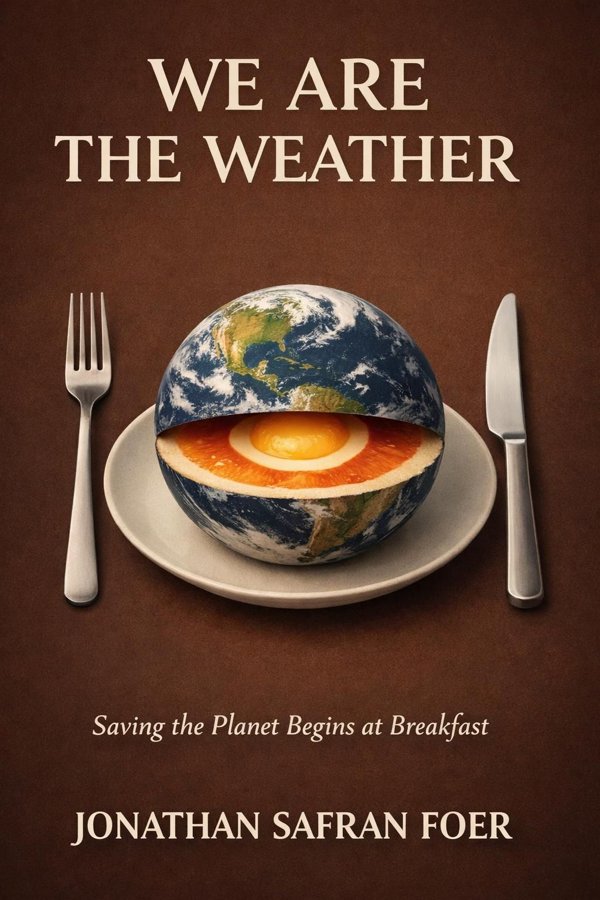
We Are the Weather: Saving the Planet Begins at Breakfast: Summary & Key Insights
 10 min7 chaptersAudio available
What Is We Are the Weather: Saving the Planet Begins at Breakfast About?
We Are the Weather: Saving the Planet Begins at Breakfast by Jonathan Safran Foer is a environment book spanning 7 pages. In this thought-provoking work, Jonathan Safran Foer explores the connection between our daily food choices and the global climate crisis. He argues that small, collective changes in eating habits—particularly reducing animal product consumption—can have a profound impact on the environment. Blending personal reflection, scientific research, and moral inquiry, Foer challenges readers to confront the urgency of climate change and to act through mindful consumption.
This FizzRead summary covers all 7 key chapters of We Are the Weather: Saving the Planet Begins at Breakfast in approximately 10 minutes, distilling the most important ideas, arguments, and takeaways from Jonathan Safran Foer's work. Also available as an audio summary and Key Quotes Podcast.
We Are the Weather: Saving the Planet Begins at Breakfast
In this thought-provoking work, Jonathan Safran Foer explores the connection between our daily food choices and the global climate crisis. He argues that small, collective changes in eating habits—particularly reducing animal product consumption—can have a profound impact on the environment. Blending personal reflection, scientific research, and moral inquiry, Foer challenges readers to confront the urgency of climate change and to act through mindful consumption.
Who Should Read We Are the Weather: Saving the Planet Begins at Breakfast?
This book is perfect for anyone interested in environment and looking to gain actionable insights in a short read. Whether you're a student, professional, or lifelong learner, the key ideas from We Are the Weather: Saving the Planet Begins at Breakfast by Jonathan Safran Foer will help you think differently.
- ✓Readers who enjoy environment and want practical takeaways
- ✓Professionals looking to apply new ideas to their work and life
- ✓Anyone who wants the core insights of We Are the Weather: Saving the Planet Begins at Breakfast in just 10 minutes
Want the full summary?
Get instant access to this book summary and 100K+ more with Fizz Moment.
Get Free SummaryAvailable on App Store • Free to download
Key Chapters
I often begin by admitting my own failure. I know the science, I care about my children’s future, and yet I have still boarded planes, eaten cheese, or ordered a burger. This isn’t hypocrisy—it’s humanity. Our culture is structured around routines that soothe moral discomfort. We scroll past catastrophes, we tell ourselves our contribution is too small to matter, and by doing so, we collectively do nothing.
In the opening section of *We Are the Weather*, I explore this paralysis. The problem isn’t ignorance; we know more than enough about climate change. The problem is our inability to convert knowledge into sustained action. When we look back at history, moments of collective courage—whether the mobilization of Americans during World War II or the civil rights movement—teach us that people act not because they’re certain of success but because they feel morally implicated. Climate change demands the same kind of moral imagination.
I propose that the only way forward is through partial participation. No one can fight climate change alone, but millions of small acts of restraint and care can reshape culture itself. The decision to skip animal products in the morning might appear meaningless, yet if multiplied across communities, it becomes a force of transformation. The silence between knowing and acting is not inevitable—it can be filled with the sound of a billion forks choosing differently.
Of all the human activities altering the planet, animal agriculture is among the most destructive. It accounts for almost 15 percent of global greenhouse gas emissions, uses more land and water than any other industry, and is responsible for widespread deforestation. The methane from cows, the nitrous oxide from manure, and the carbon released by clearing forests all converge into a single crisis of appetite.
But I did not want to write another statistical lecture. Instead, I wanted to remind readers that every statistic hides a story—a field once green, a river poisoned, an animal confined. Our plates are maps of the Earth’s wounds. By making this connection visible, eating becomes an act of awareness rather than habit.
The physics of eating is the physics of energy transfer. Every calorie of meat is an inefficient conversion of plant energy, requiring many times more land and water. When we eat lower on the food chain, we reclaim abundance. The solution is not about purity but participation: each meal without animal products keeps vast quantities of greenhouse gases out of the atmosphere.
If science has given us the diagnosis, ethics must give us the strength to change. To eat with conscience is to accept that the line between our kitchen and the climate is thinner than we imagine.
+ 5 more chapters — available in the FizzRead app
All Chapters in We Are the Weather: Saving the Planet Begins at Breakfast
About the Author
Jonathan Safran Foer is an American novelist and essayist known for his works 'Everything Is Illuminated' and 'Extremely Loud & Incredibly Close'. His writing often explores themes of identity, memory, and moral responsibility. In addition to fiction, Foer has written influential nonfiction addressing ethical eating and environmental sustainability.
Get This Summary in Your Preferred Format
Read or listen to the We Are the Weather: Saving the Planet Begins at Breakfast summary by Jonathan Safran Foer anytime, anywhere. FizzRead offers multiple formats so you can learn on your terms — all free.
Available formats: App · Audio · PDF · EPUB — All included free with FizzRead
Download We Are the Weather: Saving the Planet Begins at Breakfast PDF and EPUB Summary
Key Quotes from We Are the Weather: Saving the Planet Begins at Breakfast
“I often begin by admitting my own failure.”
“Of all the human activities altering the planet, animal agriculture is among the most destructive.”
Frequently Asked Questions about We Are the Weather: Saving the Planet Begins at Breakfast
We Are the Weather: Saving the Planet Begins at Breakfast by Jonathan Safran Foer is a environment book that explores key ideas across 7 chapters. In this thought-provoking work, Jonathan Safran Foer explores the connection between our daily food choices and the global climate crisis. He argues that small, collective changes in eating habits—particularly reducing animal product consumption—can have a profound impact on the environment. Blending personal reflection, scientific research, and moral inquiry, Foer challenges readers to confront the urgency of climate change and to act through mindful consumption.
More by Jonathan Safran Foer

You Might Also Like

A Life on Our Planet: My Witness Statement and a Vision for the Future
David Attenborough
10 min
A Sky Full Of Birds
Matt Merritt
10 min
Carbon Zero: Imagining Cities That Can Save the Planet
Alex Steffen
10 min
Eaarth: Making a Life on a Tough New Planet
Bill McKibben
10 min
The Social Contract and Environmental Governance
Various Editors
10 min
The Wild Places
Robert Macfarlane
10 minBrowse by Category
Ready to read We Are the Weather: Saving the Planet Begins at Breakfast?
Get the full summary and 100K+ more books with Fizz Moment.