
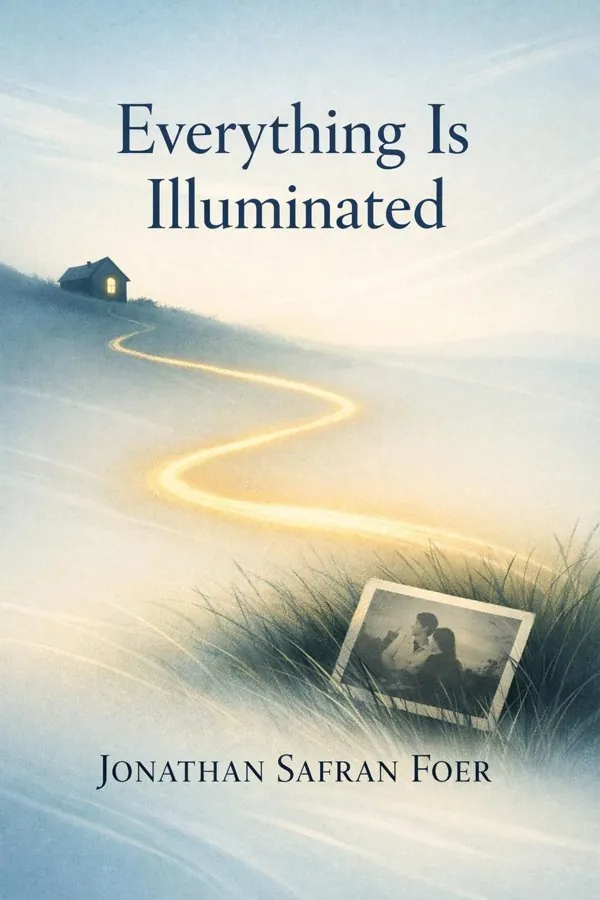
Everything Is Illuminated: Summary & Key Insights
 10 min9 chaptersAudio available
Key Takeaways from Everything Is Illuminated
We often begin searching because something essential is missing, and that absence can shape an entire life.
Misunderstanding is not the opposite of truth; sometimes it is the strange route by which truth arrives.
When history has been erased, imagination can become a moral instrument.
Laughter can coexist with devastation, and in this novel it must.
We inherit more than names and faces; we inherit silences, fears, loyalties, and unresolved moral debts.
What Is Everything Is Illuminated About?
Everything Is Illuminated by Jonathan Safran Foer is a classics book spanning 5 pages. Some novels tell a story; others search for the very possibility of telling one. Jonathan Safran Foer’s Everything Is Illuminated is both a comic road trip and a profound meditation on memory, ancestry, and loss. The book follows a young American named Jonathan Safran Foer as he travels to Ukraine with a photograph, a few family clues, and a desperate desire to find the woman who saved his grandfather during the Holocaust. Alongside him are Alex, his hilariously unreliable translator, and Alex’s irascible grandfather, whose own buried past slowly rises to the surface. Interwoven with this contemporary quest is a mythic, imaginative history of the vanished shtetl of Trachimbrod, a world destroyed by Nazi violence but revived through storytelling. What makes the novel matter is not only its emotional subject but its daring form: Foer blends satire, folklore, epistolary exchange, and historical reckoning into a work that is inventive without losing its human core. As one of the most acclaimed literary debuts of its generation, the novel established Foer as a distinctive voice on trauma, inheritance, and the stories families tell to survive.
This FizzRead summary covers all 9 key chapters of Everything Is Illuminated in approximately 10 minutes, distilling the most important ideas, arguments, and takeaways from Jonathan Safran Foer's work. Also available as an audio summary and Key Quotes Podcast.
Everything Is Illuminated
Some novels tell a story; others search for the very possibility of telling one. Jonathan Safran Foer’s Everything Is Illuminated is both a comic road trip and a profound meditation on memory, ancestry, and loss. The book follows a young American named Jonathan Safran Foer as he travels to Ukraine with a photograph, a few family clues, and a desperate desire to find the woman who saved his grandfather during the Holocaust. Alongside him are Alex, his hilariously unreliable translator, and Alex’s irascible grandfather, whose own buried past slowly rises to the surface. Interwoven with this contemporary quest is a mythic, imaginative history of the vanished shtetl of Trachimbrod, a world destroyed by Nazi violence but revived through storytelling. What makes the novel matter is not only its emotional subject but its daring form: Foer blends satire, folklore, epistolary exchange, and historical reckoning into a work that is inventive without losing its human core. As one of the most acclaimed literary debuts of its generation, the novel established Foer as a distinctive voice on trauma, inheritance, and the stories families tell to survive.
Who Should Read Everything Is Illuminated?
This book is perfect for anyone interested in classics and looking to gain actionable insights in a short read. Whether you're a student, professional, or lifelong learner, the key ideas from Everything Is Illuminated by Jonathan Safran Foer will help you think differently.
- ✓Readers who enjoy classics and want practical takeaways
- ✓Professionals looking to apply new ideas to their work and life
- ✓Anyone who wants the core insights of Everything Is Illuminated in just 10 minutes
Want the full summary?
Get instant access to this book summary and 100K+ more with Fizz Moment.
Get Free SummaryAvailable on App Store • Free to download
Key Chapters
We often begin searching because something essential is missing, and that absence can shape an entire life. In Everything Is Illuminated, Jonathan’s trip to Ukraine is not simply tourism or even straightforward research; it is an attempt to recover a broken family history. He carries little more than a photograph and the name of Augustine, the woman believed to have saved his grandfather from the Nazis. That thin trail matters because it reflects how descendants of trauma often inherit fragments rather than full narratives. The journey is therefore driven by uncertainty, longing, and the hope that a single recovered detail might illuminate generations of silence.
Foer uses this premise to show that historical investigation is rarely neat. Jonathan is emotionally serious but practically unprepared. He depends on Alex Perchov, a translator whose English is exuberant, distorted, and often comic, and on Alex’s grandfather, who serves as driver and claims expertise he may not possess. Their mismatched companionship gives the novel much of its charm, but it also underscores a deeper point: our search for truth is almost always mediated by others, by language, and by flawed memory.
In practical terms, the novel invites readers to think about their own family histories. Many people know only pieces of their ancestry: a name, a migration story, a wartime rumor, a photograph with no caption. The book suggests that such fragments still matter. Asking elders questions, preserving documents, and recording family stories can become acts of emotional and historical repair.
Actionable takeaway: identify one missing part of your own family story and take one concrete step toward recovering it, whether by interviewing a relative, labeling old photos, or researching a place your family once called home.
Misunderstanding is not the opposite of truth; sometimes it is the strange route by which truth arrives. One of the novel’s most memorable achievements is Alex Perchov’s narration, full of malapropisms, inflated diction, and accidental wisdom. Alex desperately wants to seem American and sophisticated, and his imperfect English creates a comic voice unlike any other in contemporary fiction. Yet his mistakes do more than entertain. They reveal how language shapes identity, how people perform versions of themselves, and how sincerity can shine through even badly chosen words.
Alex initially appears superficial. He is preoccupied with pop culture, style, and the image of coolness. But as the journey continues, his narration becomes one of the book’s emotional anchors. Through him, readers witness the limits of translation—not just from Ukrainian or Russian into English, but from experience into speech. Traumatic history resists easy articulation. Family shame hides behind jokes. National memory is distorted by convenience and denial. Alex’s voice, therefore, becomes a brilliant formal tool: funny on the surface, deeply vulnerable underneath.
This idea has clear real-world relevance. Every conversation across generations, cultures, or backgrounds involves some degree of mistranslation. We often assume that precision alone creates understanding, but Foer suggests that patience, humility, and willingness to keep trying matter just as much. In workplaces, friendships, and families, people regularly speak past one another while still longing to connect.
Actionable takeaway: the next time someone expresses themselves awkwardly, listen for intention rather than perfection. Ask clarifying questions, resist quick judgment, and treat communication as a collaborative act rather than a test of correctness.
When history has been erased, imagination can become a moral instrument. Interwoven with the road trip narrative is Jonathan’s fictionalized reconstruction of Trachimbrod, the shtetl where his ancestors lived. Rather than presenting a dry archive, Foer creates a lush, absurd, mythical community born from an accident, expanded through legend, and populated by unforgettable figures. The result is not falsehood for its own sake, but an act of resurrection. Since the real town was annihilated and its records largely lost, fiction becomes a way to honor what cannot be fully recovered.
This section of the novel often surprises readers because it shifts dramatically in tone and style. It is exuberant, magical, erotic, strange, and playful. Yet beneath that inventiveness lies grief. The richness of Trachimbrod’s imagined life intensifies the tragedy of its destruction. By giving the town texture, humor, gossip, and eccentricity, Foer refuses to let it remain merely a statistic of genocide. He restores individuality to a world history tried to flatten.
The broader lesson is that memory is never purely factual. Families embellish stories, communities mythologize origins, and people shape narratives to preserve emotional truth. This does not mean facts do not matter. It means that facts alone may fail to convey what was lost. Museums, memoirs, oral histories, and even family anecdotes often need storytelling devices to make the past felt.
For readers, this idea offers a practical invitation. If a family place, tradition, or person risks being forgotten, don’t wait for perfect information before preserving it. Write what you know, note what you don’t know, and acknowledge the role of imagination where records end.
Actionable takeaway: choose one family story or ancestral place and document it in a vivid way—through a written sketch, audio recording, or memory essay—before more detail disappears.
Laughter can coexist with devastation, and in this novel it must. Everything Is Illuminated is frequently very funny, even though it centers on Holocaust memory and historical annihilation. Foer’s daring lies in refusing the assumption that solemn subjects require uniformly solemn treatment. Alex’s comic narration, the absurd logistics of the trip, the grandfather’s dog Sammy Davis, Junior, Junior, and the travelers’ cultural misunderstandings all create humor. But the comedy does not trivialize suffering. Instead, it reveals how people survive proximity to unbearable truths.
This balance is one of the novel’s defining strengths. Humor allows characters and readers to approach painful material without turning away. The jokes create trust, rhythm, and humanity. They also expose denial, vanity, and self-deception. Alex’s bluster, for instance, is funny, but it also signals insecurity. Grandfather’s eccentricity amuses us until we realize it conceals a lifetime of moral burden. In this way, the novel shows that comedy can be a delivery system for seriousness rather than an escape from it.
This insight applies far beyond literature. Families dealing with illness, grief, or old conflict often use humor as a coping mechanism. Communities marked by trauma may rely on irony or storytelling to make pain bearable enough to discuss. The key difference is whether humor opens people to truth or shields them from it. Foer repeatedly steers his comedy toward revelation.
Readers can learn from that emotional complexity. Serious conversations need not be joyless to be meaningful. A light touch can create openness, so long as it is grounded in respect and honesty.
Actionable takeaway: when discussing difficult personal or family history, allow room for warmth and even humor, but use it to build connection and courage—not to dismiss what hurts.
We inherit more than names and faces; we inherit silences, fears, loyalties, and unresolved moral debts. As Jonathan, Alex, and Grandfather travel together, their relationship evolves from awkward arrangement to genuine intimacy. What begins as a transactional guiding service becomes a confrontation with generational memory. Jonathan seeks his grandfather’s rescuer, but Alex gradually discovers that he too is living inside a family story shaped by concealment. The road trip therefore binds strangers through shared encounters with inherited pain.
The novel is especially powerful in showing how younger generations carry the emotional consequences of events they did not witness. Jonathan has inherited a longing to understand Jewish loss and survival. Alex has inherited the habits and prejudices of his environment, along with a version of his grandfather that proves deeply incomplete. As truths emerge, both young men are forced to rethink who their elders were and what they themselves owe to the past.
This dynamic appears in many real families. Children often sense tensions they cannot explain: why certain topics are avoided, why one relative is idealized, why another is never named. Sometimes these patterns stem from migration, war, discrimination, addiction, or personal betrayal. The novel suggests that love requires more than preserving a family image. It may require confronting what that image excludes.
The friendship between Jonathan and Alex also matters because it models ethical encounter across difference. Their bond is uneven, funny, and imperfect, but it grows through curiosity and vulnerability rather than ideological agreement. They begin as caricatures to one another and end as more fully seen human beings.
Actionable takeaway: notice one inherited family pattern—silence, shame, idealization, or avoidance—and ask what story it may be protecting. Then begin a respectful conversation that moves your family one step closer to honesty.
The most devastating truths often arrive not as abstractions but as names, places, and choices. As the search continues, the travelers discover what happened to Trachimbrod: it was destroyed by the Nazis, and nearly everyone in it was murdered. The revelation is not simply historical information. It transforms the novel’s imaginative sections from whimsical folklore into a memorial landscape. Every colorful life imagined earlier now feels shadowed by impending erasure. The gap between vitality and annihilation becomes unbearable, and that emotional shock is precisely the point.
Central to this reckoning is the fate of Augustine and the discovery of Lista, the last living witness tied to the town. Through her, the search narrows from fantasy and rumor to testimony. The book insists that genocide is not only the destruction of bodies but the destruction of context: households, jokes, courtships, petty rivalries, local myths, and shared routines vanish along with lives. By restoring attention to those details, Foer resists the numbing effect of scale.
The revelation also forces the characters to confront moral complexity. Survival stories are rarely clean. Rescuers, bystanders, victims, and witnesses all exist within impossible conditions. This challenges the human desire for simple categories and neat redemption. Historical atrocity leaves residues that continue long after the event itself—in descendants, in landscapes, and in what communities choose not to remember.
In everyday life, this idea reminds us to treat historical suffering as concrete rather than distant. Learning about one town, one family, or one witness can make vast history emotionally legible.
Actionable takeaway: when engaging with a major historical tragedy, study one specific local story or testimony. Concrete human detail deepens understanding far more than statistics alone.
The stories families hide often shape them more powerfully than the stories they proudly repeat. One of the novel’s deepest emotional turns comes through Grandfather’s concealed history. His persona—comic, abrasive, performative—masks guilt tied to the Holocaust and to decisions made under threat. As the truth emerges, Foer refuses easy judgment while also refusing sentimental absolution. The past cannot be undone, but it can be named. That naming changes everyone involved.
This thread expands the novel beyond a search for ancestry into a meditation on moral compromise. Extreme violence forces impossible choices, and survivors may carry unbearable shame regardless of what they did or failed to do. Grandfather’s silence has protected him only superficially; in reality, it has distorted his relationships, his self-understanding, and the emotional world of his family. Alex, who grew up under a simplified image of him, must suddenly absorb a more painful and human truth.
The novel’s insight here is crucial: secrecy is rarely inert. Hidden guilt leaks into tone, behavior, and family structure. It can produce anger, rigidity, nostalgia, or emotional distance. In modern contexts, families may conceal different things—bankruptcy, betrayal, abuse, prejudice, political collaboration, or addiction—but the mechanism is similar. Silence may feel protective in the short term, yet it often enlarges confusion over time.
Foer does not propose total disclosure without care. Instead, he shows the value of honest reckoning, especially when the alternative is inherited falseness. Ethical maturity requires holding complexity: compassion for human vulnerability alongside seriousness about moral consequence.
Actionable takeaway: if there is a difficult truth in your personal or family life that has been avoided for years, consider a thoughtful, supported way to begin addressing it—through conversation, writing, or therapy—before silence hardens into legacy.
To tell a story is sometimes the closest we can come to saving what was lost. Everything Is Illuminated repeatedly asks what narrative can do in the face of historical destruction. It cannot resurrect the dead or restore a vanished world. Yet it can preserve names, transmit feeling, complicate inherited myths, and resist oblivion. The novel itself becomes an example of this power through its layered structure: travel narrative, invented shtetl chronicle, letters between Jonathan and Alex, and testimonial revelation all interact to show storytelling as a living process rather than a finished artifact.
The exchange of letters is especially important. Through them, Jonathan and Alex revise, critique, and encourage one another’s accounts. This collaborative process demonstrates that stories are made through relationship. We need witnesses, editors, and interlocutors. Memory is not a sealed possession; it is shaped through retelling. The novel therefore honors both artistic invention and ethical responsibility. It suggests that the most meaningful narratives are neither purely factual records nor unrestricted fantasies, but attempts to carry truth across damaged terrain.
This has practical implications for readers navigating personal history. Journals, memoirs, family trees, oral recordings, and community archives all function as acts of preservation. They may not capture everything, but they prevent total disappearance. Even small gestures matter: writing down a grandparent’s expression, saving a recipe, recording a migration route, or preserving a letter.
Foer also reminds us that storytelling can repair relationships by making hidden experience shareable. When we narrate honestly, we invite others into our inner world and loosen the grip of isolation.
Actionable takeaway: create one intentional record of memory this month—a written family anecdote, a voice memo from an elder, or a personal reflection on inherited history—so that forgetting is not the final word.
Illumination is not mere discovery; it is the painful and transformative act of seeing what was always there more fully. The title Everything Is Illuminated captures the novel’s central paradox. As the search proceeds, the characters do uncover facts, but the deeper illumination is moral and emotional. Jonathan learns that ancestry cannot be reduced to neat origin stories. Alex learns to question inherited assumptions and sentimental loyalties. Grandfather is forced into self-revelation. Even the reader is illuminated, moving from comic adventure into an encounter with the lingering shadows of historical violence.
This idea gives the book its enduring force. Illumination does not heal by making the past simpler. It heals, if at all, by making denial harder. Knowledge can wound. Testimony can destabilize identity. Yet without such illumination, people remain trapped inside partial stories. Foer presents truth not as a static possession but as a difficult ethical event. To be illuminated is to become responsible for what one now knows.
In ordinary life, people often seek clarity while secretly hoping it will not require change. The novel argues otherwise. Real understanding alters relationships, self-image, and future choices. Learning the truth about family history may complicate pride. Learning a community’s past may demand accountability. Learning another person’s hidden pain may require greater tenderness.
The practical value of this message is significant. Readers are encouraged to pursue truth not for curiosity alone, but for transformation. Illumination matters because it deepens empathy, honesty, and moral seriousness.
Actionable takeaway: ask yourself what truth you have been willing to approach only from a safe distance. Then take one step toward fuller understanding, accepting that genuine clarity may ask something of you.
All Chapters in Everything Is Illuminated
About the Author
Jonathan Safran Foer is an American novelist born in 1977 in Washington, D.C. He studied at Princeton University, where he developed under the mentorship of writer Joyce Carol Oates. Foer rose to literary prominence with his debut novel, Everything Is Illuminated, which was widely praised for its stylistic daring, emotional intelligence, and fresh approach to memory and historical trauma. He later published Extremely Loud & Incredibly Close, further establishing himself as a major contemporary voice. His writing often explores family, loss, Jewish identity, and the long aftereffects of catastrophe, combining formal experimentation with intimate feeling. In addition to fiction, Foer has written nonfiction on ethical and environmental issues, showing the same curiosity about how private lives intersect with larger moral questions.
Get This Summary in Your Preferred Format
Read or listen to the Everything Is Illuminated summary by Jonathan Safran Foer anytime, anywhere. FizzRead offers multiple formats so you can learn on your terms — all free.
Available formats: App · Audio · PDF · EPUB — All included free with FizzRead
Download Everything Is Illuminated PDF and EPUB Summary
Key Quotes from Everything Is Illuminated
“We often begin searching because something essential is missing, and that absence can shape an entire life.”
“Misunderstanding is not the opposite of truth; sometimes it is the strange route by which truth arrives.”
“When history has been erased, imagination can become a moral instrument.”
“Laughter can coexist with devastation, and in this novel it must.”
“We inherit more than names and faces; we inherit silences, fears, loyalties, and unresolved moral debts.”
Frequently Asked Questions about Everything Is Illuminated
Everything Is Illuminated by Jonathan Safran Foer is a classics book that explores key ideas across 9 chapters. Some novels tell a story; others search for the very possibility of telling one. Jonathan Safran Foer’s Everything Is Illuminated is both a comic road trip and a profound meditation on memory, ancestry, and loss. The book follows a young American named Jonathan Safran Foer as he travels to Ukraine with a photograph, a few family clues, and a desperate desire to find the woman who saved his grandfather during the Holocaust. Alongside him are Alex, his hilariously unreliable translator, and Alex’s irascible grandfather, whose own buried past slowly rises to the surface. Interwoven with this contemporary quest is a mythic, imaginative history of the vanished shtetl of Trachimbrod, a world destroyed by Nazi violence but revived through storytelling. What makes the novel matter is not only its emotional subject but its daring form: Foer blends satire, folklore, epistolary exchange, and historical reckoning into a work that is inventive without losing its human core. As one of the most acclaimed literary debuts of its generation, the novel established Foer as a distinctive voice on trauma, inheritance, and the stories families tell to survive.
More by Jonathan Safran Foer

You Might Also Like



Browse by Category
Ready to read Everything Is Illuminated?
Get the full summary and 100K+ more books with Fizz Moment.