
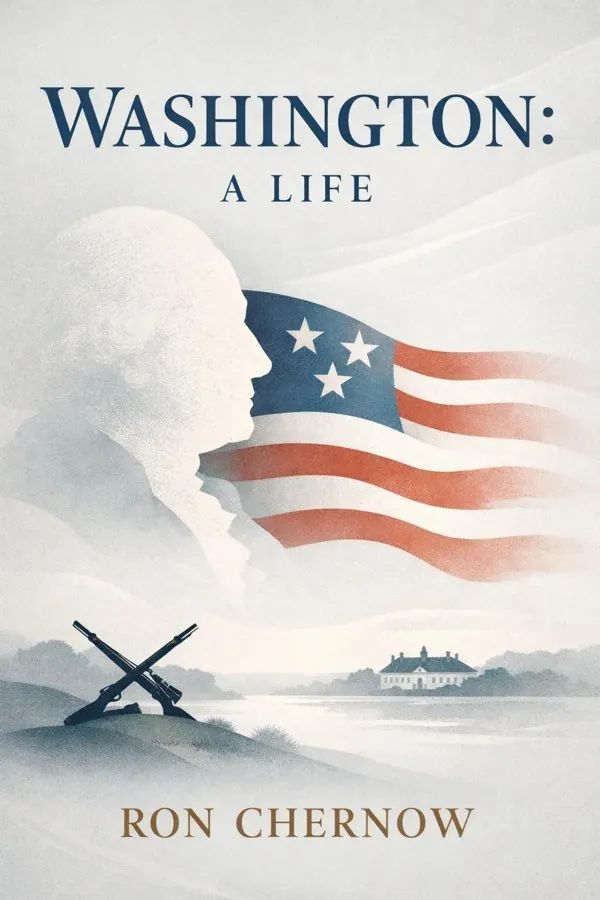
Washington: A Life: Summary & Key Insights
by Ron Chernow
 10 min9 chaptersAudio available
Key Takeaways from Washington: A Life
Great public figures are often shaped as much by what they lack as by what they inherit.
The leaders who last are rarely those who avoid mistakes; they are those who learn from humiliating ones.
Before Washington became the symbol of a nation, he was a planter obsessed with land, status, and improvement.
History often celebrates charisma, but republics are more often saved by endurance.
One of Washington’s most revolutionary acts was not seizing power, but surrendering it.
What Is Washington: A Life About?
Washington: A Life by Ron Chernow is a biographies book spanning 12 pages. George Washington is often remembered as an icon rather than a person: the general on horseback, the calm president, the father of a nation. In Washington: A Life, Ron Chernow strips away that polished mythology and reveals a far more fascinating figure—ambitious, disciplined, emotionally guarded, deeply self-aware, and constantly tested by war, politics, and personal contradiction. This Pulitzer Prize-winning biography traces Washington from his modest beginnings in colonial Virginia to his rise as commander of the Continental Army, presiding officer at the Constitutional Convention, and the first president of the United States. Along the way, Chernow shows how Washington learned from failure, mastered self-control, and shaped the fragile customs that gave legitimacy to the American republic. The book matters because it explains not only who Washington was, but how character and restraint can become forms of power. Chernow, one of America’s most respected biographers, brings extraordinary authority to the subject through meticulous research, vivid storytelling, and a gift for making major historical figures feel human. The result is both a definitive life of Washington and a profound study of leadership under pressure.
This FizzRead summary covers all 9 key chapters of Washington: A Life in approximately 10 minutes, distilling the most important ideas, arguments, and takeaways from Ron Chernow's work. Also available as an audio summary and Key Quotes Podcast.
Washington: A Life
George Washington is often remembered as an icon rather than a person: the general on horseback, the calm president, the father of a nation. In Washington: A Life, Ron Chernow strips away that polished mythology and reveals a far more fascinating figure—ambitious, disciplined, emotionally guarded, deeply self-aware, and constantly tested by war, politics, and personal contradiction. This Pulitzer Prize-winning biography traces Washington from his modest beginnings in colonial Virginia to his rise as commander of the Continental Army, presiding officer at the Constitutional Convention, and the first president of the United States. Along the way, Chernow shows how Washington learned from failure, mastered self-control, and shaped the fragile customs that gave legitimacy to the American republic. The book matters because it explains not only who Washington was, but how character and restraint can become forms of power. Chernow, one of America’s most respected biographers, brings extraordinary authority to the subject through meticulous research, vivid storytelling, and a gift for making major historical figures feel human. The result is both a definitive life of Washington and a profound study of leadership under pressure.
Who Should Read Washington: A Life?
This book is perfect for anyone interested in biographies and looking to gain actionable insights in a short read. Whether you're a student, professional, or lifelong learner, the key ideas from Washington: A Life by Ron Chernow will help you think differently.
- ✓Readers who enjoy biographies and want practical takeaways
- ✓Professionals looking to apply new ideas to their work and life
- ✓Anyone who wants the core insights of Washington: A Life in just 10 minutes
Want the full summary?
Get instant access to this book summary and 100K+ more with Fizz Moment.
Get Free SummaryAvailable on App Store • Free to download
Key Chapters
Great public figures are often shaped as much by what they lack as by what they inherit. George Washington’s early life was marked by insecurity, limited formal schooling, and a constant awareness of Virginia’s rigid social hierarchy. Born in 1732 into a respectable but not elite planter family, he did not possess the wealth, pedigree, or education enjoyed by the highest-ranking Virginians. His father’s death when George was young deprived him of both financial stability and a traditional path into England for schooling. Instead, Washington developed practical skills in surveying, land management, and self-presentation—tools that would become central to his rise.
Chernow shows that Washington was intensely conscious of reputation from an early age. He copied rules of civility, studied how gentlemen behaved, and worked tirelessly to cultivate poise. This was not empty vanity; it was an early recognition that in his world, character was judged through conduct. His years as a surveyor toughened him physically, exposed him to the frontier, and gave him firsthand knowledge of land speculation and expansion. These experiences planted habits of discipline, observation, and endurance.
For modern readers, Washington’s youth offers a powerful reminder that polish can be learned and that limitations do not determine destiny. He lacked ease, but he built competence. He lacked inherited greatness, but he pursued self-mastery. His example applies to careers, leadership, and personal growth: when you cannot control your starting position, you can still control your standards, preparation, and bearing.
Actionable takeaway: Identify one area where insecurity drives you, and convert it into disciplined improvement rather than self-doubt.
The leaders who last are rarely those who avoid mistakes; they are those who learn from humiliating ones. Washington’s early military career during the French and Indian War was filled with blunders, confusion, and painful lessons. As a young officer sent into contested frontier territory, he was brave and energetic, but also inexperienced and eager for recognition. His involvement in the skirmish that helped ignite the war, his difficult retreat at Fort Necessity, and his frustrations with British regular officers all exposed his weaknesses.
Chernow emphasizes that this period was a crucible. Washington learned that courage without judgment can be disastrous. He saw the dangers of vanity, the complexity of diplomacy with Native nations, and the importance of logistics, chain of command, and patience. He also developed a lasting distrust of British military arrogance after watching colonial officers treated as inferior. Most importantly, he gained battlefield resilience. Repeated exposure to danger strengthened his composure and contributed to the aura of steadiness that later inspired troops.
There is a practical leadership lesson here: early setbacks can become strategic assets if they deepen judgment. Washington did not emerge from these years as a flawless commander; he emerged as a more cautious, observant, and adaptable one. In business, public service, or personal decision-making, difficult beginnings often provide the exact knowledge needed for later success.
Actionable takeaway: Revisit a past failure and write down the specific habits, blind spots, or assumptions it exposed—then turn those insights into a new operating principle.
Before Washington became the symbol of a nation, he was a planter obsessed with land, status, and improvement. After the French and Indian War, he returned to Mount Vernon and devoted himself to agriculture, estate management, and regional influence. Chernow portrays this period not as a pause in history, but as the stage on which Washington refined the managerial habits that later served him in war and government. He experimented with crops, expanded his holdings, tracked accounts carefully, and treated efficiency as a form of discipline.
His marriage to Martha Custis in 1759 transformed his social and financial position. The union brought him wealth, stability, and a domestic life that grounded him. Martha offered emotional support, social polish, and partnership, helping Washington consolidate his standing among Virginia’s elite. Yet this prosperous world rested on slavery, and Chernow does not soften that reality. Washington depended on enslaved labor, pursued fugitives, and operated within the moral framework of a slaveholding society even as he gradually grew more uneasy with the institution.
This tension is central to the biography. Washington was capable of growth, but not innocence. His life at Mount Vernon reveals how personal achievement can coexist with moral blindness shaped by one’s time and interests. For readers today, this chapter underscores the importance of examining the systems that make our success possible and asking whether they are just.
Actionable takeaway: Audit one source of comfort, status, or advantage in your life and ask what hidden structures support it—and what responsibility that creates.
History often celebrates charisma, but republics are more often saved by endurance. When the colonies moved from protest to rebellion, Washington emerged as an unlikely unifying choice to command the Continental Army. He was not the most brilliant tactician in America, nor the most radical revolutionary. What he possessed was something rarer: stature, regional acceptability, personal discipline, and a willingness to absorb pressure without collapsing. Chernow shows that Washington’s leadership during the Revolutionary War depended less on dazzling victories than on preserving the army long enough for the British to fail.
The war tested him relentlessly. He faced shortages, desertions, congressional weakness, political intrigue, and repeated battlefield defeats. Yet he understood that the army itself was the revolution’s backbone. If it survived, the cause survived. His persistence at moments such as the retreat across New Jersey, the surprise attack at Trenton, the endurance of Valley Forge, and the eventual coordination with French forces revealed a commander who learned to think strategically over the long term.
Washington also mastered the symbolism of command. He appeared composed when panic spread. He projected confidence when resources were scarce. In modern leadership, this matters enormously. Teams do not need performative certainty; they need visible steadiness anchored in purpose. Washington’s example suggests that resilience, consistency, and moral seriousness can hold institutions together even when outcomes remain uncertain.
Actionable takeaway: In a crisis, define the one asset, team, or principle that must be preserved at all costs—and organize every decision around sustaining it.
The American presidency did not begin as a settled office; it began as an improvisation watched by a nervous nation. When Washington accepted the presidency, he stepped into a role with immense symbolic weight but few clear precedents. Chernow demonstrates that nearly every action he took carried constitutional meaning. How formal should the office be? How close should the president remain to Congress? Could executive authority be energetic without becoming monarchical? Washington had to answer these questions in real time.
He moved carefully. He assembled a talented but often combative cabinet, including Thomas Jefferson and Alexander Hamilton. He established protocols, emphasized dignity without royal excess, and insisted that the executive branch possess enough independence to function effectively. His support for Hamilton’s financial system helped stabilize the nation’s credit and strengthen federal power, even as it widened political divisions. Washington understood that weak institutions invite chaos; legitimacy required both restraint and capability.
What makes this relevant today is that many leadership roles—founder, manager, parent, civic organizer—also lack complete scripts. People in such positions create norms through repeated choices. Washington’s genius lay in recognizing that style becomes structure over time. His punctuality, emotional control, seriousness, and procedural care were not quirks; they were constitutional tools.
For anyone building something new, his example is invaluable. The habits you normalize at the start can outlive you. Culture is formed not only by ideals but by repeated behavior under scrutiny.
Actionable takeaway: If you occupy a leadership role, list three behaviors you model consistently and ask whether they are creating the culture you actually want.
The hardest decision in leadership is often not choosing a side, but refusing a seductive conflict. During Washington’s presidency, the French Revolution and the war between Britain and France threatened to drag the United States into another destructive struggle. Many Americans, especially Jeffersonian sympathizers, felt emotionally tied to France because of its support during the American Revolution. Yet Washington believed the young republic was too fragile, indebted, and divided to survive foreign entanglement.
Chernow shows that Washington’s policy of neutrality was not passive avoidance. It was an active, deeply contested strategy designed to protect national independence. He understood that revolutionary fervor could become ideological theater that ignored material reality. By issuing the Neutrality Proclamation and resisting pressure from both foreign agents and domestic partisans, Washington asserted that the United States must define its interests soberly rather than emotionally.
This decision also revealed his larger political philosophy. He distrusted faction, feared imported extremism, and believed self-government required patience as much as passion. The same mindset informed his response to the Whiskey Rebellion, when he used federal power to enforce law while avoiding vindictive excess. For contemporary readers, the lesson is clear: maturity often means resisting applause for the sake of stability.
In workplaces and communities, neutrality can take the form of refusing performative outrage, declining premature commitments, or separating loyalty from impulse. Strategic patience is not weakness; it is disciplined timing.
Actionable takeaway: Before joining a heated conflict, ask what long-term capacity, trust, or independence might be lost by reacting too quickly.
Stoicism can look like simplicity from a distance, but Chernow reveals that Washington’s emotional life was far richer than the marble myth suggests. He was intensely reserved, careful with words, and deeply protective of his inner world. Yet behind that control stood powerful emotions: longing for status, grief over personal losses, tenderness toward family, sensitivity to criticism, and a profound need for honor. His marriage to Martha brought companionship and steadiness, while his relationship with her children created a household identity he otherwise lacked, since he had no biological children of his own.
Chernow also explores Washington’s friendships, social anxieties, and the rumors surrounding his bond with Sally Fairfax, suggesting that his emotional world cannot be reduced to public stiffness. He used self-command not because he felt little, but because he felt deeply and believed disorderly emotion could be destructive. This habit made him appear distant, but it also helped him shoulder extraordinary burdens.
For modern readers, Washington’s example complicates common assumptions about strength. Emotional maturity is not constant disclosure, nor is reserve always coldness. Sometimes leadership requires filtering feeling into judgment rather than broadcasting it impulsively. At the same time, excessive restraint can create distance and misunderstanding.
The practical lesson is balance: self-control is valuable, but so is selective openness with trusted people. Sustainable leadership depends on both discipline and emotional grounding.
Actionable takeaway: Practice one act of intentional self-restraint in public pressure, and one act of honest vulnerability in a trusted private relationship.
The most useful biographies do not ask us to choose between admiration and criticism; they ask us to hold both honestly. Chernow’s portrait of Washington is ultimately expansive enough to include his greatness and his failures. Washington helped win independence, legitimize republican government, restrain military power, and establish the presidency on durable foundations. His presence gave coherence to a fragile nation at moments when collapse was a real possibility. In that sense, his contribution to American political culture was extraordinary.
Yet the book also insists that Washington cannot be separated from slavery. He owned enslaved people, benefited from their labor, and moved slowly toward moral recognition. Over time, his discomfort with slavery deepened, and in his will he arranged for the emancipation of those enslaved people he legally controlled after Martha’s death. This decision set him apart from many fellow founders, but it does not erase the decades in which he upheld the institution. Chernow’s achievement is to show development without granting absolution.
That is why the biography remains so valuable. It models mature historical understanding. Washington was neither saint nor fraud. He was a nation-builder of unusual discipline operating within, and partially beyond, the moral confines of his world. Readers can draw a broader lesson for judging leaders today: character matters, context matters, and consequences matter.
Actionable takeaway: When evaluating any influential figure, ask three questions: What did they build, what did they ignore, and what moral costs accompanied their achievements?
All Chapters in Washington: A Life
About the Author
Ron Chernow is an American historian, journalist, and award-winning biographer renowned for his deeply researched and narratively compelling lives of major historical figures. Before becoming a full-time author, he worked as a journalist and developed a reputation for making complex subjects accessible to broad audiences. Chernow has written celebrated biographies of Alexander Hamilton, George Washington, John D. Rockefeller, and Ulysses S. Grant, among others. His work is known for blending archival depth with vivid character portrayal, allowing readers to see famous figures as fully human and historically consequential. Washington: A Life earned Chernow the Pulitzer Prize for Biography, confirming his place among the most respected biographers of his generation. His books have also influenced popular culture, most notably through the stage adaptation of Hamilton.
Get This Summary in Your Preferred Format
Read or listen to the Washington: A Life summary by Ron Chernow anytime, anywhere. FizzRead offers multiple formats so you can learn on your terms — all free.
Available formats: App · Audio · PDF · EPUB — All included free with FizzRead
Download Washington: A Life PDF and EPUB Summary
Key Quotes from Washington: A Life
“Great public figures are often shaped as much by what they lack as by what they inherit.”
“The leaders who last are rarely those who avoid mistakes; they are those who learn from humiliating ones.”
“Before Washington became the symbol of a nation, he was a planter obsessed with land, status, and improvement.”
“History often celebrates charisma, but republics are more often saved by endurance.”
“One of Washington’s most revolutionary acts was not seizing power, but surrendering it.”
Frequently Asked Questions about Washington: A Life
Washington: A Life by Ron Chernow is a biographies book that explores key ideas across 9 chapters. George Washington is often remembered as an icon rather than a person: the general on horseback, the calm president, the father of a nation. In Washington: A Life, Ron Chernow strips away that polished mythology and reveals a far more fascinating figure—ambitious, disciplined, emotionally guarded, deeply self-aware, and constantly tested by war, politics, and personal contradiction. This Pulitzer Prize-winning biography traces Washington from his modest beginnings in colonial Virginia to his rise as commander of the Continental Army, presiding officer at the Constitutional Convention, and the first president of the United States. Along the way, Chernow shows how Washington learned from failure, mastered self-control, and shaped the fragile customs that gave legitimacy to the American republic. The book matters because it explains not only who Washington was, but how character and restraint can become forms of power. Chernow, one of America’s most respected biographers, brings extraordinary authority to the subject through meticulous research, vivid storytelling, and a gift for making major historical figures feel human. The result is both a definitive life of Washington and a profound study of leadership under pressure.
More by Ron Chernow
You Might Also Like
An American Marriage
Tayari Jones
10 min
Benjamin Franklin: An American Life
Walter Isaacson
10 min
I Know Why The Caged Bird Sings
Maya Angelou
10 min
Long Walk to Freedom
Nelson Mandela
10 min
Persepolis
Marjane Satrapi
10 min
Surely You're Joking, Mr. Feynman!
Richard P. Feynman
10 minBrowse by Category
Ready to read Washington: A Life?
Get the full summary and 100K+ more books with Fizz Moment.