
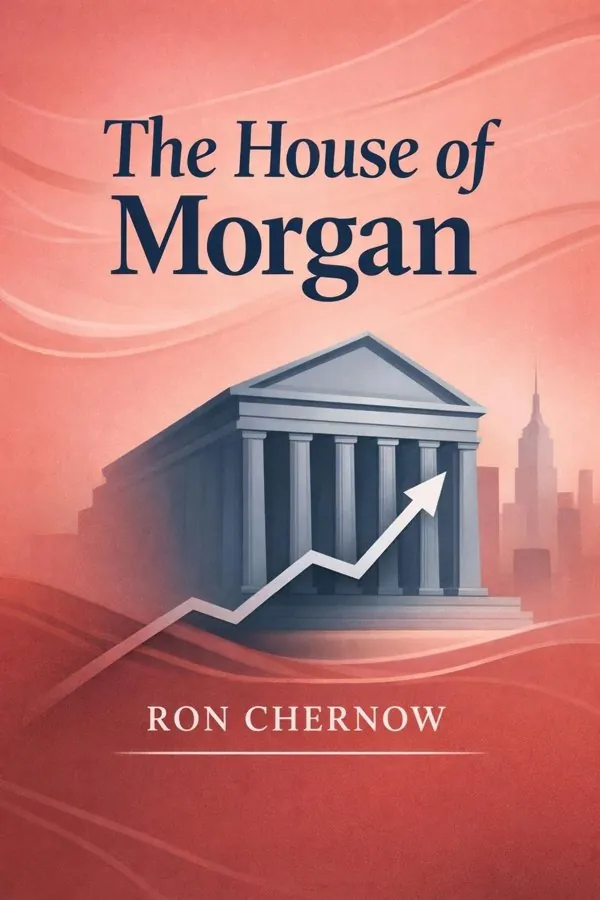
The House of Morgan: An American Banking Dynasty and the Rise of Modern Finance: Summary & Key Insights
by Ron Chernow
 10 min6 chaptersAudio available
What Is The House of Morgan: An American Banking Dynasty and the Rise of Modern Finance About?
The House of Morgan: An American Banking Dynasty and the Rise of Modern Finance by Ron Chernow is a economics book spanning 6 pages. The House of Morgan es una obra de no ficción que narra la historia de la dinastía bancaria Morgan y su papel en el desarrollo de las finanzas modernas. Ron Chernow ofrece una crónica detallada de cómo la familia Morgan y sus bancos moldearon la economía estadounidense y mundial desde el siglo XIX hasta el siglo XX, explorando las personalidades, las estrategias financieras y las transformaciones sociales que acompañaron su ascenso.
This FizzRead summary covers all 6 key chapters of The House of Morgan: An American Banking Dynasty and the Rise of Modern Finance in approximately 10 minutes, distilling the most important ideas, arguments, and takeaways from Ron Chernow's work. Also available as an audio summary and Key Quotes Podcast.
The House of Morgan: An American Banking Dynasty and the Rise of Modern Finance
The House of Morgan es una obra de no ficción que narra la historia de la dinastía bancaria Morgan y su papel en el desarrollo de las finanzas modernas. Ron Chernow ofrece una crónica detallada de cómo la familia Morgan y sus bancos moldearon la economía estadounidense y mundial desde el siglo XIX hasta el siglo XX, explorando las personalidades, las estrategias financieras y las transformaciones sociales que acompañaron su ascenso.
Who Should Read The House of Morgan: An American Banking Dynasty and the Rise of Modern Finance?
This book is perfect for anyone interested in economics and looking to gain actionable insights in a short read. Whether you're a student, professional, or lifelong learner, the key ideas from The House of Morgan: An American Banking Dynasty and the Rise of Modern Finance by Ron Chernow will help you think differently.
- ✓Readers who enjoy economics and want practical takeaways
- ✓Professionals looking to apply new ideas to their work and life
- ✓Anyone who wants the core insights of The House of Morgan: An American Banking Dynasty and the Rise of Modern Finance in just 10 minutes
Want the full summary?
Get instant access to this book summary and 100K+ more with Fizz Moment.
Get Free SummaryAvailable on App Store • Free to download
Key Chapters
Every dynasty begins with a foundation, and for the Morgans, that foundation was laid in London, not New York. When Junius Spencer Morgan took the reins of the firm that would eventually bear his family’s name, the world of finance was a gentleman’s domain—a place where reputation was currency and credit rested on the perceived character of the banker himself.
Junius Morgan understood this world intimately. He was precise, reserved, and disciplined, a man who considered banking to be a moral profession. Working under George Peabody & Co., Junius built a business where trust was treated as sacred. In an era before deposit insurance or federal oversight, the firm’s stability depended entirely on the public’s faith in a banker’s word. Junius’s London operation thrived on that faith, creating a link between American enterprise and European capital that would outlast empires.
Junius’s task was not glamorous; it was about establishing credibility across oceans. He financed railroads, issued bonds, and cultivated relationships with aristocrats and industrialists alike. His success laid the groundwork for what would become the world’s most powerful private bank—a transatlantic bridge between old-world finance and the new industrial America.
In retrospect, Junius represents the moral roots of the Morgan identity. His sense of stewardship, his devotion to probity, and his insistence that banking was a calling rather than a hustle became the unwritten constitution of the Morgan firm. When we later see J. Pierpont Morgan dominating boardrooms and governments, we see the iron bones of his father’s discipline beneath the grandeur.
J. Pierpont Morgan transformed banking into empire-building. When he inherited the firm, the United States was entering a new age of scale—railroads crisscrossed the continent, steel mills roared, and trusts began to dominate industries once ruled by small producers. Pierpont saw in this chaos not disorder but opportunity. He believed that consolidation would bring stability and order to an economy torn by violent cycles of boom and bust.
Morgan was a man of paradox: deeply religious, fiercely proud, almost brutal in temperament, yet capable of astonishing subtlety in negotiation. His method was simple but revolutionary—he didn’t just fund corporations; he reorganized them. He brought warring executives into marble chambers, forced mergers, imposed discipline, and placed trusted lieutenants in key posts. In doing so, he created what we now call ‘corporate governance.’ To finance was, in his mind, to arbitrate civilization.
When Morgan built U.S. Steel in 1901, combining Carnegie, Frick, and other producers into the world’s first billion-dollar corporation, he didn’t merely celebrate a triumph of capital; he ushered America into the modern industrial era. For the first time, finance was seen as the invisible hand behind production itself.
His dominance drew awe and resentment alike. The public saw him as a deity of money; reformers saw him as a usurper of democratic control. He bailed out the Treasury in 1895, stabilized markets in panics, and in 1907 personally orchestrated the rescue of American finance. In that moment, he was not only a banker but a national savior—a symbol of both power’s potential and its peril.
+ 4 more chapters — available in the FizzRead app
All Chapters in The House of Morgan: An American Banking Dynasty and the Rise of Modern Finance
About the Author
Ron Chernow es un historiador y biógrafo estadounidense reconocido por sus obras sobre figuras influyentes en la historia financiera y política de Estados Unidos. Ganador del National Book Award, Chernow es autor de biografías de Alexander Hamilton, George Washington y John D. Rockefeller, entre otros.
Get This Summary in Your Preferred Format
Read or listen to the The House of Morgan: An American Banking Dynasty and the Rise of Modern Finance summary by Ron Chernow anytime, anywhere. FizzRead offers multiple formats so you can learn on your terms — all free.
Available formats: App · Audio · PDF · EPUB — All included free with FizzRead
Download The House of Morgan: An American Banking Dynasty and the Rise of Modern Finance PDF and EPUB Summary
Key Quotes from The House of Morgan: An American Banking Dynasty and the Rise of Modern Finance
“Every dynasty begins with a foundation, and for the Morgans, that foundation was laid in London, not New York.”
“Pierpont Morgan transformed banking into empire-building.”
Frequently Asked Questions about The House of Morgan: An American Banking Dynasty and the Rise of Modern Finance
The House of Morgan: An American Banking Dynasty and the Rise of Modern Finance by Ron Chernow is a economics book that explores key ideas across 6 chapters. The House of Morgan es una obra de no ficción que narra la historia de la dinastía bancaria Morgan y su papel en el desarrollo de las finanzas modernas. Ron Chernow ofrece una crónica detallada de cómo la familia Morgan y sus bancos moldearon la economía estadounidense y mundial desde el siglo XIX hasta el siglo XX, explorando las personalidades, las estrategias financieras y las transformaciones sociales que acompañaron su ascenso.
More by Ron Chernow



You Might Also Like
Business Adventures
John Brooks
10 min
Nudge
Richard H. Thaler, Cass R. Sunstein
10 min
The Hitchhiker"s Guide to the Galaxy
Douglas Adams
10 minThe Muqaddimah
Ibn Khaldun
10 minThe Outsiders
William N. Thorndike
10 min
A Little History of Economics
Niall Kishtainy
10 minBrowse by Category
Ready to read The House of Morgan: An American Banking Dynasty and the Rise of Modern Finance?
Get the full summary and 100K+ more books with Fizz Moment.