
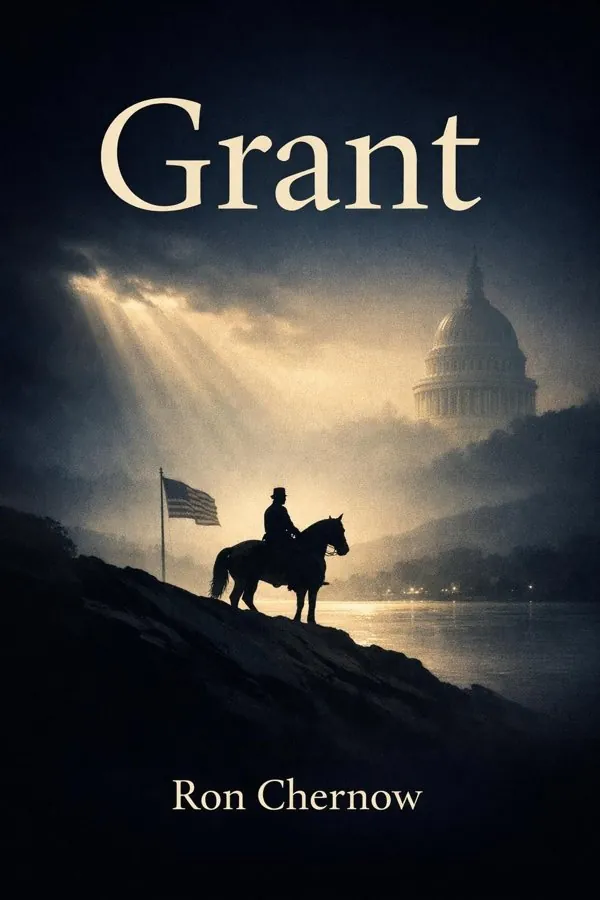
Grant: Summary & Key Insights
by Ron Chernow
 10 min9 chaptersAudio available
Key Takeaways from Grant
Great leaders do not always announce themselves early.
Public success often rests on private humiliation.
In moments of national crisis, hesitation can cost more than error.
The clearest proof of leadership is not confidence but results under complex conditions.
Winning a just cause does not make the struggle clean or emotionally easy.
What Is Grant About?
Grant by Ron Chernow is a biographies book spanning 6 pages. Ron Chernow’s Grant is a sweeping biography of Ulysses S. Grant that restores depth, dignity, and complexity to one of the most underestimated figures in American history. Rather than repeating old stereotypes of Grant as a dull general, a drunk, or a failed president, Chernow reconstructs a life marked by persistence, moral clarity, and unusual humility. The book follows Grant from his modest Ohio childhood to West Point, from years of failure and obscurity to his emergence as the Union’s most decisive Civil War commander, and finally through the triumphs and disappointments of his presidency and final years. What makes this biography especially important is that Chernow shows how Grant’s character—steady, loyal, humane, and often underestimated—shaped both military victory and the nation’s unfinished struggle for racial justice after the Civil War. Chernow, one of America’s most respected biographers, brings exhaustive research and graceful storytelling to the task. The result is not just the life of a man, but a fresh interpretation of leadership, courage, and historical memory itself.
This FizzRead summary covers all 9 key chapters of Grant in approximately 10 minutes, distilling the most important ideas, arguments, and takeaways from Ron Chernow's work. Also available as an audio summary and Key Quotes Podcast.
Grant
Ron Chernow’s Grant is a sweeping biography of Ulysses S. Grant that restores depth, dignity, and complexity to one of the most underestimated figures in American history. Rather than repeating old stereotypes of Grant as a dull general, a drunk, or a failed president, Chernow reconstructs a life marked by persistence, moral clarity, and unusual humility. The book follows Grant from his modest Ohio childhood to West Point, from years of failure and obscurity to his emergence as the Union’s most decisive Civil War commander, and finally through the triumphs and disappointments of his presidency and final years. What makes this biography especially important is that Chernow shows how Grant’s character—steady, loyal, humane, and often underestimated—shaped both military victory and the nation’s unfinished struggle for racial justice after the Civil War. Chernow, one of America’s most respected biographers, brings exhaustive research and graceful storytelling to the task. The result is not just the life of a man, but a fresh interpretation of leadership, courage, and historical memory itself.
Who Should Read Grant?
This book is perfect for anyone interested in biographies and looking to gain actionable insights in a short read. Whether you're a student, professional, or lifelong learner, the key ideas from Grant by Ron Chernow will help you think differently.
- ✓Readers who enjoy biographies and want practical takeaways
- ✓Professionals looking to apply new ideas to their work and life
- ✓Anyone who wants the core insights of Grant in just 10 minutes
Want the full summary?
Get instant access to this book summary and 100K+ more with Fizz Moment.
Get Free SummaryAvailable on App Store • Free to download
Key Chapters
Great leaders do not always announce themselves early. One of Chernow’s central achievements is showing that Grant’s later greatness was rooted not in charisma or self-promotion, but in traits that looked almost ordinary in youth: self-control, endurance, modesty, and an aversion to empty display. Born in 1822 in Point Pleasant, Ohio, and raised in a household shaped by hard work and stern values, Grant developed a temperament that was inward, observant, and emotionally disciplined. He disliked cruelty, hated boasting, and found comfort in animals, especially horses, which he handled with unusual skill and gentleness.
His father, Jesse Grant, was ambitious and energetic, while Grant himself was quiet and resistant to grandstanding. That tension shaped him. He learned how to function around stronger personalities without becoming one himself. At West Point, where a clerical error gave him the name Ulysses S. Grant, he did not stand out as a dazzling scholar or natural social leader. Yet he proved reliable, calm under pressure, and highly competent with horses and logistics. Those traits mattered later far more than youthful brilliance would have.
Chernow makes an important point: character often forms in unglamorous settings. Grant’s reserve was frequently mistaken for passivity, but it concealed unusual steadiness. In crises, he would become more focused, not less. In a world that often rewards noise, he embodied the power of restraint.
In practical terms, this part of Grant’s life reminds readers that strengths are often misread early on. A person who is not theatrical may still be deeply capable. Quiet people can build influence through consistency, emotional balance, and trustworthiness.
Actionable takeaway: Pay attention to understated strengths—in yourself and others. Reliability, composure, and humility may become your greatest advantages when pressure rises.
Public success often rests on private humiliation. Before Grant became the victorious general of the Union, he spent years looking like a disappointment. After serving with distinction in the Mexican-American War, he resigned from the army in 1854 amid isolation, financial strain, and persistent rumors tied to drinking. His civilian life then became a sequence of frustrations: failed farming, poor business ventures, dependence on relatives, and a humbling return to work in his father’s leather goods store in Galena, Illinois.
These years matter because Chernow refuses to treat them as a mere gap between military achievements. They were formative. Grant learned what insecurity felt like. He knew embarrassment, debt, and the erosion of social standing. Unlike men born into stable prestige, he had direct experience with uncertainty and personal defeat. That suffering deepened his empathy and stripped away vanity. It also taught him persistence. He kept going without self-dramatizing his hardship.
When the Civil War began, Grant was not a polished celebrity waiting for his chance. He was a man who had already been tested by obscurity. That made him unusually fit for command. He did not need glamour. He needed purpose. Once given responsibility, he moved decisively because he had little illusion left about life’s fragility.
There is a practical lesson here for modern readers. Career setbacks, stalled ambitions, and periods of underemployment can feel defining in the worst way. But Chernow’s portrait of Grant suggests that failure can become preparation rather than verdict. Difficult years can produce resilience, realism, and freedom from ego—qualities that later make strong leadership possible.
Actionable takeaway: Reframe personal setbacks as training. Instead of asking whether a failure disqualifies you, ask what discipline, humility, or insight it is building for the next chapter.
In moments of national crisis, hesitation can cost more than error. Grant’s rise during the Civil War came from a quality Chernow highlights repeatedly: he was willing to act. While many Union generals hesitated, exaggerated enemy strength, or became paralyzed by caution, Grant moved. Early victories at Fort Henry and Fort Donelson made him a national figure and introduced his defining military demand: “unconditional surrender.” It was not theatrical bravado; it signaled resolve.
Even his setbacks revealed his nature. At Shiloh, where Union forces suffered shocking casualties, Grant was criticized for surprise and disorder. Yet he did not collapse psychologically. He held on, reorganized, and fought through the chaos. Chernow presents this as a key distinction: Grant absorbed battlefield shock without losing strategic clarity. He understood that war at that scale would be brutal and that recoiling from its reality would only prolong it.
Grant’s leadership style combined aggression with practical intelligence. He valued coordinated action, logistics, timing, and pressure. He was not a romantic warrior seeking glorious maneuvers; he was a realist trying to win. That realism set him apart from commanders who confused caution with wisdom. He accepted that decisive campaigns involve risk, but he also saw that inactivity carries its own hidden dangers.
This has broad application beyond military history. Many institutions fail not because leaders lack intelligence, but because they overprotect themselves from criticism and delay difficult choices. Grant’s example suggests that informed decisiveness often beats elegant hesitation.
Actionable takeaway: When you have enough evidence and a clear objective, act. Don’t wait for perfect certainty if delay itself strengthens the problem you need to solve.
The clearest proof of leadership is not confidence but results under complex conditions. Chernow shows that Grant’s campaigns at Vicksburg and Chattanooga revealed him as more than a tenacious fighter; they established him as a master strategist capable of integrating logistics, geography, morale, and timing into coherent victory.
At Vicksburg, Grant faced one of the Confederacy’s strongest positions, guarding control of the Mississippi River. Repeated conventional approaches failed, and pressure mounted. Instead of clinging rigidly to one plan, Grant adapted. He moved troops south of the city, crossed the river, cut loose from traditional supply lines, and struck inland with bold speed. This campaign required nerve and trust in his own judgment. By isolating and eventually capturing Vicksburg on July 4, 1863, Grant split the Confederacy and gave the Union control of the Mississippi—one of the war’s decisive strategic achievements.
At Chattanooga, he inherited a demoralized Union situation and transformed it quickly. He stabilized command, improved supply routes, coordinated with capable subordinates, and turned a near-defeat into a major victory. Chernow emphasizes that Grant excelled not merely by commanding troops, but by creating conditions in which others could perform effectively.
What makes these campaigns enduringly relevant is their lesson in adaptive thinking. Grant did not worship procedure. He used plans as tools, not chains. When circumstances changed, he changed with them without losing sight of the larger goal.
In everyday leadership, the same principle applies. Whether running a team, a project, or a company, you often need to distinguish between the mission and the method. Sticking stubbornly to a failed approach can feel disciplined, but it is often just fear disguised as consistency.
Actionable takeaway: Protect the objective, not the original plan. When reality changes, adapt boldly while keeping your larger purpose fixed.
Winning a just cause does not make the struggle clean or emotionally easy. In the final campaigns against Robert E. Lee, Grant emerged as the Union’s indispensable commander, but Chernow is careful not to romanticize this stage. Grant’s Overland Campaign and the siege of Petersburg were costly, exhausting, and controversial. Critics labeled him a butcher because of the heavy casualties. Yet Chernow argues that this judgment misses the strategic and moral reality Grant faced.
Grant understood that the Confederacy could not be defeated through limited gestures or symbolic victories. The war had to be brought to conclusion through sustained pressure on all fronts. Unlike earlier Union generals who withdrew after setbacks, Grant kept advancing. He coordinated with Sherman and others to ensure that the Confederacy faced unrelenting force. This was not mindless attrition. It was a recognition that partial war was prolonging national agony and slavery’s survival.
At Appomattox, Grant’s greatness appeared in a different form: magnanimity. He offered generous terms to Lee’s defeated army, allowing officers to keep sidearms and soldiers to take horses home for spring planting. He wanted reunion without humiliation. Chernow presents this as a defining combination in Grant: toughness in pursuit of victory, restraint in the moment of triumph.
This dual capacity matters deeply in modern leadership. Sometimes people learn how to compete but not how to conclude conflict wisely. Grant shows that strength includes knowing when to press hard and when to lower the temperature.
Actionable takeaway: In high-stakes conflict, stay firm on essentials but humane in victory. Lasting resolution depends not only on defeating opposition, but on shaping what comes after.
It is easier to win a war than to govern its aftermath. Chernow’s treatment of Grant’s presidency is one of the biography’s most revisionist and valuable contributions. Long dismissed as corrupt and politically naive, Grant emerges here as a sincere and often admirable president whose real failures existed alongside significant moral courage and constitutional seriousness.
Grant entered office in 1869 with enormous prestige but limited political experience. He struggled with appointments, trusted some unworthy associates, and presided over an administration tainted by scandals involving subordinates. Chernow does not excuse these weaknesses. Grant’s loyalty could become blindness, and his desire to see the best in friends made him vulnerable to manipulation.
Yet reducing his presidency to scandal misses the larger record. Grant aggressively defended Reconstruction, fought white supremacist terrorism in the South, supported federal enforcement against the Ku Klux Klan, and sought to protect the civil and voting rights of formerly enslaved people. He also pursued a more humane policy toward Native Americans than many of his contemporaries, even if its results were mixed and constrained by broader forces.
Chernow’s larger point is that peacetime leadership requires different skills from wartime command. Institutions, coalitions, and politics are murkier than battlefields. Grant did not master all of them. But he brought to the presidency an ethical seriousness that matters, especially on racial justice.
The practical lesson is that success in one domain does not automatically translate to another, but moral conviction still matters when technical mastery is incomplete. Leaders should build systems around their weaknesses rather than assuming past victories make them universally effective.
Actionable takeaway: Know where your strengths stop. If you lead in a new arena, pair integrity with stronger processes, better advisers, and clearer accountability.
A person’s true beliefs are often clearest not in speeches, but in whom they are willing to defend when it becomes politically costly. Chernow argues that Grant��s deepest moral significance lies in his commitment to Black citizenship after the Civil War. This is one of the biography’s most important corrective points. Grant was not merely the general who preserved the Union; he became a central defender of the attempt to create a more equal republic.
During Reconstruction, violent white supremacist groups sought to overturn emancipation through intimidation, murder, and fraud. Grant understood that without federal protection, freedom would become hollow. He backed legislation and enforcement measures designed to suppress the Ku Klux Klan and preserve Black voting rights. He used presidential authority more forcefully than many later leaders would in defense of civil rights.
Chernow also shows that Grant’s racial views evolved. Exposure to war, emancipation, and the realities of Southern violence sharpened his sense of justice. He increasingly recognized that the former Confederacy’s resistance was not just political but racial and terroristic. While he was still a man of his time, he proved far more progressive in action than many of his contemporaries.
This matters because historical reputations often center military success while ignoring moral choices in governance. Grant’s legacy is inseparable from his effort to make Union victory mean something for the formerly enslaved.
For readers today, this section offers a powerful reminder that legal change is never self-executing. Rights require protection, enforcement, and political will. Good intentions without institutional action accomplish little.
Actionable takeaway: If you care about justice, move beyond symbolic support. Ask what structures, enforcement, and personal risk are required to defend vulnerable people in practice.
The virtues that elevate a person can also expose them. One of Chernow’s most nuanced insights is that Grant’s famous loyalty—so central to his friendships, command style, and public service—was both noble and dangerous. He inspired devotion because he himself was deeply loyal. He stood by subordinates after setbacks, trusted old companions, and recoiled from betrayal. This helped create effective military partnerships and fostered a culture of confidence among officers who knew he would not panic at adversity.
But the same trait damaged his presidency and finances. Grant repeatedly gave trust to people who did not deserve it. He was uncomfortable with suspicion, slow to detect deception, and often inclined to defend associates too long. Political opportunists and financial schemers recognized this. Late in life, he was disastrously swindled by Ferdinand Ward, whose fraudulent investment firm wiped out Grant’s savings.
Chernow does not present this as mere gullibility. Rather, it reflects a deeper ethical structure in Grant. He believed in honor and had difficulty imagining the full depth of calculated dishonor in others. That is admirable in spirit, but costly in systems that reward scrutiny.
This pattern is highly relevant today. Many leaders pride themselves on trust and loyalty, yet fail to build safeguards against abuse. Healthy trust is not the absence of verification. In fact, strong relationships often depend on transparent accountability.
Whether in business, family, or public life, Grant’s example shows that character is not enough by itself. Good motives need protective structures. Loyalty should strengthen judgment, not replace it.
Actionable takeaway: Trust generously, but verify consistently. Build checks, ask hard questions, and remember that integrity requires boundaries as well as devotion.
Sometimes a person’s last and greatest act is not physical but intellectual. In the final stage of Grant’s life, bankrupt, gravely ill with throat cancer, and racing against death, he undertook the writing of his Personal Memoirs. Chernow treats this episode as one of the most moving and revealing sections of the entire biography. It transformed Grant from a man acted upon by misfortune into an author reclaiming his narrative and securing his family’s future.
Encouraged by Mark Twain, Grant wrote under enormous pressure. He was in severe pain, physically weakened, and financially desperate after being ruined by fraud. Yet he produced prose of remarkable clarity, restraint, and force. The Memoirs were not sentimental self-justification. They reflected the same qualities that defined his life at its best: precision, modesty, and directness. In literary terms, they became a classic of military autobiography. In personal terms, they ensured financial support for Julia Grant after his death.
Chernow uses this period to make a larger point about dignity. Grant could no longer command armies or shape policy, but he could still think, write, and impose order on experience. He turned suffering into disciplined creation. That is a powerful model for anyone confronting limitation, illness, or loss.
This final chapter also reminds readers that legacy is not fixed by enemies or critics. It can be reclaimed through honest work, even at the edge of life. Grant’s Memoirs became his last campaign—and one of his finest victories.
Actionable takeaway: When circumstances narrow your options, focus on the meaningful work still within your control. Purpose, clearly pursued, can outlast decline and restore agency.
All Chapters in Grant
About the Author
Ron Chernow is an American historian, biographer, and former journalist known for producing expansive, deeply researched lives of major historical figures. He first gained wide recognition with books on finance and business leaders, then became one of the country’s best-known biographers through acclaimed works on John D. Rockefeller, J. P. Morgan, George Washington, Alexander Hamilton, and Ulysses S. Grant. Chernow’s writing is valued for its narrative clarity, archival depth, and ability to humanize iconic figures without flattening their contradictions. His biography Alexander Hamilton had an especially large cultural impact, helping inspire the hit musical Hamilton. In Grant, Chernow applies the same strengths—scholarly rigor, vivid storytelling, and revisionist insight—to restore complexity and stature to a long-misunderstood American leader.
Get This Summary in Your Preferred Format
Read or listen to the Grant summary by Ron Chernow anytime, anywhere. FizzRead offers multiple formats so you can learn on your terms — all free.
Available formats: App · Audio · PDF · EPUB — All included free with FizzRead
Download Grant PDF and EPUB Summary
Key Quotes from Grant
“Great leaders do not always announce themselves early.”
“Public success often rests on private humiliation.”
“In moments of national crisis, hesitation can cost more than error.”
“The clearest proof of leadership is not confidence but results under complex conditions.”
“Winning a just cause does not make the struggle clean or emotionally easy.”
Frequently Asked Questions about Grant
Grant by Ron Chernow is a biographies book that explores key ideas across 9 chapters. Ron Chernow’s Grant is a sweeping biography of Ulysses S. Grant that restores depth, dignity, and complexity to one of the most underestimated figures in American history. Rather than repeating old stereotypes of Grant as a dull general, a drunk, or a failed president, Chernow reconstructs a life marked by persistence, moral clarity, and unusual humility. The book follows Grant from his modest Ohio childhood to West Point, from years of failure and obscurity to his emergence as the Union’s most decisive Civil War commander, and finally through the triumphs and disappointments of his presidency and final years. What makes this biography especially important is that Chernow shows how Grant’s character—steady, loyal, humane, and often underestimated—shaped both military victory and the nation’s unfinished struggle for racial justice after the Civil War. Chernow, one of America’s most respected biographers, brings exhaustive research and graceful storytelling to the task. The result is not just the life of a man, but a fresh interpretation of leadership, courage, and historical memory itself.
More by Ron Chernow

You Might Also Like
An American Marriage
Tayari Jones
10 min
Benjamin Franklin: An American Life
Walter Isaacson
10 min
I Know Why The Caged Bird Sings
Maya Angelou
10 min
Long Walk to Freedom
Nelson Mandela
10 min
Persepolis
Marjane Satrapi
10 min
Surely You're Joking, Mr. Feynman!
Richard P. Feynman
10 minBrowse by Category
Ready to read Grant?
Get the full summary and 100K+ more books with Fizz Moment.