
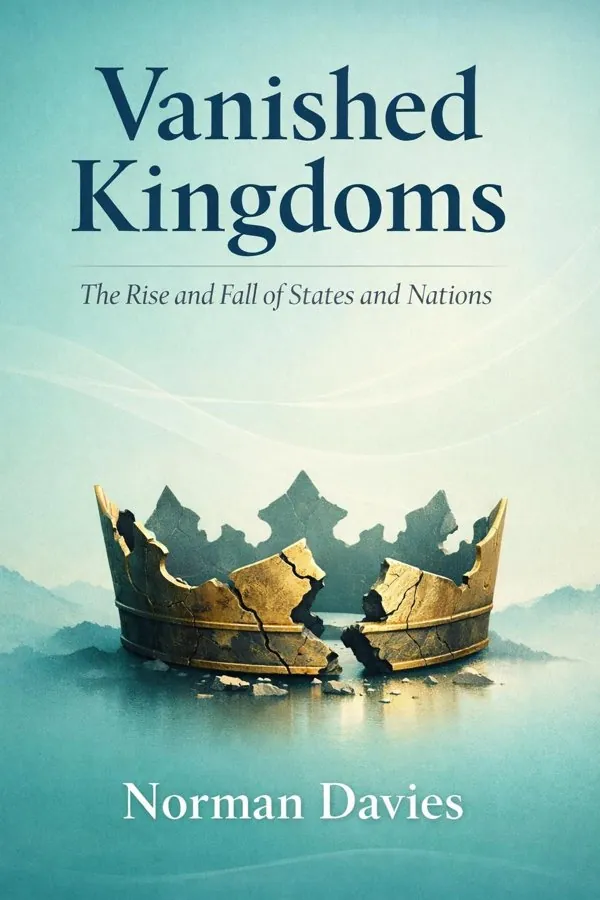
Vanished Kingdoms: The Rise and Fall of States and Nations: Summary & Key Insights
 10 min9 chaptersAudio available
Key Takeaways from Vanished Kingdoms: The Rise and Fall of States and Nations
A modern map looks definitive, but history rarely is.
States do not survive only by being strong; often, they survive by being adaptable.
Brilliance can make a state famous, but it cannot guarantee survival.
The idea that one state must equal one people is far newer than many assume.
Few vanished states are as paradoxical as Prussia: a polity so successful that it helped create a larger power that eventually consumed its own identity.
What Is Vanished Kingdoms: The Rise and Fall of States and Nations About?
Vanished Kingdoms: The Rise and Fall of States and Nations by Norman Davies is a world_history book spanning 6 pages. What if the political map of Europe is not a stable record of reality, but only the latest draft in a very long and unfinished story? In Vanished Kingdoms, historian Norman Davies explores the states, kingdoms, duchies, and political experiments that once shaped Europe but later disappeared from the map. Rather than treating today’s nations as inevitable, he shows how fragile borders, identities, and sovereignties really are. Through vivid case studies—from Burgundy and Aragon to Lithuania, Prussia, and the Soviet Union—Davies reconstructs worlds that were once powerful, culturally rich, and historically consequential, yet are now often overlooked or simplified in national histories. The book matters because it challenges modern assumptions about nationhood, reminding readers that political legitimacy is often retrospective and selective. Davies is especially qualified to make this argument: a major British historian of Europe with deep expertise in Central and Eastern Europe, he combines narrative flair, archival breadth, and a rare ability to connect forgotten states to enduring questions about memory, identity, and power.
This FizzRead summary covers all 9 key chapters of Vanished Kingdoms: The Rise and Fall of States and Nations in approximately 10 minutes, distilling the most important ideas, arguments, and takeaways from Norman Davies's work. Also available as an audio summary and Key Quotes Podcast.
Vanished Kingdoms: The Rise and Fall of States and Nations
What if the political map of Europe is not a stable record of reality, but only the latest draft in a very long and unfinished story? In Vanished Kingdoms, historian Norman Davies explores the states, kingdoms, duchies, and political experiments that once shaped Europe but later disappeared from the map. Rather than treating today’s nations as inevitable, he shows how fragile borders, identities, and sovereignties really are. Through vivid case studies—from Burgundy and Aragon to Lithuania, Prussia, and the Soviet Union—Davies reconstructs worlds that were once powerful, culturally rich, and historically consequential, yet are now often overlooked or simplified in national histories. The book matters because it challenges modern assumptions about nationhood, reminding readers that political legitimacy is often retrospective and selective. Davies is especially qualified to make this argument: a major British historian of Europe with deep expertise in Central and Eastern Europe, he combines narrative flair, archival breadth, and a rare ability to connect forgotten states to enduring questions about memory, identity, and power.
Who Should Read Vanished Kingdoms: The Rise and Fall of States and Nations?
This book is perfect for anyone interested in world_history and looking to gain actionable insights in a short read. Whether you're a student, professional, or lifelong learner, the key ideas from Vanished Kingdoms: The Rise and Fall of States and Nations by Norman Davies will help you think differently.
- ✓Readers who enjoy world_history and want practical takeaways
- ✓Professionals looking to apply new ideas to their work and life
- ✓Anyone who wants the core insights of Vanished Kingdoms: The Rise and Fall of States and Nations in just 10 minutes
Want the full summary?
Get instant access to this book summary and 100K+ more with Fizz Moment.
Get Free SummaryAvailable on App Store • Free to download
Key Chapters
A modern map looks definitive, but history rarely is. One of Norman Davies’s central insights is that political maps create an illusion of permanence. Borders appear clean, nations appear fixed, and statehood seems like a natural outcome of long historical development. Yet Europe’s past tells a different story: countless realms once commanded loyalty, raised armies, minted coins, produced literature, and shaped culture, only to vanish or be absorbed into larger powers. The map we inherit is the result of conflict, negotiation, forgetting, and retrospective storytelling.
Davies uses vanished states to expose how misleading modern assumptions can be. We tend to read history backwards, imagining that France, Germany, Italy, or Russia were always destined to exist in their current forms. But Burgundy, the Crown of Aragon, the Grand Duchy of Lithuania, and Prussia all remind us that alternative Europes once seemed equally plausible. Their disappearance was not proof of insignificance; it was often the result of war, dynastic accidents, ideological change, or imperial conquest.
This perspective has practical value well beyond historical study. It helps readers question simplistic narratives in politics, journalism, and education. When modern leaders speak as if national borders are sacred or identities are timeless, history urges caution. It also improves how we interpret regional movements today, from debates over autonomy to disputes over heritage and memory.
A useful application is to compare any current nation-state with one vanished polity from the same region. Ask what institutions, languages, and loyalties existed before the present arrangement. The result is usually humbling. Actionable takeaway: whenever you encounter a political map, treat it not as the final truth, but as one temporary snapshot in a much longer historical process.
States do not survive only by being strong; often, they survive by being adaptable. The Grand Duchy of Lithuania is one of Davies’s most striking examples of a forgotten power that became vast not through rigid uniformity, but through political flexibility. Emerging in the medieval period, Lithuania expanded into a large and diverse realm stretching from the Baltic toward the Black Sea. It governed peoples of different languages, religions, and legal traditions, and for a time it proved remarkably capable of balancing variety without immediate collapse.
Davies shows that Lithuania’s greatness rested partly on its willingness to accommodate difference. Rather than impose a single identity overnight, it often incorporated existing elites and customs. This made expansion and governance possible across an enormous territory. At the same time, that very pluralism created long-term tensions. Union with Poland transformed Lithuania’s role, and later partitions and imperial pressures obscured its earlier status as a major European actor.
The story matters because it complicates modern ideas about nationhood. We often assume that successful states require a single language, uniform culture, and centralized identity. Lithuania demonstrates that premodern political success could rest on looser, layered forms of belonging. It also shows how later historical memory can shrink a once-large state into a narrowly national story.
In practical terms, Lithuania offers lessons for organizations, institutions, and modern states alike. Diverse systems can work when they respect local realities and create shared purpose without demanding total sameness. But they also need durable institutions that can translate flexibility into continuity.
Actionable takeaway: when managing diversity—whether in a country, company, or community—do not mistake uniformity for strength. Build structures that can hold difference together while preserving a common framework.
Brilliance can make a state famous, but it cannot guarantee survival. The Kingdom or state complex of Burgundy represents one of Europe’s most dazzling lost possibilities. Positioned between French and German spheres, Burgundy became a center of wealth, courtly culture, trade, diplomacy, and artistic achievement. Under the Valois dukes, it looked like a rising great power, one that might have altered the balance of Europe permanently.
Davies presents Burgundy as more than a romantic medieval curiosity. Its importance lies in its hybridity. It drew together territories with different customs and political traditions, turning strategic geography into commercial and cultural strength. Flemish cities, aristocratic chivalry, and ambitious statecraft combined to produce a polity that was wealthy, sophisticated, and influential. Yet Burgundy’s success also exposed its vulnerability. Dynastic dependence, geopolitical pressure, and the ambitions of neighboring powers made its position precarious.
The death of Charles the Bold and the partition of Burgundian inheritance show how quickly apparent greatness can unravel. A state may possess riches, prestige, and momentum, but if its institutions are fragile or its succession insecure, it can disintegrate with startling speed. Burgundy therefore becomes a case study in the limits of glamour and the danger of overpersonalized power.
This has modern relevance. Businesses, political movements, and even nations can become captivated by image, growth, and elite prestige while neglecting succession planning, institutional depth, and resilience. A flourishing center may mask structural weakness.
To apply the lesson, look beyond surface indicators of success. Ask whether a system can survive the loss of a charismatic leader, a strategic shock, or a sudden redistribution of assets. Actionable takeaway: admire achievement, but always test whether it rests on durable institutions or on unstable brilliance.
The idea that one state must equal one people is far newer than many assume. The Crown of Aragon, one of Davies’s most illuminating examples, demonstrates that political communities in Europe were often composite arrangements rather than neatly unified nations. Aragon was not a single, homogeneous realm but a federation-like monarchy that included territories such as Aragon proper, Catalonia, Valencia, and Mediterranean possessions with distinct laws, customs, and interests.
Davies uses Aragon to show that statehood historically often meant negotiated coexistence. Different regions could share a ruler while retaining institutions, privileges, and legal identities. This arrangement was not a flaw but a workable political model for centuries. Aragon’s maritime reach, commercial energy, and constitutional traditions made it a significant Mediterranean power. Yet over time, dynastic unions, changing imperial priorities, and later centralizing pressures reduced its distinct political role.
The larger lesson is that political unity does not always require cultural or administrative uniformity. Modern debates often frame decentralization, regional autonomy, or federalism as signs of weakness. Aragon suggests the opposite: layered sovereignty can be a source of vitality when properly managed. At the same time, it also reveals the difficulty of maintaining balance when larger national projects begin to privilege central authority and standardized identity.
Readers can apply this insight to current debates about regionalism, constitutional design, and multinational states. Whether in Spain, the United Kingdom, or the European Union, tensions between center and periphery are not historical anomalies; they are recurring features of political life.
Actionable takeaway: when evaluating conflicts over autonomy, do not default to an all-or-nothing view of sovereignty. Consider whether shared rule plus preserved local identity may offer a more historically grounded and workable solution.
Few vanished states are as paradoxical as Prussia: a polity so successful that it helped create a larger power that eventually consumed its own identity. Davies treats Prussia not simply as a militaristic stereotype, but as a historical formation that evolved from an electorate into a kingdom and then into a dominant force in German affairs. Its administrative discipline, military efficiency, and state-building capacity gave it influence far beyond its original scale.
Prussia’s rise reveals how institutions, strategy, and elite discipline can turn a relatively limited state into a major actor. It cultivated a reputation for order, competence, and seriousness, qualities that allowed it to punch above its weight in European politics. Yet Davies also shows the cost of success. As Prussia became the engine of German unification, its distinctness was transformed. The state that forged a nation eventually became difficult to separate from that nation, and after the catastrophes of the twentieth century, Prussia itself was formally abolished and morally discredited.
This makes Prussia a warning against historical simplification. A state can be admirable in some institutional respects and deeply implicated in destructive political outcomes. It also reminds us that power often changes the identity of the power-holder. Success at one scale may erase what made an entity distinctive in the first place.
In practical terms, this applies to organizations that grow through mergers, market dominance, or centralization. Expansion may achieve strategic goals while dissolving the original culture or mission. Leaders must ask not only whether they can grow, but what growth will turn them into.
Actionable takeaway: when pursuing success, define what must be preserved. Growth that destroys the identity, ethics, or purpose of the institution may be a hidden form of failure.
Some vanished kingdoms disappeared centuries ago; others vanished within living memory. The Soviet Union gives Davies a modern example of how immense power can collapse with shocking speed. For much of the twentieth century, the USSR appeared permanent: militarily formidable, ideologically expansive, and geopolitically central. It governed a vast territory, projected a universal mission, and seemed to embody a durable alternative to Western liberal capitalism. Yet it, too, disappeared from the map.
Davies uses the Soviet case to connect the old story of vanished states with modern assumptions about inevitability. The USSR did not fall because it lacked power in a narrow sense. It fell because coercive unity, economic strain, ideological exhaustion, national tensions, and elite miscalculation eroded the foundations of the state. Its official image of permanence could not compensate for declining legitimacy. Once the structure weakened, multiple suppressed identities and grievances resurfaced rapidly.
The Soviet Union also demonstrates how empires and federations often maintain coherence through narratives as much as through force. When the narrative fails, institutions can unravel faster than outside observers expect. This is why Davies’s broader argument matters: disappearance is not merely an ancient phenomenon but a recurring political possibility.
Modern readers can apply this lesson to any large system that appears unshakable—states, corporations, alliances, even technologies. Scale and control are not the same as stability. Watch for legitimacy, adaptability, and the ability to incorporate criticism without repression.
Actionable takeaway: do not confuse size with permanence. Evaluate the health of any system by asking whether people obey it only out of fear and habit, or also out of belief, trust, and shared interest.
History is not just about what happened; it is also about what later generations choose to remember. One of Davies’s deepest themes is that vanished states disappear twice: first politically, and then in memory. Once a kingdom or republic is absorbed, partitioned, or abolished, its story is often rewritten by successor states. The victors decide which ancestors count, which traditions become national heritage, and which political experiments are reduced to footnotes.
Davies pushes readers to see memory as an arena of power. National histories often present the present state as the natural culmination of the past. In doing so, they downplay rival lineages, shared sovereignties, or multicultural formations that do not fit the current national narrative. A vanished kingdom may have been central in its own time, yet later be treated as marginal because it complicates modern identities.
This insight has broad practical value. In education, public monuments, museums, and media, the past is constantly curated. Asking what has been omitted can be as important as asking what has been included. The theme also encourages humility in personal and collective identity. Communities often inherit simplified stories that feel ancient but were actually constructed relatively recently.
A practical exercise is to examine a local museum, school textbook, or national holiday and ask which historical communities are celebrated, which are ignored, and why. Such questions can reveal the politics behind memory and belonging.
Actionable takeaway: whenever you encounter a national story, ask not only whether it is true, but whom it leaves out. Historical understanding deepens when you recover the voices and polities that later narratives have silenced.
People have rarely belonged to only one identity at a time. Davies repeatedly shows that in vanished European polities, individuals could be loyal to a dynasty, a city, a region, a faith, a language group, and a legal order simultaneously. The modern expectation that identity should be singular and nationally defined is often projected backward onto periods when belonging was far more layered and situational.
This matters because it changes how we interpret conflict and cohesion. A state did not necessarily fail because its inhabitants lacked one common ethnicity or language. Many historical entities functioned through negotiated pluralism, overlapping jurisdictions, and practical coexistence. Tension was real, but diversity itself was not always fatal. In fact, later nationalism sometimes created sharper divisions by insisting that each people required its own exclusive state.
Davies’s approach helps explain why so many vanished kingdoms resist neat classification. Was Burgundy French or not? Was Lithuania Eastern or Western? Was Aragon Spanish before Spain existed in its modern sense? Such questions reveal the limits of binary thinking. Historical communities often lived in borderlands of culture and power.
In modern life, this lesson can be liberating. It suggests that people need not choose between every inherited identity. A person can be regional, national, religious, linguistic, and cosmopolitan at once. Institutions work better when they recognize this complexity instead of forcing false choices.
To apply the idea, notice situations where public debate reduces identity to a single category. Ask what additional loyalties or affiliations are being ignored. Actionable takeaway: resist narratives that demand one exclusive identity. Durable societies make room for layered belonging rather than trying to erase it.
History often looks inevitable only after the fact. Another core lesson of Vanished Kingdoms is the power of contingency: small decisions, dynastic marriages, untimely deaths, military gambles, diplomatic settlements, and ideological shifts can redirect the fate of entire political communities. Davies does not deny large structural forces, but he insists that outcomes were frequently uncertain and alternatives were real.
This is why his vanished states are so compelling. They are reminders of roads not taken. Burgundy might have consolidated more fully. Aragon might have remained politically more distinct. Prussia might have developed a different legacy. The Soviet Union might have reformed into another kind of federation. These are not fantasies but historically grounded possibilities that were closed off by events.
Seeing contingency clearly changes the way readers understand the present. It reduces fatalism and challenges triumphalist histories. If today’s states are products of unstable processes, then tomorrow’s arrangements may also be more open than they appear. This is not a call to political recklessness; it is a call to historical realism.
The practical application is to avoid narratives that explain every result as unavoidable. In policy, leadership, and personal judgment, deterministic thinking weakens imagination and accountability. If outcomes are treated as preordained, poor decisions are excused and alternatives are ignored.
A useful habit is to ask of any major historical event: what were at least two plausible alternatives at the time? This question sharpens analysis and restores agency to historical actors. Actionable takeaway: train yourself to see contingency. It will make you a better reader of history and a less passive observer of the present.
All Chapters in Vanished Kingdoms: The Rise and Fall of States and Nations
About the Author
Norman Davies is a British historian renowned for his sweeping works on European history and his particular expertise in Central and Eastern Europe. Educated at Oxford and the University of Sussex, he built a distinguished career by combining rigorous scholarship with vivid, accessible narrative. Davies is especially known for challenging narrow, nation-centered interpretations of history and for restoring overlooked regions and peoples to the broader European story. His major books include Europe: A History, The Isles: A History, and acclaimed works on Poland, whose history he has helped introduce to wider English-speaking audiences. In Vanished Kingdoms, he brings those strengths together, exploring forgotten states with intellectual range, narrative energy, and a persistent interest in how power and memory shape what later generations choose to remember.
Get This Summary in Your Preferred Format
Read or listen to the Vanished Kingdoms: The Rise and Fall of States and Nations summary by Norman Davies anytime, anywhere. FizzRead offers multiple formats so you can learn on your terms — all free.
Available formats: App · Audio · PDF · EPUB — All included free with FizzRead
Download Vanished Kingdoms: The Rise and Fall of States and Nations PDF and EPUB Summary
Key Quotes from Vanished Kingdoms: The Rise and Fall of States and Nations
“A modern map looks definitive, but history rarely is.”
“States do not survive only by being strong; often, they survive by being adaptable.”
“Brilliance can make a state famous, but it cannot guarantee survival.”
“The idea that one state must equal one people is far newer than many assume.”
“Few vanished states are as paradoxical as Prussia: a polity so successful that it helped create a larger power that eventually consumed its own identity.”
Frequently Asked Questions about Vanished Kingdoms: The Rise and Fall of States and Nations
Vanished Kingdoms: The Rise and Fall of States and Nations by Norman Davies is a world_history book that explores key ideas across 9 chapters. What if the political map of Europe is not a stable record of reality, but only the latest draft in a very long and unfinished story? In Vanished Kingdoms, historian Norman Davies explores the states, kingdoms, duchies, and political experiments that once shaped Europe but later disappeared from the map. Rather than treating today’s nations as inevitable, he shows how fragile borders, identities, and sovereignties really are. Through vivid case studies—from Burgundy and Aragon to Lithuania, Prussia, and the Soviet Union—Davies reconstructs worlds that were once powerful, culturally rich, and historically consequential, yet are now often overlooked or simplified in national histories. The book matters because it challenges modern assumptions about nationhood, reminding readers that political legitimacy is often retrospective and selective. Davies is especially qualified to make this argument: a major British historian of Europe with deep expertise in Central and Eastern Europe, he combines narrative flair, archival breadth, and a rare ability to connect forgotten states to enduring questions about memory, identity, and power.
More by Norman Davies
You Might Also Like
The Age of Capital
Eric Hobsbawm
10 min
The Gulag Archipelago
Aleksandr Solzhenitsyn
10 min
Jerusalem: The Biography
Simon Sebag Montefiore
10 min
The Anglo-Saxons
James Campbell
10 min
The Boer War
Thomas Pakenham
10 min
The Industrial Revolutionaries: The Making of the Modern World 1776–1914
Gavin Weightman
10 minBrowse by Category
Ready to read Vanished Kingdoms: The Rise and Fall of States and Nations?
Get the full summary and 100K+ more books with Fizz Moment.