
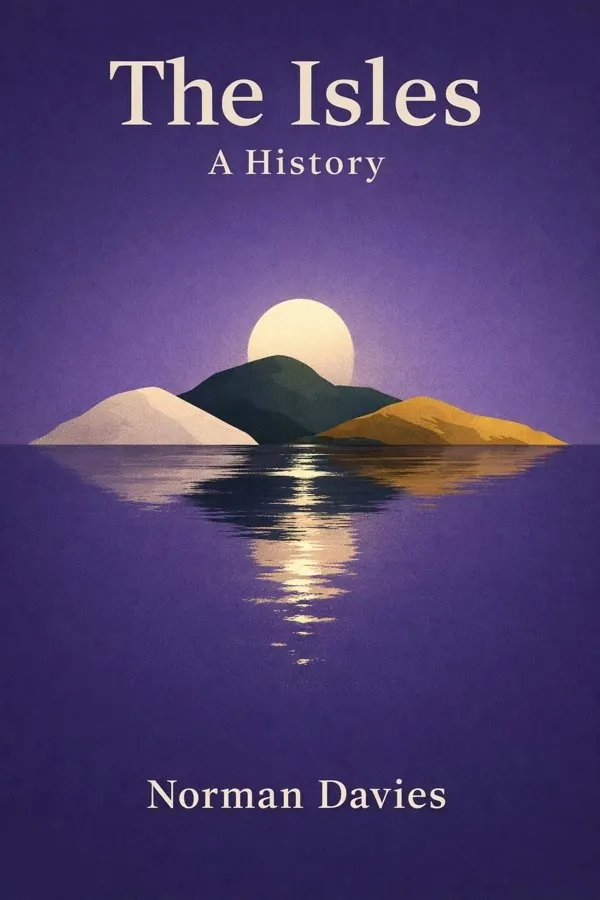
The Isles: A History: Summary & Key Insights
 10 min11 chaptersAudio available
What Is The Isles: A History About?
The Isles: A History by Norman Davies is a world_history book spanning 11 pages. A sweeping narrative history of the British Isles, exploring the complex and intertwined stories of England, Scotland, Wales, and Ireland from prehistoric times to the modern era. Norman Davies challenges conventional national narratives, presenting the Isles as a mosaic of cultures, peoples, and identities shaped by centuries of migration, conquest, and exchange.
This FizzRead summary covers all 11 key chapters of The Isles: A History in approximately 10 minutes, distilling the most important ideas, arguments, and takeaways from Norman Davies's work. Also available as an audio summary and Key Quotes Podcast.
The Isles: A History
A sweeping narrative history of the British Isles, exploring the complex and intertwined stories of England, Scotland, Wales, and Ireland from prehistoric times to the modern era. Norman Davies challenges conventional national narratives, presenting the Isles as a mosaic of cultures, peoples, and identities shaped by centuries of migration, conquest, and exchange.
Who Should Read The Isles: A History?
This book is perfect for anyone interested in world_history and looking to gain actionable insights in a short read. Whether you're a student, professional, or lifelong learner, the key ideas from The Isles: A History by Norman Davies will help you think differently.
- ✓Readers who enjoy world_history and want practical takeaways
- ✓Professionals looking to apply new ideas to their work and life
- ✓Anyone who wants the core insights of The Isles: A History in just 10 minutes
Want the full summary?
Get instant access to this book summary and 100K+ more with Fizz Moment.
Get Free SummaryAvailable on App Store • Free to download
Key Chapters
We begin before the written word, when the Isles were not yet political spaces but ecological zones defined by water, stone, and climate. The prehistoric peoples who inhabited these lands did not see boundaries; they saw resources—woodlands, streams, game, fertile plains. Archaeology tells us that communities emerged independently yet shared remarkably similar instincts for monument-making and ritual life. The great stone circles at Avebury and Stonehenge, the burial mounds scattered across Ireland, and the village remains on the Scottish islands—each speaks of societies conscious of the passage of time, of continuity between the living and the dead. Geography itself shaped the multiplicity of later history. Isolation fostered difference; proximity fostered exchange. The rugged coasts of Wales bred small, tight-knit tribes; the English river valleys encouraged agriculture and population density; the Irish plains supported pastoral mobility. The foundation of identity in these Isles was already polyphonic—different rhythms, but a shared pulse.
As I reconstructed this distant past, the central theme became clear: insularity produces diversity. While continental Europe was swept by large political currents, the Isles grew through smaller communal experiments. Those regional instincts persisted, echoing through later political forms. The prehistoric cultures laid not a single ethnic foundation but a mosaic of social units that could later evolve into kingdoms, clans, and nations.
Rome’s arrival changed everything—the Isles became part of an imperial system, with roads, baths, towns, and disciplined administration. Yet the story of Roman Britannia is not of total transformation. The Empire pacified much of southern Britain but never subdued the northern and western margins; Scotland and Ireland remained beyond imperial grasp, retaining their Celtic independence. When the legions withdrew in the fifth century, what remained was an archipelago divided between zones of Roman memory and zones of native resurgence. With the collapse of centralized rule came fragmentation. The Roman towns decayed, the written administration vanished, and new polities—the successor kingdoms—emerged from the ruins. This period shows how adaptation defines the Isles: each region absorbed Rome differently. England carried the legacy of Roman infrastructure; Wales and Cornwall maintained older linguistic and tribal traditions; Ireland, untouched by Roman power, preserved its indigenous social order and mythic imagination.
The Roman and post-Roman ages were thus formative in creating differing historical tempos within one geographical frame. Rome’s presence planted seeds of statehood, but its departure reaffirmed the power of local autonomy. The Isles moved forward not as one civilization, but as several parallel ones—each responding to memory in its own way.
+ 9 more chapters — available in the FizzRead app
All Chapters in The Isles: A History
About the Author
Norman Davies is a British historian known for his comprehensive works on European and British history, including 'Europe: A History' and 'Rising '44'. Educated at Oxford and the University of Sussex, he has held academic positions at several universities and is recognized for his accessible yet scholarly approach to large-scale historical synthesis.
Get This Summary in Your Preferred Format
Read or listen to the The Isles: A History summary by Norman Davies anytime, anywhere. FizzRead offers multiple formats so you can learn on your terms — all free.
Available formats: App · Audio · PDF · EPUB — All included free with FizzRead
Download The Isles: A History PDF and EPUB Summary
Key Quotes from The Isles: A History
“We begin before the written word, when the Isles were not yet political spaces but ecological zones defined by water, stone, and climate.”
“Rome’s arrival changed everything—the Isles became part of an imperial system, with roads, baths, towns, and disciplined administration.”
Frequently Asked Questions about The Isles: A History
The Isles: A History by Norman Davies is a world_history book that explores key ideas across 11 chapters. A sweeping narrative history of the British Isles, exploring the complex and intertwined stories of England, Scotland, Wales, and Ireland from prehistoric times to the modern era. Norman Davies challenges conventional national narratives, presenting the Isles as a mosaic of cultures, peoples, and identities shaped by centuries of migration, conquest, and exchange.
More by Norman Davies
You Might Also Like
The Age of Capital
Eric Hobsbawm
10 min
The Gulag Archipelago
Aleksandr Solzhenitsyn
10 min
Jerusalem: The Biography
Simon Sebag Montefiore
10 min
The Anglo-Saxons
James Campbell
10 min
The Boer War
Thomas Pakenham
10 min
The Industrial Revolutionaries: The Making of the Modern World 1776–1914
Gavin Weightman
10 minBrowse by Category
Ready to read The Isles: A History?
Get the full summary and 100K+ more books with Fizz Moment.