
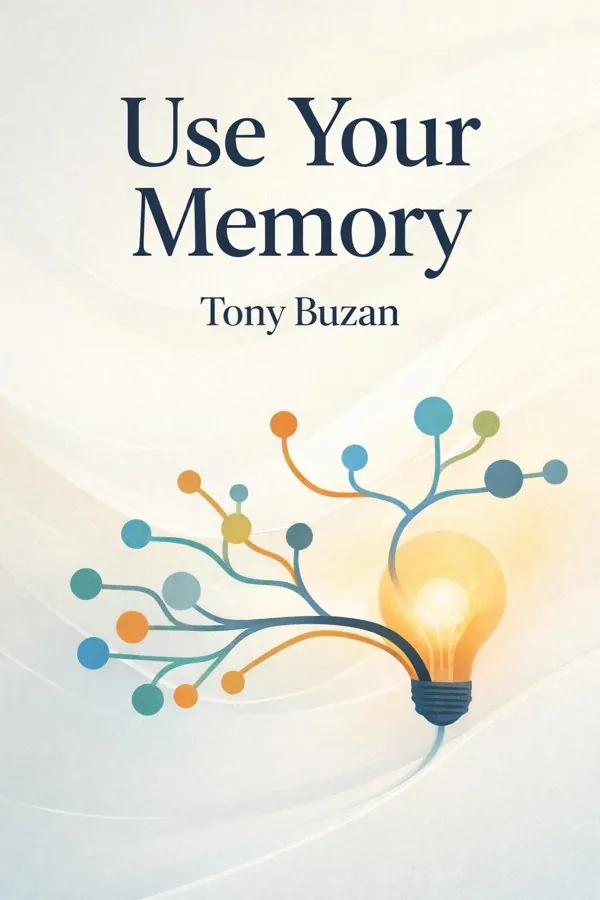
Use Your Memory: Summary & Key Insights
by Tony Buzan
 10 min10 chaptersAudio available
What Is Use Your Memory About?
Use Your Memory by Tony Buzan is a cognition book spanning 10 pages. A practical guide by Tony Buzan that teaches readers how to improve memory retention and recall through visualization, association, and mind mapping techniques. The book provides exercises and strategies to enhance learning, concentration, and creativity, making it a foundational text in the field of cognitive self-improvement.
This FizzRead summary covers all 10 key chapters of Use Your Memory in approximately 10 minutes, distilling the most important ideas, arguments, and takeaways from Tony Buzan's work. Also available as an audio summary and Key Quotes Podcast.
Use Your Memory
A practical guide by Tony Buzan that teaches readers how to improve memory retention and recall through visualization, association, and mind mapping techniques. The book provides exercises and strategies to enhance learning, concentration, and creativity, making it a foundational text in the field of cognitive self-improvement.
Who Should Read Use Your Memory?
This book is perfect for anyone interested in cognition and looking to gain actionable insights in a short read. Whether you're a student, professional, or lifelong learner, the key ideas from Use Your Memory by Tony Buzan will help you think differently.
- ✓Readers who enjoy cognition and want practical takeaways
- ✓Professionals looking to apply new ideas to their work and life
- ✓Anyone who wants the core insights of Use Your Memory in just 10 minutes
Want the full summary?
Get instant access to this book summary and 100K+ more with Fizz Moment.
Get Free SummaryAvailable on App Store • Free to download
Key Chapters
Every powerful memory begins with understanding what memory truly is. In this chapter, I unpack the way our brains process and store information. The brain is not a filing cabinet—it doesn’t store static facts in locked compartments. Instead, memory resides in a living network of associations. When we perceive something—a face, a piece of music, a phrase—it triggers countless neural pathways, combining visuals, emotions, sounds, and meanings into a complex web.
These webs determine how easily we recall the information later. A memory becomes stronger not by repetition alone, but by the richness of connections it forms. If you link new information with more vivid and imaginative associations, you increase the strength and number of retrieval paths. This is why creativity and imagination are not luxuries in memory—they’re necessities.
I explore how the brain uses both hemispheres in memory work. The left brain deals with logic, sequence, and language; the right brain with color, imagery, and emotion. When you integrate both, your memory becomes powerful and holistic. Too often, we’ve limited ourselves to the left-brain method—rote memorization, linear notes, and dull repetition. But the right brain adds vibrancy and depth. When both work together, learning becomes natural and effective.
Once you recognize that memory is dynamic, it’s clear why everyone—without exception—can improve. Age, professional background, or education level do not determine memory capacity. What matters is how you train and use your brain’s associative power. By learning how your brain creates and retrieves associations, you become your own memory engineer.
Most people have been conditioned to think they have a bad memory. In truth, what they have is an untrained one. I’ve encountered millions of students and professionals who complain, ‘I can never remember names,’ or ‘my memory isn’t as good as it used to be.’ But every time we test their recall using associative techniques, their performance skyrockets.
One of the most damaging myths is that memory declines inevitably with age. While biological factors can influence speed of recall, the capacity for association and imagination often grows richer with experience. The key is continual exercise—just as you’d train muscles in the gym, the brain thrives on use.
In this section, I demonstrate how people sabotage their own memory through negative language and limiting beliefs. When you say, ‘I can’t remember,’ your brain actually receives that as an instruction not to try. By resetting your mindset—approaching every recall challenge with curiosity and play—you reawaken memory’s natural creativity.
I also share fascinating cases from historical figures and memory champions. The ancient Greeks and Romans developed complex systems not because they were geniuses, but because they understood structure and visualization. Modern champions use similar devices: converting sounds to images, stories, and mental journeys. These examples prove that memory success isn’t about extraordinary talent; it’s about method and attitude.
+ 8 more chapters — available in the FizzRead app
All Chapters in Use Your Memory
About the Author
Tony Buzan (1942–2019) was a British author and educational consultant known for developing the concept of mind mapping and promoting techniques for mental literacy, creativity, and memory improvement. He wrote numerous books on learning and thinking skills that have been translated worldwide.
Get This Summary in Your Preferred Format
Read or listen to the Use Your Memory summary by Tony Buzan anytime, anywhere. FizzRead offers multiple formats so you can learn on your terms — all free.
Available formats: App · Audio · PDF · EPUB — All included free with FizzRead
Download Use Your Memory PDF and EPUB Summary
Key Quotes from Use Your Memory
“Every powerful memory begins with understanding what memory truly is.”
“Most people have been conditioned to think they have a bad memory.”
Frequently Asked Questions about Use Your Memory
Use Your Memory by Tony Buzan is a cognition book that explores key ideas across 10 chapters. A practical guide by Tony Buzan that teaches readers how to improve memory retention and recall through visualization, association, and mind mapping techniques. The book provides exercises and strategies to enhance learning, concentration, and creativity, making it a foundational text in the field of cognitive self-improvement.
More by Tony Buzan
You Might Also Like
A Field Guide to Lies: Critical Thinking in the Information Age
Daniel J. Levitin
10 min
A Theory of Cognitive Dissonance
Leon Festinger
10 min
Black-And-White Thinking: The Burden of a Binary Brain in a Complex World
Kevin Dutton
10 min
Born Liars: Why We Can’t Live Without Deceit
Ian Leslie
10 min
Collective Illusions: Conformity, Complicity, and the Science of Why We Make Bad Decisions
Todd Rose
10 min
Concrete Mathematics: A Foundation for Computer Science
Ronald L. Graham, Donald E. Knuth, Oren Patashnik
10 minBrowse by Category
Ready to read Use Your Memory?
Get the full summary and 100K+ more books with Fizz Moment.